
While hailing the City of Upland’s now unfolding plan to provide Memorial Park with a comprehensive makeover, several of that city’s residents expressed lingering suspicions that the improvement plan contains within it a provision that will nonetheless reduce the grand recreational centerpiece’s footprint once more, this time by more than four-and-a-half acres.
Indeed, a differently composed city council than the one now overseeing civic affairs in the City of Gracious Living just last year angered a wide cross section of the city’s populace by committing to sell 4.631 acres of the southwestern portion of the park, one that contains a baseball field that is actively used by the city’s youth leagues, to San Antonio Regional Hospital. The main campus of the hospital immediately adjoins the park, and the hospital wants to convert the baseball diamond and some of the greenland around it to a multistory parking structure to accommodate the hospital’s burgeoning clientele. More parking is needed because of the hospital’s expansion and its recent partnering with the City of Hope to establish an oncology clinic.
On March 26, 2018, with 72 hours notice, the Upland City Council, advised by then-City Manager Bill Manis, then-Development Services Director Jeff Zwack and City Attorney James Markman, voted 3-to-1 to approve a purchase and sale agreement between the hospital and the city, with San Antonio Hospital paying $906,931.55 per acre, or a total of $4.2 million to acquire the 4.631 acres. Mayor Debbie Stone and then-council members Gino Filippi and Carol Timm went along with making the sale. Councilwoman Janice Elliott opposed it. Then-Councilman Sid Robinson was not present at the meeting.
With the 2018 election cycle, Filippi, Timm and Robinson, who was allied with them and Stone, were turned out of office, at least in some measure as a consequence of the unpopular move to reduce the park’s size.
In approving the sale, the city council also authorized City Attorney James Markman to undertake a so-called validation proceeding intended to foreclose any procedural or future legal challenge to the sale. In its validation action filed with the court, the city invited anyone opposed to the sale to lodge a protest. The challenge to the validation had to be filed within 60 days. Once the court validated the sale, any future lawsuits contesting the sale would be barred. The calculation by those favoring the sale was that no one would go to the expense of hiring an attorney to make an answer to the validation petition.
The validation procedure was directed to the courtroom of Superior Court Judge David Cohn in San Bernardino. To the chagrin of city and hospital officials, Marjorie Mikels, an attorney living in the city, as well as Cory Briggs, an attorney based in both Upland and San Diego, filed answers to the validation action. Those responses took issue with the sale on multiple grounds, among which was that the city selling off a slice of the park – in particular the one sold by the council on March 26, 2018, which included the long extant and actively used baseball field – is tantamount to abandoning public property. Such abandonments, under state law, cannot be effectuated without a vote of the citizens residing in the jurisdiction that owns that property.
Faced with not one but two challenges to the sale he had not anticipated, Markman sought to convince Judge Cohn that the city council, acting on its own authority, was within its rights to sell off city land. In response to the argument that a municipality’s abandonment of property it owned and was putting to beneficial public use had to be subjected to a vote, Markman asserted that selling the property did not constitute an abandonment.
Ultimately, some 14 months after the sale of the park property was approved by the city council, on May 29, 2019, Judge Cohn, after hearing the responses to the city’s filing, dismissed its petition for validation. Judge Cohn’s ruling cleared the way for anyone with standing – meaning essentially any city resident – to file a lawsuit challenging the sale.
Penultimately, hospital officials have resigned themselves to the necessity of subjecting the sale of the property to a citywide vote. It appears that balloting will take place in conjunction with the March 2020 California Primary election.
In what is perhaps a coincidence or perhaps another calculated move on the part of city staff committed to assisting the hospital in obtaining the parking structure to augment its operational growth, Doug Story, the city’s recreational services manager, has put together a conceptual plan for upgrading Memorial Park. Contained within that plan is a provision for a reduction of the park’s overall area that is in keeping with the hospital’s intention of proceeding with the construction of the parking structure on the aforementioned 4.631-acre parcel.
Story this week, at the city council’s August 12 meeting on Monday night, previewed the sugar-coated park enhancement plan – replete with refurbishing or replacing playground equipment, adding an amphitheater and an artificial turf multi-sports competition field, walking and exercise trails, a basketball court and an intensified outdoor nature conservancy with trees and plants hospitable toward bees, hummingbirds and the like – in which was buried the fishhook for the parking structure.
Envisioned in the grandiose plan are fulfilling some of the never-realized elements of the original blueprint for the park as it was drawn up by landscape architect Ralph Dalton Cornell when the park was designed in the 1930s, including oak trees, a greenbelt and the amphitheater. Were all of the elements Story has outlined to be brought to fruition, they would cost more than $18 million. Story proposes getting started with an infusion of $8.5 million, which is the maximum amount an applicant can receive in response to a grant request under the auspices of Proposition 68, a $4.1-billion bond measure to fund park improvement and enhancement projects approved by voters last year. Story has made just such a grant application on the city’s behalf.
What was hinted at is that other donors could put up money to augment the $8.5 million, should the city receive the grant. If the grant comes in, Story said $2.7 million of it will be earmarked for an amphitheater encircled by a greenbelt; $1.4 million will go to create a soccer/rugby/football field featuring not grass by artificial turf; $718,000 will be spent on playground equipment; $209,000 will cover the completion of a basketball court; $380,000 will be utilized to provide one tree-lined walking trail and one exercise station-outfitted walking trail; $310,000 is to be used for establishing a pollinator garden; and $600,000 would be utilized for lighting.
It was reported that San Antonio Regional Hospital has committed, conditional upon the city selling it the 4.631 acres, to springing for the exercise stations along one of the trails.
Contained on page 32 of the staff report Story authored to accompany his presentation of the park master plan was the following statement, “San Antonio Regional Hospital is interested in acquiring the existing southwest quadrant of Memorial Park for a potential joint-use parking lot sponsored by San Antonio Regional Hospital per an agreement with the City of Upland. This acquisition and agreement is subject to voter approval of a ballot initiative scheduled for the March 2020 election.”
Lois Sicking-Dieter, an Upland resident, on Monday night addressed the city council, telling its members and the city’s residents that they should take stock of what San Antonio Hospital is doing.
“San Antonio Hospital is interested in contributing funds to help build exercise fitness stations in a walking path to help improve public health,” Sicking-Dieter said. “Kudos to you, San Antonio Hospital! Now, they might be trying to buy good will because they are going out for an election. Knock yourself out. You can do it. It’s legal. You can buy good will in this town. We really need those exercise stations. Another thing is, there have been medical studies done on the benefit, the health benefit, to the public on parklands, open space. The 4.6 acres is a part of a wonderful paradise that we have here in Upland. And so, I would also ask San Antonio Hospital to take a look at the health benefits that the public can derive from their keeping their hands off our park. Let the people have the park.”
This is not the first or even second raid San Antonio Hospital has made on Memorial Park, Sicking-Dieter said.
“San Antonio Hospital has been buying parkland, or getting parkland from us since the 1970s, and then the 80s, and then the 90s,” she said. “Here we are, folks. It’s 2019 and we are their primary plan for parking here in Upland. They’re like a 55-year-old kid who returns home to mom and dad and says, ‘You know, rent is really high out there. They make me work so hard. Can I crash with you for a while? For the tenth time?’ Come on, San Antonio Hospital! We need to do toughlove. Let’s do toughlove with San Antonio Hospital, and say, ‘Find your own parking. Find your own parking capacity. You have it. We’ve given you enough land already.’ It’s time to say, ‘No.’”
Sicking-Dieter said there should be full disclosure of all aspects of the proposed sale, with requirements that the hospital inform the citizenry of the sale, and the city facilitating awareness of the matter, as well.
“I appreciate this time we are going to an election,” Dicking-Dieter said. “Some are saying, ‘Wait a minute. We’ve been giving them land since the 1970s?’ Yes. Giving them. It should have gone to a vote. This is the first time we’re going to do it right. Let’s do it right. Let’s make San Antonio Hospital put signs up on every entrance going into Memorial Park, saying, ‘We’re trying to buy this land.’ I think we should have a flier, and those should go out in our water bills.”
-Mark Gutglueck
Category Archives: Uncategorized
Chino Valley Fire District Board Pulls Up Short Of Censuring Williams A Third Time
The Chino Valley Independent Fire District Board on August 14 declined Board President John DeMonaco’s motion to slap Board Member Winn Williams with what would have been a third censure.
Williams, a former fire captain employed by the district who previously served a two-year term on the board from 2004 to 2006, was returned to the board by voters last November. After he retired from the district as a firefighter in 2002 following an extended leave following an injury on the job in 2000, Williams in 2008 initiated an effort, at the age of 59, to be rehired as a firefighter, asserting he had by that point recovered from his injury. When the district declined to rehire him, he engaged in a series of three legal actions to be reinstated as a firefighter, two in state court and one in federal court, all of which were ultimately unsuccessful.
Almost immediately upon Williams’ swearing in in December 2018, tense relations developed between him and other members of the board and some district staff. Williams maintains the hostility in the district against him is unjustified and is an outgrowth of his having unseated longtime board member Ed Gray, with whom he says the other members of the board had a chummy relationship. The other members of the board, including DeMonaco, Harvey Luth, Sarah Evinger-Ramos and Mike Kreeger, have indicated that working with a board member who has thrice sued the district and has not yet come to terms with his having failed to rehire with the department after he had injured himself and reached an advanced age, has put the district in an awkward position. They say Williams is not on the board to represent the district’s constituents but rather to get even for what he wrongfully believes was a slight by the district he suffered more than a decade ago.
By February, little more than two months after Williams had assumed office, he was censured by a vote of his colleagues. That censure was based on the contention that Williams was unduly harassing district employees and making use of district assets for his personal use. Williams denied the allegations.
Censures of elected officials are exceedingly rare, and usually are a move of last or near-last resort by members of a governing board against a colleague with whom they do not get along. The February censure of Williams appears to be the most rapid application of the censure process against an elected official in San Bernardino County history. Four months later, in June, the board censured Williams a second time, on that occasion for his having disregarded the expectations of his comportment set out in the February censure.
DeMonaco this week sought a third censure, which he asserted was appropriate based on an incident that occurred after the conclusion of the fire board’s meeting on July 10. According to DeMonaco, Williams “touched” him on the back and neck as they were engaged in an intense argument.
DeMonaco contacted the Chino Police Department on July 12 about what had occurred, and filed a complaint.
While Williams acknowledges that he had casual contact with DeMoaco during the July 10 encounter, he maintains that DeMonaco was mischaracterizing and exaggerating a gesture that was made as he voiced a sincere appeal to see if the contretemps between him and the rest of the board could be resolved.
The fire board, by taking up the board president’s request for another censure, gave currency to DeMonaco’s assertion that the incident was another of a series of actions by Williams that are out of keeping with the decorum that the board should maintain. Ultimately, however, the board decided against making a further official public rebuke of one of its members. The ongoing back-and-forth between Williams and the other board members has garnered considerable publicity that in the opinion of some does not reflect positively on the district.
Board Vice President Harvey Luth, who has been sharply critical of Williams in the past, spoke for the balance of the board when he stated that he was not in favor of lodging any further censures against Williams unless Williams’ action went beyond a threshold of negligence or wrongdoing that would involve the district in civil or criminal liability.
Williams, irascibly, referred to DeMoanco’s motion as both “stupid” and “crazy.”
San Bernardino Police Chief Burguan, 48, Retires Two Years Early
Two years prior to the time he would otherwise be eligible to do so, San Bernardino Police Chief Jarrod Burguan is retiring today at the age of 48, 27 years after he began with the department.
Paradoxically, as is sometimes the case with law enforcement professionals, the worse day of Burguan’s career launched him into the stratosphere of his vocation, transforming him instantaneously into a celebrity of national and even international standing.
Fate dictated that Burguan was at the helm of the department on December 2, 2015 when Syed Rizwan Farook, a restaurant inspector employed with the San Bernardino County Department of Public Health, and his wife, Tashfeen Malik, approached and then went into an auditorium at the Inland Regional Center where both a training session and a pre-Christmas banquet for Public Health Department employees was being held. Wearing ski masks, armed with semi-automatic pistols and rifles and clad in load bearing vests holding magazines and ammunition, Farrok and Malik killed two pepole before entering the building and thereafter unleashed a fusillade of more than 100 rounds inside before fleeing. In the process they killed fourteen and wounded 22 of the 86 people present, virtually all of whom had been Malik’s co-workers in the Department of Public Health. Ultimately, some four hours after the initial attack and Farook and Malik had returned to their residence in Redlands and were coming back into San Bernardino, San Bernardino Police officers spotted the couple driving a vehicle rented by Farook four days before the attack, and which the department had identified. Officers gave pursuit and confronted Farook and Malik, at which juncture a shootout ensued on San Bernardino Avenue just east of Sheddon Drive. As more police units arrived to converge on them in and around their vehicles, 23 officers firing a combined total of at least 440 rounds mortally wounded the murderous pair.
Burguan was widely credited with his calm, methodical, vigilant, thorough and ultimately successful response and the coordination of his department’s resources throughout the ordeal. Thereafter, he was in great demand by other departments all over the country for input on preparation for similar emergencies. The highly articulate Burguan found himself torn between what he felt was a legitimate need to contribute to readiness and preparation among agencies throughout the law enforcement industry nationally and his duties in running his own department that was struggling under challenging circumstances that were unrelated to the December 2, 2015 attack. San Bernardino had filed for Chapter 9 bankruptcy protection in 2012, and the city’s overall financial condition complicated even further the city’s unenviable position of being what was ranked on one survey as the 16th most dangerous city in the United States with a murder rate that was more than twice the national average.
Despite the opportunities that were presented to him to take on an even more lucrative police chief’s assignment elsewhere, Burguan remained in San Bernardino, even as he was being criticized for his attention sometimes being diffused by requests for his input with regard to response readiness in other jurisdictions.
He began with the San Bernardino Police Department in January 1992, when he was 21. Throughout his time with San Bernardino, he worked in, supervised or managed units in every division of the department, while earning a bachelor’s degree and a masters degree in management from the University of Redlands. In 2012, he sojourned to Boston, where he took graduate courses and graduated from the Senior Management Institute for Police, which is part of the Police Executive Research Forum of Boston University, He also was a member of Class 53 of the California Police Officer Standard and Training College, from which he was provided with a management certificate.
In 2013, he succeeded Robert Handy as police chief.
Burguan for years has made the daily commute from Lake Arrowhead.
He took an extended leave in February to undergo knee replacement surgery. Boosted into the position of his temporary replacement at that time was Eric McBride, who had promoted to the position of assistant chief under Burguan and whom Burguan had supported in that promotion. McBride has now moved into the police chief’s position, which was not previously anticipated as McBride is four years older than Burguan. With the traditional minimum retirement age for police officers being 50, it was previously thought Burguan would most certainly remain with the department at least until he eclipses his 50th birthday in November 2020, and would perhaps remain with the department until 2025, at which point he would maximize his pension at 100 percent of his salary. In 2025, McBride will be 59, somewhat past what is considered the standard retirment age in the law enforcement profession presently.
Burguan’s return from his medical leave for the knee surgery was anticipated in May. One unconfirmed report was that his physician had not cleared him for resuming his duties. The true reason for the delay in his return has not been made clear, however. There are indications that the ascendancy of John Valdivia as San Bernardino mayor may have been a factor in Burguan’s decision not to return. It is an open secret that Valdivia is under investigation by the FBI stemming from reports that money originating from the sale of illegal drugs has been filtered into his personal banking and political campaign accounts, accompanied by reports that the largesse provided to the mayor purchased those donors protection from investigation and arrest by the San Bernardino Police Department and prosecution by the district attorney’s office, and that Valdivia had encouraged the department to step up enforcement efforts against his donors’ competitors in the sale of illicit substances out of storefronts and other businesses within the city. Burguan’s positive reputation as a consequence of his handling of the December 2, 2015 attack has opened doors for his possible employment elsewhere, including at the federal level with the Department of Homeland Security or with big city police departments such as those in Philadelphia or Cleveland, conditional only upon the formality of his making an application. He thus may have decided that returning as police chief in San Bernadino under the current circumstance is too risky and potentially damaging to his prospects elsewhere.
It is unclear whether the city had given him a special dispensation in allowing him to retire at 48.
In an email to police staff that went out on Wednesday and which has since been publicly disclosed and has come to serve as his farewell statement, Burguan wrote, “Any success that I ever had in a leadership position came as a result of good people within the organization doing good work, and I am truly appreciative of each and every one of you and the service that you have provided to the city and the department.”
–Mark Gutglueck
Judge Orders SB To Reinstate City Attorney & City Clerk To Full Pay
Judge David Cohn this morning rebuffed the coalition on the San Bernardino City Council led by Mayor John Valdivia in its effort to have the financially-challenged city it heads reduce the pay of two of its lame duck officeholders.
In June, the city council, in a move orchestrated by Valdvia and his then-chief of staff, Bilal Essayli, followed a recommendation to reduce the pay to be provided to City Attorney Gary Saenz and City Clerk Georgeann Hanna during the last nine months of their terms in office.
Both Saenz and Hanna hold office under the bylaws of San Bernardino’s municipal charter that was first put in place in 1905 and which remained in absolute effect for 111 years. In 2016, the city’s voters gave approval to Measure L, which called for a redrafting of the charter and reduced the mayor’s administrative authority, moved the city from an odd-numbered-year election cycle to an even-numbered year one, and transitioned the city attorney’s post and the position of city clerk from elected ones to staff members hired or appointed at the discretion of the city council, and dispensed with the elected city treasurer’s office altogether.
Because Saenz and Hanna had been most recently reelected in 2015 to terms that ran from April 1, 2016 through March 31, 2020, they were and are entitled to remain in office, as elected officials, for the duration of their terms, at which point their positions will be filled by the city council’s designees. As elected officials, Saenz was being provided with $246,266 in total annual compensation as city attorney, including salary, benefits and add-ons, and Hanna was receiving $171,466 in total annual compensation as city clerk, including salary, benefits and additional pay. A committee formed by Mayor Valdivia to explore cost-saving strategies chaired by Councilman Henry Nickel and including council members Theodore Sanchez and Juan Figueroa, all of whom are Valdivia’s political affiliates, recommended that Saenz see the $184,700 he was scheduled to receive between July 1, 2019 and March 31, 2020 reduced to $100,000 and that the $128,600 Hanna was scheduled to get over the same nine-month span be dropped to $52,500.
A host of considerations attended that move. Perhaps foremost was the city’s financial circumstance. In August 2012, San Bernardino had filed for Chapter 9 bankruptcy protection and did not emerge from that status until June 2017, during which period the city stiffed its creditors, vendors and service providers for more than $350 million. Indications this year are that two years after the city’s assumed financial recovery, it is again poised over a deepening financial abyss, with expenditures once more substantially outrunning revenue such that by October or November 2020 the city will have burned entirely through the reserves it was able to accrue while being artificially propped up by the bankruptcy court, at which point it will again face the likelihood of needing to make another bankruptcy petition. Curiously, the committee did not call for the $160,800 to be saved by the reductions in pay to Saenz and Hanna to be salted into the city’s reserve account but rather to be used to pay for lobbyists and legislative advocates. Another issue driving the pay reduction was the perception that Saenz was a member of former Mayor Carey Davis’s team. Valdivia served nearly five of his previous six-and-a-half years on the city council while Davis was mayor, and had challenged him in 2018, qualifying by finishing first in the June primary to then vie head-to-head against Davis in the November run, a race which Valdivia narrowly won. He is now intent on purging the city of any vestiges of the Davis era. Moreover, Saenz as city attorney had offered legal counsel that on occasion clashed with the direction Valdivia wanted the city council to take. Hanna, who has proven somewhat mercurial in her relationships with the city’s mayors, council members and staff over the years she has been in office, had been among those who ran for mayor in the 2018 primary. After Valdivia’s installment as mayor, she had clashed with him on the issue of city record availability.
The city council on June 11, with Councilman Jim Mulvihill absent, voted 4-to-2, with councilmen Nickel, Sanchez and Figueroa and councilwoman Bessine Richard prevailing over Councilman Fred Shorett and Councilwoman Sandra Ibarra, to institute the pay reductions for Saenz and Hanna as of July 1.
Subsequently, Saenz and Hanna, represented by the law firm of Wagner & Pelayes, filed claims and a legal action against the city, including a petition for a writ of mandate challenging the pay reductions.
That matter came before Judge Cohn this morning as a predisposition hearing.
Representing the city was attorney Edward Kotkin of the law firm Lynberg & Watkins, a different firm than that of Best Best & Krieger, which the city has retained as what is essentially its acting city attorney at present and which will officially replace Saenz in April.
Saenz and Hanna were not represented by anyone from Wagner & Pelayes but rather an independent labor law attorney from West Covina, Thomas Yu.
In hearing Sanez’s and Hanna’s motion regarding the writ for mandate, Judge Cohn took judicial notice of both the 1905 and 2016 charters and ruled that the provisions of the former and current San Bernardino municipal charters were not specific in providing the city council with the authority to change the rate of pay of the city attorney and city clerk while they are serving in their elected capacities, and that the California Elections Code thus dictates that they are entitled to receive, throughout the duration of their terms in office, the salaries and further compensation that was in place for those respective positions when they were elected.
Judge Cohn reasoned that the vote of the city’s residents in 2015, when Saenz and Hanna ran unopposed and were elected with 7,601 and 7,607 votes, respectively, was tantamount to being hired through the electoral process, entitling them to the salaries and benefits then associated with the positions, and that allowing the city council to change that would in essence invalidate the election.
Judge Cohn then stated his tentative ruling, entered before the hearing, on the record. “The writ of mandate is granted,” the record of his ruling states. “Salaries which were in place remain in place till [the] end of office.”
After the hearing, Hanna told the Sentinel, “I’m glad the court agreed that the council had no authority to cut our salaries. It was an ill-advised, costly and completely unnecessary distraction. They were warned by Best Best & Krieger recently, and another law firm in 2017, that it was not advisable to do this. Going forward, perhaps the council would be well-served to heed the advice of its professional advisors.”
Tree-Killing Pest Detected In Big Bear Area
The invasive goldspotted oak borer (GSOB, Agrilus auroguttatus) was detected last week in recently-killed and dying California black oaks on private property in the unincorporated San Bernardino County community of Sugarloaf. Larval, pupal and adult life stages of the beetle were extracted by the California Department of Forestry and Fire Protection (CAL FIRE) and U.S. Forest Service personnel from under the tree bark. A San Bernardino County fire hazard officer, who had received goldspotted oak borer identification training, made the initial discovery while conducting hazard inspections. This is the second goldspotted oak borer infestation identified in San Bernardino County, the first discovery being in the Oak Glen area in fall of 2018. This is also the second goldspotted oak borer infestation on the San Bernardino National Forest, the first being in Idyllwild in 2012.
The long-range spread of the goldspotted oak borer from its native range in Arizona to San Diego, then Riverside, Orange, Los Angeles counties and, now, San Bernardino County, has been attributed to the movement of goldspotted oak borer-infested firewood. Therefore, it is critical to take precautions to avoid transporting potentially-infested oak firewood within, to or from the San Bernardino Mountains.
The goldspotted oak borer may already be in other portions of San Bernardino County but haven’t been discovered yet. These non-native beetles aggressively attack California black oaks, coast live oaks and even canyon live oaks, whether in mountain communities, forests, valleys or cities. To make matters worse, goldspotted oak borers prefer larger oaks, the very trees we depend on for beauty, shade and wildlife habitat.
Learn about the goldspotted oak borer at www.GSOB.org, including how to identify and report a suspected goldspotted oak borer infestation. If you have oak trees that have recently died and have been cut down, it’s critical to make sure the wood is not infested before transporting it! The goldspotted oak borer website has information on how to manage infested wood.
CAL FIRE, the San Bernardino National Forest and other collaborating agencies will develop a goldspotted oak borer response plan for the mountaintop communities in San Bernardino County. This will include determining the current extent of the infestation in the area. In the interim, at-risk communities should educate themselves about the goldspotted oak borer threat and share the information with their neighbors and friends in any San Bernardino County communities with oak trees.
California Style
Notice Of Petition To Repeal The Expansion Of Fire Protection Zone 5
Double left click on each of the pages below to enlarge them.
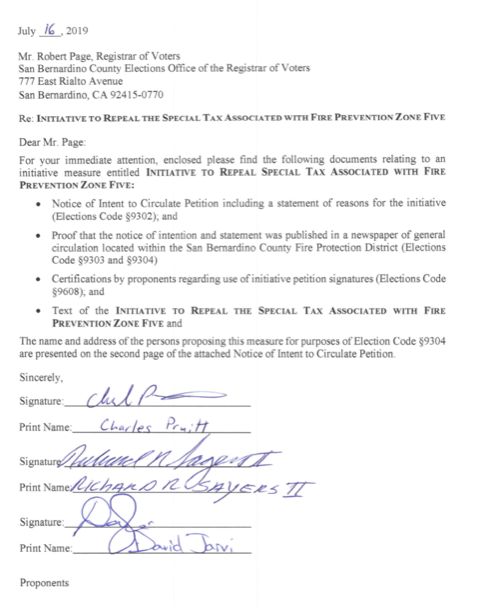
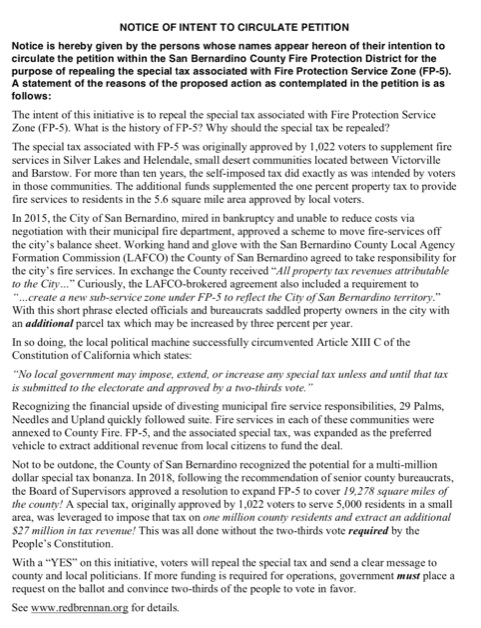
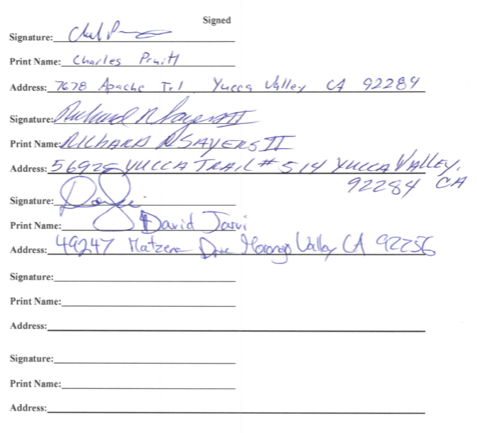
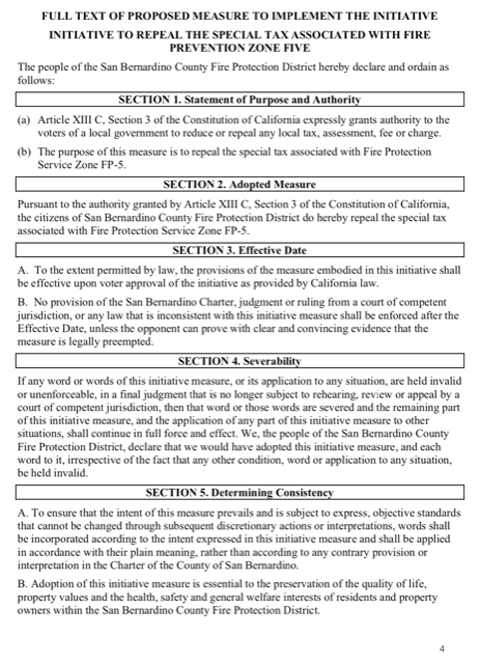
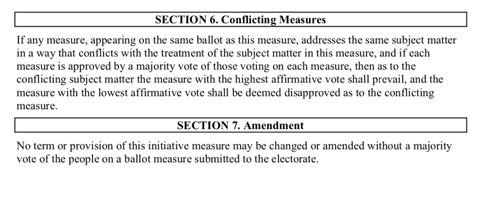
Notice Of Intent To Circulate A Petition To Repeal The Expansion Of Fire Protection Zone 5
Double left click on each of the pages below to expand them.
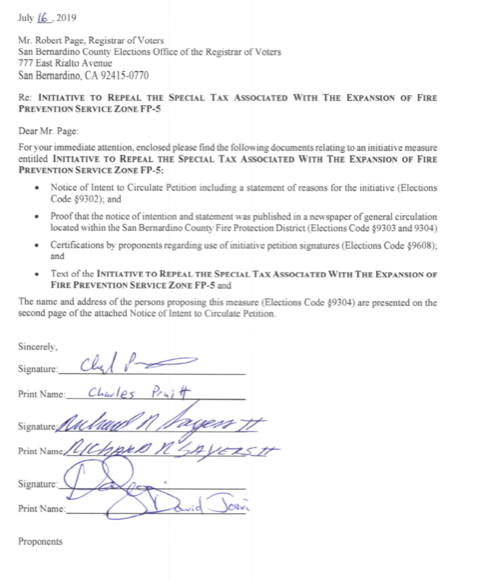
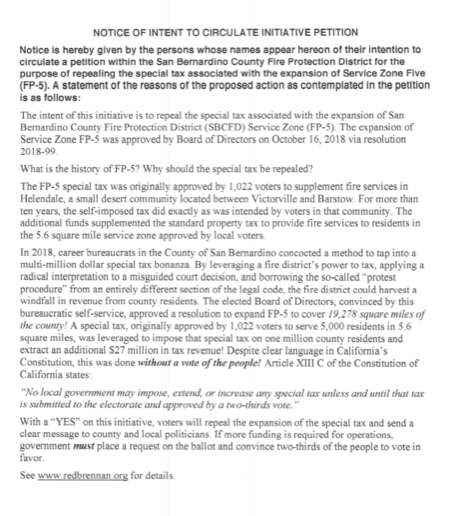
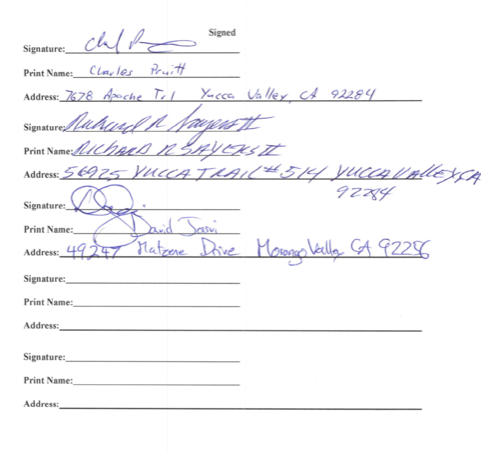
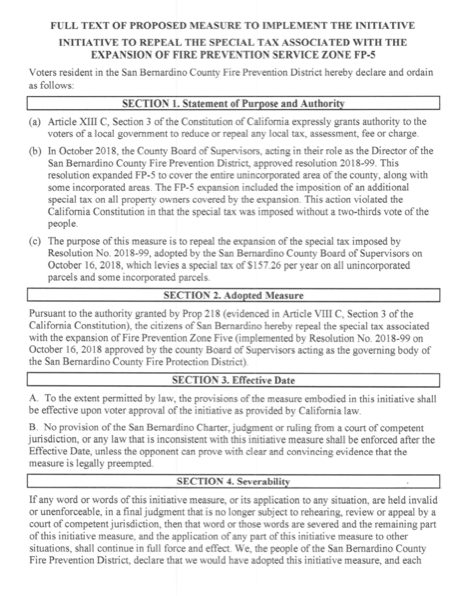
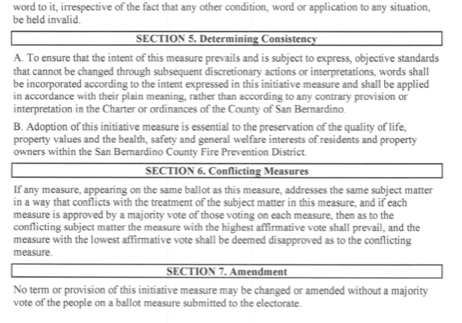
August 16 SBC Sentinel Legal Notices
SUMMONS – (CITACION JUDICIAL)
CASE NUMBER (NUMERO DEL CASO) CIVDS1827317
NOTICE TO DEFENDANT (AVISO DEMANDADO):
ADAM ISMAEL HAFFAJEE, and DOES 1 through 5, inclusive.
YOU ARE BEING SUED BY PLAINTIFF (LO ESTA DEMANDANDO EL DEMANDANTE):
EIGHTH STREET COMMERCE CENTER ASSOCIATION
NOTICE! You have been sued. The court may decide against you without your being heard unless you respond within 30 days. Read the information below.
You have 30 CALENDAR DAYS after this summons and legal papers are served on you to file a written response at this court and have a copy served on the plaintiff. A letter or phone call will not protect you. Your written response must be in proper legal form if you want the court to hear your case. There may be a court form that you can use for your response. You can find these court forms and more information at the California Courts Online Self-Help Center (www.courtinfo.ca.gov/selfhelp), your county law library, or the courthouse nearest you. If you cannot pay the filing fee, ask the court clerk for a fee waiver form. If you do not file your response on time, you may lose the case by default, and your wages, money, and property may be taken without further warning from the court.
There are other legal requirements. You may want to call an attorney right away. If you do not know an attorney, you may want to call an attorney referral service. If you cannot afford an attorney, you may be eligible for free legal services from a nonprofit legal services program. You can locate these nonprofit groups at the California Legal Services Web site (www.lawhelpcalifornia.org), the California Courts Online Self-Help Center (www.courtinfo.ca.gov/selfhelp), or by contacting your local court or county bar association. NOTE: The court has a statutory lien for waived fees and costs on any settlement or arbitration award of $10,000 or more in a civil case. The court’s lien must be paid before the court will dismiss the case. ¡AVISO! Lo han demandado. Si no responde dentro de 30 dias, la corte puede decidir en su contra sin escuchar su version. Lea la informacion a continuacion
Tiene 30 DIAS DE CALENDARIO después de que le entreguen esta citación y papeles legales para presentar una repuesta por escrito en esta corte y hacer que se entreque una copia al demandante. Una carta o una llamada telefónica no lo protegen. Su respuesta por escrito tiene que estar en formulario legal correcto si desea que procesen su caso en la corte. Es posible que haya un formulano que usted puede usar para su respuesta. Puede encontrar estos formularios de la corte y mas más información en el Centro de Ayuda de las Cortes de California (www.sucorte.ca.gov), en la biblioteca de leyes de su condado o en la corte que le quede mas cerca. Si no puede pagar la cuota de presentación, pida al secretario de la corta que le dé un formulario de exencion de pago de cuotas. Si no presenta su respuesta a tiempo, puede perder el caso por incumplimiento y la corte le podrá quitar su sueldo, dinero y bienes sin mas advertencia.
Hay otros requisitos legales. Es recomendable que llame a un abogado inmediatamente. Si no conoce a un abogado, puede llamar a un servicio de remisión a abogados. Si no puede pagar a un abogado, es posible que cumpla con los requisitos para obtener servicios legales gratuitos de un programa de servicios legales sin fines de lucro. Puede encontrar estos grupos sin fines de lucro en el sitio web de California Legal Services, (www.lawhelpcalifornia.org), en el Centro de Ayuda de las Cortes de California, (www.sucorte.ca.gov), o poniéndoso en contacto con la corte o el colegio de abogados locales. AVISO: Por ley, la corte tiene derecho a reclamar las cuotas y los costos exentos por imponer un gravamen sobre cualquier recuperación da $10,000 o mas de vaior recibida mediante un aceurdo o una concesión de arbitraje en un caso de derecho civil. Tiene que pagar el gravamen de la corta antes de que la corta pueda desechar el caso.
The name and address of the court is: (El nombre y la direccion de la corte es):
SAN BERNARDINO SUPERIOR COURT
247 West Third Street
San Bernardino, California 92415-0210
The name, address and telephone number of plaintiff’s attorney, or plaintiff without an attorney, is: (El nombre, la direccion y el número de teléfono del abogado del demandante, o del demendante que no tiene abogado, es):
DANIEL MEDIONI (SBN 281329)
WOLF, RIFKIN, SHAPIRO, SCHULMAN & RABKIN, LLP 11400 WEST OLYMPIC BOULEVARD, 9th FLOOR
LOS ANGELES, CALIFORNIA 90064-1562 (310) 478-4100 (310) 479-1422
DATE (Fecha): OCTOBER 16, 2018
Clerk (Secretario), by DANIELLE PARIS, Deputy (Adjunto)
Published in the San Bernardino County Sentinel on 7/26, 8/2, 8/9 & 8/16, 2019
CASE NUMBER (NUMERO DEL CASO) CIVDS1827317
NOTICE TO DEFENDANT (AVISO DEMANDADO):
ADAM ISMAEL HAFFAJEE, and DOES 1 through 5, inclusive.
YOU ARE BEING SUED BY PLAINTIFF (LO ESTA DEMANDANDO EL DEMANDANTE):
EIGHTH STREET COMMERCE CENTER ASSOCIATION
NOTICE! You have been sued. The court may decide against you without your being heard unless you respond within 30 days. Read the information below.
You have 30 CALENDAR DAYS after this summons and legal papers are served on you to file a written response at this court and have a copy served on the plaintiff. A letter or phone call will not protect you. Your written response must be in proper legal form if you want the court to hear your case. There may be a court form that you can use for your response. You can find these court forms and more information at the California Courts Online Self-Help Center (www.courtinfo.ca.gov/selfhelp), your county law library, or the courthouse nearest you. If you cannot pay the filing fee, ask the court clerk for a fee waiver form. If you do not file your response on time, you may lose the case by default, and your wages, money, and property may be taken without further warning from the court.
There are other legal requirements. You may want to call an attorney right away. If you do not know an attorney, you may want to call an attorney referral service. If you cannot afford an attorney, you may be eligible for free legal services from a nonprofit legal services program. You can locate these nonprofit groups at the California Legal Services Web site (www.lawhelpcalifornia.org), the California Courts Online Self-Help Center (www.courtinfo.ca.gov/selfhelp), or by contacting your local court or county bar association. NOTE: The court has a statutory lien for waived fees and costs on any settlement or arbitration award of $10,000 or more in a civil case. The court’s lien must be paid before the court will dismiss the case. ¡AVISO! Lo han demandado. Si no responde dentro de 30 dias, la corte puede decidir en su contra sin escuchar su version. Lea la informacion a continuacion
Tiene 30 DIAS DE CALENDARIO después de que le entreguen esta citación y papeles legales para presentar una repuesta por escrito en esta corte y hacer que se entreque una copia al demandante. Una carta o una llamada telefónica no lo protegen. Su respuesta por escrito tiene que estar en formulario legal correcto si desea que procesen su caso en la corte. Es posible que haya un formulano que usted puede usar para su respuesta. Puede encontrar estos formularios de la corte y mas más información en el Centro de Ayuda de las Cortes de California (www.sucorte.ca.gov), en la biblioteca de leyes de su condado o en la corte que le quede mas cerca. Si no puede pagar la cuota de presentación, pida al secretario de la corta que le dé un formulario de exencion de pago de cuotas. Si no presenta su respuesta a tiempo, puede perder el caso por incumplimiento y la corte le podrá quitar su sueldo, dinero y bienes sin mas advertencia.
Hay otros requisitos legales. Es recomendable que llame a un abogado inmediatamente. Si no conoce a un abogado, puede llamar a un servicio de remisión a abogados. Si no puede pagar a un abogado, es posible que cumpla con los requisitos para obtener servicios legales gratuitos de un programa de servicios legales sin fines de lucro. Puede encontrar estos grupos sin fines de lucro en el sitio web de California Legal Services, (www.lawhelpcalifornia.org), en el Centro de Ayuda de las Cortes de California, (www.sucorte.ca.gov), o poniéndoso en contacto con la corte o el colegio de abogados locales. AVISO: Por ley, la corte tiene derecho a reclamar las cuotas y los costos exentos por imponer un gravamen sobre cualquier recuperación da $10,000 o mas de vaior recibida mediante un aceurdo o una concesión de arbitraje en un caso de derecho civil. Tiene que pagar el gravamen de la corta antes de que la corta pueda desechar el caso.
The name and address of the court is: (El nombre y la direccion de la corte es):
SAN BERNARDINO SUPERIOR COURT
247 West Third Street
San Bernardino, California 92415-0210
The name, address and telephone number of plaintiff’s attorney, or plaintiff without an attorney, is: (El nombre, la direccion y el número de teléfono del abogado del demandante, o del demendante que no tiene abogado, es):
DANIEL MEDIONI (SBN 281329)
WOLF, RIFKIN, SHAPIRO, SCHULMAN & RABKIN, LLP 11400 WEST OLYMPIC BOULEVARD, 9th FLOOR
LOS ANGELES, CALIFORNIA 90064-1562 (310) 478-4100 (310) 479-1422
DATE (Fecha): OCTOBER 16, 2018
Clerk (Secretario), by DANIELLE PARIS, Deputy (Adjunto)
Published in the San Bernardino County Sentinel on 7/26, 8/2, 8/9 & 8/16, 2019
FBN 20190007636
The following entity is doing business as: HELLO BEAUTIFUL GALS 20801 BARN RD. RIVERSIDE, CA 92507 ROCIO G SOTO CENTERS 20801 BARN RD. RIVERSIDE, CA 92507
Business is Conducted By: AN INDIVIDUAL
Signed: BY SIGNING BELOW, I DECLARE THAT ALL INFORMATION IN THIS STATEMENT IS TRUE AND CORRECT. A registrant who declares as true information, which he or she knows to be false, is guilty of a crime. (B&P Code 17913) I am also aware that all information on this statement becomes Public Record upon filing.
s/Rocio G Soto
This statement was filed with the County Clerk of San Bernardino on: 6/27/2019
I hereby certify that this is a correct copy of the original statement on file in my office.
Began Transacting Business: N/A
County Clerk, deputy
NOTICE- This fictitious business name statement expires five years from the date it was filed in the office of the county clerk. A new fictitious business name statement must be filed before that time. The filing of this statement does not of itself authorize the use in this state of a fictitious name in violation of the rights of another under federal, state, or common law (see section 14400 et. Seq. Business & Professions Code).
Published in the San Bernardino County Sentinel on 7/26, 8/02, 8/09 & 8/16, 2019.
The following entity is doing business as: HELLO BEAUTIFUL GALS 20801 BARN RD. RIVERSIDE, CA 92507 ROCIO G SOTO CENTERS 20801 BARN RD. RIVERSIDE, CA 92507
Business is Conducted By: AN INDIVIDUAL
Signed: BY SIGNING BELOW, I DECLARE THAT ALL INFORMATION IN THIS STATEMENT IS TRUE AND CORRECT. A registrant who declares as true information, which he or she knows to be false, is guilty of a crime. (B&P Code 17913) I am also aware that all information on this statement becomes Public Record upon filing.
s/Rocio G Soto
This statement was filed with the County Clerk of San Bernardino on: 6/27/2019
I hereby certify that this is a correct copy of the original statement on file in my office.
Began Transacting Business: N/A
County Clerk, deputy
NOTICE- This fictitious business name statement expires five years from the date it was filed in the office of the county clerk. A new fictitious business name statement must be filed before that time. The filing of this statement does not of itself authorize the use in this state of a fictitious name in violation of the rights of another under federal, state, or common law (see section 14400 et. Seq. Business & Professions Code).
Published in the San Bernardino County Sentinel on 7/26, 8/02, 8/09 & 8/16, 2019.
FBN 20190007826
The following entity is doing business as: STAIRLIFTS ABC 2140 MENTONE BLVD SP 71 MENTONE, CA 92359 NICOLAS ROSADO 2140 MENTONE BLVD SP 71 MENTONE, CA 92359
Mailing Address: 2140 MENTONE BLVD SP 71 MENTONE, CA 92359
Business is Conducted By: AN INDIVIDUAL
Signed: BY SIGNING BELOW, I DECLARE THAT ALL INFORMATION IN THIS STATEMENT IS TRUE AND CORRECT. A registrant who declares as true information, which he or she knows to be false, is guilty of a crime. (B&P Code 17913) I am also aware that all information on this statement becomes Public Record upon filing.
s/Nicolas Rosado
This statement was filed with the County Clerk of San Bernardino on: 7/02/2019
I hereby certify that this is a correct copy of the original statement on file in my office.
Began Transacting Business: N/A
County Clerk, deputy
NOTICE- This fictitious business name statement expires five years from the date it was filed in the office of the county clerk. A new fictitious business name statement must be filed before that time. The filing of this statement does not of itself authorize the use in this state of a fictitious name in violation of the rights of another under federal, state, or common law (see section 14400 et. Seq. Business & Professions Code).
Published in the San Bernardino County Sentinel on 7/26, 8/02, 8/09 & 8/16, 2019.
The following entity is doing business as: STAIRLIFTS ABC 2140 MENTONE BLVD SP 71 MENTONE, CA 92359 NICOLAS ROSADO 2140 MENTONE BLVD SP 71 MENTONE, CA 92359
Mailing Address: 2140 MENTONE BLVD SP 71 MENTONE, CA 92359
Business is Conducted By: AN INDIVIDUAL
Signed: BY SIGNING BELOW, I DECLARE THAT ALL INFORMATION IN THIS STATEMENT IS TRUE AND CORRECT. A registrant who declares as true information, which he or she knows to be false, is guilty of a crime. (B&P Code 17913) I am also aware that all information on this statement becomes Public Record upon filing.
s/Nicolas Rosado
This statement was filed with the County Clerk of San Bernardino on: 7/02/2019
I hereby certify that this is a correct copy of the original statement on file in my office.
Began Transacting Business: N/A
County Clerk, deputy
NOTICE- This fictitious business name statement expires five years from the date it was filed in the office of the county clerk. A new fictitious business name statement must be filed before that time. The filing of this statement does not of itself authorize the use in this state of a fictitious name in violation of the rights of another under federal, state, or common law (see section 14400 et. Seq. Business & Professions Code).
Published in the San Bernardino County Sentinel on 7/26, 8/02, 8/09 & 8/16, 2019.
FICTITIOUS BUSINESS NAME
STATEMENT FILE NO-20190006073
The following person(s) is(are) doing business as: Sav-On Auto Sales, 1325 S Auto Plaza Dr #140, San Bernardino, CA 92408, Mailing Address: PO Box 8021, Redlands, CA 92375, Batroun Auto Sales, 1325 S Auto Plaza Dr #140, San Bernardino, CA 92408
Business is Conducted By: A Corporation
Signed: BY SIGNING BELOW, I DECLARE THAT ALL INFORMATION IN THIS STATEMENT IS TRUE AND CORRECT. A registrant who declares as true information, which he or she knows to be false, is guilty of a crime. (B&P Code 17913) I am also aware that all information on this statement becomes Public Record upon filing.
s/ George Awad
This statement was filed with the County Clerk of San Bernardino on: 5/17/19
I hereby certify that this is a correct copy of the original statement on file in my office.
Began Transacting Business: N/A
County Clerk, s/DOM
NOTICE- This fictitious business name statement expires five years from the date it was filed in the office of the county clerk. A new fictitious business name statement must be filed before that time. The filing of this statement does not of itself authorize the use in this state of a fictitious name in violation of the rights of another under federal, state, or common law (see section 14400 et. Seq. Business & Professions Code).
5/24/19, 5/31/19, 6/7/19, 6/14/19
Corrected on: 7/26/19, 8/2/19, 8/9/19, 8/16/19FICTITIOUS BUSINESS NAME
STATEMENT FILE NO-20190008537
The following person(s) is(are) doing business as: AccuScan Livescan Fingerprinting & Notary Services, 7365 Carnelian St. Suite 238, Rancho Cucamonga, CA 91730, Evelyn D. Edington, 6215 Valinda Ave, Alta Loma, CA 91737
Business is Conducted By: An Individual
Signed: BY SIGNING BELOW, I DECLARE THAT ALL INFORMATION IN THIS STATEMENT IS TRUE AND CORRECT. A registrant who declares as true information, which he or she knows to be false, is guilty of a crime. (B&P Code 17913) I am also aware that all information on this statement becomes Public Record upon filing.
s/Evelyn D. Edington
This statement was filed with the County Clerk of San Bernardino on: 7/19/2019
I hereby certify that this is a correct copy of the original statement on file in my office.
Began Transacting Business: N/A
County Clerk, s/AG
NOTICE- This fictitious business name statement expires five years from the date it was filed in the office of the county clerk. A new fictitious business name statement must be filed before that time. The filing of this statement does not of itself authorize the use in this state of a fictitious name in violation of the rights of another under federal, state, or common law (see section 14400 et. Seq. Business & Professions Code).
7/26/2019, 8/2/2019, 8/9/2019, 8/16/2019
STATEMENT FILE NO-20190006073
The following person(s) is(are) doing business as: Sav-On Auto Sales, 1325 S Auto Plaza Dr #140, San Bernardino, CA 92408, Mailing Address: PO Box 8021, Redlands, CA 92375, Batroun Auto Sales, 1325 S Auto Plaza Dr #140, San Bernardino, CA 92408
Business is Conducted By: A Corporation
Signed: BY SIGNING BELOW, I DECLARE THAT ALL INFORMATION IN THIS STATEMENT IS TRUE AND CORRECT. A registrant who declares as true information, which he or she knows to be false, is guilty of a crime. (B&P Code 17913) I am also aware that all information on this statement becomes Public Record upon filing.
s/ George Awad
This statement was filed with the County Clerk of San Bernardino on: 5/17/19
I hereby certify that this is a correct copy of the original statement on file in my office.
Began Transacting Business: N/A
County Clerk, s/DOM
NOTICE- This fictitious business name statement expires five years from the date it was filed in the office of the county clerk. A new fictitious business name statement must be filed before that time. The filing of this statement does not of itself authorize the use in this state of a fictitious name in violation of the rights of another under federal, state, or common law (see section 14400 et. Seq. Business & Professions Code).
5/24/19, 5/31/19, 6/7/19, 6/14/19
Corrected on: 7/26/19, 8/2/19, 8/9/19, 8/16/19FICTITIOUS BUSINESS NAME
STATEMENT FILE NO-20190008537
The following person(s) is(are) doing business as: AccuScan Livescan Fingerprinting & Notary Services, 7365 Carnelian St. Suite 238, Rancho Cucamonga, CA 91730, Evelyn D. Edington, 6215 Valinda Ave, Alta Loma, CA 91737
Business is Conducted By: An Individual
Signed: BY SIGNING BELOW, I DECLARE THAT ALL INFORMATION IN THIS STATEMENT IS TRUE AND CORRECT. A registrant who declares as true information, which he or she knows to be false, is guilty of a crime. (B&P Code 17913) I am also aware that all information on this statement becomes Public Record upon filing.
s/Evelyn D. Edington
This statement was filed with the County Clerk of San Bernardino on: 7/19/2019
I hereby certify that this is a correct copy of the original statement on file in my office.
Began Transacting Business: N/A
County Clerk, s/AG
NOTICE- This fictitious business name statement expires five years from the date it was filed in the office of the county clerk. A new fictitious business name statement must be filed before that time. The filing of this statement does not of itself authorize the use in this state of a fictitious name in violation of the rights of another under federal, state, or common law (see section 14400 et. Seq. Business & Professions Code).
7/26/2019, 8/2/2019, 8/9/2019, 8/16/2019
FICTITIOUS BUSINESS NAME
STATEMENT FILE NO-20190008185
The following person(s) is(are) doing business as: Wing Plus 350, 331 E. 9th Street #4, San Bernardino, CA 92410,
Mailing Address: 25925 Barton Rd #822, Loma Linda, CA 92354, Waterman Market, Inc., 331 East 9th Street, Unit 2, San Bernardino, CA 92410
Business is Conducted By: A Corporation
Signed: BY SIGNING BELOW, I DECLARE THAT ALL INFORMATION IN THIS STATEMENT IS TRUE AND CORRECT. A registrant who declares as true information, which he or she knows to be false, is guilty of a crime. (B&P Code 17913) I am also aware that all information on this statement becomes Public Record upon filing.
s/Kunthea Ros
This statement was filed with the County Clerk of San Bernardino on: 7/12/2019
I hereby certify that this is a correct copy of the original statement on file in my office.
Began Transacting Business: N/A
County Clerk, s/AJ
NOTICE- This fictitious business name statement expires five years from the date it was filed in the office of the county clerk. A new fictitious business name statement must be filed before that time. The filing of this statement does not of itself authorize the use in this state of a fictitious name in violation of the rights of another under federal, state, or common law (see section 14400 et. Seq. Business & Professions Code).
7/26/2019, 8/2/2019, 8/9/2019, 8/16/2019
FICTITIOUS BUSINESS NAME
STATEMENT FILE NO-20190008674
The following person(s) is(are) doing business as: Zrigz, 13247 Foothill Blvd #1208, Rancho Cucamonga, CA 91739, Karla L Solorio, 13247 Foothill Blvd #1208, Rancho Cucamonga, CA 91739
Business is Conducted By: An Individual
Signed: BY SIGNING BELOW, I DECLARE THAT ALL INFORMATION IN THIS STATEMENT IS TRUE AND CORRECT. A registrant who declares as true information, which he or she knows to be false, is guilty of a crime. (B&P Code 17913) I am also aware that all information on this statement becomes Public Record upon filing.
s/Karla L. Solorio
This statement was filed with the County Clerk of San Bernardino on: 7/24/2019
I hereby certify that this is a correct copy of the original statement on file in my office.
Began Transacting Business: N/A
County Clerk, s/AJ
NOTICE- This fictitious business name statement expires five years from the date it was filed in the office of the county clerk. A new fictitious business name statement must be filed before that time. The filing of this statement does not of itself authorize the use in this state of a fictitious name in violation of the rights of another under federal, state, or common law (see section 14400 et. Seq. Business & Professions Code).
7/26/2019, 8/2/2019, 8/9/2019, 8/16/2019
ORDER TO SHOW CAUSE FOR CHANGE OF NAME CASE NUMBER CIVDS1921029
TO ALL INTERESTED PERSONS: Petitioner: Edward Joseph Jr. filed with this court for a decree changing names as follows:
Edward Joseph Jr. to Joseph Muhammad
THE COURT ORDERS that all persons interested in this matter appear before this court at the hearing indicated below to show cause, if any, why the petition for change of name should not be granted. Any person objecting to the name changes described above must file a written objection that includes the reasons for the objection at least two court days before the matter is scheduled to be heard and must appear at the hearing to show cause why the petition should not be granted. If no written objection is timely filed, the court may grant the petition without a hearing.
Notice of Hearing:
Date: 09/03/2019
Time: 8:30 a.m.
Department: S17
The address of the court is Superior Court of California, County of San Bernardino, San Bernardino District – Civil Division, 247 W Third Street, Same as above, San Bernardino, CA 92415-0210, San Bernardino
IT IS FURTHER ORDERED that a copy of this order be published in the SAN BERNARDINO COUNTY SENTINEL in San Bernardino County California, once a week for four successive weeks prior to the date set for hearing of the petition.
Dated: July 19, 2019
Michael A. Sachs
Judge of the Superior Court.
Published in the San Bernardino County Sentinel on 7/26/19, 8/2/19, 8/9/19, 8/16/19
NOTICE OF PETITION TO ADMINISTER ESTATE OF JEFFREY MICHAEL MANES, CASE NO. PROPS1900989
To all heirs, beneficiaries, creditors, and contingent creditors of JEFFREY MICHAEL MANES, and persons who may be otherwise interested in the will or estate, or both: A petition has been filed by MEGAN A. MANES in the Superior Court of California, County of SAN BERNARDINO, requesting that MEGAN A. MANES be appointed administrator to administer the estate of JEFFREY MICHAEL MANES.
The petition requests authority to administer the estate under the Independent Administration of Estates Act. This authority will allow the personal representative to take many actions without obtaining court approval. Before taking certain very important actions, however, the personal representative will be required to give notice to interested persons unless they have waived notice or consented to the proposed action. The independent administration authority will be granted unless an interested person files an objection to the petition and shows good cause why the court should not grant the authority.
The petition is set for hearing in Dept. No. S37 at SUPERIOR COURT OF CALIFORNIA, COUNTY OF SAN BERNARDINO SAN BERNARDINO DISTRICT – PROBATE DIVISION 247 W. 3rd STREET SAN BERNARDINO, CA 92415-0212 on SEPTEMBER 11, 2019 at 08:30 AM
IF YOU OBJECT to the granting of the petition, you should appear at the hearing and state your objections or file written objections with the court before the hearing. Your appearance may be in person or by your attorney.
IF YOU ARE A CREDITOR or a contingent creditor of the deceased, you must file your claim with the court and mail a copy to the personal representative appointed by the court within the later of either (1) four months from the date of first issuance of letters to a general personal representative, as defined in subdivision (b) of Section 58 of the California Probate Code, or (2) 60 days from the date of mailing or personal delivery of the notice to you under Section 9052 of the California Probate Code.
YOU MAY EXAMINE the file kept by the court. If you are interested in the estate, you may request special notice of the filing of an inventory and appraisal of estate assets or of any petition or account as provided in Section 1250 of the California Probate Code.
Attorney for the Petitioner: JENNIFER M. DANIEL, ESQUIRE 220 NORDINA STREET, REDLANDS, CA 92373 Telephone: (909) 792-9244 lawofficeofjenniferdaniel@gmail.com Attorney for MEGAN A. MANES
Published in the San Bernardino County Sentinel 8/02, 8/09 & 8/16, 2019
To all heirs, beneficiaries, creditors, and contingent creditors of JEFFREY MICHAEL MANES, and persons who may be otherwise interested in the will or estate, or both: A petition has been filed by MEGAN A. MANES in the Superior Court of California, County of SAN BERNARDINO, requesting that MEGAN A. MANES be appointed administrator to administer the estate of JEFFREY MICHAEL MANES.
The petition requests authority to administer the estate under the Independent Administration of Estates Act. This authority will allow the personal representative to take many actions without obtaining court approval. Before taking certain very important actions, however, the personal representative will be required to give notice to interested persons unless they have waived notice or consented to the proposed action. The independent administration authority will be granted unless an interested person files an objection to the petition and shows good cause why the court should not grant the authority.
The petition is set for hearing in Dept. No. S37 at SUPERIOR COURT OF CALIFORNIA, COUNTY OF SAN BERNARDINO SAN BERNARDINO DISTRICT – PROBATE DIVISION 247 W. 3rd STREET SAN BERNARDINO, CA 92415-0212 on SEPTEMBER 11, 2019 at 08:30 AM
IF YOU OBJECT to the granting of the petition, you should appear at the hearing and state your objections or file written objections with the court before the hearing. Your appearance may be in person or by your attorney.
IF YOU ARE A CREDITOR or a contingent creditor of the deceased, you must file your claim with the court and mail a copy to the personal representative appointed by the court within the later of either (1) four months from the date of first issuance of letters to a general personal representative, as defined in subdivision (b) of Section 58 of the California Probate Code, or (2) 60 days from the date of mailing or personal delivery of the notice to you under Section 9052 of the California Probate Code.
YOU MAY EXAMINE the file kept by the court. If you are interested in the estate, you may request special notice of the filing of an inventory and appraisal of estate assets or of any petition or account as provided in Section 1250 of the California Probate Code.
Attorney for the Petitioner: JENNIFER M. DANIEL, ESQUIRE 220 NORDINA STREET, REDLANDS, CA 92373 Telephone: (909) 792-9244 lawofficeofjenniferdaniel@gmail.com Attorney for MEGAN A. MANES
Published in the San Bernardino County Sentinel 8/02, 8/09 & 8/16, 2019
FBN 20190008799
The following entity is doing business as: BEYOND MANUFACTURING 15080 HILTON DRIVE FONTANA, CA 92336 BREAKTHRU INC. 5080 HILTON DRIVE FONTANA, CA 92336
Business is Conducted By: A CORPORATION
Signed: BY SIGNING BELOW, I DECLARE THAT ALL INFORMATION IN THIS STATEMENT IS TRUE AND CORRECT. A registrant who declares as true information, which he or she knows to be false, is guilty of a crime. (B&P Code 17913) I am also aware that all information on this statement becomes Public Record upon filing.
s/Anhua Chin
This statement was filed with the County Clerk of San Bernardino on: 07/26/2019
I hereby certify that this is a correct copy of the original statement on file in my office.
Began Transacting Business: 07/01/2019
County Clerk, deputy
NOTICE- This fictitious business name statement expires five years from the date it was filed in the office of the county clerk. A new fictitious business name statement must be filed before that time. The filing of this statement does not of itself authorize the use in this state of a fictitious name in violation of the rights of another under federal, state, or common law (see section 14400 et. Seq. Business & Professions Code).
Published in the San Bernardino County Sentinel on 7/26, 8/02, 8/09 & 8/16, 2019.
The following entity is doing business as: BEYOND MANUFACTURING 15080 HILTON DRIVE FONTANA, CA 92336 BREAKTHRU INC. 5080 HILTON DRIVE FONTANA, CA 92336
Business is Conducted By: A CORPORATION
Signed: BY SIGNING BELOW, I DECLARE THAT ALL INFORMATION IN THIS STATEMENT IS TRUE AND CORRECT. A registrant who declares as true information, which he or she knows to be false, is guilty of a crime. (B&P Code 17913) I am also aware that all information on this statement becomes Public Record upon filing.
s/Anhua Chin
This statement was filed with the County Clerk of San Bernardino on: 07/26/2019
I hereby certify that this is a correct copy of the original statement on file in my office.
Began Transacting Business: 07/01/2019
County Clerk, deputy
NOTICE- This fictitious business name statement expires five years from the date it was filed in the office of the county clerk. A new fictitious business name statement must be filed before that time. The filing of this statement does not of itself authorize the use in this state of a fictitious name in violation of the rights of another under federal, state, or common law (see section 14400 et. Seq. Business & Professions Code).
Published in the San Bernardino County Sentinel on 7/26, 8/02, 8/09 & 8/16, 2019.
FICTITIOUS BUSINESS NAME
STATEMENT FILE NO-20190008680
The following person(s) is(are) doing business as: Upland Cascade Mobilehome Park, 1350 San Bernardino Rd., Upland, CA 91786, Mailing Address: 1801 E. Edinger Ave., Ste 230, Santa Ana, CA 92705, Jeffrey A Kaplan, 10877 Wilshire BLVD., STE 1520, Los Angeles, CA 90024, Thomas T Tatum, 10877 Wilshire BLVD., STE 1520, Los Angeles, CA 90024
Business is Conducted By: A Limited Partnership
Signed: BY SIGNING BELOW, I DECLARE THAT ALL INFORMATION IN THIS STATEMENT IS TRUE AND CORRECT. A registrant who declares as true information, which he or she knows to be false, is guilty of a crime. (B&P Code 17913) I am also aware that all information on this statement becomes Public Record upon filing.
s/ Jeffrey A. Kaplan
This statement was filed with the County Clerk of San Bernardino on: 7/24/2019
I hereby certify that this is a correct copy of the original statement on file in my office.
Began Transacting Business: 08/02/1988
County Clerk, s/AM
NOTICE- This fictitious business name statement expires five years from the date it was filed in the office of the county clerk. A new fictitious business name statement must be filed before that time. The filing of this statement does not of itself authorize the use in this state of a fictitious name in violation of the rights of another under federal, state, or common law (see section 14400 et. Seq. Business & Professions Code).
8/2/19, 8/9/19, 8/16/19, 8/23/19FICTITIOUS BUSINESS NAME
STATEMENT FILE NO-20190008681
The following person(s) is(are) doing business as: Cadena Creek Mobilehome Park, 2851 S. La Cadena Dr., Colton, CA 92324, Mailing Address: 1801 E. Edinger Ave., Ste 230, Santa Ana, CA 92705, Jeffrey A Kaplan, 10877 Wilshire BLVD., STE 1520, Los Angeles, CA 90024, Thomas T Tatum, 10877 Wilshire BLVD., STE 1520, Los Angeles, CA 90024
Business is Conducted By: A Limited Partnership
Signed: BY SIGNING BELOW, I DECLARE THAT ALL INFORMATION IN THIS STATEMENT IS TRUE AND CORRECT. A registrant who declares as true information, which he or she knows to be false, is guilty of a crime. (B&P Code 17913) I am also aware that all information on this statement becomes Public Record upon filing.
s/ Jeffrey A. Kaplan
This statement was filed with the County Clerk of San Bernardino on: 7/24/2019
I hereby certify that this is a correct copy of the original statement on file in my office.
Began Transacting Business: 8/02/1988
County Clerk, s/AM
NOTICE- This fictitious business name statement expires five years from the date it was filed in the office of the county clerk. A new fictitious business name statement must be filed before that time. The filing of this statement does not of itself authorize the use in this state of a fictitious name in violation of the rights of another under federal, state, or common law (see section 14400 et. Seq. Business & Professions Code).
8/2/19, 8/9/19, 8/16/19, 8/23/19
STATEMENT FILE NO-20190008680
The following person(s) is(are) doing business as: Upland Cascade Mobilehome Park, 1350 San Bernardino Rd., Upland, CA 91786, Mailing Address: 1801 E. Edinger Ave., Ste 230, Santa Ana, CA 92705, Jeffrey A Kaplan, 10877 Wilshire BLVD., STE 1520, Los Angeles, CA 90024, Thomas T Tatum, 10877 Wilshire BLVD., STE 1520, Los Angeles, CA 90024
Business is Conducted By: A Limited Partnership
Signed: BY SIGNING BELOW, I DECLARE THAT ALL INFORMATION IN THIS STATEMENT IS TRUE AND CORRECT. A registrant who declares as true information, which he or she knows to be false, is guilty of a crime. (B&P Code 17913) I am also aware that all information on this statement becomes Public Record upon filing.
s/ Jeffrey A. Kaplan
This statement was filed with the County Clerk of San Bernardino on: 7/24/2019
I hereby certify that this is a correct copy of the original statement on file in my office.
Began Transacting Business: 08/02/1988
County Clerk, s/AM
NOTICE- This fictitious business name statement expires five years from the date it was filed in the office of the county clerk. A new fictitious business name statement must be filed before that time. The filing of this statement does not of itself authorize the use in this state of a fictitious name in violation of the rights of another under federal, state, or common law (see section 14400 et. Seq. Business & Professions Code).
8/2/19, 8/9/19, 8/16/19, 8/23/19FICTITIOUS BUSINESS NAME
STATEMENT FILE NO-20190008681
The following person(s) is(are) doing business as: Cadena Creek Mobilehome Park, 2851 S. La Cadena Dr., Colton, CA 92324, Mailing Address: 1801 E. Edinger Ave., Ste 230, Santa Ana, CA 92705, Jeffrey A Kaplan, 10877 Wilshire BLVD., STE 1520, Los Angeles, CA 90024, Thomas T Tatum, 10877 Wilshire BLVD., STE 1520, Los Angeles, CA 90024
Business is Conducted By: A Limited Partnership
Signed: BY SIGNING BELOW, I DECLARE THAT ALL INFORMATION IN THIS STATEMENT IS TRUE AND CORRECT. A registrant who declares as true information, which he or she knows to be false, is guilty of a crime. (B&P Code 17913) I am also aware that all information on this statement becomes Public Record upon filing.
s/ Jeffrey A. Kaplan
This statement was filed with the County Clerk of San Bernardino on: 7/24/2019
I hereby certify that this is a correct copy of the original statement on file in my office.
Began Transacting Business: 8/02/1988
County Clerk, s/AM
NOTICE- This fictitious business name statement expires five years from the date it was filed in the office of the county clerk. A new fictitious business name statement must be filed before that time. The filing of this statement does not of itself authorize the use in this state of a fictitious name in violation of the rights of another under federal, state, or common law (see section 14400 et. Seq. Business & Professions Code).
8/2/19, 8/9/19, 8/16/19, 8/23/19
SUMMONS – (CITACION JUDICIAL)
CASE NUMBER (NUMERO DEL CASO) CIVDS1908297
NOTICE TO DEFENDANT (AVISO DEMANDADO): KELLYE RUMNEY aka KELLYE MARIE RUMNEY, an individual; CORINTHIAN ENERGY, LLC, a limited liability company; ALL-MOBILE BAIL BONDS, a business entity form unknown; COUNTY OF SAN BERNARDINO DEPARTMENT OF CHILD SUPPORT SERVICES, a government entity; and DOES 1 through 10, inclusive.
YOU ARE BEING SUED BY PLAINTIFF (LO ESTA DEMANDANDO EL DEMANDANTE):
LAKEVIEW LOAN SERVICING, LLC.
NOTICE! You have been sued. The court may decide against you without your being heard unless you respond within 30 days. Read the information below.
You have 30 CALENDAR DAYS after this summons is served on you to file a written response at this court and have a copy served on the plaintiff. A letter or phone call will not protect you. Your written response must be in proper legal form if you want the court to hear your case. There may be a court form that you can use for your response. You can find these court forms and more information at the California Courts Online Self-Help Center (www.courtinfo.ca.gov/selfhelp), your county law library, or the courthouse nearest you. If you cannot pay the filing fee, ask the court clerk for a fee waiver form. If you do not file your response on time, you may lose the case by default, and your wages, money, and property may be taken without further warning from the court.
There are other legal requirements. You may want to call an attorney right away. If you do not know an attorney, you may want to call an attorney referral service. If you cannot afford an attorney, you may be eligible for free legal services from a nonprofit legal services program. You can locate these nonprofit groups at the California Legal Services Web site (www.lawhelpcalifornia.org), the California Courts Online Self-Help Center (www.courtinfo.ca.gov/selfhelp), or by contacting your local court or county bar association. NOTE: The court has a statutory lien for waived fees and costs on any settlement or arbitration award of $10,000 or more in a civil case. The court’s lien must be paid before the court will dismiss the case. ¡AVISO! Lo han demandado. Si no responde dentro de 30 dias, la corte puede decidir en su contra sin escuchar su version. Lea la informacion a continuacion
Tiene 30 DIAS DE CALENDARIO después de que le entreguen esta citación y papeles legales para presentar una repuesta por escrito en esta corte y hacer que se entreque una copia al demandante. Una carta o una llamada telefonica no le protegen. Su respuesta por escrito tiene que estar on formato legal correcto si desea que procesen su caso en la corte. Es posible que haya un formulano que usted puede usar para su respuesta. Puede encontrar estos formularios de la corte y mas información en el Centro de Ayuda de las Cortes de California (www.sucorte.ca.gov), en la biblioteca de leyes de su condado o en la corte que le quede mas cerca. Si no puede pagar la cuota de presentación, pida si secretario de la corta que le de un formulario de exencion de pago de cuotas. Si no presenta su respuesta a tiempo, puede perder el caso por incumplimiento y la corta le podrá quitar su sueldo, dinero y bienes sin mas advertencia.
Hay otros requisitos legales. Es recomendable que llame a un abogado inmediatamente. Si no conace a un abogado, puede llamar a un servicio de referencia a abogados. Si no peude pagar a un a un abogado, es posible que cumpia con los requisitos para obtener servicios legales gratu de un programa de servicios legales sin fines de lucro. Puede encontrar estos grupos sin fines de lucro en el sitio web de California Legal Services, (www.lawhelpcalifornia.org), en el Centro de Ayuda de las Cortes de California, (www.sucorte.ca.gov), o poniendoso en contacto con la corte o el colegio de abogados locales. AVISO: Por ley, la corte tiene derecho a reclamar las cuotas y los costos exentos gravamen sobre cualquier recuperación da $10,000 o mas de vaior recibida mediante un aceurdo o una concesión de arbitraje en un caso de derecho civil. Tiene que pagar el gravamen de la corta antes de que la corta pueda desechar el caso.
The name and address of the court is: (El nombre y la direccion de la corte es):
Superior Court of California, County of San Bernardino
247 West Third Street,
San Bernardino, CA 92415-0210
The name, address and telephone number of plaintiff’s attorney, or plaintiff without an attorney, is: (El nombre, la direccion y el numero de telefono del abogado del demandante, o del demendante que no tiene abogado, es):
NICOLAS MATAYRON
MALCOLM & CISNEROS
2112 Business Center Dr., Irvine, CA 92612
Telephone: (949) 252-9400
DATE (Fecha): March 18, 2019
Clerk (Secretario), by Veronica Gonzalez, Deputy (Adjunto)
Published in the San Bernardino County Sentinel on 8/2/19, 8/9/19, 8/16/19, 8/23/19
ORDER TO SHOW CAUSE FOR CHANGE OF NAME CASE NUMBER CIVDS1922869
TO ALL INTERESTED PERSONS: Petitioner: Shirley Chan Banuelos filed with this court for a decree changing names as follows:
HIU YU XAVIERA LEE to XAVIERA LEE BANUELOS ; CHI KONG ALVA LEE to ALVA LEE BANUELOS
THE COURT ORDERS that all persons interested in this matter appear before this court at the hearing indicated below to show cause, if any, why the petition for change of name should not be granted. Any person objecting to the name changes described above must file a written objection that includes the reasons for the objection at least two court days before the matter is scheduled to be heard and must appear at the hearing to show cause why the petition should not be granted. If no written objection is timely filed, the court may grant the petition without a hearing.
Notice of Hearing:
Date: 09/12/2019
Time: 8:30 a.m.
Department: S17
The address of the court is Superior Court of California, County of San Bernardino, San Bernardino District – Civil Division, 247 W Third Street, Same as above, San Bernardino, CA 92415-0210, San Bernardino
IT IS FURTHER ORDERED that a copy of this order be published in the SAN BERNARDINO COUNTY SENTINEL in San Bernardino County California, once a week for four successive weeks prior to the date set for hearing of the petition.
Dated: August 01, 2019
Michael A. Sachs
Judge of the Superior Court.
Published in the San Bernardino County Sentinel on 8/2/19, 8/9/19, 8/16/19, 8/23/19
ORDER TO SHOW CAUSE FOR CHANGE OF NAME CASE NUMBER CIVDS1922629
TO ALL INTERESTED PERSONS: Petitioner: Ashley Pauline Hopkins filed with this court for a decree changing names as follows:
Ashley Pauline Hopkins to Ashley Pauline Carlson
THE COURT ORDERS that all persons interested in this matter appear before this court at the hearing indicated below to show cause, if any, why the petition for change of name should not be granted. Any person objecting to the name changes described above must file a written objection that includes the reasons for the objection at least two court days before the matter is scheduled to be heard and must appear at the hearing to show cause why the petition should not be granted. If no written objection is timely filed, the court may grant the petition without a hearing.
Notice of Hearing:
Date: 09/11/2019
Time: 8:30 a.m.
Department: S17
The address of the court is Superior Court of California, County of San Bernardino, San Bernardino District – Civil Division, 247 W Third Street, Same as above, San Bernardino, CA 92415-0210, San Bernardino
IT IS FURTHER ORDERED that a copy of this order be published in the SAN BERNARDINO COUNTY SENTINEL in San Bernardino County California, once a week for four successive weeks prior to the date set for hearing of the petition.
Dated: July 31, 2019
Michael A. Sachs
Judge of the Superior Court.
Published in the San Bernardino County Sentinel on 8/2/19, 8/9/19, 8/16/19, 8/23/19
NOTICE OF PETITION TO ADMINISTER ESTATE OF ARLINE S. LOPEZ
Case No. PROPS1901004
To all heirs, beneficiaries, creditors, contingent creditors, and persons who may otherwise be interested in the will or estate, or both, of ARLINE S. LOPEZ
A PETITION FOR PROBATE has been filed by Joe John Lopez in the Superior Court of California, County of SAN BERNARDINO.
THE PETITION FOR PROBATE requests that Joe John Lopez be appointed as personal representative to administer the estate of the decedent.
THE PETITION requests authority to administer the estate under the Independent Administration of Estates Act. (This authority will allow the personal representative to take many actions without obtaining court approval. Before taking certain very important actions, however, the personal representative will be required to give notice to interested persons unless they have waived notice or consented to the proposed action.) The independent administration authority will be granted unless an interested person files an objection to the petition and shows good cause why the court should not grant the authority.
A HEARING on the petition will be held on Sept. 16, 2019 at 8:30 AM in Dept. No. S36 located at 247 W. Third St., San Bernardino, CA 92415.
IF YOU OBJECT to the granting of the petition, you should appear at the hearing and state your objections or file written objections with the court before the hearing. Your appearance may be in person or by your attorney.
IF YOU ARE A CREDITOR or a contingent creditor of the decedent, you must file your claim with the court and mail a copy to the personal representative appointed by the court within the later of either (1) four months from the date of first issuance of letters to a general personal representative, as defined in section 58(b) of the California Probate Code, or (2) 60 days from the date of mailing or personal delivery to you of a notice under section 9052 of the California Probate Code.
Other California statutes and legal authority may affect your rights as a creditor. You may want to consult with an attorney knowledgeable in California law.
YOU MAY EXAMINE the file kept by the court. If you are a person interested in the estate, you may file with the court a Request for Special Notice (form DE-154) of the filing of an inventory and appraisal of estate assets or of any petition or account as provided in Probate Code section 1250. A Request for Special Notice form is available from the court clerk.
Attorney for petitioner:
J BENJAMIN SELTERS III ESQ SBN 082786
SELTERS & SELTERS
399 W MISSION BLVD
STE K
POMONA CA 91766
CN962657 LOPEZ Aug 9,16,23, 2019ORDER TO SHOW CAUSE FOR CHANGE OF NAME CASE NUMBER CIVDS1923063
TO ALL INTERESTED PERSONS: Petitioner: Hang Thuy Nguyen filed with this court for a decree changing names as follows:
Cade Tao Curtis to Cade Van Curtis
THE COURT ORDERS that all persons interested in this matter appear before this court at the hearing indicated below to show cause, if any, why the petition for change of name should not be granted. Any person objecting to the name changes described above must file a written objection that includes the reasons for the objection at least two court days before the matter is scheduled to be heard and must appear at the hearing to show cause why the petition should not be granted. If no written objection is timely filed, the court may grant the petition without a hearing.
Notice of Hearing:
Date: 09/13/2019
Time: 8:30 a.m.
Department: S16
The address of the court is Superior Court of California, County of San Bernardino, San Bernardino District – Civil Division, 247 W Third Street, Same as above, San Bernardino, CA 92415-0210, San Bernardino
IT IS FURTHER ORDERED that a copy of this order be published in the SAN BERNARDINO COUNTY SENTINEL in San Bernardino County California, once a week for four successive weeks prior to the date set for hearing of the petition.
Dated: August 02, 2019
Michael A. Sachs
Judge of the Superior Court.
Published in the San Bernardino County Sentinel on 8/9/19, 8/16/19, 8/23/19, 8/30/19
Case No. PROPS1901004
To all heirs, beneficiaries, creditors, contingent creditors, and persons who may otherwise be interested in the will or estate, or both, of ARLINE S. LOPEZ
A PETITION FOR PROBATE has been filed by Joe John Lopez in the Superior Court of California, County of SAN BERNARDINO.
THE PETITION FOR PROBATE requests that Joe John Lopez be appointed as personal representative to administer the estate of the decedent.
THE PETITION requests authority to administer the estate under the Independent Administration of Estates Act. (This authority will allow the personal representative to take many actions without obtaining court approval. Before taking certain very important actions, however, the personal representative will be required to give notice to interested persons unless they have waived notice or consented to the proposed action.) The independent administration authority will be granted unless an interested person files an objection to the petition and shows good cause why the court should not grant the authority.
A HEARING on the petition will be held on Sept. 16, 2019 at 8:30 AM in Dept. No. S36 located at 247 W. Third St., San Bernardino, CA 92415.
IF YOU OBJECT to the granting of the petition, you should appear at the hearing and state your objections or file written objections with the court before the hearing. Your appearance may be in person or by your attorney.
IF YOU ARE A CREDITOR or a contingent creditor of the decedent, you must file your claim with the court and mail a copy to the personal representative appointed by the court within the later of either (1) four months from the date of first issuance of letters to a general personal representative, as defined in section 58(b) of the California Probate Code, or (2) 60 days from the date of mailing or personal delivery to you of a notice under section 9052 of the California Probate Code.
Other California statutes and legal authority may affect your rights as a creditor. You may want to consult with an attorney knowledgeable in California law.
YOU MAY EXAMINE the file kept by the court. If you are a person interested in the estate, you may file with the court a Request for Special Notice (form DE-154) of the filing of an inventory and appraisal of estate assets or of any petition or account as provided in Probate Code section 1250. A Request for Special Notice form is available from the court clerk.
Attorney for petitioner:
J BENJAMIN SELTERS III ESQ SBN 082786
SELTERS & SELTERS
399 W MISSION BLVD
STE K
POMONA CA 91766
CN962657 LOPEZ Aug 9,16,23, 2019ORDER TO SHOW CAUSE FOR CHANGE OF NAME CASE NUMBER CIVDS1923063
TO ALL INTERESTED PERSONS: Petitioner: Hang Thuy Nguyen filed with this court for a decree changing names as follows:
Cade Tao Curtis to Cade Van Curtis
THE COURT ORDERS that all persons interested in this matter appear before this court at the hearing indicated below to show cause, if any, why the petition for change of name should not be granted. Any person objecting to the name changes described above must file a written objection that includes the reasons for the objection at least two court days before the matter is scheduled to be heard and must appear at the hearing to show cause why the petition should not be granted. If no written objection is timely filed, the court may grant the petition without a hearing.
Notice of Hearing:
Date: 09/13/2019
Time: 8:30 a.m.
Department: S16
The address of the court is Superior Court of California, County of San Bernardino, San Bernardino District – Civil Division, 247 W Third Street, Same as above, San Bernardino, CA 92415-0210, San Bernardino
IT IS FURTHER ORDERED that a copy of this order be published in the SAN BERNARDINO COUNTY SENTINEL in San Bernardino County California, once a week for four successive weeks prior to the date set for hearing of the petition.
Dated: August 02, 2019
Michael A. Sachs
Judge of the Superior Court.
Published in the San Bernardino County Sentinel on 8/9/19, 8/16/19, 8/23/19, 8/30/19
FICTITIOUS BUSINESS NAME
STATEMENT FILE NO-20190009108
The following person(s) is(are) doing business as: Upland Endodontic Dental Group, 600 North Euclid Ave., Suite 102, Upland, CA 91786
Business is Conducted By: A Corporation
Signed: BY SIGNING BELOW, I DECLARE THAT ALL INFORMATION IN THIS STATEMENT IS TRUE AND CORRECT. A registrant who declares as true information, which he or she knows to be false, is guilty of a crime. (B&P Code 17913) I am also aware that all information on this statement becomes Public Record upon filing.
s/ John G. Hockin, II
This statement was filed with the County Clerk of San Bernardino on: 8/2/19
I hereby certify that this is a correct copy of the original statement on file in my office.
Began Transacting Business: 1/1/1986
County Clerk, s/EF
NOTICE- This fictitious business name statement expires five years from the date it was filed in the office of the county clerk. A new fictitious business name statement must be filed before that time. The filing of this statement does not of itself authorize the use in this state of a fictitious name in violation of the rights of another under federal, state, or common law (see section 14400 et. Seq. Business & Professions Code).
8/9/19, 8/16/19, 8/23/19, 8/30/19
FICTITIOUS BUSINESS NAME
STATEMENT FILE NO-20190009234
The following person(s) is(are) doing business as: Premier Training Institute, Theatrical Arts Foundation, Prime Time Academy, CA College of Arts & Technology, Golden College, 417 B Central Avenue, Upland, CA 91786, Mailing Address: 1520 Majesty Street, Upland, CA 91784, SunnyMD2, LLC, 841 Buffalo St, Gilbert, AZ 85295
Business is Conducted By: A Limited Liability Company
Signed: BY SIGNING BELOW, I DECLARE THAT ALL INFORMATION IN THIS STATEMENT IS TRUE AND CORRECT. A registrant who declares as true information, which he or she knows to be false, is guilty of a crime. (B&P Code 17913) I am also aware that all information on this statement becomes Public Record upon filing.
s/ Devdat Mashsswari
This statement was filed with the County Clerk of San Bernardino on: 8/6/19
I hereby certify that this is a correct copy of the original statement on file in my office.
Began Transacting Business: N/A
County Clerk, s/JV
NOTICE- This fictitious business name statement expires five years from the date it was filed in the office of the county clerk. A new fictitious business name statement must be filed before that time. The filing of this statement does not of itself authorize the use in this state of a fictitious name in violation of the rights of another under federal, state, or common law (see section 14400 et. Seq. Business & Professions Code).
8/9/19, 8/16/19, 8/23/19, 8/30/19
FICTITIOUS BUSINESS NAME
STATEMENT FILE NO-20190008166
The following person(s) is(are) doing business as: VB Beauty, 15997 Los Cedros Ave, Fontana, CA 92336, Mailing Address: P.O. Box 2265, Rancho Cucamonga, CA 91729, Vianca B Beltran, 15997 Los Cedros Ave, Fontana, CA 92336
Business is Conducted By: An Individual
Signed: BY SIGNING BELOW, I DECLARE THAT ALL INFORMATION IN THIS STATEMENT IS TRUE AND CORRECT. A registrant who declares as true information, which he or she knows to be false, is guilty of a crime. (B&P Code 17913) I am also aware that all information on this statement becomes Public Record upon filing.
s/ Vianca B Beltran
This statement was filed with the County Clerk of San Bernardino on: 7/11/19
I hereby certify that this is a correct copy of the original statement on file in my office.
Began Transacting Business: 2/27/2019
County Clerk, s/SH
NOTICE- This fictitious business name statement expires five years from the date it was filed in the office of the county clerk. A new fictitious business name statement must be filed before that time. The filing of this statement does not of itself authorize the use in this state of a fictitious name in violation of the rights of another under federal, state, or common law (see section 14400 et. Seq. Business & Professions Code).
8/9/19, 8/16/19, 8/23/19, 8/30/19
FBN 20190009192
The following entity is doing business as: CONNECT COUNSELING 9033 BASELINE Road SUITE K RANCHO CUCAMONGA, CA 91730 REGINA Y FAMIGLIETTI 15427 SHARON AVENUE FONTANA, CA 92336
Mailing Address: 15427 SHARON AVENUE FONTANA, CA 92336
Business is Conducted By: AN INDIVIDUAL
Signed: BY SIGNING BELOW, I DECLARE THAT ALL INFORMATION IN THIS STATEMENT IS TRUE AND CORRECT. A registrant who declares as true information, which he or she knows to be false, is guilty of a crime. (B&P Code 17913) I am also aware that all information on this statement becomes Public Record upon filing.
s/REGINA FAMIGLIETTI
This statement was filed with the County Clerk of San Bernardino on: 08/06/2019
I hereby certify that this is a correct copy of the original statement on file in my office.
Began Transacting Business: N/A
County Clerk, deputy
NOTICE- This fictitious business name statement expires five years from the date it was filed in the office of the county clerk. A new fictitious business name statement must be filed before that time. The filing of this statement does not of itself authorize the use in this state of a fictitious name in violation of the rights of another under federal, state, or common law (see section 14400 et. Seq. Business & Professions Code).
Published in the San Bernardino County Sentinel on 8/09, 8/16, 8/23 & 8/30, 2019.
The following entity is doing business as: CONNECT COUNSELING 9033 BASELINE Road SUITE K RANCHO CUCAMONGA, CA 91730 REGINA Y FAMIGLIETTI 15427 SHARON AVENUE FONTANA, CA 92336
Mailing Address: 15427 SHARON AVENUE FONTANA, CA 92336
Business is Conducted By: AN INDIVIDUAL
Signed: BY SIGNING BELOW, I DECLARE THAT ALL INFORMATION IN THIS STATEMENT IS TRUE AND CORRECT. A registrant who declares as true information, which he or she knows to be false, is guilty of a crime. (B&P Code 17913) I am also aware that all information on this statement becomes Public Record upon filing.
s/REGINA FAMIGLIETTI
This statement was filed with the County Clerk of San Bernardino on: 08/06/2019
I hereby certify that this is a correct copy of the original statement on file in my office.
Began Transacting Business: N/A
County Clerk, deputy
NOTICE- This fictitious business name statement expires five years from the date it was filed in the office of the county clerk. A new fictitious business name statement must be filed before that time. The filing of this statement does not of itself authorize the use in this state of a fictitious name in violation of the rights of another under federal, state, or common law (see section 14400 et. Seq. Business & Professions Code).
Published in the San Bernardino County Sentinel on 8/09, 8/16, 8/23 & 8/30, 2019.
FBN 20190007989
The following entity is doing business as: ACE CNA ACADEMY CHINO [and] ACE CAREER EDUCATION 4091 RIVERSIDE AVENUE #213 CHINO, CA 91710 ACE QM. INC. 29022 ARROYO DRIVE IRVINE, CA 92837
Mailing Address: P.O BOX 2363 FULLERTON, CA 92837
Business is Conducted By: A CORPORATION
Signed: BY SIGNING BELOW, I DECLARE THAT ALL INFORMATION IN THIS STATEMENT IS TRUE AND CORRECT. A registrant who declares as true information, which he or she knows to be false, is guilty of a crime. (B&P Code 17913) I am also aware that all information on this statement becomes Public Record upon filing.
s/Kelvin Kim
This statement was filed with the County Clerk of San Bernardino on: 07/08/2019
I hereby certify that this is a correct copy of the original statement on file in my office.
Began Transacting Business: N/A
County Clerk, deputy
NOTICE- This fictitious business name statement expires five years from the date it was filed in the office of the county clerk. A new fictitious business name statement must be filed before that time. The filing of this statement does not of itself authorize the use in this state of a fictitious name in violation of the rights of another under federal, state, or common law (see section 14400 et. Seq. Business & Professions Code).
Published in the San Bernardino County Sentinel on 8/02, 8/09, 8/16, 8/23 & 8/30, 2019.
The following entity is doing business as: ACE CNA ACADEMY CHINO [and] ACE CAREER EDUCATION 4091 RIVERSIDE AVENUE #213 CHINO, CA 91710 ACE QM. INC. 29022 ARROYO DRIVE IRVINE, CA 92837
Mailing Address: P.O BOX 2363 FULLERTON, CA 92837
Business is Conducted By: A CORPORATION
Signed: BY SIGNING BELOW, I DECLARE THAT ALL INFORMATION IN THIS STATEMENT IS TRUE AND CORRECT. A registrant who declares as true information, which he or she knows to be false, is guilty of a crime. (B&P Code 17913) I am also aware that all information on this statement becomes Public Record upon filing.
s/Kelvin Kim
This statement was filed with the County Clerk of San Bernardino on: 07/08/2019
I hereby certify that this is a correct copy of the original statement on file in my office.
Began Transacting Business: N/A
County Clerk, deputy
NOTICE- This fictitious business name statement expires five years from the date it was filed in the office of the county clerk. A new fictitious business name statement must be filed before that time. The filing of this statement does not of itself authorize the use in this state of a fictitious name in violation of the rights of another under federal, state, or common law (see section 14400 et. Seq. Business & Professions Code).
Published in the San Bernardino County Sentinel on 8/02, 8/09, 8/16, 8/23 & 8/30, 2019.
NOTICE OF PETITION TO ADMINISTER ESTATE OF ANITA LOUISE MCBURNEY, CASE NO. PROPS1900664
To all heirs, beneficiaries, creditors, and contingent creditors of ANITA LOUISE MCBURNEY, and persons who may be otherwise interested in the will or estate, or both: A petition has been filed by DONNA LOUISE CALES in the Superior Court of California, County of SAN BERNARDINO, requesting that DONNA LOUISE CALES be appointed as personal representative to administer the estate of ANITA LOUISE MCBURNEY. Decedent died intestate. (The petition requests authority to administer the estate under the Independent Administration of Estates Act. This will avoid the need to obtain court approval for many actions taken in connection with the estate. However, before taking certain actions, the personal representative will be required to give notice to interested persons unless they have waived notice or have consented to the proposed action. The petition will be granted unless good cause is shown why it should not be.) The petition is set for hearing in Dept. No. S36 at SUPERIOR COURT OF CALIFORNIA, COUNTY OF SAN BERNARDINO SAN BERNARDINO DISTRICT – PROBATE DIVISION 247 W. 3rd STREET SAN BERNARDINO, CA 92415-0212 on October 7, 2019 at 08:30 AM
IF YOU OBJECT to the granting of the petition, you should appear at the hearing and state your objections or file written objections with the court before the hearing. Your appearance may be in person or by your attorney.
IF YOU ARE A CREDITOR or a contingent creditor of the deceased, you must file your claim with the court and mail a copy to the personal representative appointed by the court within the later of either (1) four months from the date of first issuance of letters to a general personal representative, as defined in subdivision (b) of Section 58 of the California Probate Code, or (2) 60 days from the date of mailing or personal delivery of the notice to you under Section 9052 of the California Probate Code.
YOU MAY EXAMINE the file kept by the court. If you are interested in the estate, you may request special notice of the filing of an inventory and appraisal of estate assets or of any petition or account as provided in Section 1250 of the California Probate Code.
Petitioner: DONNA LOUISE CALES 27819 TIMBERWOOD DR. HIGHLAND, CA. 92346 Telephone: 909-310-0987
Published in the San Bernardino County Sentinel 8/16, 8/23 & 8/30, 2019
To all heirs, beneficiaries, creditors, and contingent creditors of ANITA LOUISE MCBURNEY, and persons who may be otherwise interested in the will or estate, or both: A petition has been filed by DONNA LOUISE CALES in the Superior Court of California, County of SAN BERNARDINO, requesting that DONNA LOUISE CALES be appointed as personal representative to administer the estate of ANITA LOUISE MCBURNEY. Decedent died intestate. (The petition requests authority to administer the estate under the Independent Administration of Estates Act. This will avoid the need to obtain court approval for many actions taken in connection with the estate. However, before taking certain actions, the personal representative will be required to give notice to interested persons unless they have waived notice or have consented to the proposed action. The petition will be granted unless good cause is shown why it should not be.) The petition is set for hearing in Dept. No. S36 at SUPERIOR COURT OF CALIFORNIA, COUNTY OF SAN BERNARDINO SAN BERNARDINO DISTRICT – PROBATE DIVISION 247 W. 3rd STREET SAN BERNARDINO, CA 92415-0212 on October 7, 2019 at 08:30 AM
IF YOU OBJECT to the granting of the petition, you should appear at the hearing and state your objections or file written objections with the court before the hearing. Your appearance may be in person or by your attorney.
IF YOU ARE A CREDITOR or a contingent creditor of the deceased, you must file your claim with the court and mail a copy to the personal representative appointed by the court within the later of either (1) four months from the date of first issuance of letters to a general personal representative, as defined in subdivision (b) of Section 58 of the California Probate Code, or (2) 60 days from the date of mailing or personal delivery of the notice to you under Section 9052 of the California Probate Code.
YOU MAY EXAMINE the file kept by the court. If you are interested in the estate, you may request special notice of the filing of an inventory and appraisal of estate assets or of any petition or account as provided in Section 1250 of the California Probate Code.
Petitioner: DONNA LOUISE CALES 27819 TIMBERWOOD DR. HIGHLAND, CA. 92346 Telephone: 909-310-0987
Published in the San Bernardino County Sentinel 8/16, 8/23 & 8/30, 2019
NOTICE OF PETITION TO ADMINISTER ESTATE OF ALETHA JOY LORBER, CASE NO. PROPS1900607
To all heirs, beneficiaries, creditors, and contingent creditors of ALETHA JOY LORBER, and persons who may be otherwise interested in the will or estate, or both: A petition has been filed by ROBERT KELLY LORBER and CHARISSA BRADLEY in the Superior Court of California, County of SAN BERNARDINO, requesting that ROBERT KELLY LORBER and CHARISSA BRADLEY be appointed administrator to administer the estate of ALETHA JOY LORBER.
The petition requests authority to administer the estate under the Independent Administration of Estates Act. This authority will allow the personal representative to take many actions without obtaining court approval. Before taking certain very important actions, however, the personal representative will be required to give notice to interested persons unless they have waived notice or consented to the proposed action. The independent administration authority will be granted unless an interested person files an objection to the petition and shows good cause why the court should not grant the authority.
The petition is set for hearing in Dept. No. S37P at SUPERIOR COURT OF CALIFORNIA, COUNTY OF SAN BERNARDINO SAN BERNARDINO DISTRICT – PROBATE DIVISION 247 W. 3rd STREET SAN BERNARDINO, CA 92415-0212 on OCTOBER 15, 2019 at 08:30 AM
IF YOU OBJECT to the granting of the petition, you should appear at the hearing and state your objections or file written objections with the court before the hearing. Your appearance may be in person or by your attorney.
IF YOU ARE A CREDITOR or a contingent creditor of the deceased, you must file your claim with the court and mail a copy to the personal representative appointed by the court within the later of either (1) four months from the date of first issuance of letters to a general personal representative, as defined in subdivision (b) of Section 58 of the California Probate Code, or (2) 60 days from the date of mailing or personal delivery of the notice to you under Section 9052 of the California Probate Code.
YOU MAY EXAMINE the file kept by the court. If you are interested in the estate, you may request special notice of the filing of an inventory and appraisal of estate assets or of any petition or account as provided in Section 1250 of the California Probate Code.
Attorney for the Petitioner: MARY M. BADER 9227 HAVEN AVENUE, SUITE 368 RANCHO CUCAMONGA, CA 91730 Telephone: (909) 945-2775
Published in the San Bernardino County Sentinel 8/16, 8/23 & 8/30, 2019
To all heirs, beneficiaries, creditors, and contingent creditors of ALETHA JOY LORBER, and persons who may be otherwise interested in the will or estate, or both: A petition has been filed by ROBERT KELLY LORBER and CHARISSA BRADLEY in the Superior Court of California, County of SAN BERNARDINO, requesting that ROBERT KELLY LORBER and CHARISSA BRADLEY be appointed administrator to administer the estate of ALETHA JOY LORBER.
The petition requests authority to administer the estate under the Independent Administration of Estates Act. This authority will allow the personal representative to take many actions without obtaining court approval. Before taking certain very important actions, however, the personal representative will be required to give notice to interested persons unless they have waived notice or consented to the proposed action. The independent administration authority will be granted unless an interested person files an objection to the petition and shows good cause why the court should not grant the authority.
The petition is set for hearing in Dept. No. S37P at SUPERIOR COURT OF CALIFORNIA, COUNTY OF SAN BERNARDINO SAN BERNARDINO DISTRICT – PROBATE DIVISION 247 W. 3rd STREET SAN BERNARDINO, CA 92415-0212 on OCTOBER 15, 2019 at 08:30 AM
IF YOU OBJECT to the granting of the petition, you should appear at the hearing and state your objections or file written objections with the court before the hearing. Your appearance may be in person or by your attorney.
IF YOU ARE A CREDITOR or a contingent creditor of the deceased, you must file your claim with the court and mail a copy to the personal representative appointed by the court within the later of either (1) four months from the date of first issuance of letters to a general personal representative, as defined in subdivision (b) of Section 58 of the California Probate Code, or (2) 60 days from the date of mailing or personal delivery of the notice to you under Section 9052 of the California Probate Code.
YOU MAY EXAMINE the file kept by the court. If you are interested in the estate, you may request special notice of the filing of an inventory and appraisal of estate assets or of any petition or account as provided in Section 1250 of the California Probate Code.
Attorney for the Petitioner: MARY M. BADER 9227 HAVEN AVENUE, SUITE 368 RANCHO CUCAMONGA, CA 91730 Telephone: (909) 945-2775
Published in the San Bernardino County Sentinel 8/16, 8/23 & 8/30, 2019
NOTICE OF PETITION TO ADMINISTER ESTATE OF RANDALL FRANCIS KIEFER, CASE NO. PROPS1900669
To all heirs, beneficiaries, creditors, and contingent creditors of RANDALL FRANCIS KIEFER, and persons who may be otherwise interested in the will or estate, or both: A petition has been filed by J. CHARLES COONS in the Superior Court of California, County of SAN BERNARDINO, requesting that J. CHARLES COONS be appointed administrator to administer the estate of RANDALL FRANCIS KIEFER.
The petition requests authority to administer the estate under the Independent Administration of Estates Act. This authority will allow the personal representative to take many actions without obtaining court approval. Before taking certain very important actions, however, the personal representative will be required to give notice to interested persons unless they have waived notice or consented to the proposed action. The independent administration authority will be granted unless an interested person files an objection to the petition and shows good cause why the court should not grant the authority.
The petition is set for hearing in Dept. No. S37 at SUPERIOR COURT OF CALIFORNIA, COUNTY OF SAN BERNARDINO SAN BERNARDINO DISTRICT – PROBATE DIVISION 247 W. 3rd STREET SAN BERNARDINO, CA 92415-0212 on OCTOBER 10, 2019 at 08:30 AM
IF YOU OBJECT to the granting of the petition, you should appear at the hearing and state your objections or file written objections with the court before the hearing. Your appearance may be in person or by your attorney.
IF YOU ARE A CREDITOR or a contingent creditor of the deceased, you must file your claim with the court and mail a copy to the personal representative appointed by the court within the later of either (1) four months from the date of first issuance of letters to a general personal representative, as defined in subdivision (b) of Section 58 of the California Probate Code, or (2) 60 days from the date of mailing or personal delivery of the notice to you under Section 9052 of the California Probate Code.
YOU MAY EXAMINE the file kept by the court. If you are interested in the estate, you may request special notice of the filing of an inventory and appraisal of estate assets or of any petition or account as provided in Section 1250 of the California Probate Code.
Attorney for the Petitioner: MICHAEL MADDUX, ESQUIRE 1894 COMMERCENTER W. SUITE 108 SAN BERNARDINO, CA 92408 Telephone: (909) 890-2350
Published in the San Bernardino County Sentinel 8/16, 8/23 & 8/30, 2019
To all heirs, beneficiaries, creditors, and contingent creditors of RANDALL FRANCIS KIEFER, and persons who may be otherwise interested in the will or estate, or both: A petition has been filed by J. CHARLES COONS in the Superior Court of California, County of SAN BERNARDINO, requesting that J. CHARLES COONS be appointed administrator to administer the estate of RANDALL FRANCIS KIEFER.
The petition requests authority to administer the estate under the Independent Administration of Estates Act. This authority will allow the personal representative to take many actions without obtaining court approval. Before taking certain very important actions, however, the personal representative will be required to give notice to interested persons unless they have waived notice or consented to the proposed action. The independent administration authority will be granted unless an interested person files an objection to the petition and shows good cause why the court should not grant the authority.
The petition is set for hearing in Dept. No. S37 at SUPERIOR COURT OF CALIFORNIA, COUNTY OF SAN BERNARDINO SAN BERNARDINO DISTRICT – PROBATE DIVISION 247 W. 3rd STREET SAN BERNARDINO, CA 92415-0212 on OCTOBER 10, 2019 at 08:30 AM
IF YOU OBJECT to the granting of the petition, you should appear at the hearing and state your objections or file written objections with the court before the hearing. Your appearance may be in person or by your attorney.
IF YOU ARE A CREDITOR or a contingent creditor of the deceased, you must file your claim with the court and mail a copy to the personal representative appointed by the court within the later of either (1) four months from the date of first issuance of letters to a general personal representative, as defined in subdivision (b) of Section 58 of the California Probate Code, or (2) 60 days from the date of mailing or personal delivery of the notice to you under Section 9052 of the California Probate Code.
YOU MAY EXAMINE the file kept by the court. If you are interested in the estate, you may request special notice of the filing of an inventory and appraisal of estate assets or of any petition or account as provided in Section 1250 of the California Probate Code.
Attorney for the Petitioner: MICHAEL MADDUX, ESQUIRE 1894 COMMERCENTER W. SUITE 108 SAN BERNARDINO, CA 92408 Telephone: (909) 890-2350
Published in the San Bernardino County Sentinel 8/16, 8/23 & 8/30, 2019
NOTICE OF PETITION TO ADMINISTER ESTATE OF:
Gerald Austin Nichols
NO. PROPS1900556
To all heirs, beneficiaries, creditors, contingent creditors, and persons who may otherwise be interested in the will or estate, or both of Gerald Austin Nichols, Jerry Nichols, GA Nichols
A PETITION FOR PROBATE has been filed by Tamara Nichols Finn, in the Superior Court of California, County of SAN BERNARDINO.
THE PETITION FOR PROBATE requests that Tamara Nichols Finn be appointed as personal representative to administer the estate of the decedent.
THE PETITION requests authority to administer the estate under the Independent Administration of Estates Act. (This authority will allow the personal representative to take many actions without obtaining court approval. Before taking certain very important actions, however, the personal representative will be required to give notice to interested persons unless they have waived notice or consented to the proposed action.) The independent administration authority will be granted unless an interested person files an objection to the petition and shows good cause why the court should not grant the authority.
A hearing on the petition will be held in Dept. No. S36 at 8:30 a.m. on October 1, 2019 at Superior Court of California, County of San Bernardino, 247 West Third Street, San Bernardino, CA 92415, San Bernardino District.
IF YOU OBJECT to the granting of the petition, you should appear at the hearing and state your objections or file written objections with the court before the hearing. Your appearance may be in person or by your attorney.
IF YOU ARE A CREDITOR or a contingent creditor of the decedent, you must file your claim with the court and mail a copy to the personal representative appointed by the court within the later of either (1) four months from the date of first issuance of letters to a general personal representative, as defined in section 58(b) of the California Probate Code, or (2) 60 days from the date of mailing or personal delivery to you of a notice under Section 9052 of the California Probate Code.
Other California statutes and legal authority may affect your rights as a creditor. You may want to consult with an attorney knowledgeable in California law.
YOU MAY EXAMINE the file kept by the court. If you are a person interested in the estate, you may file with the court a Request for Special Notice (form DE-154) of the filing of an inventory and appraisal of estate assets or of any petition or account as provided in Probate Code section 1250. A Request for Special Notice form is available from the court clerk.
Petitioner: Tamara Nichols Finn
2125 Lake Crest Dr
Grapevine, TX 76051
Telephone No: 817-988-5229
Published in San Bernardino County Sentinel
8/16/19, 8/23/19, 8/30/19APN: 1089-221-08-0-000 TS No: CA08000361-16-1 TO No: 160027292-CA-VOI NOTICE OF TRUSTEE’S SALE (The above statement is made pursuant to CA Civil Code Section 2923.3(d)(1). The Summary will be provided to Trustor(s) and/or vested owner(s) only, pursuant to CA Civil Code Section 2923.3(d)(2).) YOU ARE IN DEFAULT UNDER A DEED OF TRUST DATED November 22, 2005. UNLESS YOU TAKE ACTION TO PROTECT YOUR PROPERTY, IT MAY BE SOLD AT A PUBLIC SALE. IF YOU NEED AN EXPLANATION OF THE NATURE OF THE PROCEEDINGS AGAINST YOU, YOU SHOULD CONTACT A LAWYER. On September 16, 2019 at 01:00 PM, at the main (south) entrance to the City of Chino Civic Center, 13220 Central Ave, Chino, CA 91710, MTC Financial Inc. dba Trustee Corps, as the duly Appointed Trustee, under and pursuant to the power of sale contained in that certain Deed of Trust recorded on December 13, 2005 as Instrument No. 2005-0944171, of official records in the Office of the Recorder of San Bernardino County, California, executed by ROBERT HERALDEZ AND NANCY C. HERALDEZ, HUSBAND AND WIFE AS COMMUNITY PROPERTY, as Trustor(s), in favor of MORTGAGE ELECTRONIC REGISTRATION SYSTEMS, INC. as nominee for CYPRESS POINT FUNDING, INC as Beneficiary, WILL SELL AT PUBLIC AUCTION TO THE HIGHEST BIDDER, in lawful money of the United States, all payable at the time of sale, that certain property situated in said County, California describing the land therein as: AS MORE FULLY DESCRIBED IN SAID DEED OF TRUST The property heretofore described is being sold “as is”. The street address and other common designation, if any, of the real property described above is purported to be: 6940 GALATIN PLACE, RANCHO CUCAMONGA, CA 91701 The undersigned Trustee disclaims any liability for any incorrectness of the street address and other common designation, if any, shown herein. Said sale will be made without covenant or warranty, express or implied, regarding title, possession, or encumbrances, to pay the remaining principal sum of the Note(s) secured by said Deed of Trust, with interest thereon, as provided in said Note(s), advances if any, under the terms of the Deed of Trust, estimated fees, charges and expenses of the Trustee and of the trusts created by said Deed of Trust. The total amount of the unpaid balance of the obligations secured by the property to be sold and reasonable estimated costs, expenses and advances at the time of the initial publication of this Notice of Trustee’s Sale is estimated to be $997,351.94 (Estimated). However, prepayment premiums, accrued interest and advances will increase this figure prior to sale. Beneficiary’s bid at said sale may include all or part of said amount. In addition to cash, the Trustee will accept a cashier’s check drawn on a state or national bank, a check drawn by a state or federal credit union or a check drawn by a state or federal savings and loan association, savings association or savings bank specified in Section 5102 of the California Financial Code and authorized to do business in California, or other such funds as may be acceptable to the Trustee. In the event tender other than cash is accepted, the Trustee may withhold the issuance of the Trustee’s Deed Upon Sale until funds become available to the payee or endorsee as a matter of right. The property offered for sale excludes all funds held on account by the property receiver, if applicable. If the Trustee is unable to convey title for any reason, the successful bidder’s sole and exclusive remedy shall be the return of monies paid to the Trustee and the successful bidder shall have no further recourse. Notice to Potential Bidders If you are considering bidding on this property lien, you should understand that there are risks involved in bidding at a Trustee auction. You will be bidding on a lien, not on the property itself. Placing the highest bid at a Trustee auction does not automatically entitle you to free and clear ownership of the property. You should also be aware that the lien being auctioned off may be a junior lien. If you are the highest bidder at the auction, you are or may be responsible for paying off all liens senior to the lien being auctioned off, before you can receive clear title to the property. You are encouraged to investigate the existence, priority, and size of outstanding liens that may exist on this property by contacting the county recorder’s office or a title insurance company, either of which may charge you a fee for this information. If you consult either of these resources, you should be aware that the same Lender may hold more than one mortgage or Deed of Trust on the property. Notice to Property Owner The sale date shown on this Notice of Sale may be postponed one or more times by the Mortgagee, Beneficiary, Trustee, or a court, pursuant to Section 2924g of the California Civil Code. The law requires that information about Trustee Sale postponements be made available to you and to the public, as a courtesy to those not present at the sale. If you wish to learn whether your sale date has been postponed, and, if applicable, the rescheduled time and date for the sale of this property, you may call In Source Logic at 702-659-7766 for information regarding the Trustee’s Sale or visit the Internet Web site address listed below for information regarding the sale of this property, using the file number assigned to this case, CA08000361-16-1. Information about postponements that are very short in duration or that occur close in time to the scheduled sale may not immediately be reflected in the telephone information or on the Internet Web site. The best way to verify postponement information is to attend the scheduled sale. Date: August 1, 2019 MTC Financial Inc. dba Trustee Corps TS No. CA08000361-16-1 17100 Gillette Ave Irvine, CA 92614 Phone: 949-252-8300 TDD: 866-660-4288 Myron Ravelo, Authorized Signatory SALE INFORMATION CAN BE OBTAINED ON LINE AT www.insourcelogic.com FOR AUTOMATED SALES INFORMATION PLEASE CALL: In Source Logic AT 702-659-7766 Trustee Corps may be acting as a debt collector attempting to collect a debt. Any information obtained may be used for that purpose. Order Number 62846, Pub Dates: 08/16/2019, 08/23/2019, 08/30/2019, SAN BERNARDINO SENTINEL
Gerald Austin Nichols
NO. PROPS1900556
To all heirs, beneficiaries, creditors, contingent creditors, and persons who may otherwise be interested in the will or estate, or both of Gerald Austin Nichols, Jerry Nichols, GA Nichols
A PETITION FOR PROBATE has been filed by Tamara Nichols Finn, in the Superior Court of California, County of SAN BERNARDINO.
THE PETITION FOR PROBATE requests that Tamara Nichols Finn be appointed as personal representative to administer the estate of the decedent.
THE PETITION requests authority to administer the estate under the Independent Administration of Estates Act. (This authority will allow the personal representative to take many actions without obtaining court approval. Before taking certain very important actions, however, the personal representative will be required to give notice to interested persons unless they have waived notice or consented to the proposed action.) The independent administration authority will be granted unless an interested person files an objection to the petition and shows good cause why the court should not grant the authority.
A hearing on the petition will be held in Dept. No. S36 at 8:30 a.m. on October 1, 2019 at Superior Court of California, County of San Bernardino, 247 West Third Street, San Bernardino, CA 92415, San Bernardino District.
IF YOU OBJECT to the granting of the petition, you should appear at the hearing and state your objections or file written objections with the court before the hearing. Your appearance may be in person or by your attorney.
IF YOU ARE A CREDITOR or a contingent creditor of the decedent, you must file your claim with the court and mail a copy to the personal representative appointed by the court within the later of either (1) four months from the date of first issuance of letters to a general personal representative, as defined in section 58(b) of the California Probate Code, or (2) 60 days from the date of mailing or personal delivery to you of a notice under Section 9052 of the California Probate Code.
Other California statutes and legal authority may affect your rights as a creditor. You may want to consult with an attorney knowledgeable in California law.
YOU MAY EXAMINE the file kept by the court. If you are a person interested in the estate, you may file with the court a Request for Special Notice (form DE-154) of the filing of an inventory and appraisal of estate assets or of any petition or account as provided in Probate Code section 1250. A Request for Special Notice form is available from the court clerk.
Petitioner: Tamara Nichols Finn
2125 Lake Crest Dr
Grapevine, TX 76051
Telephone No: 817-988-5229
Published in San Bernardino County Sentinel
8/16/19, 8/23/19, 8/30/19APN: 1089-221-08-0-000 TS No: CA08000361-16-1 TO No: 160027292-CA-VOI NOTICE OF TRUSTEE’S SALE (The above statement is made pursuant to CA Civil Code Section 2923.3(d)(1). The Summary will be provided to Trustor(s) and/or vested owner(s) only, pursuant to CA Civil Code Section 2923.3(d)(2).) YOU ARE IN DEFAULT UNDER A DEED OF TRUST DATED November 22, 2005. UNLESS YOU TAKE ACTION TO PROTECT YOUR PROPERTY, IT MAY BE SOLD AT A PUBLIC SALE. IF YOU NEED AN EXPLANATION OF THE NATURE OF THE PROCEEDINGS AGAINST YOU, YOU SHOULD CONTACT A LAWYER. On September 16, 2019 at 01:00 PM, at the main (south) entrance to the City of Chino Civic Center, 13220 Central Ave, Chino, CA 91710, MTC Financial Inc. dba Trustee Corps, as the duly Appointed Trustee, under and pursuant to the power of sale contained in that certain Deed of Trust recorded on December 13, 2005 as Instrument No. 2005-0944171, of official records in the Office of the Recorder of San Bernardino County, California, executed by ROBERT HERALDEZ AND NANCY C. HERALDEZ, HUSBAND AND WIFE AS COMMUNITY PROPERTY, as Trustor(s), in favor of MORTGAGE ELECTRONIC REGISTRATION SYSTEMS, INC. as nominee for CYPRESS POINT FUNDING, INC as Beneficiary, WILL SELL AT PUBLIC AUCTION TO THE HIGHEST BIDDER, in lawful money of the United States, all payable at the time of sale, that certain property situated in said County, California describing the land therein as: AS MORE FULLY DESCRIBED IN SAID DEED OF TRUST The property heretofore described is being sold “as is”. The street address and other common designation, if any, of the real property described above is purported to be: 6940 GALATIN PLACE, RANCHO CUCAMONGA, CA 91701 The undersigned Trustee disclaims any liability for any incorrectness of the street address and other common designation, if any, shown herein. Said sale will be made without covenant or warranty, express or implied, regarding title, possession, or encumbrances, to pay the remaining principal sum of the Note(s) secured by said Deed of Trust, with interest thereon, as provided in said Note(s), advances if any, under the terms of the Deed of Trust, estimated fees, charges and expenses of the Trustee and of the trusts created by said Deed of Trust. The total amount of the unpaid balance of the obligations secured by the property to be sold and reasonable estimated costs, expenses and advances at the time of the initial publication of this Notice of Trustee’s Sale is estimated to be $997,351.94 (Estimated). However, prepayment premiums, accrued interest and advances will increase this figure prior to sale. Beneficiary’s bid at said sale may include all or part of said amount. In addition to cash, the Trustee will accept a cashier’s check drawn on a state or national bank, a check drawn by a state or federal credit union or a check drawn by a state or federal savings and loan association, savings association or savings bank specified in Section 5102 of the California Financial Code and authorized to do business in California, or other such funds as may be acceptable to the Trustee. In the event tender other than cash is accepted, the Trustee may withhold the issuance of the Trustee’s Deed Upon Sale until funds become available to the payee or endorsee as a matter of right. The property offered for sale excludes all funds held on account by the property receiver, if applicable. If the Trustee is unable to convey title for any reason, the successful bidder’s sole and exclusive remedy shall be the return of monies paid to the Trustee and the successful bidder shall have no further recourse. Notice to Potential Bidders If you are considering bidding on this property lien, you should understand that there are risks involved in bidding at a Trustee auction. You will be bidding on a lien, not on the property itself. Placing the highest bid at a Trustee auction does not automatically entitle you to free and clear ownership of the property. You should also be aware that the lien being auctioned off may be a junior lien. If you are the highest bidder at the auction, you are or may be responsible for paying off all liens senior to the lien being auctioned off, before you can receive clear title to the property. You are encouraged to investigate the existence, priority, and size of outstanding liens that may exist on this property by contacting the county recorder’s office or a title insurance company, either of which may charge you a fee for this information. If you consult either of these resources, you should be aware that the same Lender may hold more than one mortgage or Deed of Trust on the property. Notice to Property Owner The sale date shown on this Notice of Sale may be postponed one or more times by the Mortgagee, Beneficiary, Trustee, or a court, pursuant to Section 2924g of the California Civil Code. The law requires that information about Trustee Sale postponements be made available to you and to the public, as a courtesy to those not present at the sale. If you wish to learn whether your sale date has been postponed, and, if applicable, the rescheduled time and date for the sale of this property, you may call In Source Logic at 702-659-7766 for information regarding the Trustee’s Sale or visit the Internet Web site address listed below for information regarding the sale of this property, using the file number assigned to this case, CA08000361-16-1. Information about postponements that are very short in duration or that occur close in time to the scheduled sale may not immediately be reflected in the telephone information or on the Internet Web site. The best way to verify postponement information is to attend the scheduled sale. Date: August 1, 2019 MTC Financial Inc. dba Trustee Corps TS No. CA08000361-16-1 17100 Gillette Ave Irvine, CA 92614 Phone: 949-252-8300 TDD: 866-660-4288 Myron Ravelo, Authorized Signatory SALE INFORMATION CAN BE OBTAINED ON LINE AT www.insourcelogic.com FOR AUTOMATED SALES INFORMATION PLEASE CALL: In Source Logic AT 702-659-7766 Trustee Corps may be acting as a debt collector attempting to collect a debt. Any information obtained may be used for that purpose. Order Number 62846, Pub Dates: 08/16/2019, 08/23/2019, 08/30/2019, SAN BERNARDINO SENTINEL
NOTICE OF PETITION TO ADMINISTER ESTATE OF:
Lynn Kathleen Poston; aka: Lynn K. Poston, Lynn Poston
NO. PROPS1900668
To all heirs, beneficiaries, creditors, contingent creditors, and persons who may otherwise be interested in the will or estate, or both of Lynn Kathleen Poston
A PETITION FOR PROBATE has been filed by William Arthur Poston III, in the Superior Court of California, County of SAN BERNARDINO.
THE PETITION FOR PROBATE requests that William Arthur Poston III be appointed as personal representative to administer the estate of the decedent.
THE PETITION requests authority to administer the estate under the Independent Administration of Estates Act. (This authority will allow the personal representative to take many actions without obtaining court approval. Before taking certain very important actions, however, the personal representative will be required to give notice to interested persons unless they have waived notice or consented to the proposed action.) The independent administration authority will be granted unless an interested person files an objection to the petition and shows good cause why the court should not grant the authority.
A hearing on the petition will be held in Dept. No. S37 at 8:30 a.m. on September 23, 2019 at Superior Court of California, County of San Bernardino, 247 West Third Street, San Bernardino, CA 92415, San Bernardino District.
IF YOU OBJECT to the granting of the petition, you should appear at the hearing and state your objections or file written objections with the court before the hearing. Your appearance may be in person or by your attorney.
IF YOU ARE A CREDITOR or a contingent creditor of the decedent, you must file your claim with the court and mail a copy to the personal representative appointed by the court within the later of either (1) four months from the date of first issuance of letters to a general personal representative, as defined in section 58(b) of the California Probate Code, or (2) 60 days from the date of mailing or personal delivery to you of a notice under Section 9052 of the California Probate Code.
Other California statutes and legal authority may affect your rights as a creditor. You may want to consult with an attorney knowledgeable in California law.
YOU MAY EXAMINE the file kept by the court. If you are a person interested in the estate, you may file with the court a Request for Special Notice (form DE-154) of the filing of an inventory and appraisal of estate assets or of any petition or account as provided in Probate Code section 1250. A Request for Special Notice form is available from the court clerk.
Attorney for Petitioner:
Duane P. Booth, Esq.
555 North D Street, Suite 110
San Bernardino, CA 92401
Telephone No: 909-888-7895
Published in the San Bernardino County Sentinel
On: 8/16/19, 8/23/19, 8/30/19
ORDER TO SHOW CAUSE FOR CHANGE OF NAME CASE NUMBER CIVDS1919087
TO ALL INTERESTED PERSONS: Petitioner: Rania Bishay filed with this court for a decree changing names as follows:
Andrea Usama Girges Boleus Girges to Andreas Usama Girges Boleus Girges
THE COURT ORDERS that all persons interested in this matter appear before this court at the hearing indicated below to show cause, if any, why the petition for change of name should not be granted. Any person objecting to the name changes described above must file a written objection that includes the reasons for the objection at least two court days before the matter is scheduled to be heard and must appear at the hearing to show cause why the petition should not be granted. If no written objection is timely filed, the court may grant the petition without a hearing.
Notice of Hearing:
Date: 09/30/2019
Time: 8:30 a.m.
Department: S17
The address of the court is Superior Court of California, County of San Bernardino, San Bernardino District – Civil Division, 247 W Third Street, Same as above, San Bernardino, CA 92415-0210, San Bernardino
IT IS FURTHER ORDERED that a copy of this order be published in the SAN BERNARDINO COUNTY SENTINEL in San Bernardino County California, once a week for four successive weeks prior to the date set for hearing of the petition.
Dated: August 14, 2019
Michael A. Sachs
Judge of the Superior Court.
Published in the San Bernardino County Sentinel on 8/16/19, 8/23/19, 8/30/19, 9/6/19
ORDER TO SHOW CAUSE FOR CHANGE OF NAME CASE NUMBER CIVDS1923724
TO ALL INTERESTED PERSONS: Petitioner: Jo Lynn Esparza filed with this court for a decree changing names as follows:
Jo Lynn Esparza to Jolynn Duran Esparza
THE COURT ORDERS that all persons interested in this matter appear before this court at the hearing indicated below to show cause, if any, why the petition for change of name should not be granted. Any person objecting to the name changes described above must file a written objection that includes the reasons for the objection at least two court days before the matter is scheduled to be heard and must appear at the hearing to show cause why the petition should not be granted. If no written objection is timely filed, the court may grant the petition without a hearing.
Notice of Hearing:
Date: 09/23/2019
Time: 8:30 a.m.
Department: S16
The address of the court is Superior Court of California, County of San Bernardino, San Bernardino District – Civil Division, 247 W Third Street, Same as above, San Bernardino, CA 92415-0210, San Bernardino
IT IS FURTHER ORDERED that a copy of this order be published in the SAN BERNARDINO COUNTY SENTINEL in San Bernardino County California, once a week for four successive weeks prior to the date set for hearing of the petition.
Dated: August 12, 2019
Michael A. Sachs
Judge of the Superior Court.
Published in the San Bernardino County Sentinel on 8/16/19, 8/23/19, 8/30/19, 9/6/19
ORDER TO SHOW CAUSE FOR CHANGE OF NAME CASE NUMBER CIVDS1922400
TO ALL INTERESTED PERSONS: Petitioner: YVETTE VOLTAIRE filed with this court for a decree changing names as follows:
IVAN DEMITRI GONZALEZ to DEMITRI KANANI VOLTAIRE
THE COURT ORDERS that all persons interested in this matter appear before this court at the hearing indicated below to show cause, if any, why the petition for change of name should not be granted. Any person objecting to the name changes described above must file a written objection that includes the reasons for the objection at least two court days before the matter is scheduled to be heard and must appear at the hearing to show cause why the petition should not be granted. If no written objection is timely filed, the court may grant the petition without a hearing.
Notice of Hearing:
Date: 09/9/2019
Time: 8:30 a.m.
Department: S16
The address of the court is Superior Court of California, County of San Bernardino, San Bernardino District – Civil Division, 247 W Third Street, Same as above, San Bernardino, CA 92415-0210, San Bernardino
IT IS FURTHER ORDERED that a copy of this order be published in the SAN BERNARDINO COUNTY SENTINEL in San Bernardino County California, once a week for four successive weeks prior to the date set for hearing of the petition.
Dated: JULY 29, 2019
Michael A. Sachs
Judge of the Superior Court.
Published in the San Bernardino County Sentinel on 8/16/19, 8/23/19, 8/30/19, 9/6/19
TO ALL INTERESTED PERSONS: Petitioner: YVETTE VOLTAIRE filed with this court for a decree changing names as follows:
IVAN DEMITRI GONZALEZ to DEMITRI KANANI VOLTAIRE
THE COURT ORDERS that all persons interested in this matter appear before this court at the hearing indicated below to show cause, if any, why the petition for change of name should not be granted. Any person objecting to the name changes described above must file a written objection that includes the reasons for the objection at least two court days before the matter is scheduled to be heard and must appear at the hearing to show cause why the petition should not be granted. If no written objection is timely filed, the court may grant the petition without a hearing.
Notice of Hearing:
Date: 09/9/2019
Time: 8:30 a.m.
Department: S16
The address of the court is Superior Court of California, County of San Bernardino, San Bernardino District – Civil Division, 247 W Third Street, Same as above, San Bernardino, CA 92415-0210, San Bernardino
IT IS FURTHER ORDERED that a copy of this order be published in the SAN BERNARDINO COUNTY SENTINEL in San Bernardino County California, once a week for four successive weeks prior to the date set for hearing of the petition.
Dated: JULY 29, 2019
Michael A. Sachs
Judge of the Superior Court.
Published in the San Bernardino County Sentinel on 8/16/19, 8/23/19, 8/30/19, 9/6/19
FICTITIOUS BUSINESS NAME
STATEMENT FILE NO-20190009681
The following person(s) is(are) doing business as: Simply Pop, 4990 Arrow Hwy, Montclair, CA 91763, Fernanda C Fernandez, 4990 Arrow Hwy, Montclair, CA 91763
Business is Conducted By: An Individual
Signed: BY SIGNING BELOW, I DECLARE THAT ALL INFORMATION IN THIS STATEMENT IS TRUE AND CORRECT. A registrant who declares as true information, which he or she knows to be false, is guilty of a crime. (B&P Code 17913) I am also aware that all information on this statement becomes Public Record upon filing.
s/ Fernanda C Fernandez
This statement was filed with the County Clerk of San Bernardino on: 8/14/19
I hereby certify that this is a correct copy of the original statement on file in my office.
Began Transacting Business: 8/12/19
County Clerk, s/SH
NOTICE- This fictitious business name statement expires five years from the date it was filed in the office of the county clerk. A new fictitious business name statement must be filed before that time. The filing of this statement does not of itself authorize the use in this state of a fictitious name in violation of the rights of another under federal, state, or common law (see section 14400 et. Seq. Business & Professions Code).
8/16/19, 8/23/19, 8/30/19, 9/6/19
FICTITIOUS BUSINESS NAME
STATEMENT FILE NO-20190009529
The following person(s) is(are) doing business as: CCS Distribution, 16155 Sierra Lakes Pkwy, #160-609, Fontana, CA 92336, Leadforum LLC, 16155 Sierra Lakes Pkwy, #160-609, Fontana, CA 92336
Business is Conducted By: A Limited Liability Company
Signed: BY SIGNING BELOW, I DECLARE THAT ALL INFORMATION IN THIS STATEMENT IS TRUE AND CORRECT. A registrant who declares as true information, which he or she knows to be false, is guilty of a crime. (B&P Code 17913) I am also aware that all information on this statement becomes Public Record upon filing.
s/ Diaresina Gonzales
This statement was filed with the County Clerk of San Bernardino on: 8/12/19
I hereby certify that this is a correct copy of the original statement on file in my office.
Began Transacting Business: N/A
County Clerk, s/AJ
NOTICE- This fictitious business name statement expires five years from the date it was filed in the office of the county clerk. A new fictitious business name statement must be filed before that time. The filing of this statement does not of itself authorize the use in this state of a fictitious name in violation of the rights of another under federal, state, or common law (see section 14400 et. Seq. Business & Professions Code).
8/16/19, 8/23/19, 8/30/19, 9/6/19
FICTITIOUS BUSINESS NAME
STATEMENT FILE NO-20190008715
The following person(s) is(are) doing business as: J’s Fingerprinting, 2947 North E St, San Bernardino, CA 92405, Jacqueline R Johnson, 2947 North E St, San Bernardino, CA 92405
Business is Conducted By: An Individual
Signed: BY SIGNING BELOW, I DECLARE THAT ALL INFORMATION IN THIS STATEMENT IS TRUE AND CORRECT. A registrant who declares as true information, which he or she knows to be false, is guilty of a crime. (B&P Code 17913) I am also aware that all information on this statement becomes Public Record upon filing.
s/ Jacqueline R. Johnson
This statement was filed with the County Clerk of San Bernardino on: 7/24/19
I hereby certify that this is a correct copy of the original statement on file in my office.
Began Transacting Business: N/A
County Clerk, s/AJ
NOTICE- This fictitious business name statement expires five years from the date it was filed in the office of the county clerk. A new fictitious business name statement must be filed before that time. The filing of this statement does not of itself authorize the use in this state of a fictitious name in violation of the rights of another under federal, state, or common law (see section 14400 et. Seq. Business & Professions Code).
8/16/19, 8/23/19, 8/30/19, 9/6/19
FICTITIOUS BUSINESS NAME
STATEMENT FILE NO-20190009457
The following person(s) is(are) doing business as: All American Hauling, 15289 Camp Rock Ct, Fontana, CA 92336, Jessica M Orozco, 15289 Camp Rock Ct, Fontana, CA 92336, Rigoberto Orozco Jr., 15289 Camp Rock Ct, Fontana, CA 92336
Business is Conducted By: A Married Couple
Signed: BY SIGNING BELOW, I DECLARE THAT ALL INFORMATION IN THIS STATEMENT IS TRUE AND CORRECT. A registrant who declares as true information, which he or she knows to be false, is guilty of a crime. (B&P Code 17913) I am also aware that all information on this statement becomes Public Record upon filing.
s/ Jessica M Orozco
This statement was filed with the County Clerk of San Bernardino on: 8/12/19
I hereby certify that this is a correct copy of the original statement on file in my office.
Began Transacting Business: 8/12/2014
County Clerk, s/GM
NOTICE- This fictitious business name statement expires five years from the date it was filed in the office of the county clerk. A new fictitious business name statement must be filed before that time. The filing of this statement does not of itself authorize the use in this state of a fictitious name in violation of the rights of another under federal, state, or common law (see section 14400 et. Seq. Business & Professions Code).
8/16/19, 8/23/19, 8/30/19, 9/6/19
FICTITIOUS BUSINESS NAME
STATEMENT FILE NO-20190009196
The following person(s) is(are) doing business as: Zlu Design & Associates, 9805 La Vine Ct, Rancho Cucamonga, CA 91701, Zheng Lu, 9805 La Vine Ct, Rancho Cucamonga, CA 91701
Business is Conducted By: An Individual
Signed: BY SIGNING BELOW, I DECLARE THAT ALL INFORMATION IN THIS STATEMENT IS TRUE AND CORRECT. A registrant who declares as true information, which he or she knows to be false, is guilty of a crime. (B&P Code 17913) I am also aware that all information on this statement becomes Public Record upon filing.
s/ Zheng Lu
This statement was filed with the County Clerk of San Bernardino on: 8/06/19
I hereby certify that this is a correct copy of the original statement on file in my office.
Began Transacting Business: N/A
County Clerk, s/AG
NOTICE- This fictitious business name statement expires five years from the date it was filed in the office of the county clerk. A new fictitious business name statement must be filed before that time. The filing of this statement does not of itself authorize the use in this state of a fictitious name in violation of the rights of another under federal, state, or common law (see section 14400 et. Seq. Business & Professions Code).
8/16/19, 8/23/19, 8/30/19, 9/6/19
FBN 20190008960
The following entity is doing business as: LOKISM EXPERIMENT 14620 NEVADA CT FONTANA, CA 92336
EDWARD R SEGURA 14620 NEVADA CT FONTANA, CA 92336 [and] ETHAN K LAZO 1700 EAST DATE ST APT #1097 SAN BERNARDINO, CA 92404 [and] ALEX K LE 13372 CUMBERLAND PL FONTANA, CA 92336
Business is Conducted By: A GENERAL PARTNERSHIP
Signed: BY SIGNING BELOW, I DECLARE THAT ALL INFORMATION IN THIS STATEMENT IS TRUE AND CORRECT. A registrant who declares as true information, which he or she knows to be false, is guilty of a crime. (B&P Code 17913) I am also aware that all information on this statement becomes Public Record upon filing.
s/Edward R Segura
This statement was filed with the County Clerk of San Bernardino on: 7/31/2019
I hereby certify that this is a correct copy of the original statement on file in my office.
Began Transacting Business: 5/15/2019
County Clerk, deputy
NOTICE- This fictitious business name statement expires five years from the date it was filed in the office of the county clerk. A new fictitious business name statement must be filed before that time. The filing of this statement does not of itself authorize the use in this state of a fictitious name in violation of the rights of another under federal, state, or common law (see section 14400 et. Seq. Business & Professions Code).
Published in the San Bernardino County Sentinel on 8/16, 8/23, 8/30 & 9/06, 2019.
The following entity is doing business as: LOKISM EXPERIMENT 14620 NEVADA CT FONTANA, CA 92336
EDWARD R SEGURA 14620 NEVADA CT FONTANA, CA 92336 [and] ETHAN K LAZO 1700 EAST DATE ST APT #1097 SAN BERNARDINO, CA 92404 [and] ALEX K LE 13372 CUMBERLAND PL FONTANA, CA 92336
Business is Conducted By: A GENERAL PARTNERSHIP
Signed: BY SIGNING BELOW, I DECLARE THAT ALL INFORMATION IN THIS STATEMENT IS TRUE AND CORRECT. A registrant who declares as true information, which he or she knows to be false, is guilty of a crime. (B&P Code 17913) I am also aware that all information on this statement becomes Public Record upon filing.
s/Edward R Segura
This statement was filed with the County Clerk of San Bernardino on: 7/31/2019
I hereby certify that this is a correct copy of the original statement on file in my office.
Began Transacting Business: 5/15/2019
County Clerk, deputy
NOTICE- This fictitious business name statement expires five years from the date it was filed in the office of the county clerk. A new fictitious business name statement must be filed before that time. The filing of this statement does not of itself authorize the use in this state of a fictitious name in violation of the rights of another under federal, state, or common law (see section 14400 et. Seq. Business & Professions Code).
Published in the San Bernardino County Sentinel on 8/16, 8/23, 8/30 & 9/06, 2019.
FBN 20190007689
The following person is doing business as: T-SHIRT HIGHLAND OUTLET 1120 E. HIGHLAND AVE. S-1 SAN BERNARDINO, CA 92404; TAN I KIM-MULLER 1120 E. HIGHLAND AVE. S-1 SAN BERNARDINO, CA 92404
The business is conducted by: AN INDIVIDUAL.
The registrant commenced to transact business under the fictitious business name or names listed above on: 12/15/2015
By signing, I declare that all information in this statement is true and correct. A registrant who declares as true information which he or she knows to be false is guilty of a crime (B&P Code 179130. I am also aware that all information on this statement becomes Public Record upon filing.
s/ TAN I KIM MULLER, OWNER
Statement filed with the County Clerk of San Bernardino on: 06/28/2019
I hereby certify that this copy is a correct copy of the original statement on file in my office San Bernardino County Clerk By:/Deputy
Notice-This fictitious name statement expires five years from the date it was filed in the office of the county clerk. A new fictitious business name statement must be filed before that time. The filing of this statement does not of itself authorize the use in this state of a fictitious business name in violation of the rights of another under federal, state, or common law (see Section 14400 et seq., Business and Professions Code).
Published in the San Bernardino County Sentinel 07/26/2019, 08/02/2019, 08/09/2019, 08/16/2019 CNBB30201942CV
The following person is doing business as: T-SHIRT HIGHLAND OUTLET 1120 E. HIGHLAND AVE. S-1 SAN BERNARDINO, CA 92404; TAN I KIM-MULLER 1120 E. HIGHLAND AVE. S-1 SAN BERNARDINO, CA 92404
The business is conducted by: AN INDIVIDUAL.
The registrant commenced to transact business under the fictitious business name or names listed above on: 12/15/2015
By signing, I declare that all information in this statement is true and correct. A registrant who declares as true information which he or she knows to be false is guilty of a crime (B&P Code 179130. I am also aware that all information on this statement becomes Public Record upon filing.
s/ TAN I KIM MULLER, OWNER
Statement filed with the County Clerk of San Bernardino on: 06/28/2019
I hereby certify that this copy is a correct copy of the original statement on file in my office San Bernardino County Clerk By:/Deputy
Notice-This fictitious name statement expires five years from the date it was filed in the office of the county clerk. A new fictitious business name statement must be filed before that time. The filing of this statement does not of itself authorize the use in this state of a fictitious business name in violation of the rights of another under federal, state, or common law (see Section 14400 et seq., Business and Professions Code).
Published in the San Bernardino County Sentinel 07/26/2019, 08/02/2019, 08/09/2019, 08/16/2019 CNBB30201942CV
FBN 20190008380
The following person is doing business as: PARADISE LIQUOR AND MART. 1580 N MOUNT VERNON AVE SAN BERNARDINO, CA, 92411; CHOHAN LIQUOR,INC. 1580 N MOUNT VERNON AVE SAN BERNARDINO, CA 92411
The business is conducted by: A CORPORATION.
The registrant commenced to transact business under the fictitious business name or names listed above on: N/A
By signing, I declare that all information in this statement is true and correct. A registrant who declares as true information which he or she knows to be false is guilty of a crime (B&P Code 179130. I am also aware that all information on this statement becomes Public Record upon filing.
s/ GURDEEP SINGH CHOHAN, PRESIDENT
Statement filed with the County Clerk of San Bernardino on: 07/16/2019
I hereby certify that this copy is a correct copy of the original statement on file in my office San Bernardino County Clerk By:/Deputy
Notice-This fictitious name statement expires five years from the date it was filed in the office of the county clerk. A new fictitious business name statement must be filed before that time. The filing of this statement does not of itself authorize the use in this state of a fictitious business name in violation of the rights of another under federal, state, or common law (see Section 14400 et seq., Business and Professions Code).
Published in the San Bernardino County Sentinel 07/26/2019, 08/02/2019, 08/09/2019, 08/16/2019 CNBB30201941CH
The following person is doing business as: PARADISE LIQUOR AND MART. 1580 N MOUNT VERNON AVE SAN BERNARDINO, CA, 92411; CHOHAN LIQUOR,INC. 1580 N MOUNT VERNON AVE SAN BERNARDINO, CA 92411
The business is conducted by: A CORPORATION.
The registrant commenced to transact business under the fictitious business name or names listed above on: N/A
By signing, I declare that all information in this statement is true and correct. A registrant who declares as true information which he or she knows to be false is guilty of a crime (B&P Code 179130. I am also aware that all information on this statement becomes Public Record upon filing.
s/ GURDEEP SINGH CHOHAN, PRESIDENT
Statement filed with the County Clerk of San Bernardino on: 07/16/2019
I hereby certify that this copy is a correct copy of the original statement on file in my office San Bernardino County Clerk By:/Deputy
Notice-This fictitious name statement expires five years from the date it was filed in the office of the county clerk. A new fictitious business name statement must be filed before that time. The filing of this statement does not of itself authorize the use in this state of a fictitious business name in violation of the rights of another under federal, state, or common law (see Section 14400 et seq., Business and Professions Code).
Published in the San Bernardino County Sentinel 07/26/2019, 08/02/2019, 08/09/2019, 08/16/2019 CNBB30201941CH
FBN 20190008355
The following person is doing business as: DR BROKERAGE. 21971 CREST FOREST RD CEDAR PINES, CA, 92322;[ MAILING ADDRESS PO BOX 9243 CEDAR PINES, CA, 92322]; DANIEL K ROGERS 617 ALCOTT AVE PLACENTA, CA 92870
The business is conducted by: AN INDIVIDUAL.
The registrant commenced to transact business under the fictitious business name or names listed above on: N/A
By signing, I declare that all information in this statement is true and correct. A registrant who declares as true information which he or she knows to be false is guilty of a crime (B&P Code 179130. I am also aware that all information on this statement becomes Public Record upon filing.
s/ DANIEL K ROGERS, OWNER
Statement filed with the County Clerk of San Bernardino on: 07/16/2019
I hereby certify that this copy is a correct copy of the original statement on file in my office San Bernardino County Clerk By:/Deputy
Notice-This fictitious name statement expires five years from the date it was filed in the office of the county clerk. A new fictitious business name statement must be filed before that time. The filing of this statement does not of itself authorize the use in this state of a fictitious business name in violation of the rights of another under federal, state, or common law (see Section 14400 et seq., Business and Professions Code).
Published in the San Bernardino County Sentinel 07/26/2019, 08/02/2019, 08/09/2019, 08/16/2019 CNBB30201940CH
The following person is doing business as: DR BROKERAGE. 21971 CREST FOREST RD CEDAR PINES, CA, 92322;[ MAILING ADDRESS PO BOX 9243 CEDAR PINES, CA, 92322]; DANIEL K ROGERS 617 ALCOTT AVE PLACENTA, CA 92870
The business is conducted by: AN INDIVIDUAL.
The registrant commenced to transact business under the fictitious business name or names listed above on: N/A
By signing, I declare that all information in this statement is true and correct. A registrant who declares as true information which he or she knows to be false is guilty of a crime (B&P Code 179130. I am also aware that all information on this statement becomes Public Record upon filing.
s/ DANIEL K ROGERS, OWNER
Statement filed with the County Clerk of San Bernardino on: 07/16/2019
I hereby certify that this copy is a correct copy of the original statement on file in my office San Bernardino County Clerk By:/Deputy
Notice-This fictitious name statement expires five years from the date it was filed in the office of the county clerk. A new fictitious business name statement must be filed before that time. The filing of this statement does not of itself authorize the use in this state of a fictitious business name in violation of the rights of another under federal, state, or common law (see Section 14400 et seq., Business and Professions Code).
Published in the San Bernardino County Sentinel 07/26/2019, 08/02/2019, 08/09/2019, 08/16/2019 CNBB30201940CH
FBN 20190008354
The following person is doing business as: LUXURY DENTAL STUDIO; LUXURY SMILE STUDIO 15944 LOS SERRANOS COUNTRY CLUB DR. SUITE 120
CHINO HILLS, CA, 91709; THAO T NGO 17 VILLENEUVE NEWPORT COAST, CA 92657
The business is conducted by: AN INDIVIDUAL.
The registrant commenced to transact business under the fictitious business name or names listed above on: N/A
By signing, I declare that all information in this statement is true and correct. A registrant who declares as true information which he or she knows to be false is guilty of a crime (B&P Code 179130. I am also aware that all information on this statement becomes Public Record upon filing.
s/ THAO T NGO, OWNER
Statement filed with the County Clerk of San Bernardino on: 07/16/2019
I hereby certify that this copy is a correct copy of the original statement on file in my office San Bernardino County Clerk By:/Deputy
Notice-This fictitious name statement expires five years from the date it was filed in the office of the county clerk. A new fictitious business name statement must be filed before that time. The filing of this statement does not of itself authorize the use in this state of a fictitious business name in violation of the rights of another under federal, state, or common law (see Section 14400 et seq., Business and Professions Code).
Published in the San Bernardino County Sentinel 07/26/2019, 08/02/2019, 08/09/2019, 08/16/2019 CNBB30201939CH
The following person is doing business as: LUXURY DENTAL STUDIO; LUXURY SMILE STUDIO 15944 LOS SERRANOS COUNTRY CLUB DR. SUITE 120
CHINO HILLS, CA, 91709; THAO T NGO 17 VILLENEUVE NEWPORT COAST, CA 92657
The business is conducted by: AN INDIVIDUAL.
The registrant commenced to transact business under the fictitious business name or names listed above on: N/A
By signing, I declare that all information in this statement is true and correct. A registrant who declares as true information which he or she knows to be false is guilty of a crime (B&P Code 179130. I am also aware that all information on this statement becomes Public Record upon filing.
s/ THAO T NGO, OWNER
Statement filed with the County Clerk of San Bernardino on: 07/16/2019
I hereby certify that this copy is a correct copy of the original statement on file in my office San Bernardino County Clerk By:/Deputy
Notice-This fictitious name statement expires five years from the date it was filed in the office of the county clerk. A new fictitious business name statement must be filed before that time. The filing of this statement does not of itself authorize the use in this state of a fictitious business name in violation of the rights of another under federal, state, or common law (see Section 14400 et seq., Business and Professions Code).
Published in the San Bernardino County Sentinel 07/26/2019, 08/02/2019, 08/09/2019, 08/16/2019 CNBB30201939CH
FBN 20190008328
The following person is doing business as: A & J BARBER SHOP. 1038 E. FOURTH ST. ONTARIO, CA, 91764; LUZ E MARTINEZ 1038 E. FOURTH ST ONTARIO, CA 91764
The business is conducted by: AN INDIVIDUAL.
The registrant commenced to transact business under the fictitious business name or names listed above on: N/A
By signing, I declare that all information in this statement is true and correct. A registrant who declares as true information which he or she knows to be false is guilty of a crime (B&P Code 179130. I am also aware that all information on this statement becomes Public Record upon filing.
s/ LUZ E MARTINEZ, OWNER
Statement filed with the County Clerk of San Bernardino on: 07/16/2019
I hereby certify that this copy is a correct copy of the original statement on file in my office San Bernardino County Clerk By:/Deputy
Notice-This fictitious name statement expires five years from the date it was filed in the office of the county clerk. A new fictitious business name statement must be filed before that time. The filing of this statement does not of itself authorize the use in this state of a fictitious business name in violation of the rights of another under federal, state, or common law (see Section 14400 et seq., Business and Professions Code).
Published in the San Bernardino County Sentinel 07/26/2019, 08/02/2019, 08/09/2019, 08/16/2019 CNBB30201938CH
The following person is doing business as: A & J BARBER SHOP. 1038 E. FOURTH ST. ONTARIO, CA, 91764; LUZ E MARTINEZ 1038 E. FOURTH ST ONTARIO, CA 91764
The business is conducted by: AN INDIVIDUAL.
The registrant commenced to transact business under the fictitious business name or names listed above on: N/A
By signing, I declare that all information in this statement is true and correct. A registrant who declares as true information which he or she knows to be false is guilty of a crime (B&P Code 179130. I am also aware that all information on this statement becomes Public Record upon filing.
s/ LUZ E MARTINEZ, OWNER
Statement filed with the County Clerk of San Bernardino on: 07/16/2019
I hereby certify that this copy is a correct copy of the original statement on file in my office San Bernardino County Clerk By:/Deputy
Notice-This fictitious name statement expires five years from the date it was filed in the office of the county clerk. A new fictitious business name statement must be filed before that time. The filing of this statement does not of itself authorize the use in this state of a fictitious business name in violation of the rights of another under federal, state, or common law (see Section 14400 et seq., Business and Professions Code).
Published in the San Bernardino County Sentinel 07/26/2019, 08/02/2019, 08/09/2019, 08/16/2019 CNBB30201938CH
FBN 20190008353
The following person is doing business as: NATIONAL RECOVERY SOLUTIONS. 5501 PINE AVE CHINO HILLS, CA, 91709; ISRAEL SIGUENZA 5501 PINE AVE CHINO HILLS, CA 91709
The business is conducted by: AN INDIVIDUAL.
The registrant commenced to transact business under the fictitious business name or names listed above on: N/A
By signing, I declare that all information in this statement is true and correct. A registrant who declares as true information which he or she knows to be false is guilty of a crime (B&P Code 179130. I am also aware that all information on this statement becomes Public Record upon filing.
s/ ISRAEL SIGUENZA, OWNER
Statement filed with the County Clerk of San Bernardino on: 07/16/2019
I hereby certify that this copy is a correct copy of the original statement on file in my office San Bernardino County Clerk By:/Deputy
Notice-This fictitious name statement expires five years from the date it was filed in the office of the county clerk. A new fictitious business name statement must be filed before that time. The filing of this statement does not of itself authorize the use in this state of a fictitious business name in violation of the rights of another under federal, state, or common law (see Section 14400 et seq., Business and Professions Code).
Published in the San Bernardino County Sentinel 07/26/2019, 08/02/2019, 08/09/2019, 08/16/2019 CNBB30201937CH
The following person is doing business as: NATIONAL RECOVERY SOLUTIONS. 5501 PINE AVE CHINO HILLS, CA, 91709; ISRAEL SIGUENZA 5501 PINE AVE CHINO HILLS, CA 91709
The business is conducted by: AN INDIVIDUAL.
The registrant commenced to transact business under the fictitious business name or names listed above on: N/A
By signing, I declare that all information in this statement is true and correct. A registrant who declares as true information which he or she knows to be false is guilty of a crime (B&P Code 179130. I am also aware that all information on this statement becomes Public Record upon filing.
s/ ISRAEL SIGUENZA, OWNER
Statement filed with the County Clerk of San Bernardino on: 07/16/2019
I hereby certify that this copy is a correct copy of the original statement on file in my office San Bernardino County Clerk By:/Deputy
Notice-This fictitious name statement expires five years from the date it was filed in the office of the county clerk. A new fictitious business name statement must be filed before that time. The filing of this statement does not of itself authorize the use in this state of a fictitious business name in violation of the rights of another under federal, state, or common law (see Section 14400 et seq., Business and Professions Code).
Published in the San Bernardino County Sentinel 07/26/2019, 08/02/2019, 08/09/2019, 08/16/2019 CNBB30201937CH
FBN 20190008374
The following person is doing business as: NACO MUSIC. 421 PYRAMID DR LAKE ARROWHEAD, CA, 92352;[ MAILING ADDRESS P.O BOX 3635 BLUE JAY, CA, 92317]; BARBARA A ACUNA 421 PYRAMID DR LAKE ARROWHEAD, CA 92352
The business is conducted by: AN INDIVIDUAL.
The registrant commenced to transact business under the fictitious business name or names listed above on: N/A
By signing, I declare that all information in this statement is true and correct. A registrant who declares as true information which he or she knows to be false is guilty of a crime (B&P Code 179130. I am also aware that all information on this statement becomes Public Record upon filing.
s/ BARBARA A ACUNA, OWNER
Statement filed with the County Clerk of San Bernardino on: 07/16/2019
I hereby certify that this copy is a correct copy of the original statement on file in my office San Bernardino County Clerk By:/Deputy
Notice-This fictitious name statement expires five years from the date it was filed in the office of the county clerk. A new fictitious business name statement must be filed before that time. The filing of this statement does not of itself authorize the use in this state of a fictitious business name in violation of the rights of another under federal, state, or common law (see Section 14400 et seq., Business and Professions Code).
Published in the San Bernardino County Sentinel 07/26/2019, 08/02/2019, 08/09/2019, 08/16/2019 CNBB30201936MT
The following person is doing business as: NACO MUSIC. 421 PYRAMID DR LAKE ARROWHEAD, CA, 92352;[ MAILING ADDRESS P.O BOX 3635 BLUE JAY, CA, 92317]; BARBARA A ACUNA 421 PYRAMID DR LAKE ARROWHEAD, CA 92352
The business is conducted by: AN INDIVIDUAL.
The registrant commenced to transact business under the fictitious business name or names listed above on: N/A
By signing, I declare that all information in this statement is true and correct. A registrant who declares as true information which he or she knows to be false is guilty of a crime (B&P Code 179130. I am also aware that all information on this statement becomes Public Record upon filing.
s/ BARBARA A ACUNA, OWNER
Statement filed with the County Clerk of San Bernardino on: 07/16/2019
I hereby certify that this copy is a correct copy of the original statement on file in my office San Bernardino County Clerk By:/Deputy
Notice-This fictitious name statement expires five years from the date it was filed in the office of the county clerk. A new fictitious business name statement must be filed before that time. The filing of this statement does not of itself authorize the use in this state of a fictitious business name in violation of the rights of another under federal, state, or common law (see Section 14400 et seq., Business and Professions Code).
Published in the San Bernardino County Sentinel 07/26/2019, 08/02/2019, 08/09/2019, 08/16/2019 CNBB30201936MT
FBN 20190008337
The following person is doing business as: THE GIRLS LOCKER ROOM. 495 N MAPLE AVE #42 FONTANA, CA, 92336; KAREN Y GUTIERREZ 495 N MAPLE AVE #42 FONTANA, CA 92336
The business is conducted by: AN INDIVIDUAL.
The registrant commenced to transact business under the fictitious business name or names listed above on: N/A
By signing, I declare that all information in this statement is true and correct. A registrant who declares as true information which he or she knows to be false is guilty of a crime (B&P Code 179130. I am also aware that all information on this statement becomes Public Record upon filing.
s/ KAREN Y GUTIERREZ, OWNER
Statement filed with the County Clerk of San Bernardino on: 07/16/2019
I hereby certify that this copy is a correct copy of the original statement on file in my office San Bernardino County Clerk By:/Deputy
Notice-This fictitious name statement expires five years from the date it was filed in the office of the county clerk. A new fictitious business name statement must be filed before that time. The filing of this statement does not of itself authorize the use in this state of a fictitious business name in violation of the rights of another under federal, state, or common law (see Section 14400 et seq., Business and Professions Code).
Published in the San Bernardino County Sentinel 07/26/2019, 08/02/2019, 08/09/2019, 08/16/2019 CNBB30201935MT
The following person is doing business as: THE GIRLS LOCKER ROOM. 495 N MAPLE AVE #42 FONTANA, CA, 92336; KAREN Y GUTIERREZ 495 N MAPLE AVE #42 FONTANA, CA 92336
The business is conducted by: AN INDIVIDUAL.
The registrant commenced to transact business under the fictitious business name or names listed above on: N/A
By signing, I declare that all information in this statement is true and correct. A registrant who declares as true information which he or she knows to be false is guilty of a crime (B&P Code 179130. I am also aware that all information on this statement becomes Public Record upon filing.
s/ KAREN Y GUTIERREZ, OWNER
Statement filed with the County Clerk of San Bernardino on: 07/16/2019
I hereby certify that this copy is a correct copy of the original statement on file in my office San Bernardino County Clerk By:/Deputy
Notice-This fictitious name statement expires five years from the date it was filed in the office of the county clerk. A new fictitious business name statement must be filed before that time. The filing of this statement does not of itself authorize the use in this state of a fictitious business name in violation of the rights of another under federal, state, or common law (see Section 14400 et seq., Business and Professions Code).
Published in the San Bernardino County Sentinel 07/26/2019, 08/02/2019, 08/09/2019, 08/16/2019 CNBB30201935MT
FBN 20190008319
The following person is doing business as: QUEENIE’S TACOS. 18080 TANZANITE RD SAN BERNARDINO, CA, 92406; KYRESE V MONTGOMERY 18080 TANZANITE RD SAN BERNARDINO, CA 92406
The business is conducted by: AN INDIVIDUAL.
The registrant commenced to transact business under the fictitious business name or names listed above on: N/A
By signing, I declare that all information in this statement is true and correct. A registrant who declares as true information which he or she knows to be false is guilty of a crime (B&P Code 179130. I am also aware that all information on this statement becomes Public Record upon filing.
s/ KYRESE V MONTGOMERY, OWNER
Statement filed with the County Clerk of San Bernardino on: 07/16/2019
I hereby certify that this copy is a correct copy of the original statement on file in my office San Bernardino County Clerk By:/Deputy
Notice-This fictitious name statement expires five years from the date it was filed in the office of the county clerk. A new fictitious business name statement must be filed before that time. The filing of this statement does not of itself authorize the use in this state of a fictitious business name in violation of the rights of another under federal, state, or common law (see Section 14400 et seq., Business and Professions Code).
Published in the San Bernardino County Sentinel 07/26/2019, 08/02/2019, 08/09/2019, 08/16/2019 CNBB30201934MT
The following person is doing business as: QUEENIE’S TACOS. 18080 TANZANITE RD SAN BERNARDINO, CA, 92406; KYRESE V MONTGOMERY 18080 TANZANITE RD SAN BERNARDINO, CA 92406
The business is conducted by: AN INDIVIDUAL.
The registrant commenced to transact business under the fictitious business name or names listed above on: N/A
By signing, I declare that all information in this statement is true and correct. A registrant who declares as true information which he or she knows to be false is guilty of a crime (B&P Code 179130. I am also aware that all information on this statement becomes Public Record upon filing.
s/ KYRESE V MONTGOMERY, OWNER
Statement filed with the County Clerk of San Bernardino on: 07/16/2019
I hereby certify that this copy is a correct copy of the original statement on file in my office San Bernardino County Clerk By:/Deputy
Notice-This fictitious name statement expires five years from the date it was filed in the office of the county clerk. A new fictitious business name statement must be filed before that time. The filing of this statement does not of itself authorize the use in this state of a fictitious business name in violation of the rights of another under federal, state, or common law (see Section 14400 et seq., Business and Professions Code).
Published in the San Bernardino County Sentinel 07/26/2019, 08/02/2019, 08/09/2019, 08/16/2019 CNBB30201934MT
FBN 20190008596
The following person is doing business as: BODY ESSENTIALS DAY SPA & RELAXATION CENTER. 14516 PIPELINE AVENUE CHINO, CA, 91710;[ MAILING ADDRESS 30793 OAK KNOLL DRIVE MENIFEE, CA, 92584; JOHN R DEWORKEN 30793 OAK KNOLL DRIVE MENIFEE, CA 92584
The business is conducted by: AN INDIVIDUAL.
The registrant commenced to transact business under the fictitious business name or names listed above on: N/A
By signing, I declare that all information in this statement is true and correct. A registrant who declares as true information which he or she knows to be false is guilty of a crime (B&P Code 179130. I am also aware that all information on this statement becomes Public Record upon filing.
s/ JOHN R DEWORKEN, OWNER
Statement filed with the County Clerk of San Bernardino on: 07/22/2019
I hereby certify that this copy is a correct copy of the original statement on file in my office San Bernardino County Clerk By:/Deputy
Notice-This fictitious name statement expires five years from the date it was filed in the office of the county clerk. A new fictitious business name statement must be filed before that time. The filing of this statement does not of itself authorize the use in this state of a fictitious business name in violation of the rights of another under federal, state, or common law (see Section 14400 et seq., Business and Professions Code).
Published in the San Bernardino County Sentinel 07/26/2019, 08/02/2019, 08/09/2019, 08/16/2019 CNBB30201933IR
The following person is doing business as: BODY ESSENTIALS DAY SPA & RELAXATION CENTER. 14516 PIPELINE AVENUE CHINO, CA, 91710;[ MAILING ADDRESS 30793 OAK KNOLL DRIVE MENIFEE, CA, 92584; JOHN R DEWORKEN 30793 OAK KNOLL DRIVE MENIFEE, CA 92584
The business is conducted by: AN INDIVIDUAL.
The registrant commenced to transact business under the fictitious business name or names listed above on: N/A
By signing, I declare that all information in this statement is true and correct. A registrant who declares as true information which he or she knows to be false is guilty of a crime (B&P Code 179130. I am also aware that all information on this statement becomes Public Record upon filing.
s/ JOHN R DEWORKEN, OWNER
Statement filed with the County Clerk of San Bernardino on: 07/22/2019
I hereby certify that this copy is a correct copy of the original statement on file in my office San Bernardino County Clerk By:/Deputy
Notice-This fictitious name statement expires five years from the date it was filed in the office of the county clerk. A new fictitious business name statement must be filed before that time. The filing of this statement does not of itself authorize the use in this state of a fictitious business name in violation of the rights of another under federal, state, or common law (see Section 14400 et seq., Business and Professions Code).
Published in the San Bernardino County Sentinel 07/26/2019, 08/02/2019, 08/09/2019, 08/16/2019 CNBB30201933IR
FBN 20190008217
The following person is doing business as: MIRACLE MIRROR PHOTO BOOTH. 13539 HATCHER PL FONTANA, CA, 92336; DANIEL O EKELEM 13539 HATCHER PL FONTANA, CA 92336
The business is conducted by: AN INDIVIDUAL.
The registrant commenced to transact business under the fictitious business name or names listed above on: N/A
By signing, I declare that all information in this statement is true and correct. A registrant who declares as true information which he or she knows to be false is guilty of a crime (B&P Code 179130. I am also aware that all information on this statement becomes Public Record upon filing.
s/ DANIEL O EKELEM, OWNER
Statement filed with the County Clerk of San Bernardino on: 07/15/2019
I hereby certify that this copy is a correct copy of the original statement on file in my office San Bernardino County Clerk By:/Deputy
Notice-This fictitious name statement expires five years from the date it was filed in the office of the county clerk. A new fictitious business name statement must be filed before that time. The filing of this statement does not of itself authorize the use in this state of a fictitious business name in violation of the rights of another under federal, state, or common law (see Section 14400 et seq., Business and Professions Code).
Published in the San Bernardino County Sentinel 07/26/2019, 08/02/2019, 08/09/2019, 08/16/2019 CNBB30201932MT
The following person is doing business as: MIRACLE MIRROR PHOTO BOOTH. 13539 HATCHER PL FONTANA, CA, 92336; DANIEL O EKELEM 13539 HATCHER PL FONTANA, CA 92336
The business is conducted by: AN INDIVIDUAL.
The registrant commenced to transact business under the fictitious business name or names listed above on: N/A
By signing, I declare that all information in this statement is true and correct. A registrant who declares as true information which he or she knows to be false is guilty of a crime (B&P Code 179130. I am also aware that all information on this statement becomes Public Record upon filing.
s/ DANIEL O EKELEM, OWNER
Statement filed with the County Clerk of San Bernardino on: 07/15/2019
I hereby certify that this copy is a correct copy of the original statement on file in my office San Bernardino County Clerk By:/Deputy
Notice-This fictitious name statement expires five years from the date it was filed in the office of the county clerk. A new fictitious business name statement must be filed before that time. The filing of this statement does not of itself authorize the use in this state of a fictitious business name in violation of the rights of another under federal, state, or common law (see Section 14400 et seq., Business and Professions Code).
Published in the San Bernardino County Sentinel 07/26/2019, 08/02/2019, 08/09/2019, 08/16/2019 CNBB30201932MT
FBN 20190008413
The following person is doing business as: ALICIA’S SUPER CLEANING. 843 W MIRADA RD SAN BERNARDINO, CA, 92405; ALICIA TORRES DE GARCIA 843 W MIRADA RD SAN BERNARDINO, CA 92405
The business is conducted by: AN INDIVIDUAL.
The registrant commenced to transact business under the fictitious business name or names listed above on: N/A
By signing, I declare that all information in this statement is true and correct. A registrant who declares as true information which he or she knows to be false is guilty of a crime (B&P Code 179130. I am also aware that all information on this statement becomes Public Record upon filing.
s/ ALICIA TORRES DE GARCIA, OWNER
Statement filed with the County Clerk of San Bernardino on: 07/17/2019
I hereby certify that this copy is a correct copy of the original statement on file in my office San Bernardino County Clerk By:/Deputy
Notice-This fictitious name statement expires five years from the date it was filed in the office of the county clerk. A new fictitious business name statement must be filed before that time. The filing of this statement does not of itself authorize the use in this state of a fictitious business name in violation of the rights of another under federal, state, or common law (see Section 14400 et seq., Business and Professions Code).
Published in the San Bernardino County Sentinel 07/26/2019, 08/02/2019, 08/09/2019, 08/16/2019 CNBB30201931IR
The following person is doing business as: ALICIA’S SUPER CLEANING. 843 W MIRADA RD SAN BERNARDINO, CA, 92405; ALICIA TORRES DE GARCIA 843 W MIRADA RD SAN BERNARDINO, CA 92405
The business is conducted by: AN INDIVIDUAL.
The registrant commenced to transact business under the fictitious business name or names listed above on: N/A
By signing, I declare that all information in this statement is true and correct. A registrant who declares as true information which he or she knows to be false is guilty of a crime (B&P Code 179130. I am also aware that all information on this statement becomes Public Record upon filing.
s/ ALICIA TORRES DE GARCIA, OWNER
Statement filed with the County Clerk of San Bernardino on: 07/17/2019
I hereby certify that this copy is a correct copy of the original statement on file in my office San Bernardino County Clerk By:/Deputy
Notice-This fictitious name statement expires five years from the date it was filed in the office of the county clerk. A new fictitious business name statement must be filed before that time. The filing of this statement does not of itself authorize the use in this state of a fictitious business name in violation of the rights of another under federal, state, or common law (see Section 14400 et seq., Business and Professions Code).
Published in the San Bernardino County Sentinel 07/26/2019, 08/02/2019, 08/09/2019, 08/16/2019 CNBB30201931IR
FBN 20190008397
The following person is doing business as: IC COMPUTER TECHS. 9531 CENTRAL AVE MONTCLAIR, CA, 91763; ALLEN BUSINESS GROUP CORP. 9531 CENTRAL AVE MONTCLAIR, CA 91763
The business is conducted by: A CORPORATION.
The registrant commenced to transact business under the fictitious business name or names listed above on: N/A
By signing, I declare that all information in this statement is true and correct. A registrant who declares as true information which he or she knows to be false is guilty of a crime (B&P Code 179130. I am also aware that all information on this statement becomes Public Record upon filing.
s/ MAURILE ALLEN, PRESIDENT
Statement filed with the County Clerk of San Bernardino on: 07/17/2019
I hereby certify that this copy is a correct copy of the original statement on file in my office San Bernardino County Clerk By:/Deputy
Notice-This fictitious name statement expires five years from the date it was filed in the office of the county clerk. A new fictitious business name statement must be filed before that time. The filing of this statement does not of itself authorize the use in this state of a fictitious business name in violation of the rights of another under federal, state, or common law (see Section 14400 et seq., Business and Professions Code).
Published in the San Bernardino County Sentinel 07/26/2019, 08/02/2019, 08/09/2019, 08/16/2019 CNBB30201930MT
The following person is doing business as: IC COMPUTER TECHS. 9531 CENTRAL AVE MONTCLAIR, CA, 91763; ALLEN BUSINESS GROUP CORP. 9531 CENTRAL AVE MONTCLAIR, CA 91763
The business is conducted by: A CORPORATION.
The registrant commenced to transact business under the fictitious business name or names listed above on: N/A
By signing, I declare that all information in this statement is true and correct. A registrant who declares as true information which he or she knows to be false is guilty of a crime (B&P Code 179130. I am also aware that all information on this statement becomes Public Record upon filing.
s/ MAURILE ALLEN, PRESIDENT
Statement filed with the County Clerk of San Bernardino on: 07/17/2019
I hereby certify that this copy is a correct copy of the original statement on file in my office San Bernardino County Clerk By:/Deputy
Notice-This fictitious name statement expires five years from the date it was filed in the office of the county clerk. A new fictitious business name statement must be filed before that time. The filing of this statement does not of itself authorize the use in this state of a fictitious business name in violation of the rights of another under federal, state, or common law (see Section 14400 et seq., Business and Professions Code).
Published in the San Bernardino County Sentinel 07/26/2019, 08/02/2019, 08/09/2019, 08/16/2019 CNBB30201930MT
FBN 20190007745
The following person is doing business as: DEE UNLIMITED. 166 CHESHIRE LN SAN BERNARDINO, CA, 92408; DEWANDA L MITCHELL 166 CHESHIRE LN SAN BERNARDINO, CA 92408
The business is conducted by: AN INDIVIDUAL.
The registrant commenced to transact business under the fictitious business name or names listed above on: N/A
By signing, I declare that all information in this statement is true and correct. A registrant who declares as true information which he or she knows to be false is guilty of a crime (B&P Code 179130. I am also aware that all information on this statement becomes Public Record upon filing.
s/ DEWANDA L MITCHELL, OWNER
Statement filed with the County Clerk of San Bernardino on: 07/01/2019
I hereby certify that this copy is a correct copy of the original statement on file in my office San Bernardino County Clerk By:/Deputy
Notice-This fictitious name statement expires five years from the date it was filed in the office of the county clerk. A new fictitious business name statement must be filed before that time. The filing of this statement does not of itself authorize the use in this state of a fictitious business name in violation of the rights of another under federal, state, or common law (see Section 14400 et seq., Business and Professions Code).
Published in the San Bernardino County Sentinel 07/26/2019, 08/02/2019, 08/09/2019, 08/16/2019 CNBB30201929MT
The following person is doing business as: DEE UNLIMITED. 166 CHESHIRE LN SAN BERNARDINO, CA, 92408; DEWANDA L MITCHELL 166 CHESHIRE LN SAN BERNARDINO, CA 92408
The business is conducted by: AN INDIVIDUAL.
The registrant commenced to transact business under the fictitious business name or names listed above on: N/A
By signing, I declare that all information in this statement is true and correct. A registrant who declares as true information which he or she knows to be false is guilty of a crime (B&P Code 179130. I am also aware that all information on this statement becomes Public Record upon filing.
s/ DEWANDA L MITCHELL, OWNER
Statement filed with the County Clerk of San Bernardino on: 07/01/2019
I hereby certify that this copy is a correct copy of the original statement on file in my office San Bernardino County Clerk By:/Deputy
Notice-This fictitious name statement expires five years from the date it was filed in the office of the county clerk. A new fictitious business name statement must be filed before that time. The filing of this statement does not of itself authorize the use in this state of a fictitious business name in violation of the rights of another under federal, state, or common law (see Section 14400 et seq., Business and Professions Code).
Published in the San Bernardino County Sentinel 07/26/2019, 08/02/2019, 08/09/2019, 08/16/2019 CNBB30201929MT
FBN 20190008399
The following person is doing business as: MARISOL’S INSURANCE SERVICES & AUTO REGISTRATION. 1167 MT VERNON AVE SUITE 102
SAN BERNARDINO, CA, 92411;[ MAILING ADDRESS 3120 PARKSIDE DR SAN BERNARDINO, CA, 92404]; MARISOL’S INSURANCE SERVICES, INC. 1212 WHITE AVE STE 201 POMONA, CA 91768
The business is conducted by: A CORPORATION.
The registrant commenced to transact business under the fictitious business name or names listed above on: N/A
By signing, I declare that all information in this statement is true and correct. A registrant who declares as true information which he or she knows to be false is guilty of a crime (B&P Code 179130. I am also aware that all information on this statement becomes Public Record upon filing.
s/ MARISOL ALVAREZ ARDON, PRESIDENT
Statement filed with the County Clerk of San Bernardino on: 07/17/2019
I hereby certify that this copy is a correct copy of the original statement on file in my office San Bernardino County Clerk By:/Deputy
Notice-This fictitious name statement expires five years from the date it was filed in the office of the county clerk. A new fictitious business name statement must be filed before that time. The filing of this statement does not of itself authorize the use in this state of a fictitious business name in violation of the rights of another under federal, state, or common law (see Section 14400 et seq., Business and Professions Code).
Published in the San Bernardino County Sentinel 07/26/2019, 08/02/2019, 08/09/2019, 08/16/2019 CNBB30201928MT
The following person is doing business as: MARISOL’S INSURANCE SERVICES & AUTO REGISTRATION. 1167 MT VERNON AVE SUITE 102
SAN BERNARDINO, CA, 92411;[ MAILING ADDRESS 3120 PARKSIDE DR SAN BERNARDINO, CA, 92404]; MARISOL’S INSURANCE SERVICES, INC. 1212 WHITE AVE STE 201 POMONA, CA 91768
The business is conducted by: A CORPORATION.
The registrant commenced to transact business under the fictitious business name or names listed above on: N/A
By signing, I declare that all information in this statement is true and correct. A registrant who declares as true information which he or she knows to be false is guilty of a crime (B&P Code 179130. I am also aware that all information on this statement becomes Public Record upon filing.
s/ MARISOL ALVAREZ ARDON, PRESIDENT
Statement filed with the County Clerk of San Bernardino on: 07/17/2019
I hereby certify that this copy is a correct copy of the original statement on file in my office San Bernardino County Clerk By:/Deputy
Notice-This fictitious name statement expires five years from the date it was filed in the office of the county clerk. A new fictitious business name statement must be filed before that time. The filing of this statement does not of itself authorize the use in this state of a fictitious business name in violation of the rights of another under federal, state, or common law (see Section 14400 et seq., Business and Professions Code).
Published in the San Bernardino County Sentinel 07/26/2019, 08/02/2019, 08/09/2019, 08/16/2019 CNBB30201928MT
FBN 20190008417
The following person is doing business as: CALIBER PROPERTY MANAGEMENT. 9330 BASELINE ROAD SUITE 208 RANCHO CUCAMONGA, CA, 91701; CALIBER PROPERTY MANAGEMENT, INC. 9330 BASELINE ROAD SUITE 208 RANCHO CUCAMONGA, CA 91701
The business is conducted by: A CORPORATION.
The registrant commenced to transact business under the fictitious business name or names listed above on: N/A
By signing, I declare that all information in this statement is true and correct. A registrant who declares as true information which he or she knows to be false is guilty of a crime (B&P Code 179130. I am also aware that all information on this statement becomes Public Record upon filing.
s/ TRINA PAPARELLA, PRESIDENT
Statement filed with the County Clerk of San Bernardino on: 07/17/2019
I hereby certify that this copy is a correct copy of the original statement on file in my office San Bernardino County Clerk By:/Deputy
Notice-This fictitious name statement expires five years from the date it was filed in the office of the county clerk. A new fictitious business name statement must be filed before that time. The filing of this statement does not of itself authorize the use in this state of a fictitious business name in violation of the rights of another under federal, state, or common law (see Section 14400 et seq., Business and Professions Code).
Published in the San Bernardino County Sentinel 07/26/2019, 08/02/2019, 08/09/2019, 08/16/2019 CNBB30201927MT
The following person is doing business as: CALIBER PROPERTY MANAGEMENT. 9330 BASELINE ROAD SUITE 208 RANCHO CUCAMONGA, CA, 91701; CALIBER PROPERTY MANAGEMENT, INC. 9330 BASELINE ROAD SUITE 208 RANCHO CUCAMONGA, CA 91701
The business is conducted by: A CORPORATION.
The registrant commenced to transact business under the fictitious business name or names listed above on: N/A
By signing, I declare that all information in this statement is true and correct. A registrant who declares as true information which he or she knows to be false is guilty of a crime (B&P Code 179130. I am also aware that all information on this statement becomes Public Record upon filing.
s/ TRINA PAPARELLA, PRESIDENT
Statement filed with the County Clerk of San Bernardino on: 07/17/2019
I hereby certify that this copy is a correct copy of the original statement on file in my office San Bernardino County Clerk By:/Deputy
Notice-This fictitious name statement expires five years from the date it was filed in the office of the county clerk. A new fictitious business name statement must be filed before that time. The filing of this statement does not of itself authorize the use in this state of a fictitious business name in violation of the rights of another under federal, state, or common law (see Section 14400 et seq., Business and Professions Code).
Published in the San Bernardino County Sentinel 07/26/2019, 08/02/2019, 08/09/2019, 08/16/2019 CNBB30201927MT
FBN 20190008484
The following person is doing business as: ARACHNIDA PEST CONTROL. 21063 PAHUETE RD. APPLE VALLEY, CA, 92308; MICHAEL C ESPINOZA JR 21063 APPLE VALLEY, CA 92308
The business is conducted by: AN INDIVIDUAL.
The registrant commenced to transact business under the fictitious business name or names listed above on: N/A
By signing, I declare that all information in this statement is true and correct. A registrant who declares as true information which he or she knows to be false is guilty of a crime (B&P Code 179130. I am also aware that all information on this statement becomes Public Record upon filing.
s/ MICHAEL C ESPINOZA JR, OWNER
Statement filed with the County Clerk of San Bernardino on: 07/18/2019
I hereby certify that this copy is a correct copy of the original statement on file in my office San Bernardino County Clerk By:/Deputy
Notice-This fictitious name statement expires five years from the date it was filed in the office of the county clerk. A new fictitious business name statement must be filed before that time. The filing of this statement does not of itself authorize the use in this state of a fictitious business name in violation of the rights of another under federal, state, or common law (see Section 14400 et seq., Business and Professions Code).
Published in the San Bernardino County Sentinel 07/26/2019, 08/02/2019, 08/09/2019, 08/16/2019 CNBB30201926CH
The following person is doing business as: ARACHNIDA PEST CONTROL. 21063 PAHUETE RD. APPLE VALLEY, CA, 92308; MICHAEL C ESPINOZA JR 21063 APPLE VALLEY, CA 92308
The business is conducted by: AN INDIVIDUAL.
The registrant commenced to transact business under the fictitious business name or names listed above on: N/A
By signing, I declare that all information in this statement is true and correct. A registrant who declares as true information which he or she knows to be false is guilty of a crime (B&P Code 179130. I am also aware that all information on this statement becomes Public Record upon filing.
s/ MICHAEL C ESPINOZA JR, OWNER
Statement filed with the County Clerk of San Bernardino on: 07/18/2019
I hereby certify that this copy is a correct copy of the original statement on file in my office San Bernardino County Clerk By:/Deputy
Notice-This fictitious name statement expires five years from the date it was filed in the office of the county clerk. A new fictitious business name statement must be filed before that time. The filing of this statement does not of itself authorize the use in this state of a fictitious business name in violation of the rights of another under federal, state, or common law (see Section 14400 et seq., Business and Professions Code).
Published in the San Bernardino County Sentinel 07/26/2019, 08/02/2019, 08/09/2019, 08/16/2019 CNBB30201926CH
FBN 20190008486
The following person is doing business as: SHOGUN RESTAURANT. 1050 HARRIMAN PLACE SAN BERNARDINO, CA, 92408; RISING STAR SHOGUN LLC 1050 E HARRIMAN PL SAN BERNARDINO, CA 92408
The business is conducted by: A LIMITED LIABILITY COMPANY.
The registrant commenced to transact business under the fictitious business name or names listed above on: 4/01/2018
By signing, I declare that all information in this statement is true and correct. A registrant who declares as true information which he or she knows to be false is guilty of a crime (B&P Code 179130. I am also aware that all information on this statement becomes Public Record upon filing.
s/ ANTONIO GONZALEZ, VICE PRESIDENT
Statement filed with the County Clerk of San Bernardino on: 07/18/2019
I hereby certify that this copy is a correct copy of the original statement on file in my office San Bernardino County Clerk By:/Deputy
Notice-This fictitious name statement expires five years from the date it was filed in the office of the county clerk. A new fictitious business name statement must be filed before that time. The filing of this statement does not of itself authorize the use in this state of a fictitious business name in violation of the rights of another under federal, state, or common law (see Section 14400 et seq., Business and Professions Code).
Published in the San Bernardino County Sentinel 07/26/2019, 08/02/2019, 08/09/2019, 08/16/2019 CNBB30201925CH
The following person is doing business as: SHOGUN RESTAURANT. 1050 HARRIMAN PLACE SAN BERNARDINO, CA, 92408; RISING STAR SHOGUN LLC 1050 E HARRIMAN PL SAN BERNARDINO, CA 92408
The business is conducted by: A LIMITED LIABILITY COMPANY.
The registrant commenced to transact business under the fictitious business name or names listed above on: 4/01/2018
By signing, I declare that all information in this statement is true and correct. A registrant who declares as true information which he or she knows to be false is guilty of a crime (B&P Code 179130. I am also aware that all information on this statement becomes Public Record upon filing.
s/ ANTONIO GONZALEZ, VICE PRESIDENT
Statement filed with the County Clerk of San Bernardino on: 07/18/2019
I hereby certify that this copy is a correct copy of the original statement on file in my office San Bernardino County Clerk By:/Deputy
Notice-This fictitious name statement expires five years from the date it was filed in the office of the county clerk. A new fictitious business name statement must be filed before that time. The filing of this statement does not of itself authorize the use in this state of a fictitious business name in violation of the rights of another under federal, state, or common law (see Section 14400 et seq., Business and Professions Code).
Published in the San Bernardino County Sentinel 07/26/2019, 08/02/2019, 08/09/2019, 08/16/2019 CNBB30201925CH
FBN 20190008503
The following person is doing business as: RED AUTO SALES. 10130 CYPRESS AVE. FONTANA, CA, 92335; ROCIO NOVA 10130 CYPRESS AVE. FONTANA, CA 92335; EZEQUIEL A SANCHEZ 10130 CYPRESS AVE. FONTANA, CA 92335
The business is conducted by: A GENERAL PARTNERSHIP.
The registrant commenced to transact business under the fictitious business name or names listed above on: N/A
By signing, I declare that all information in this statement is true and correct. A registrant who declares as true information which he or she knows to be false is guilty of a crime (B&P Code 179130. I am also aware that all information on this statement becomes Public Record upon filing.
s/ ROCIO NOVA, GENERAL PARTNER,
Statement filed with the County Clerk of San Bernardino on: 07/18/2019
I hereby certify that this copy is a correct copy of the original statement on file in my office San Bernardino County Clerk By:/Deputy
Notice-This fictitious name statement expires five years from the date it was filed in the office of the county clerk. A new fictitious business name statement must be filed before that time. The filing of this statement does not of itself authorize the use in this state of a fictitious business name in violation of the rights of another under federal, state, or common law (see Section 14400 et seq., Business and Professions Code).
Published in the San Bernardino County Sentinel 07/26/2019, 08/02/2019, 08/09/2019, 08/16/2019 CNBB30201924IR
The following person is doing business as: RED AUTO SALES. 10130 CYPRESS AVE. FONTANA, CA, 92335; ROCIO NOVA 10130 CYPRESS AVE. FONTANA, CA 92335; EZEQUIEL A SANCHEZ 10130 CYPRESS AVE. FONTANA, CA 92335
The business is conducted by: A GENERAL PARTNERSHIP.
The registrant commenced to transact business under the fictitious business name or names listed above on: N/A
By signing, I declare that all information in this statement is true and correct. A registrant who declares as true information which he or she knows to be false is guilty of a crime (B&P Code 179130. I am also aware that all information on this statement becomes Public Record upon filing.
s/ ROCIO NOVA, GENERAL PARTNER,
Statement filed with the County Clerk of San Bernardino on: 07/18/2019
I hereby certify that this copy is a correct copy of the original statement on file in my office San Bernardino County Clerk By:/Deputy
Notice-This fictitious name statement expires five years from the date it was filed in the office of the county clerk. A new fictitious business name statement must be filed before that time. The filing of this statement does not of itself authorize the use in this state of a fictitious business name in violation of the rights of another under federal, state, or common law (see Section 14400 et seq., Business and Professions Code).
Published in the San Bernardino County Sentinel 07/26/2019, 08/02/2019, 08/09/2019, 08/16/2019 CNBB30201924IR
FBN 20190008491
The following person is doing business as: HIBACHI SUPREME. 16444 PINE WOOD ST FONTANA, CA, 92336; AMY R CHACON 16444 PINE WOOD ST FONTANA, CA 92336
The business is conducted by: AN INDIVIDUAL.
The registrant commenced to transact business under the fictitious business name or names listed above on: N/A
By signing, I declare that all information in this statement is true and correct. A registrant who declares as true information which he or she knows to be false is guilty of a crime (B&P Code 179130. I am also aware that all information on this statement becomes Public Record upon filing.
s/ AMY R CHACON, OWNER
Statement filed with the County Clerk of San Bernardino on: 07/18/2019
I hereby certify that this copy is a correct copy of the original statement on file in my office San Bernardino County Clerk By:/Deputy
Notice-This fictitious name statement expires five years from the date it was filed in the office of the county clerk. A new fictitious business name statement must be filed before that time. The filing of this statement does not of itself authorize the use in this state of a fictitious business name in violation of the rights of another under federal, state, or common law (see Section 14400 et seq., Business and Professions Code).
Published in the San Bernardino County Sentinel 07/26/2019, 08/02/2019, 08/09/2019, 08/16/2019 CNBB30201923IR
The following person is doing business as: HIBACHI SUPREME. 16444 PINE WOOD ST FONTANA, CA, 92336; AMY R CHACON 16444 PINE WOOD ST FONTANA, CA 92336
The business is conducted by: AN INDIVIDUAL.
The registrant commenced to transact business under the fictitious business name or names listed above on: N/A
By signing, I declare that all information in this statement is true and correct. A registrant who declares as true information which he or she knows to be false is guilty of a crime (B&P Code 179130. I am also aware that all information on this statement becomes Public Record upon filing.
s/ AMY R CHACON, OWNER
Statement filed with the County Clerk of San Bernardino on: 07/18/2019
I hereby certify that this copy is a correct copy of the original statement on file in my office San Bernardino County Clerk By:/Deputy
Notice-This fictitious name statement expires five years from the date it was filed in the office of the county clerk. A new fictitious business name statement must be filed before that time. The filing of this statement does not of itself authorize the use in this state of a fictitious business name in violation of the rights of another under federal, state, or common law (see Section 14400 et seq., Business and Professions Code).
Published in the San Bernardino County Sentinel 07/26/2019, 08/02/2019, 08/09/2019, 08/16/2019 CNBB30201923IR
FBN 20190008474
The following person is doing business as: K&M CREATIONS AND PARTY RENTALS. 17904 FOOTHILL BLVD STE A FONTANA, CA, 92335; ANA M RIVERA 9848 CAROB AVE FONTANA, CA 92335
The business is conducted by: AN INDIVIDUAL.
The registrant commenced to transact business under the fictitious business name or names listed above on: N/A
By signing, I declare that all information in this statement is true and correct. A registrant who declares as true information which he or she knows to be false is guilty of a crime (B&P Code 179130. I am also aware that all information on this statement becomes Public Record upon filing.
s/ ANA M RIVERA, OWNER
Statement filed with the County Clerk of San Bernardino on: 07/18/2019
I hereby certify that this copy is a correct copy of the original statement on file in my office San Bernardino County Clerk By:/Deputy
Notice-This fictitious name statement expires five years from the date it was filed in the office of the county clerk. A new fictitious business name statement must be filed before that time. The filing of this statement does not of itself authorize the use in this state of a fictitious business name in violation of the rights of another under federal, state, or common law (see Section 14400 et seq., Business and Professions Code).
Published in the San Bernardino County Sentinel 07/26/2019, 08/02/2019, 08/09/2019, 08/16/2019 CNBB30201922IR
The following person is doing business as: K&M CREATIONS AND PARTY RENTALS. 17904 FOOTHILL BLVD STE A FONTANA, CA, 92335; ANA M RIVERA 9848 CAROB AVE FONTANA, CA 92335
The business is conducted by: AN INDIVIDUAL.
The registrant commenced to transact business under the fictitious business name or names listed above on: N/A
By signing, I declare that all information in this statement is true and correct. A registrant who declares as true information which he or she knows to be false is guilty of a crime (B&P Code 179130. I am also aware that all information on this statement becomes Public Record upon filing.
s/ ANA M RIVERA, OWNER
Statement filed with the County Clerk of San Bernardino on: 07/18/2019
I hereby certify that this copy is a correct copy of the original statement on file in my office San Bernardino County Clerk By:/Deputy
Notice-This fictitious name statement expires five years from the date it was filed in the office of the county clerk. A new fictitious business name statement must be filed before that time. The filing of this statement does not of itself authorize the use in this state of a fictitious business name in violation of the rights of another under federal, state, or common law (see Section 14400 et seq., Business and Professions Code).
Published in the San Bernardino County Sentinel 07/26/2019, 08/02/2019, 08/09/2019, 08/16/2019 CNBB30201922IR
FBN 20190008469
The following person is doing business as: DIMAS PALLETS. 673 W. 9TH ST. SAN BERNARDINO, CA, 92410; MIGUEL DIMAS PEREZ 673 W. 9TH ST. SAN BERNARDINO, CA 92410
The business is conducted by: AN INDIVIDUAL.
The registrant commenced to transact business under the fictitious business name or names listed above on: N/A
By signing, I declare that all information in this statement is true and correct. A registrant who declares as true information which he or she knows to be false is guilty of a crime (B&P Code 179130. I am also aware that all information on this statement becomes Public Record upon filing.
s/ MIGUEL DIMAS PEREZ, OWNER
Statement filed with the County Clerk of San Bernardino on: 07/18/2019
I hereby certify that this copy is a correct copy of the original statement on file in my office San Bernardino County Clerk By:/Deputy
Notice-This fictitious name statement expires five years from the date it was filed in the office of the county clerk. A new fictitious business name statement must be filed before that time. The filing of this statement does not of itself authorize the use in this state of a fictitious business name in violation of the rights of another under federal, state, or common law (see Section 14400 et seq., Business and Professions Code).
Published in the San Bernardino County Sentinel 07/26/2019, 08/02/2019, 08/09/2019, 08/16/2019 CNBB30201921IR
The following person is doing business as: DIMAS PALLETS. 673 W. 9TH ST. SAN BERNARDINO, CA, 92410; MIGUEL DIMAS PEREZ 673 W. 9TH ST. SAN BERNARDINO, CA 92410
The business is conducted by: AN INDIVIDUAL.
The registrant commenced to transact business under the fictitious business name or names listed above on: N/A
By signing, I declare that all information in this statement is true and correct. A registrant who declares as true information which he or she knows to be false is guilty of a crime (B&P Code 179130. I am also aware that all information on this statement becomes Public Record upon filing.
s/ MIGUEL DIMAS PEREZ, OWNER
Statement filed with the County Clerk of San Bernardino on: 07/18/2019
I hereby certify that this copy is a correct copy of the original statement on file in my office San Bernardino County Clerk By:/Deputy
Notice-This fictitious name statement expires five years from the date it was filed in the office of the county clerk. A new fictitious business name statement must be filed before that time. The filing of this statement does not of itself authorize the use in this state of a fictitious business name in violation of the rights of another under federal, state, or common law (see Section 14400 et seq., Business and Professions Code).
Published in the San Bernardino County Sentinel 07/26/2019, 08/02/2019, 08/09/2019, 08/16/2019 CNBB30201921IR
FBN 20190008470
The following person is doing business as: CRUZ TRUCKING. 16204 MILLER AVE FONTANA, CA, 92336; CARLOS CRUZ ESTRELLA 16204 MILLER AVE FONTANA, CA 92336; JANETTE CRUZ-PERALTA 16204 MILLER AVE FONTANA, CA 92336
The business is conducted by: A MARRIED COUPLE.
The registrant commenced to transact business under the fictitious business name or names listed above on: N/A
By signing, I declare that all information in this statement is true and correct. A registrant who declares as true information which he or she knows to be false is guilty of a crime (B&P Code 179130. I am also aware that all information on this statement becomes Public Record upon filing.
s/ CARLOS CRUZ ESTRELLA, OWNER
Statement filed with the County Clerk of San Bernardino on: 07/18/2019
I hereby certify that this copy is a correct copy of the original statement on file in my office San Bernardino County Clerk By:/Deputy
Notice-This fictitious name statement expires five years from the date it was filed in the office of the county clerk. A new fictitious business name statement must be filed before that time. The filing of this statement does not of itself authorize the use in this state of a fictitious business name in violation of the rights of another under federal, state, or common law (see Section 14400 et seq., Business and Professions Code).
Published in the San Bernardino County Sentinel 07/26/2019, 08/02/2019, 08/09/2019, 08/16/2019 CNBB30201920MT
The following person is doing business as: CRUZ TRUCKING. 16204 MILLER AVE FONTANA, CA, 92336; CARLOS CRUZ ESTRELLA 16204 MILLER AVE FONTANA, CA 92336; JANETTE CRUZ-PERALTA 16204 MILLER AVE FONTANA, CA 92336
The business is conducted by: A MARRIED COUPLE.
The registrant commenced to transact business under the fictitious business name or names listed above on: N/A
By signing, I declare that all information in this statement is true and correct. A registrant who declares as true information which he or she knows to be false is guilty of a crime (B&P Code 179130. I am also aware that all information on this statement becomes Public Record upon filing.
s/ CARLOS CRUZ ESTRELLA, OWNER
Statement filed with the County Clerk of San Bernardino on: 07/18/2019
I hereby certify that this copy is a correct copy of the original statement on file in my office San Bernardino County Clerk By:/Deputy
Notice-This fictitious name statement expires five years from the date it was filed in the office of the county clerk. A new fictitious business name statement must be filed before that time. The filing of this statement does not of itself authorize the use in this state of a fictitious business name in violation of the rights of another under federal, state, or common law (see Section 14400 et seq., Business and Professions Code).
Published in the San Bernardino County Sentinel 07/26/2019, 08/02/2019, 08/09/2019, 08/16/2019 CNBB30201920MT
FBN 20190008472
The following person is doing business as: G AVILES DELIVERY INC.. 7717 CHURCH AVE SPC 211 HIGHLAND, CA, 92346; G AVILES DELIVERY, INC. 7717 CHURCH AVE SPC 211 HIGHLAND, CA 92346
The business is conducted by: A CORPORATION.
The registrant commenced to transact business under the fictitious business name or names listed above on: N/A
By signing, I declare that all information in this statement is true and correct. A registrant who declares as true information which he or she knows to be false is guilty of a crime (B&P Code 179130. I am also aware that all information on this statement becomes Public Record upon filing.
s/ GUILLERMO AVALOS, PRESIDENT
Statement filed with the County Clerk of San Bernardino on: 07/18/2019
I hereby certify that this copy is a correct copy of the original statement on file in my office San Bernardino County Clerk By:/Deputy
Notice-This fictitious name statement expires five years from the date it was filed in the office of the county clerk. A new fictitious business name statement must be filed before that time. The filing of this statement does not of itself authorize the use in this state of a fictitious business name in violation of the rights of another under federal, state, or common law (see Section 14400 et seq., Business and Professions Code).
Published in the San Bernardino County Sentinel 07/26/2019, 08/02/2019, 08/09/2019, 08/16/2019 CNBB30201919MT
The following person is doing business as: G AVILES DELIVERY INC.. 7717 CHURCH AVE SPC 211 HIGHLAND, CA, 92346; G AVILES DELIVERY, INC. 7717 CHURCH AVE SPC 211 HIGHLAND, CA 92346
The business is conducted by: A CORPORATION.
The registrant commenced to transact business under the fictitious business name or names listed above on: N/A
By signing, I declare that all information in this statement is true and correct. A registrant who declares as true information which he or she knows to be false is guilty of a crime (B&P Code 179130. I am also aware that all information on this statement becomes Public Record upon filing.
s/ GUILLERMO AVALOS, PRESIDENT
Statement filed with the County Clerk of San Bernardino on: 07/18/2019
I hereby certify that this copy is a correct copy of the original statement on file in my office San Bernardino County Clerk By:/Deputy
Notice-This fictitious name statement expires five years from the date it was filed in the office of the county clerk. A new fictitious business name statement must be filed before that time. The filing of this statement does not of itself authorize the use in this state of a fictitious business name in violation of the rights of another under federal, state, or common law (see Section 14400 et seq., Business and Professions Code).
Published in the San Bernardino County Sentinel 07/26/2019, 08/02/2019, 08/09/2019, 08/16/2019 CNBB30201919MT
FBN 20190008534
The following person is doing business as: RIVERA JANITORIAL SERVICE. 14781 MOUNTAIN HIGH DR FONTANA, CA, 92337; TERESO RIVERA 14781 MOUNTAIN HIGH DR FONTANA, CA 92337
The business is conducted by: AN INDIVIDUAL.
The registrant commenced to transact business under the fictitious business name or names listed above on: N/A
By signing, I declare that all information in this statement is true and correct. A registrant who declares as true information which he or she knows to be false is guilty of a crime (B&P Code 179130. I am also aware that all information on this statement becomes Public Record upon filing.
s/ TERESO RIVERA, OWNER
Statement filed with the County Clerk of San Bernardino on: 07/19/2019
I hereby certify that this copy is a correct copy of the original statement on file in my office San Bernardino County Clerk By:/Deputy
Notice-This fictitious name statement expires five years from the date it was filed in the office of the county clerk. A new fictitious business name statement must be filed before that time. The filing of this statement does not of itself authorize the use in this state of a fictitious business name in violation of the rights of another under federal, state, or common law (see Section 14400 et seq., Business and Professions Code).
Published in the San Bernardino County Sentinel 07/26/2019, 08/02/2019, 08/09/2019, 08/16/2019 CNBB30201918CH/EM
The following person is doing business as: RIVERA JANITORIAL SERVICE. 14781 MOUNTAIN HIGH DR FONTANA, CA, 92337; TERESO RIVERA 14781 MOUNTAIN HIGH DR FONTANA, CA 92337
The business is conducted by: AN INDIVIDUAL.
The registrant commenced to transact business under the fictitious business name or names listed above on: N/A
By signing, I declare that all information in this statement is true and correct. A registrant who declares as true information which he or she knows to be false is guilty of a crime (B&P Code 179130. I am also aware that all information on this statement becomes Public Record upon filing.
s/ TERESO RIVERA, OWNER
Statement filed with the County Clerk of San Bernardino on: 07/19/2019
I hereby certify that this copy is a correct copy of the original statement on file in my office San Bernardino County Clerk By:/Deputy
Notice-This fictitious name statement expires five years from the date it was filed in the office of the county clerk. A new fictitious business name statement must be filed before that time. The filing of this statement does not of itself authorize the use in this state of a fictitious business name in violation of the rights of another under federal, state, or common law (see Section 14400 et seq., Business and Professions Code).
Published in the San Bernardino County Sentinel 07/26/2019, 08/02/2019, 08/09/2019, 08/16/2019 CNBB30201918CH/EM
FBN 20190008552
The following person is doing business as: INDUSTRY MUSIC GROUP. 288 N RIVERSIDE AVE RIALTO, CA, 92376;[ MAILING ADDRESS 755 W FONTLEE LANE RIALTO, CA, 92376]; RUBEN GARCIA 755 W FONTLEE LANE RIALTO, CA 92376; TANYA M GARCIA 755 W FONTLEE LANE RIALTO, CA 92376
The business is conducted by: A GENERAL PARTNERSHIP.
The registrant commenced to transact business under the fictitious business name or names listed above on: N/A
By signing, I declare that all information in this statement is true and correct. A registrant who declares as true information which he or she knows to be false is guilty of a crime (B&P Code 179130. I am also aware that all information on this statement becomes Public Record upon filing.
s/ RUBEN GARCIA, GENERAL PARTNER
Statement filed with the County Clerk of San Bernardino on: 07/19/2019
I hereby certify that this copy is a correct copy of the original statement on file in my office San Bernardino County Clerk By:/Deputy
Notice-This fictitious name statement expires five years from the date it was filed in the office of the county clerk. A new fictitious business name statement must be filed before that time. The filing of this statement does not of itself authorize the use in this state of a fictitious business name in violation of the rights of another under federal, state, or common law (see Section 14400 et seq., Business and Professions Code).
Published in the San Bernardino County Sentinel 07/26/2019, 08/02/2019, 08/09/2019, 08/16/2019 CNBB30201917CH
The following person is doing business as: INDUSTRY MUSIC GROUP. 288 N RIVERSIDE AVE RIALTO, CA, 92376;[ MAILING ADDRESS 755 W FONTLEE LANE RIALTO, CA, 92376]; RUBEN GARCIA 755 W FONTLEE LANE RIALTO, CA 92376; TANYA M GARCIA 755 W FONTLEE LANE RIALTO, CA 92376
The business is conducted by: A GENERAL PARTNERSHIP.
The registrant commenced to transact business under the fictitious business name or names listed above on: N/A
By signing, I declare that all information in this statement is true and correct. A registrant who declares as true information which he or she knows to be false is guilty of a crime (B&P Code 179130. I am also aware that all information on this statement becomes Public Record upon filing.
s/ RUBEN GARCIA, GENERAL PARTNER
Statement filed with the County Clerk of San Bernardino on: 07/19/2019
I hereby certify that this copy is a correct copy of the original statement on file in my office San Bernardino County Clerk By:/Deputy
Notice-This fictitious name statement expires five years from the date it was filed in the office of the county clerk. A new fictitious business name statement must be filed before that time. The filing of this statement does not of itself authorize the use in this state of a fictitious business name in violation of the rights of another under federal, state, or common law (see Section 14400 et seq., Business and Professions Code).
Published in the San Bernardino County Sentinel 07/26/2019, 08/02/2019, 08/09/2019, 08/16/2019 CNBB30201917CH
FBN 20190008555
The following person is doing business as: MONSTER RACING. 3608 LA REATA DR CHINO, CA, 91710; MMR SPORTS GROUP LLC 3608 LA REATA DR CHINO, CA 91710
The business is conducted by: A LIMITED LIABILITY COMPANY.
The registrant commenced to transact business under the fictitious business name or names listed above on: N/A
By signing, I declare that all information in this statement is true and correct. A registrant who declares as true information which he or she knows to be false is guilty of a crime (B&P Code 179130. I am also aware that all information on this statement becomes Public Record upon filing.
s/ CHRIS DEMARCHI, MANAGING MEMBER
Statement filed with the County Clerk of San Bernardino on: 07/19/2019
I hereby certify that this copy is a correct copy of the original statement on file in my office San Bernardino County Clerk By:/Deputy
Notice-This fictitious name statement expires five years from the date it was filed in the office of the county clerk. A new fictitious business name statement must be filed before that time. The filing of this statement does not of itself authorize the use in this state of a fictitious business name in violation of the rights of another under federal, state, or common law (see Section 14400 et seq., Business and Professions Code).
Published in the San Bernardino County Sentinel 07/26/2019, 08/02/2019, 08/09/2019, 08/16/2019 CNBB30201916CH
The following person is doing business as: MONSTER RACING. 3608 LA REATA DR CHINO, CA, 91710; MMR SPORTS GROUP LLC 3608 LA REATA DR CHINO, CA 91710
The business is conducted by: A LIMITED LIABILITY COMPANY.
The registrant commenced to transact business under the fictitious business name or names listed above on: N/A
By signing, I declare that all information in this statement is true and correct. A registrant who declares as true information which he or she knows to be false is guilty of a crime (B&P Code 179130. I am also aware that all information on this statement becomes Public Record upon filing.
s/ CHRIS DEMARCHI, MANAGING MEMBER
Statement filed with the County Clerk of San Bernardino on: 07/19/2019
I hereby certify that this copy is a correct copy of the original statement on file in my office San Bernardino County Clerk By:/Deputy
Notice-This fictitious name statement expires five years from the date it was filed in the office of the county clerk. A new fictitious business name statement must be filed before that time. The filing of this statement does not of itself authorize the use in this state of a fictitious business name in violation of the rights of another under federal, state, or common law (see Section 14400 et seq., Business and Professions Code).
Published in the San Bernardino County Sentinel 07/26/2019, 08/02/2019, 08/09/2019, 08/16/2019 CNBB30201916CH
FBN 20190008556
The following person is doing business as: CREARTIVE MEDIA & DESIGN. 328 E. COMMERCIAL RD. UNIT 106 SAN BERNARDINO, CA, 92408; MICHAEL DAVIDSON 12033 SAGE CT. YUCAIPA, CA 92399
The business is conducted by: AN INDIVIDUAL.
The registrant commenced to transact business under the fictitious business name or names listed above on: N/A
By signing, I declare that all information in this statement is true and correct. A registrant who declares as true information which he or she knows to be false is guilty of a crime (B&P Code 179130. I am also aware that all information on this statement becomes Public Record upon filing.
s/ MICHAEL DAVIDSON, OWNER
Statement filed with the County Clerk of San Bernardino on: 07/19/2019
I hereby certify that this copy is a correct copy of the original statement on file in my office San Bernardino County Clerk By:/Deputy
Notice-This fictitious name statement expires five years from the date it was filed in the office of the county clerk. A new fictitious business name statement must be filed before that time. The filing of this statement does not of itself authorize the use in this state of a fictitious business name in violation of the rights of another under federal, state, or common law (see Section 14400 et seq., Business and Professions Code).
Published in the San Bernardino County Sentinel 07/26/2019, 08/02/2019, 08/09/2019, 08/16/2019 CNBB30201915CH
The following person is doing business as: CREARTIVE MEDIA & DESIGN. 328 E. COMMERCIAL RD. UNIT 106 SAN BERNARDINO, CA, 92408; MICHAEL DAVIDSON 12033 SAGE CT. YUCAIPA, CA 92399
The business is conducted by: AN INDIVIDUAL.
The registrant commenced to transact business under the fictitious business name or names listed above on: N/A
By signing, I declare that all information in this statement is true and correct. A registrant who declares as true information which he or she knows to be false is guilty of a crime (B&P Code 179130. I am also aware that all information on this statement becomes Public Record upon filing.
s/ MICHAEL DAVIDSON, OWNER
Statement filed with the County Clerk of San Bernardino on: 07/19/2019
I hereby certify that this copy is a correct copy of the original statement on file in my office San Bernardino County Clerk By:/Deputy
Notice-This fictitious name statement expires five years from the date it was filed in the office of the county clerk. A new fictitious business name statement must be filed before that time. The filing of this statement does not of itself authorize the use in this state of a fictitious business name in violation of the rights of another under federal, state, or common law (see Section 14400 et seq., Business and Professions Code).
Published in the San Bernardino County Sentinel 07/26/2019, 08/02/2019, 08/09/2019, 08/16/2019 CNBB30201915CH
FBN 20190008546
The following person is doing business as: ASC AUTO TRANSPORT. 18154 CAROB ST HESPERIA, CA, 92345; JORGE G DE ALBA 18154 CAROB ST HESPERIA, CA 92345
The business is conducted by: AN INDIVIDUAL.
The registrant commenced to transact business under the fictitious business name or names listed above on: N/A
By signing, I declare that all information in this statement is true and correct. A registrant who declares as true information which he or she knows to be false is guilty of a crime (B&P Code 179130. I am also aware that all information on this statement becomes Public Record upon filing.
s/ JORGE G DE ALBA, OWNER
Statement filed with the County Clerk of San Bernardino on: 07/19/2019
I hereby certify that this copy is a correct copy of the original statement on file in my office San Bernardino County Clerk By:/Deputy
Notice-This fictitious name statement expires five years from the date it was filed in the office of the county clerk. A new fictitious business name statement must be filed before that time. The filing of this statement does not of itself authorize the use in this state of a fictitious business name in violation of the rights of another under federal, state, or common law (see Section 14400 et seq., Business and Professions Code).
Published in the San Bernardino County Sentinel 07/26/2019, 08/02/2019, 08/09/2019, 08/16/2019 CNBB30201914IR
The following person is doing business as: ASC AUTO TRANSPORT. 18154 CAROB ST HESPERIA, CA, 92345; JORGE G DE ALBA 18154 CAROB ST HESPERIA, CA 92345
The business is conducted by: AN INDIVIDUAL.
The registrant commenced to transact business under the fictitious business name or names listed above on: N/A
By signing, I declare that all information in this statement is true and correct. A registrant who declares as true information which he or she knows to be false is guilty of a crime (B&P Code 179130. I am also aware that all information on this statement becomes Public Record upon filing.
s/ JORGE G DE ALBA, OWNER
Statement filed with the County Clerk of San Bernardino on: 07/19/2019
I hereby certify that this copy is a correct copy of the original statement on file in my office San Bernardino County Clerk By:/Deputy
Notice-This fictitious name statement expires five years from the date it was filed in the office of the county clerk. A new fictitious business name statement must be filed before that time. The filing of this statement does not of itself authorize the use in this state of a fictitious business name in violation of the rights of another under federal, state, or common law (see Section 14400 et seq., Business and Professions Code).
Published in the San Bernardino County Sentinel 07/26/2019, 08/02/2019, 08/09/2019, 08/16/2019 CNBB30201914IR
FBN 20190008538
The following person is doing business as: TAQUERIA LA GUACAMAYA. 15004 CARROLTON ST ADELANTO, CA, 92301; ISRAEL VAZQUEZ CRUZ 15004 CARROLTON ST ADELANTO, CA 92301
The business is conducted by: AN INDIVIDUAL.
The registrant commenced to transact business under the fictitious business name or names listed above on: N/A
By signing, I declare that all information in this statement is true and correct. A registrant who declares as true information which he or she knows to be false is guilty of a crime (B&P Code 179130. I am also aware that all information on this statement becomes Public Record upon filing.
s/ ISRAEL VAZQUEZ CRUZ, OWNER,
Statement filed with the County Clerk of San Bernardino on: 07/19/2019
I hereby certify that this copy is a correct copy of the original statement on file in my office San Bernardino County Clerk By:/Deputy
Notice-This fictitious name statement expires five years from the date it was filed in the office of the county clerk. A new fictitious business name statement must be filed before that time. The filing of this statement does not of itself authorize the use in this state of a fictitious business name in violation of the rights of another under federal, state, or common law (see Section 14400 et seq., Business and Professions Code).
Published in the San Bernardino County Sentinel 07/26/2019, 08/02/2019, 08/09/2019, 08/16/2019 CNBB30201913IR
The following person is doing business as: TAQUERIA LA GUACAMAYA. 15004 CARROLTON ST ADELANTO, CA, 92301; ISRAEL VAZQUEZ CRUZ 15004 CARROLTON ST ADELANTO, CA 92301
The business is conducted by: AN INDIVIDUAL.
The registrant commenced to transact business under the fictitious business name or names listed above on: N/A
By signing, I declare that all information in this statement is true and correct. A registrant who declares as true information which he or she knows to be false is guilty of a crime (B&P Code 179130. I am also aware that all information on this statement becomes Public Record upon filing.
s/ ISRAEL VAZQUEZ CRUZ, OWNER,
Statement filed with the County Clerk of San Bernardino on: 07/19/2019
I hereby certify that this copy is a correct copy of the original statement on file in my office San Bernardino County Clerk By:/Deputy
Notice-This fictitious name statement expires five years from the date it was filed in the office of the county clerk. A new fictitious business name statement must be filed before that time. The filing of this statement does not of itself authorize the use in this state of a fictitious business name in violation of the rights of another under federal, state, or common law (see Section 14400 et seq., Business and Professions Code).
Published in the San Bernardino County Sentinel 07/26/2019, 08/02/2019, 08/09/2019, 08/16/2019 CNBB30201913IR
FBN 20190008530
The following person is doing business as: RASPADOS SINA LOKOS. 380 S RIVERSIDE AVE RIALTO, CA, 92376; OSCAR M LOPEZ CASTRO 380 S RIVERISDE AVE RIALTO, CA 92376
The business is conducted by: AN INDIVIDUAL.
The registrant commenced to transact business under the fictitious business name or names listed above on: N/A
By signing, I declare that all information in this statement is true and correct. A registrant who declares as true information which he or she knows to be false is guilty of a crime (B&P Code 179130. I am also aware that all information on this statement becomes Public Record upon filing.
s/ OSCAR M LOPEZ CASTRO, OWNER
Statement filed with the County Clerk of San Bernardino on: 07/19/2019
I hereby certify that this copy is a correct copy of the original statement on file in my office San Bernardino County Clerk By:/Deputy
Notice-This fictitious name statement expires five years from the date it was filed in the office of the county clerk. A new fictitious business name statement must be filed before that time. The filing of this statement does not of itself authorize the use in this state of a fictitious business name in violation of the rights of another under federal, state, or common law (see Section 14400 et seq., Business and Professions Code).
Published in the San Bernardino County Sentinel 07/26/2019, 08/02/2019, 08/09/2019, 08/16/2019 CNBB30201912IR
The following person is doing business as: RASPADOS SINA LOKOS. 380 S RIVERSIDE AVE RIALTO, CA, 92376; OSCAR M LOPEZ CASTRO 380 S RIVERISDE AVE RIALTO, CA 92376
The business is conducted by: AN INDIVIDUAL.
The registrant commenced to transact business under the fictitious business name or names listed above on: N/A
By signing, I declare that all information in this statement is true and correct. A registrant who declares as true information which he or she knows to be false is guilty of a crime (B&P Code 179130. I am also aware that all information on this statement becomes Public Record upon filing.
s/ OSCAR M LOPEZ CASTRO, OWNER
Statement filed with the County Clerk of San Bernardino on: 07/19/2019
I hereby certify that this copy is a correct copy of the original statement on file in my office San Bernardino County Clerk By:/Deputy
Notice-This fictitious name statement expires five years from the date it was filed in the office of the county clerk. A new fictitious business name statement must be filed before that time. The filing of this statement does not of itself authorize the use in this state of a fictitious business name in violation of the rights of another under federal, state, or common law (see Section 14400 et seq., Business and Professions Code).
Published in the San Bernardino County Sentinel 07/26/2019, 08/02/2019, 08/09/2019, 08/16/2019 CNBB30201912IR
FBN 20190008539
The following person is doing business as: GOLD COAST CONSTRUCTION. 9320 SANTA ANITA AVE. SUITE #102 RANCHO CUCAMONGA, CA, 91730;[ MAILING ADDRESS 1362 LAFAYETTE RD. #P CLAREMONT, CA, 91711];JOSEPH M RASICH 9320 SANTA ANITA AVE. SUITE #102 RANCHO CUCAMONGA, CA 91730
The business is conducted by: AN INDIVIDUAL.
The registrant commenced to transact business under the fictitious business name or names listed above on: N/A
By signing, I declare that all information in this statement is true and correct. A registrant who declares as true information which he or she knows to be false is guilty of a crime (B&P Code 179130. I am also aware that all information on this statement becomes Public Record upon filing.
s/ JOSEPH M RASICH, OWNER
Statement filed with the County Clerk of San Bernardino on: 07/19/2019
I hereby certify that this copy is a correct copy of the original statement on file in my office San Bernardino County Clerk By:/Deputy
Notice-This fictitious name statement expires five years from the date it was filed in the office of the county clerk. A new fictitious business name statement must be filed before that time. The filing of this statement does not of itself authorize the use in this state of a fictitious business name in violation of the rights of another under federal, state, or common law (see Section 14400 et seq., Business and Professions Code).
Published in the San Bernardino County Sentinel 07/26/2019, 08/02/2019, 08/09/2019, 08/16/2019 CNBB30201911IR
The following person is doing business as: GOLD COAST CONSTRUCTION. 9320 SANTA ANITA AVE. SUITE #102 RANCHO CUCAMONGA, CA, 91730;[ MAILING ADDRESS 1362 LAFAYETTE RD. #P CLAREMONT, CA, 91711];JOSEPH M RASICH 9320 SANTA ANITA AVE. SUITE #102 RANCHO CUCAMONGA, CA 91730
The business is conducted by: AN INDIVIDUAL.
The registrant commenced to transact business under the fictitious business name or names listed above on: N/A
By signing, I declare that all information in this statement is true and correct. A registrant who declares as true information which he or she knows to be false is guilty of a crime (B&P Code 179130. I am also aware that all information on this statement becomes Public Record upon filing.
s/ JOSEPH M RASICH, OWNER
Statement filed with the County Clerk of San Bernardino on: 07/19/2019
I hereby certify that this copy is a correct copy of the original statement on file in my office San Bernardino County Clerk By:/Deputy
Notice-This fictitious name statement expires five years from the date it was filed in the office of the county clerk. A new fictitious business name statement must be filed before that time. The filing of this statement does not of itself authorize the use in this state of a fictitious business name in violation of the rights of another under federal, state, or common law (see Section 14400 et seq., Business and Professions Code).
Published in the San Bernardino County Sentinel 07/26/2019, 08/02/2019, 08/09/2019, 08/16/2019 CNBB30201911IR
FBN 20190008529
The following person is doing business as: MJ EXPRESS. 19449 KATYDID AVE BLOOMINGTON, CA, 92316; MARIA G PARTIDA ORTIZ 19449 KATYDID AVE BLOOMINGTON, CA 92316
The business is conducted by: AN INDIVIDUAL.
The registrant commenced to transact business under the fictitious business name or names listed above on: N/A
By signing, I declare that all information in this statement is true and correct. A registrant who declares as true information which he or she knows to be false is guilty of a crime (B&P Code 179130. I am also aware that all information on this statement becomes Public Record upon filing.
s/ MARIA G PARTIDA ORTIZ, OWNER
Statement filed with the County Clerk of San Bernardino on: 07/19/2019
I hereby certify that this copy is a correct copy of the original statement on file in my office San Bernardino County Clerk By:/Deputy
Notice-This fictitious name statement expires five years from the date it was filed in the office of the county clerk. A new fictitious business name statement must be filed before that time. The filing of this statement does not of itself authorize the use in this state of a fictitious business name in violation of the rights of another under federal, state, or common law (see Section 14400 et seq., Business and Professions Code).
Published in the San Bernardino County Sentinel 07/26/2019, 08/02/2019, 08/09/2019, 08/16/2019 CNBB30201910IR
The following person is doing business as: MJ EXPRESS. 19449 KATYDID AVE BLOOMINGTON, CA, 92316; MARIA G PARTIDA ORTIZ 19449 KATYDID AVE BLOOMINGTON, CA 92316
The business is conducted by: AN INDIVIDUAL.
The registrant commenced to transact business under the fictitious business name or names listed above on: N/A
By signing, I declare that all information in this statement is true and correct. A registrant who declares as true information which he or she knows to be false is guilty of a crime (B&P Code 179130. I am also aware that all information on this statement becomes Public Record upon filing.
s/ MARIA G PARTIDA ORTIZ, OWNER
Statement filed with the County Clerk of San Bernardino on: 07/19/2019
I hereby certify that this copy is a correct copy of the original statement on file in my office San Bernardino County Clerk By:/Deputy
Notice-This fictitious name statement expires five years from the date it was filed in the office of the county clerk. A new fictitious business name statement must be filed before that time. The filing of this statement does not of itself authorize the use in this state of a fictitious business name in violation of the rights of another under federal, state, or common law (see Section 14400 et seq., Business and Professions Code).
Published in the San Bernardino County Sentinel 07/26/2019, 08/02/2019, 08/09/2019, 08/16/2019 CNBB30201910IR
FBN 20190008196
The following person is doing business as: MADPOWERSPORTZ.COM. 5130 SCHAEFER AVE. UNIT J CHINO, CA, 91710; GCD CONSTRUCTION, INC. 4340 ROSEVELT COURT CHINO, CA 91710
The business is conducted by: A CORPORATION.
The registrant commenced to transact business under the fictitious business name or names listed above on: N/A
By signing, I declare that all information in this statement is true and correct. A registrant who declares as true information which he or she knows to be false is guilty of a crime (B&P Code 179130. I am also aware that all information on this statement becomes Public Record upon filing.
s/ GREG C. DITOMMASO, CEO
Statement filed with the County Clerk of San Bernardino on: 07/12/2019
I hereby certify that this copy is a correct copy of the original statement on file in my office San Bernardino County Clerk By:/Deputy
Notice-This fictitious name statement expires five years from the date it was filed in the office of the county clerk. A new fictitious business name statement must be filed before that time. The filing of this statement does not of itself authorize the use in this state of a fictitious business name in violation of the rights of another under federal, state, or common law (see Section 14400 et seq., Business and Professions Code).
Published in the San Bernardino County Sentinel 07/26/2019, 08/02/2019, 08/09/2019, 08/16/2019 CNBB30201909IR
The following person is doing business as: MADPOWERSPORTZ.COM. 5130 SCHAEFER AVE. UNIT J CHINO, CA, 91710; GCD CONSTRUCTION, INC. 4340 ROSEVELT COURT CHINO, CA 91710
The business is conducted by: A CORPORATION.
The registrant commenced to transact business under the fictitious business name or names listed above on: N/A
By signing, I declare that all information in this statement is true and correct. A registrant who declares as true information which he or she knows to be false is guilty of a crime (B&P Code 179130. I am also aware that all information on this statement becomes Public Record upon filing.
s/ GREG C. DITOMMASO, CEO
Statement filed with the County Clerk of San Bernardino on: 07/12/2019
I hereby certify that this copy is a correct copy of the original statement on file in my office San Bernardino County Clerk By:/Deputy
Notice-This fictitious name statement expires five years from the date it was filed in the office of the county clerk. A new fictitious business name statement must be filed before that time. The filing of this statement does not of itself authorize the use in this state of a fictitious business name in violation of the rights of another under federal, state, or common law (see Section 14400 et seq., Business and Professions Code).
Published in the San Bernardino County Sentinel 07/26/2019, 08/02/2019, 08/09/2019, 08/16/2019 CNBB30201909IR
FBN 20190008205
The following person is doing business as: DIMAS AVIATION INC. 1755 SESSUMS DR HNGR C37 REDLANDS, CA, 92374;[ MAILING ADDRESS P.O BOX 283077 SAN FRANCISCO, CA, 94128]; DIMAS AVIATION, INC 1755 SESSUMS DR HNGR C37 REDLANDS, CA 92374
The business is conducted by: A CORPORATION.
The registrant commenced to transact business under the fictitious business name or names listed above on: N/A
By signing, I declare that all information in this statement is true and correct. A registrant who declares as true information which he or she knows to be false is guilty of a crime (B&P Code 179130. I am also aware that all information on this statement becomes Public Record upon filing.
s/ CHRISTOPHER CONTRERAS GOMEZ, PRESIDENT
Statement filed with the County Clerk of San Bernardino on: 07/12/2019
I hereby certify that this copy is a correct copy of the original statement on file in my office San Bernardino County Clerk By:/Deputy
Notice-This fictitious name statement expires five years from the date it was filed in the office of the county clerk. A new fictitious business name statement must be filed before that time. The filing of this statement does not of itself authorize the use in this state of a fictitious business name in violation of the rights of another under federal, state, or common law (see Section 14400 et seq., Business and Professions Code).
Published in the San Bernardino County Sentinel 07/26/2019, 08/02/2019, 08/09/2019, 08/16/2019 CNBB30201908MT
The following person is doing business as: DIMAS AVIATION INC. 1755 SESSUMS DR HNGR C37 REDLANDS, CA, 92374;[ MAILING ADDRESS P.O BOX 283077 SAN FRANCISCO, CA, 94128]; DIMAS AVIATION, INC 1755 SESSUMS DR HNGR C37 REDLANDS, CA 92374
The business is conducted by: A CORPORATION.
The registrant commenced to transact business under the fictitious business name or names listed above on: N/A
By signing, I declare that all information in this statement is true and correct. A registrant who declares as true information which he or she knows to be false is guilty of a crime (B&P Code 179130. I am also aware that all information on this statement becomes Public Record upon filing.
s/ CHRISTOPHER CONTRERAS GOMEZ, PRESIDENT
Statement filed with the County Clerk of San Bernardino on: 07/12/2019
I hereby certify that this copy is a correct copy of the original statement on file in my office San Bernardino County Clerk By:/Deputy
Notice-This fictitious name statement expires five years from the date it was filed in the office of the county clerk. A new fictitious business name statement must be filed before that time. The filing of this statement does not of itself authorize the use in this state of a fictitious business name in violation of the rights of another under federal, state, or common law (see Section 14400 et seq., Business and Professions Code).
Published in the San Bernardino County Sentinel 07/26/2019, 08/02/2019, 08/09/2019, 08/16/2019 CNBB30201908MT
FBN 20190008192
The following person is doing business as: INSANITY FRIES. 1859 BRADLEY CT APT C SAN BERNARDINO, CA, 92411;[ MAILING ADDRESS P.O BOX 7823 SAN BERNARDINO, CA, 92411]; MAURICE G HENRY 1859 BRADLEY CT APT C SAN BERNARDINO, CA 92411
The business is conducted by: A TRUST.
The registrant commenced to transact business under the fictitious business name or names listed above on: N/A
By signing, I declare that all information in this statement is true and correct. A registrant who declares as true information which he or she knows to be false is guilty of a crime (B&P Code 179130. I am also aware that all information on this statement becomes Public Record upon filing.
s/ MAURICE G. HENRY, TRUSTEE OF THE VAULT TRUST
Statement filed with the County Clerk of San Bernardino on: 07/12/2019
I hereby certify that this copy is a correct copy of the original statement on file in my office San Bernardino County Clerk By:/Deputy
Notice-This fictitious name statement expires five years from the date it was filed in the office of the county clerk. A new fictitious business name statement must be filed before that time. The filing of this statement does not of itself authorize the use in this state of a fictitious business name in violation of the rights of another under federal, state, or common law (see Section 14400 et seq., Business and Professions Code).
Published in the San Bernardino County Sentinel 07/26/2019, 08/02/2019, 08/09/2019, 08/16/2019 CNBB30201907MT
The following person is doing business as: INSANITY FRIES. 1859 BRADLEY CT APT C SAN BERNARDINO, CA, 92411;[ MAILING ADDRESS P.O BOX 7823 SAN BERNARDINO, CA, 92411]; MAURICE G HENRY 1859 BRADLEY CT APT C SAN BERNARDINO, CA 92411
The business is conducted by: A TRUST.
The registrant commenced to transact business under the fictitious business name or names listed above on: N/A
By signing, I declare that all information in this statement is true and correct. A registrant who declares as true information which he or she knows to be false is guilty of a crime (B&P Code 179130. I am also aware that all information on this statement becomes Public Record upon filing.
s/ MAURICE G. HENRY, TRUSTEE OF THE VAULT TRUST
Statement filed with the County Clerk of San Bernardino on: 07/12/2019
I hereby certify that this copy is a correct copy of the original statement on file in my office San Bernardino County Clerk By:/Deputy
Notice-This fictitious name statement expires five years from the date it was filed in the office of the county clerk. A new fictitious business name statement must be filed before that time. The filing of this statement does not of itself authorize the use in this state of a fictitious business name in violation of the rights of another under federal, state, or common law (see Section 14400 et seq., Business and Professions Code).
Published in the San Bernardino County Sentinel 07/26/2019, 08/02/2019, 08/09/2019, 08/16/2019 CNBB30201907MT
FBN 20190008204
The following person is doing business as: BLAST TRANSPORTATION. 17804 CITRON AVE FONTANA, CA, 92335; ALEXANDER BLAS 17804 CITRON AVE FONTANA, CA 92335
The business is conducted by: AN INDIVIDUAL.
The registrant commenced to transact business under the fictitious business name or names listed above on: N/A
By signing, I declare that all information in this statement is true and correct. A registrant who declares as true information which he or she knows to be false is guilty of a crime (B&P Code 179130. I am also aware that all information on this statement becomes Public Record upon filing.
s/ ALEXANDER BLAS, OWNER
Statement filed with the County Clerk of San Bernardino on: 07/12/2019
I hereby certify that this copy is a correct copy of the original statement on file in my office San Bernardino County Clerk By:/Deputy
Notice-This fictitious name statement expires five years from the date it was filed in the office of the county clerk. A new fictitious business name statement must be filed before that time. The filing of this statement does not of itself authorize the use in this state of a fictitious business name in violation of the rights of another under federal, state, or common law (see Section 14400 et seq., Business and Professions Code).
Published in the San Bernardino County Sentinel 07/26/2019, 08/02/2019, 08/09/2019, 08/16/2019 CNBB30201906CH
The following person is doing business as: BLAST TRANSPORTATION. 17804 CITRON AVE FONTANA, CA, 92335; ALEXANDER BLAS 17804 CITRON AVE FONTANA, CA 92335
The business is conducted by: AN INDIVIDUAL.
The registrant commenced to transact business under the fictitious business name or names listed above on: N/A
By signing, I declare that all information in this statement is true and correct. A registrant who declares as true information which he or she knows to be false is guilty of a crime (B&P Code 179130. I am also aware that all information on this statement becomes Public Record upon filing.
s/ ALEXANDER BLAS, OWNER
Statement filed with the County Clerk of San Bernardino on: 07/12/2019
I hereby certify that this copy is a correct copy of the original statement on file in my office San Bernardino County Clerk By:/Deputy
Notice-This fictitious name statement expires five years from the date it was filed in the office of the county clerk. A new fictitious business name statement must be filed before that time. The filing of this statement does not of itself authorize the use in this state of a fictitious business name in violation of the rights of another under federal, state, or common law (see Section 14400 et seq., Business and Professions Code).
Published in the San Bernardino County Sentinel 07/26/2019, 08/02/2019, 08/09/2019, 08/16/2019 CNBB30201906CH
FBN 20190008234
The following person is doing business as: BLANTONE DISTRIBUTION LOGISTICS. 1040 S. MT. VERNON AVE SUITE G #1002 COLTON, CA, 92324; ELIJAH BLANTON 1040 S. MT. VERNON AVE SUITE G #1002 COLTON, CA 92324
The business is conducted by: AN INDIVIDUAL.
The registrant commenced to transact business under the fictitious business name or names listed above on: N/A
By signing, I declare that all information in this statement is true and correct. A registrant who declares as true information which he or she knows to be false is guilty of a crime (B&P Code 179130. I am also aware that all information on this statement becomes Public Record upon filing.
s/ ELIJAH BLANTON, OWNER
Statement filed with the County Clerk of San Bernardino on: 07/15/2019
I hereby certify that this copy is a correct copy of the original statement on file in my office San Bernardino County Clerk By:/Deputy
Notice-This fictitious name statement expires five years from the date it was filed in the office of the county clerk. A new fictitious business name statement must be filed before that time. The filing of this statement does not of itself authorize the use in this state of a fictitious business name in violation of the rights of another under federal, state, or common law (see Section 14400 et seq., Business and Professions Code).
Published in the San Bernardino County Sentinel 07/26/2019, 08/02/2019, 08/09/2019, 08/16/2019 CNBB30201905CH
The following person is doing business as: BLANTONE DISTRIBUTION LOGISTICS. 1040 S. MT. VERNON AVE SUITE G #1002 COLTON, CA, 92324; ELIJAH BLANTON 1040 S. MT. VERNON AVE SUITE G #1002 COLTON, CA 92324
The business is conducted by: AN INDIVIDUAL.
The registrant commenced to transact business under the fictitious business name or names listed above on: N/A
By signing, I declare that all information in this statement is true and correct. A registrant who declares as true information which he or she knows to be false is guilty of a crime (B&P Code 179130. I am also aware that all information on this statement becomes Public Record upon filing.
s/ ELIJAH BLANTON, OWNER
Statement filed with the County Clerk of San Bernardino on: 07/15/2019
I hereby certify that this copy is a correct copy of the original statement on file in my office San Bernardino County Clerk By:/Deputy
Notice-This fictitious name statement expires five years from the date it was filed in the office of the county clerk. A new fictitious business name statement must be filed before that time. The filing of this statement does not of itself authorize the use in this state of a fictitious business name in violation of the rights of another under federal, state, or common law (see Section 14400 et seq., Business and Professions Code).
Published in the San Bernardino County Sentinel 07/26/2019, 08/02/2019, 08/09/2019, 08/16/2019 CNBB30201905CH
FBN 20190008232
The following person is doing business as: JOSEPHINE NAILS LLC. 20 N 6TH ST REDLANDS, CA, 92373; JOSEPHINE NAILS LLC. 20 N 6TH ST REDLANDS, CA, 92373
The business is conducted by: A LIMITED LIABILITY COMPANY.
The registrant commenced to transact business under the fictitious business name or names listed above on: N/A
By signing, I declare that all information in this statement is true and correct. A registrant who declares as true information which he or she knows to be false is guilty of a crime (B&P Code 179130. I am also aware that all information on this statement becomes Public Record upon filing.
s/ HOANG THANH PHAN, MANAGER
Statement filed with the County Clerk of San Bernardino on: 07/15/2019
I hereby certify that this copy is a correct copy of the original statement on file in my office San Bernardino County Clerk By:/Deputy
Notice-This fictitious name statement expires five years from the date it was filed in the office of the county clerk. A new fictitious business name statement must be filed before that time. The filing of this statement does not of itself authorize the use in this state of a fictitious business name in violation of the rights of another under federal, state, or common law (see Section 14400 et seq., Business and Professions Code).
Published in the San Bernardino County Sentinel 07/26/2019, 08/02/2019, 08/09/2019, 08/16/2019 CNBB30201904CH
The following person is doing business as: JOSEPHINE NAILS LLC. 20 N 6TH ST REDLANDS, CA, 92373; JOSEPHINE NAILS LLC. 20 N 6TH ST REDLANDS, CA, 92373
The business is conducted by: A LIMITED LIABILITY COMPANY.
The registrant commenced to transact business under the fictitious business name or names listed above on: N/A
By signing, I declare that all information in this statement is true and correct. A registrant who declares as true information which he or she knows to be false is guilty of a crime (B&P Code 179130. I am also aware that all information on this statement becomes Public Record upon filing.
s/ HOANG THANH PHAN, MANAGER
Statement filed with the County Clerk of San Bernardino on: 07/15/2019
I hereby certify that this copy is a correct copy of the original statement on file in my office San Bernardino County Clerk By:/Deputy
Notice-This fictitious name statement expires five years from the date it was filed in the office of the county clerk. A new fictitious business name statement must be filed before that time. The filing of this statement does not of itself authorize the use in this state of a fictitious business name in violation of the rights of another under federal, state, or common law (see Section 14400 et seq., Business and Professions Code).
Published in the San Bernardino County Sentinel 07/26/2019, 08/02/2019, 08/09/2019, 08/16/2019 CNBB30201904CH
FBN 20190007235
The following person is doing business as: LLANTAS/TIRES ROUTE 66. 2406 FOOTHILL BLVD. SAN BERNARDINO, CA, 92410; LILIA VALLE 2406 FOOTHILL BLVD. SAN BERNARDINO, CA 92410
The business is conducted by: A MARRIED COUPLE.
The registrant commenced to transact business under the fictitious business name or names listed above on: N/A
By signing, I declare that all information in this statement is true and correct. A registrant who declares as true information which he or she knows to be false is guilty of a crime (B&P Code 179130. I am also aware that all information on this statement becomes Public Record upon filing.
s/ LILIA VALLE, WIFE
Statement filed with the County Clerk of San Bernardino on: 07/17/2019
I hereby certify that this copy is a correct copy of the original statement on file in my office San Bernardino County Clerk By:/Deputy
Notice-This fictitious name statement expires five years from the date it was filed in the office of the county clerk. A new fictitious business name statement must be filed before that time. The filing of this statement does not of itself authorize the use in this state of a fictitious business name in violation of the rights of another under federal, state, or common law (see Section 14400 et seq., Business and Professions Code).
Published in the San Bernardino County Sentinel 07/26/2019, 08/02/2019, 08/09/2019, 08/16/2019 CNBB30201903CH
The following person is doing business as: LLANTAS/TIRES ROUTE 66. 2406 FOOTHILL BLVD. SAN BERNARDINO, CA, 92410; LILIA VALLE 2406 FOOTHILL BLVD. SAN BERNARDINO, CA 92410
The business is conducted by: A MARRIED COUPLE.
The registrant commenced to transact business under the fictitious business name or names listed above on: N/A
By signing, I declare that all information in this statement is true and correct. A registrant who declares as true information which he or she knows to be false is guilty of a crime (B&P Code 179130. I am also aware that all information on this statement becomes Public Record upon filing.
s/ LILIA VALLE, WIFE
Statement filed with the County Clerk of San Bernardino on: 07/17/2019
I hereby certify that this copy is a correct copy of the original statement on file in my office San Bernardino County Clerk By:/Deputy
Notice-This fictitious name statement expires five years from the date it was filed in the office of the county clerk. A new fictitious business name statement must be filed before that time. The filing of this statement does not of itself authorize the use in this state of a fictitious business name in violation of the rights of another under federal, state, or common law (see Section 14400 et seq., Business and Professions Code).
Published in the San Bernardino County Sentinel 07/26/2019, 08/02/2019, 08/09/2019, 08/16/2019 CNBB30201903CH
FBN 20190008257
The following person is doing business as: JENNY’S DREAM. 829 W. FOOTHILL BLVD SUITE B
UPLAND, CA, 91786;[ MAILING ADDRESS 8255 VINEYARD AVE AP#1400J RANCHO CUCAMONGA, CA, 91730]; JENNY M SANCHEZ 8255 VINEYARD AVE, AP#1400J RANCHO CUCAMONGA, CA 91730
The business is conducted by: AN INDIVIDUAL.
The registrant commenced to transact business under the fictitious business name or names listed above on: N/A
By signing, I declare that all information in this statement is true and correct. A registrant who declares as true information which he or she knows to be false is guilty of a crime (B&P Code 179130. I am also aware that all information on this statement becomes Public Record upon filing.
s/ JENNY M SANCHEZ, OWNER
Statement filed with the County Clerk of San Bernardino on: 07/15/2019
I hereby certify that this copy is a correct copy of the original statement on file in my office San Bernardino County Clerk By:/Deputy
Notice-This fictitious name statement expires five years from the date it was filed in the office of the county clerk. A new fictitious business name statement must be filed before that time. The filing of this statement does not of itself authorize the use in this state of a fictitious business name in violation of the rights of another under federal, state, or common law (see Section 14400 et seq., Business and Professions Code).
Published in the San Bernardino County Sentinel 07/26/2019, 08/02/2019, 08/09/2019, 08/16/2019 CNBB30201902CH
The following person is doing business as: JENNY’S DREAM. 829 W. FOOTHILL BLVD SUITE B
UPLAND, CA, 91786;[ MAILING ADDRESS 8255 VINEYARD AVE AP#1400J RANCHO CUCAMONGA, CA, 91730]; JENNY M SANCHEZ 8255 VINEYARD AVE, AP#1400J RANCHO CUCAMONGA, CA 91730
The business is conducted by: AN INDIVIDUAL.
The registrant commenced to transact business under the fictitious business name or names listed above on: N/A
By signing, I declare that all information in this statement is true and correct. A registrant who declares as true information which he or she knows to be false is guilty of a crime (B&P Code 179130. I am also aware that all information on this statement becomes Public Record upon filing.
s/ JENNY M SANCHEZ, OWNER
Statement filed with the County Clerk of San Bernardino on: 07/15/2019
I hereby certify that this copy is a correct copy of the original statement on file in my office San Bernardino County Clerk By:/Deputy
Notice-This fictitious name statement expires five years from the date it was filed in the office of the county clerk. A new fictitious business name statement must be filed before that time. The filing of this statement does not of itself authorize the use in this state of a fictitious business name in violation of the rights of another under federal, state, or common law (see Section 14400 et seq., Business and Professions Code).
Published in the San Bernardino County Sentinel 07/26/2019, 08/02/2019, 08/09/2019, 08/16/2019 CNBB30201902CH
FBN 20190007701
The following person is doing business as: A+ SPANISH INTERPRETING SERVICE. 245 E. 1ST STREET #2015
RIALTO, CA, 92376;[ MAILING ADDRESS P.O. BOX 147 RANCHO CUCAMONGA, CA, 92376]; ARACELY F ACOSTA 245 E. 1ST STREET #2015 RIALTO, CA 2376
The business is conducted by: AN INDIVIDUAL.
The registrant commenced to transact business under the fictitious business name or names listed above on: N/A
By signing, I declare that all information in this statement is true and correct. A registrant who declares as true information which he or she knows to be false is guilty of a crime (B&P Code 179130. I am also aware that all information on this statement becomes Public Record upon filing.
s/ ARACELY F ACOSTA, OWNER
Statement filed with the County Clerk of San Bernardino on: 06/28/2019
I hereby certify that this copy is a correct copy of the original statement on file in my office San Bernardino County Clerk By:/Deputy
Notice-This fictitious name statement expires five years from the date it was filed in the office of the county clerk. A new fictitious business name statement must be filed before that time. The filing of this statement does not of itself authorize the use in this state of a fictitious business name in violation of the rights of another under federal, state, or common law (see Section 14400 et seq., Business and Professions Code).
Published in the San Bernardino County Sentinel 07/26/2019, 08/02/2019, 08/09/2019, 08/16/2019 CNBB30201901IR
The following person is doing business as: A+ SPANISH INTERPRETING SERVICE. 245 E. 1ST STREET #2015
RIALTO, CA, 92376;[ MAILING ADDRESS P.O. BOX 147 RANCHO CUCAMONGA, CA, 92376]; ARACELY F ACOSTA 245 E. 1ST STREET #2015 RIALTO, CA 2376
The business is conducted by: AN INDIVIDUAL.
The registrant commenced to transact business under the fictitious business name or names listed above on: N/A
By signing, I declare that all information in this statement is true and correct. A registrant who declares as true information which he or she knows to be false is guilty of a crime (B&P Code 179130. I am also aware that all information on this statement becomes Public Record upon filing.
s/ ARACELY F ACOSTA, OWNER
Statement filed with the County Clerk of San Bernardino on: 06/28/2019
I hereby certify that this copy is a correct copy of the original statement on file in my office San Bernardino County Clerk By:/Deputy
Notice-This fictitious name statement expires five years from the date it was filed in the office of the county clerk. A new fictitious business name statement must be filed before that time. The filing of this statement does not of itself authorize the use in this state of a fictitious business name in violation of the rights of another under federal, state, or common law (see Section 14400 et seq., Business and Professions Code).
Published in the San Bernardino County Sentinel 07/26/2019, 08/02/2019, 08/09/2019, 08/16/2019 CNBB30201901IR
FBN 20190008725
The following person is doing business as: PORTABLE TRAILER PRODUCTS INC 560 MAPLE COURT #A COLTON, CA 92324; PORTABLE TRAILER PRODUCTS INC 560 MAPLE COURT #A COLTON, CA 92324
The business is conducted by: A CORPORATION
The registrant commenced to transact business under the fictitious business name or names listed above on: N/A
By signing, I declare that all information in this statement is true and correct. A registrant who declares as true information which he or she knows to be false is guilty of a crime (B&P Code 179130. I am also aware that all information on this statement becomes Public Record upon filing.
s/ DANIEL JAY CHASE, C.F.O
Statement filed with the County Clerk of San Bernardino on: 07/24/2019
I hereby certify that this copy is a correct copy of the original statement on file in my office San Bernardino County Clerk By:/Deputy
Notice-This fictitious name statement expires five years from the date it was filed in the office of the county clerk. A new fictitious business name statement must be filed before that time. The filing of this statement does not of itself authorize the use in this state of a fictitious business name in violation of the rights of another under federal, state, or common law (see Section 14400 et seq., Business and Professions Code).
Published in the San Bernardino County Sentinel 08/02/2019, 08/09/2019, 08/16/2019, 08/23/2019 CNBB31201925MT
The following person is doing business as: PORTABLE TRAILER PRODUCTS INC 560 MAPLE COURT #A COLTON, CA 92324; PORTABLE TRAILER PRODUCTS INC 560 MAPLE COURT #A COLTON, CA 92324
The business is conducted by: A CORPORATION
The registrant commenced to transact business under the fictitious business name or names listed above on: N/A
By signing, I declare that all information in this statement is true and correct. A registrant who declares as true information which he or she knows to be false is guilty of a crime (B&P Code 179130. I am also aware that all information on this statement becomes Public Record upon filing.
s/ DANIEL JAY CHASE, C.F.O
Statement filed with the County Clerk of San Bernardino on: 07/24/2019
I hereby certify that this copy is a correct copy of the original statement on file in my office San Bernardino County Clerk By:/Deputy
Notice-This fictitious name statement expires five years from the date it was filed in the office of the county clerk. A new fictitious business name statement must be filed before that time. The filing of this statement does not of itself authorize the use in this state of a fictitious business name in violation of the rights of another under federal, state, or common law (see Section 14400 et seq., Business and Professions Code).
Published in the San Bernardino County Sentinel 08/02/2019, 08/09/2019, 08/16/2019, 08/23/2019 CNBB31201925MT
FBN 20190008702
The following person is doing business as: H & M FENCE 935 BROOKS ST. ONTARIO, CA 91762; H & M WELDING & POWDER COATING INC 935 BROOKS ST. ONTARIO, CA 91762
The business is conducted by: A CORPORATION
The registrant commenced to transact business under the fictitious business name or names listed above on: N/A
By signing, I declare that all information in this statement is true and correct. A registrant who declares as true information which he or she knows to be false is guilty of a crime (B&P Code 179130. I am also aware that all information on this statement becomes Public Record upon filing.
s/ MANUEL PEDRAZA, SECRETARY
Statement filed with the County Clerk of San Bernardino on: 07/24/2019
I hereby certify that this copy is a correct copy of the original statement on file in my office San Bernardino County Clerk By:/Deputy
Notice-This fictitious name statement expires five years from the date it was filed in the office of the county clerk. A new fictitious business name statement must be filed before that time. The filing of this statement does not of itself authorize the use in this state of a fictitious business name in violation of the rights of another under federal, state, or common law (see Section 14400 et seq., Business and Professions Code).
Published in the San Bernardino County Sentinel 08/02/2019, 08/09/2019, 08/16/2019, 08/23/2019 CNBB30201924MT
The following person is doing business as: H & M FENCE 935 BROOKS ST. ONTARIO, CA 91762; H & M WELDING & POWDER COATING INC 935 BROOKS ST. ONTARIO, CA 91762
The business is conducted by: A CORPORATION
The registrant commenced to transact business under the fictitious business name or names listed above on: N/A
By signing, I declare that all information in this statement is true and correct. A registrant who declares as true information which he or she knows to be false is guilty of a crime (B&P Code 179130. I am also aware that all information on this statement becomes Public Record upon filing.
s/ MANUEL PEDRAZA, SECRETARY
Statement filed with the County Clerk of San Bernardino on: 07/24/2019
I hereby certify that this copy is a correct copy of the original statement on file in my office San Bernardino County Clerk By:/Deputy
Notice-This fictitious name statement expires five years from the date it was filed in the office of the county clerk. A new fictitious business name statement must be filed before that time. The filing of this statement does not of itself authorize the use in this state of a fictitious business name in violation of the rights of another under federal, state, or common law (see Section 14400 et seq., Business and Professions Code).
Published in the San Bernardino County Sentinel 08/02/2019, 08/09/2019, 08/16/2019, 08/23/2019 CNBB30201924MT
FBN 20190008687
The following person is doing business as: LA NINA FRESA 506 HOLT BLVD SUITE B ONTARIO, CA 91761; ILEANA GILES 506 HOLT BLVD SUITE B ONTARIO, CA 91761
The business is conducted by: AN INDIVIDUAL.
The registrant commenced to transact business under the fictitious business name or names listed above on: N/A
By signing, I declare that all information in this statement is true and correct. A registrant who declares as true information which he or she knows to be false is guilty of a crime (B&P Code 179130. I am also aware that all information on this statement becomes Public Record upon filing.
s/ ILEANA GILES OWNER
Statement filed with the County Clerk of San Bernardino on: 07/24/2019
I hereby certify that this copy is a correct copy of the original statement on file in my office San Bernardino County Clerk By:/Deputy
Notice-This fictitious name statement expires five years from the date it was filed in the office of the county clerk. A new fictitious business name statement must be filed before that time. The filing of this statement does not of itself authorize the use in this state of a fictitious business name in violation of the rights of another under federal, state, or common law (see Section 14400 et seq., Business and Professions Code).
Published in the San Bernardino County Sentinel 08/02/2019, 08/09/2019, 08/16/2019, 08/23/2019 CNBB31201923MT
The following person is doing business as: LA NINA FRESA 506 HOLT BLVD SUITE B ONTARIO, CA 91761; ILEANA GILES 506 HOLT BLVD SUITE B ONTARIO, CA 91761
The business is conducted by: AN INDIVIDUAL.
The registrant commenced to transact business under the fictitious business name or names listed above on: N/A
By signing, I declare that all information in this statement is true and correct. A registrant who declares as true information which he or she knows to be false is guilty of a crime (B&P Code 179130. I am also aware that all information on this statement becomes Public Record upon filing.
s/ ILEANA GILES OWNER
Statement filed with the County Clerk of San Bernardino on: 07/24/2019
I hereby certify that this copy is a correct copy of the original statement on file in my office San Bernardino County Clerk By:/Deputy
Notice-This fictitious name statement expires five years from the date it was filed in the office of the county clerk. A new fictitious business name statement must be filed before that time. The filing of this statement does not of itself authorize the use in this state of a fictitious business name in violation of the rights of another under federal, state, or common law (see Section 14400 et seq., Business and Professions Code).
Published in the San Bernardino County Sentinel 08/02/2019, 08/09/2019, 08/16/2019, 08/23/2019 CNBB31201923MT
FBN 20190008474
The following person is doing business as: MAIQUELA’S COSMETOLOGY ACADEMY, INC. 1434 E. FOOTHILL BLVD SUITE D-E UPLAND, CA 91786; MAIQUELA’S COSMETOLOGY ACADEMY, INC. 8511 LONG BEACH BLVD SOUTH GATE, CA 90280
The business is conducted by: A CORPORATION
The registrant commenced to transact business under the fictitious business name or names listed above on: 08/01/2017
By signing, I declare that all information in this statement is true and correct. A registrant who declares as true information which he or she knows to be false is guilty of a crime (B&P Code 179130. I am also aware that all information on this statement becomes Public Record upon filing.
s/ MAIQUELA NORTON, PRESIDENT
Statement filed with the County Clerk of San Bernardino on: 07/25/2019
I hereby certify that this copy is a correct copy of the original statement on file in my office San Bernardino County Clerk By:/Deputy
Notice-This fictitious name statement expires five years from the date it was filed in the office of the county clerk. A new fictitious business name statement must be filed before that time. The filing of this statement does not of itself authorize the use in this state of a fictitious business name in violation of the rights of another under federal, state, or common law (see Section 14400 et seq., Business and Professions Code).
Published in the San Bernardino County Sentinel 08/02/2019, 08/09/2019, 08/16/2019, 08/23/2019 CNBB31201922CH
The following person is doing business as: MAIQUELA’S COSMETOLOGY ACADEMY, INC. 1434 E. FOOTHILL BLVD SUITE D-E UPLAND, CA 91786; MAIQUELA’S COSMETOLOGY ACADEMY, INC. 8511 LONG BEACH BLVD SOUTH GATE, CA 90280
The business is conducted by: A CORPORATION
The registrant commenced to transact business under the fictitious business name or names listed above on: 08/01/2017
By signing, I declare that all information in this statement is true and correct. A registrant who declares as true information which he or she knows to be false is guilty of a crime (B&P Code 179130. I am also aware that all information on this statement becomes Public Record upon filing.
s/ MAIQUELA NORTON, PRESIDENT
Statement filed with the County Clerk of San Bernardino on: 07/25/2019
I hereby certify that this copy is a correct copy of the original statement on file in my office San Bernardino County Clerk By:/Deputy
Notice-This fictitious name statement expires five years from the date it was filed in the office of the county clerk. A new fictitious business name statement must be filed before that time. The filing of this statement does not of itself authorize the use in this state of a fictitious business name in violation of the rights of another under federal, state, or common law (see Section 14400 et seq., Business and Professions Code).
Published in the San Bernardino County Sentinel 08/02/2019, 08/09/2019, 08/16/2019, 08/23/2019 CNBB31201922CH
FBN 20190008760
The following person is doing business as: FAST LANE DIESEL REPAIR 1004 MAGNOLIA AVE ONTARIO, CA 91762; JARED J LEWIS 1004 MAGNOLIA AVE ONTARIO, CA 91762
The business is conducted by: AN INDIVIDUAL.
The registrant commenced to transact business under the fictitious business name or names listed above on: N/A
By signing, I declare that all information in this statement is true and correct. A registrant who declares as true information which he or she knows to be false is guilty of a crime (B&P Code 179130. I am also aware that all information on this statement becomes Public Record upon filing.
s/ JARED LEWIS, OWNER
Statement filed with the County Clerk of San Bernardino on: 07/25/2019
I hereby certify that this copy is a correct copy of the original statement on file in my office San Bernardino County Clerk By:/Deputy
Notice-This fictitious name statement expires five years from the date it was filed in the office of the county clerk. A new fictitious business name statement must be filed before that time. The filing of this statement does not of itself authorize the use in this state of a fictitious business name in violation of the rights of another under federal, state, or common law (see Section 14400 et seq., Business and Professions Code).
Published in the San Bernardino County Sentinel 08/02/2019, 08/09/2019, 08/16/2019, 08/23/2019 CNBB31201921IEM
The following person is doing business as: FAST LANE DIESEL REPAIR 1004 MAGNOLIA AVE ONTARIO, CA 91762; JARED J LEWIS 1004 MAGNOLIA AVE ONTARIO, CA 91762
The business is conducted by: AN INDIVIDUAL.
The registrant commenced to transact business under the fictitious business name or names listed above on: N/A
By signing, I declare that all information in this statement is true and correct. A registrant who declares as true information which he or she knows to be false is guilty of a crime (B&P Code 179130. I am also aware that all information on this statement becomes Public Record upon filing.
s/ JARED LEWIS, OWNER
Statement filed with the County Clerk of San Bernardino on: 07/25/2019
I hereby certify that this copy is a correct copy of the original statement on file in my office San Bernardino County Clerk By:/Deputy
Notice-This fictitious name statement expires five years from the date it was filed in the office of the county clerk. A new fictitious business name statement must be filed before that time. The filing of this statement does not of itself authorize the use in this state of a fictitious business name in violation of the rights of another under federal, state, or common law (see Section 14400 et seq., Business and Professions Code).
Published in the San Bernardino County Sentinel 08/02/2019, 08/09/2019, 08/16/2019, 08/23/2019 CNBB31201921IEM
FBN 20190008767
The following person is doing business as: JETS MOBILE SERVICE 1901 LOMITA BLVD SPC #3 LOMITA, CA 90717; JORGE E TORRES 1901 LOMITA BLVD SPC #3 LOMITA, CA 90717
The business is conducted by: AN INDIVIDUAL
The registrant commenced to transact business under the fictitious business name or names listed above on: N/A
By signing, I declare that all information in this statement is true and correct. A registrant who declares as true information which he or she knows to be false is guilty of a crime (B&P Code 179130. I am also aware that all information on this statement becomes Public Record upon filing.
s/ JORGE E. TORRES, OWNER
Statement filed with the County Clerk of San Bernardino on: 07/25/2019
I hereby certify that this copy is a correct copy of the original statement on file in my office San Bernardino County Clerk By:/Deputy
Notice-This fictitious name statement expires five years from the date it was filed in the office of the county clerk. A new fictitious business name statement must be filed before that time. The filing of this statement does not of itself authorize the use in this state of a fictitious business name in violation of the rights of another under federal, state, or common law (see Section 14400 et seq., Business and Professions Code).
Published in the San Bernardino County Sentinel 08/02/2019, 08/09/2019, 08/16/2019, 08/23/2019 CNBB31201920MT
The following person is doing business as: JETS MOBILE SERVICE 1901 LOMITA BLVD SPC #3 LOMITA, CA 90717; JORGE E TORRES 1901 LOMITA BLVD SPC #3 LOMITA, CA 90717
The business is conducted by: AN INDIVIDUAL
The registrant commenced to transact business under the fictitious business name or names listed above on: N/A
By signing, I declare that all information in this statement is true and correct. A registrant who declares as true information which he or she knows to be false is guilty of a crime (B&P Code 179130. I am also aware that all information on this statement becomes Public Record upon filing.
s/ JORGE E. TORRES, OWNER
Statement filed with the County Clerk of San Bernardino on: 07/25/2019
I hereby certify that this copy is a correct copy of the original statement on file in my office San Bernardino County Clerk By:/Deputy
Notice-This fictitious name statement expires five years from the date it was filed in the office of the county clerk. A new fictitious business name statement must be filed before that time. The filing of this statement does not of itself authorize the use in this state of a fictitious business name in violation of the rights of another under federal, state, or common law (see Section 14400 et seq., Business and Professions Code).
Published in the San Bernardino County Sentinel 08/02/2019, 08/09/2019, 08/16/2019, 08/23/2019 CNBB31201920MT
FBN 20190008751
The following person is doing business as: U&E JANITORIAL MAINTENANCE 10352 CENTRAL AVE MONTCLAIR, CA 91763;[ MAILING ADDRESS P.O BOX 310606 FONTANA, CA 92331]; ODDEM LLC 10352 CENTRAL AVE MONTCLAIR, CA 91763
The business is conducted by: A LIMITED LIABILITY COMPANY
The registrant commenced to transact business under the fictitious business name or names listed above on: N/A
By signing, I declare that all information in this statement is true and correct. A registrant who declares as true information which he or she knows to be false is guilty of a crime (B&P Code 179130. I am also aware that all information on this statement becomes Public Record upon filing.
s/ MERCEDES MORIN, MANAGING MEMBER
Statement filed with the County Clerk of San Bernardino on: 07/25/2019
I hereby certify that this copy is a correct copy of the original statement on file in my office San Bernardino County Clerk By:/Deputy
Notice-This fictitious name statement expires five years from the date it was filed in the office of the county clerk. A new fictitious business name statement must be filed before that time. The filing of this statement does not of itself authorize the use in this state of a fictitious business name in violation of the rights of another under federal, state, or common law (see Section 14400 et seq., Business and Professions Code).
Published in the San Bernardino County Sentinel 08/02/2019, 08/09/2019, 08/16/2019, 08/23/2019 CNBB31201919MT
The following person is doing business as: U&E JANITORIAL MAINTENANCE 10352 CENTRAL AVE MONTCLAIR, CA 91763;[ MAILING ADDRESS P.O BOX 310606 FONTANA, CA 92331]; ODDEM LLC 10352 CENTRAL AVE MONTCLAIR, CA 91763
The business is conducted by: A LIMITED LIABILITY COMPANY
The registrant commenced to transact business under the fictitious business name or names listed above on: N/A
By signing, I declare that all information in this statement is true and correct. A registrant who declares as true information which he or she knows to be false is guilty of a crime (B&P Code 179130. I am also aware that all information on this statement becomes Public Record upon filing.
s/ MERCEDES MORIN, MANAGING MEMBER
Statement filed with the County Clerk of San Bernardino on: 07/25/2019
I hereby certify that this copy is a correct copy of the original statement on file in my office San Bernardino County Clerk By:/Deputy
Notice-This fictitious name statement expires five years from the date it was filed in the office of the county clerk. A new fictitious business name statement must be filed before that time. The filing of this statement does not of itself authorize the use in this state of a fictitious business name in violation of the rights of another under federal, state, or common law (see Section 14400 et seq., Business and Professions Code).
Published in the San Bernardino County Sentinel 08/02/2019, 08/09/2019, 08/16/2019, 08/23/2019 CNBB31201919MT
FBN 20190008762
The following person is doing business as: ALVERO SKINCARE 12672 LIMONITE AVE E3 CORONA, CA 92880; RAMONA A ALVERO 12672 LIMONITE AVE E3 CORONA, CA 92880
The business is conducted by: AN INDIVIDUAL.
The registrant commenced to transact business under the fictitious business name or names listed above on: N/A
By signing, I declare that all information in this statement is true and correct. A registrant who declares as true information which he or she knows to be false is guilty of a crime (B&P Code 179130. I am also aware that all information on this statement becomes Public Record upon filing.
s/ RAMONA A. ALVERO, OWNER
Statement filed with the County Clerk of San Bernardino on: 07/25/2019
I hereby certify that this copy is a correct copy of the original statement on file in my office San Bernardino County Clerk By:/Deputy
Notice-This fictitious name statement expires five years from the date it was filed in the office of the county clerk. A new fictitious business name statement must be filed before that time. The filing of this statement does not of itself authorize the use in this state of a fictitious business name in violation of the rights of another under federal, state, or common law (see Section 14400 et seq., Business and Professions Code).
Published in the San Bernardino County Sentinel 08/02/2019, 08/09/2019, 08/16/2019, 08/23/2019 CNBB31201918MT
The following person is doing business as: ALVERO SKINCARE 12672 LIMONITE AVE E3 CORONA, CA 92880; RAMONA A ALVERO 12672 LIMONITE AVE E3 CORONA, CA 92880
The business is conducted by: AN INDIVIDUAL.
The registrant commenced to transact business under the fictitious business name or names listed above on: N/A
By signing, I declare that all information in this statement is true and correct. A registrant who declares as true information which he or she knows to be false is guilty of a crime (B&P Code 179130. I am also aware that all information on this statement becomes Public Record upon filing.
s/ RAMONA A. ALVERO, OWNER
Statement filed with the County Clerk of San Bernardino on: 07/25/2019
I hereby certify that this copy is a correct copy of the original statement on file in my office San Bernardino County Clerk By:/Deputy
Notice-This fictitious name statement expires five years from the date it was filed in the office of the county clerk. A new fictitious business name statement must be filed before that time. The filing of this statement does not of itself authorize the use in this state of a fictitious business name in violation of the rights of another under federal, state, or common law (see Section 14400 et seq., Business and Professions Code).
Published in the San Bernardino County Sentinel 08/02/2019, 08/09/2019, 08/16/2019, 08/23/2019 CNBB31201918MT
FBN 20190008615
The following person is doing business as: BOTANICA RAMIREZ 3770 OPAL ST. #A7 RIVERSIDE, CA 92509; PERLA RAMIREZ RAMIREZ 3770 OPAL ST. #A7 RIVERSIDE, CA 92509
The business is conducted by: AN INDIVIDUAL
The registrant commenced to transact business under the fictitious business name or names listed above on: N/A
By signing, I declare that all information in this statement is true and correct. A registrant who declares as true information which he or she knows to be false is guilty of a crime (B&P Code 179130. I am also aware that all information on this statement becomes Public Record upon filing.
s/ PERLA RAMIREZ RAMIREZ, OWNER
Statement filed with the County Clerk of San Bernardino on: 07/22/2019
I hereby certify that this copy is a correct copy of the original statement on file in my office San Bernardino County Clerk By:/Deputy
Notice-This fictitious name statement expires five years from the date it was filed in the office of the county clerk. A new fictitious business name statement must be filed before that time. The filing of this statement does not of itself authorize the use in this state of a fictitious business name in violation of the rights of another under federal, state, or common law (see Section 14400 et seq., Business and Professions Code).
Published in the San Bernardino County Sentinel 08/02/2019, 08/09/2019, 08/16/2019, 08/23/2019 CNBB31201916IR
The following person is doing business as: BOTANICA RAMIREZ 3770 OPAL ST. #A7 RIVERSIDE, CA 92509; PERLA RAMIREZ RAMIREZ 3770 OPAL ST. #A7 RIVERSIDE, CA 92509
The business is conducted by: AN INDIVIDUAL
The registrant commenced to transact business under the fictitious business name or names listed above on: N/A
By signing, I declare that all information in this statement is true and correct. A registrant who declares as true information which he or she knows to be false is guilty of a crime (B&P Code 179130. I am also aware that all information on this statement becomes Public Record upon filing.
s/ PERLA RAMIREZ RAMIREZ, OWNER
Statement filed with the County Clerk of San Bernardino on: 07/22/2019
I hereby certify that this copy is a correct copy of the original statement on file in my office San Bernardino County Clerk By:/Deputy
Notice-This fictitious name statement expires five years from the date it was filed in the office of the county clerk. A new fictitious business name statement must be filed before that time. The filing of this statement does not of itself authorize the use in this state of a fictitious business name in violation of the rights of another under federal, state, or common law (see Section 14400 et seq., Business and Professions Code).
Published in the San Bernardino County Sentinel 08/02/2019, 08/09/2019, 08/16/2019, 08/23/2019 CNBB31201916IR
FBN 20190008578
The following person is doing business as: EMMANUEL’S PAINT AND DRYWALL CONSULTING 2155 ½ OGDEN ST SAN BERNARDINO, CA 92407; EMMANUEL PALOMARES 2155 ½ OGDEN ST SAN BERNARDINO, CA 92407
The business is conducted by: AN INDIVIDUAL.
The registrant commenced to transact business under the fictitious business name or names listed above on: N/A
By signing, I declare that all information in this statement is true and correct. A registrant who declares as true information which he or she knows to be false is guilty of a crime (B&P Code 179130. I am also aware that all information on this statement becomes Public Record upon filing.
s/ EMMANUEL PALOMARES, OWNER
Statement filed with the County Clerk of San Bernardino on: 07/22/2019
I hereby certify that this copy is a correct copy of the original statement on file in my office San Bernardino County Clerk By:/Deputy
Notice-This fictitious name statement expires five years from the date it was filed in the office of the county clerk. A new fictitious business name statement must be filed before that time. The filing of this statement does not of itself authorize the use in this state of a fictitious business name in violation of the rights of another under federal, state, or common law (see Section 14400 et seq., Business and Professions Code).
Published in the San Bernardino County Sentinel 08/02/2019, 08/09/2019, 08/16/2019, 08/23/2019 CNBB31201915MT
The following person is doing business as: EMMANUEL’S PAINT AND DRYWALL CONSULTING 2155 ½ OGDEN ST SAN BERNARDINO, CA 92407; EMMANUEL PALOMARES 2155 ½ OGDEN ST SAN BERNARDINO, CA 92407
The business is conducted by: AN INDIVIDUAL.
The registrant commenced to transact business under the fictitious business name or names listed above on: N/A
By signing, I declare that all information in this statement is true and correct. A registrant who declares as true information which he or she knows to be false is guilty of a crime (B&P Code 179130. I am also aware that all information on this statement becomes Public Record upon filing.
s/ EMMANUEL PALOMARES, OWNER
Statement filed with the County Clerk of San Bernardino on: 07/22/2019
I hereby certify that this copy is a correct copy of the original statement on file in my office San Bernardino County Clerk By:/Deputy
Notice-This fictitious name statement expires five years from the date it was filed in the office of the county clerk. A new fictitious business name statement must be filed before that time. The filing of this statement does not of itself authorize the use in this state of a fictitious business name in violation of the rights of another under federal, state, or common law (see Section 14400 et seq., Business and Professions Code).
Published in the San Bernardino County Sentinel 08/02/2019, 08/09/2019, 08/16/2019, 08/23/2019 CNBB31201915MT
FBN 20190008591
The following person is doing business as: SIMPLIFIED MEALS BY JEN 7796 CALISIA WAY FONTANA, CA 92336; JENNIFER M HAYNES 7796 CALISIA WAY FONTANA, CA 92336
The business is conducted by: AN INDIVIDUAL.
The registrant commenced to transact business under the fictitious business name or names listed above on: N/A
By signing, I declare that all information in this statement is true and correct. A registrant who declares as true information which he or she knows to be false is guilty of a crime (B&P Code 179130. I am also aware that all information on this statement becomes Public Record upon filing.
s/ JENNIFER M. HAYNES, OWNER
Statement filed with the County Clerk of San Bernardino on: 7/22/2019
I hereby certify that this copy is a correct copy of the original statement on file in my office San Bernardino County Clerk By:/Deputy
Notice-This fictitious name statement expires five years from the date it was filed in the office of the county clerk. A new fictitious business name statement must be filed before that time. The filing of this statement does not of itself authorize the use in this state of a fictitious business name in violation of the rights of another under federal, state, or common law (see Section 14400 et seq., Business and Professions Code).
Published in the San Bernardino County Sentinel 08/02/2019, 08/09/2019, 08/16/2019, 08/23/2019 CNBB31201914MT
The following person is doing business as: SIMPLIFIED MEALS BY JEN 7796 CALISIA WAY FONTANA, CA 92336; JENNIFER M HAYNES 7796 CALISIA WAY FONTANA, CA 92336
The business is conducted by: AN INDIVIDUAL.
The registrant commenced to transact business under the fictitious business name or names listed above on: N/A
By signing, I declare that all information in this statement is true and correct. A registrant who declares as true information which he or she knows to be false is guilty of a crime (B&P Code 179130. I am also aware that all information on this statement becomes Public Record upon filing.
s/ JENNIFER M. HAYNES, OWNER
Statement filed with the County Clerk of San Bernardino on: 7/22/2019
I hereby certify that this copy is a correct copy of the original statement on file in my office San Bernardino County Clerk By:/Deputy
Notice-This fictitious name statement expires five years from the date it was filed in the office of the county clerk. A new fictitious business name statement must be filed before that time. The filing of this statement does not of itself authorize the use in this state of a fictitious business name in violation of the rights of another under federal, state, or common law (see Section 14400 et seq., Business and Professions Code).
Published in the San Bernardino County Sentinel 08/02/2019, 08/09/2019, 08/16/2019, 08/23/2019 CNBB31201914MT
FBN 20190008538
The following person is doing business as: COMBE WOODWORKS 39651 MOUNTAIN VIEW ROAD YERMO, CA 92398;[ MAILING ADDRESS PO BOX 622 YERMO, CA 92398]; CORINNA M COMBE 39651 MOUNTAIN VIEW ROAD YERMO, CA 92398
The business is conducted by: AN INDIVIDUAL.
The registrant commenced to transact business under the fictitious business name or names listed above on: 5/29/2019
By signing, I declare that all information in this statement is true and correct. A registrant who declares as true information which he or she knows to be false is guilty of a crime (B&P Code 179130. I am also aware that all information on this statement becomes Public Record upon filing.
s/ CORINNA M COMBE, OWNER
Statement filed with the County Clerk of San Bernardino on: 07/22/2019
I hereby certify that this copy is a correct copy of the original statement on file in my office San Bernardino County Clerk By:/Deputy
Notice-This fictitious name statement expires five years from the date it was filed in the office of the county clerk. A new fictitious business name statement must be filed before that time. The filing of this statement does not of itself authorize the use in this state of a fictitious business name in violation of the rights of another under federal, state, or common law (see Section 14400 et seq., Business and Professions Code).
Published in the San Bernardino County Sentinel 08/02/2019, 08/09/2019, 08/16/2019, 08/23/2019 CNBB31201913MT
The following person is doing business as: COMBE WOODWORKS 39651 MOUNTAIN VIEW ROAD YERMO, CA 92398;[ MAILING ADDRESS PO BOX 622 YERMO, CA 92398]; CORINNA M COMBE 39651 MOUNTAIN VIEW ROAD YERMO, CA 92398
The business is conducted by: AN INDIVIDUAL.
The registrant commenced to transact business under the fictitious business name or names listed above on: 5/29/2019
By signing, I declare that all information in this statement is true and correct. A registrant who declares as true information which he or she knows to be false is guilty of a crime (B&P Code 179130. I am also aware that all information on this statement becomes Public Record upon filing.
s/ CORINNA M COMBE, OWNER
Statement filed with the County Clerk of San Bernardino on: 07/22/2019
I hereby certify that this copy is a correct copy of the original statement on file in my office San Bernardino County Clerk By:/Deputy
Notice-This fictitious name statement expires five years from the date it was filed in the office of the county clerk. A new fictitious business name statement must be filed before that time. The filing of this statement does not of itself authorize the use in this state of a fictitious business name in violation of the rights of another under federal, state, or common law (see Section 14400 et seq., Business and Professions Code).
Published in the San Bernardino County Sentinel 08/02/2019, 08/09/2019, 08/16/2019, 08/23/2019 CNBB31201913MT
FBN 20190008530
The following person is doing business as: PANDA KITCHEN 14050 CHERRY AVE #19 FONTANA, CA 92337; TRACIE T SY 14050 CHERRY AVE #19 FONTANA, CA 92337
The business is conducted by: AN INDIVIDUAL.
The registrant commenced to transact business under the fictitious business name or names listed above on: 7/23/2019
By signing, I declare that all information in this statement is true and correct. A registrant who declares as true information which he or she knows to be false is guilty of a crime (B&P Code 179130. I am also aware that all information on this statement becomes Public Record upon filing.
s/ TRACIE T SY, OWNER
Statement filed with the County Clerk of San Bernardino on: 07/23/2019
I hereby certify that this copy is a correct copy of the original statement on file in my office San Bernardino County Clerk By:/Deputy
Notice-This fictitious name statement expires five years from the date it was filed in the office of the county clerk. A new fictitious business name statement must be filed before that time. The filing of this statement does not of itself authorize the use in this state of a fictitious business name in violation of the rights of another under federal, state, or common law (see Section 14400 et seq., Business and Professions Code).
Published in the San Bernardino County Sentinel 08/02/2019, 08/09/2019, 08/16/2019, 08/23/2019 CNBB30201912CV
The following person is doing business as: PANDA KITCHEN 14050 CHERRY AVE #19 FONTANA, CA 92337; TRACIE T SY 14050 CHERRY AVE #19 FONTANA, CA 92337
The business is conducted by: AN INDIVIDUAL.
The registrant commenced to transact business under the fictitious business name or names listed above on: 7/23/2019
By signing, I declare that all information in this statement is true and correct. A registrant who declares as true information which he or she knows to be false is guilty of a crime (B&P Code 179130. I am also aware that all information on this statement becomes Public Record upon filing.
s/ TRACIE T SY, OWNER
Statement filed with the County Clerk of San Bernardino on: 07/23/2019
I hereby certify that this copy is a correct copy of the original statement on file in my office San Bernardino County Clerk By:/Deputy
Notice-This fictitious name statement expires five years from the date it was filed in the office of the county clerk. A new fictitious business name statement must be filed before that time. The filing of this statement does not of itself authorize the use in this state of a fictitious business name in violation of the rights of another under federal, state, or common law (see Section 14400 et seq., Business and Professions Code).
Published in the San Bernardino County Sentinel 08/02/2019, 08/09/2019, 08/16/2019, 08/23/2019 CNBB30201912CV
FBN 20190008652
The following person is doing business as: NRG EVENT GROUP 1429 N. EUCLID UPLAND, CA 91786; NICHOLAS R GALLARDO 1429 N. EUCLID UPLAND, CA 91786
The business is conducted by: AN INDIVIDUAL.
The registrant commenced to transact business under the fictitious business name or names listed above on: N/A
By signing, I declare that all information in this statement is true and correct. A registrant who declares as true information which he or she knows to be false is guilty of a crime (B&P Code 179130. I am also aware that all information on this statement becomes Public Record upon filing.
s/ NICHOLAS R GALLARDO, OWNER
Statement filed with the County Clerk of San Bernardino on: 07/23/2019
I hereby certify that this copy is a correct copy of the original statement on file in my office San Bernardino County Clerk By:/Deputy
Notice-This fictitious name statement expires five years from the date it was filed in the office of the county clerk. A new fictitious business name statement must be filed before that time. The filing of this statement does not of itself authorize the use in this state of a fictitious business name in violation of the rights of another under federal, state, or common law (see Section 14400 et seq., Business and Professions Code).
Published in the San Bernardino County Sentinel 08/02/2019, 08/09/2019, 08/16/2019, 08/23/2019 CNBB31201911CH
The following person is doing business as: NRG EVENT GROUP 1429 N. EUCLID UPLAND, CA 91786; NICHOLAS R GALLARDO 1429 N. EUCLID UPLAND, CA 91786
The business is conducted by: AN INDIVIDUAL.
The registrant commenced to transact business under the fictitious business name or names listed above on: N/A
By signing, I declare that all information in this statement is true and correct. A registrant who declares as true information which he or she knows to be false is guilty of a crime (B&P Code 179130. I am also aware that all information on this statement becomes Public Record upon filing.
s/ NICHOLAS R GALLARDO, OWNER
Statement filed with the County Clerk of San Bernardino on: 07/23/2019
I hereby certify that this copy is a correct copy of the original statement on file in my office San Bernardino County Clerk By:/Deputy
Notice-This fictitious name statement expires five years from the date it was filed in the office of the county clerk. A new fictitious business name statement must be filed before that time. The filing of this statement does not of itself authorize the use in this state of a fictitious business name in violation of the rights of another under federal, state, or common law (see Section 14400 et seq., Business and Professions Code).
Published in the San Bernardino County Sentinel 08/02/2019, 08/09/2019, 08/16/2019, 08/23/2019 CNBB31201911CH
FBN 20190008611
The following person is doing business as: LOVING HANDS CARE 26277 SNOWDEN AVE. REDLANDS, CA 92374; LOVING HANDS CARE, INC.26277 SNOWDEN AVE REDLANDS, CA 92374
The business is conducted by: A CORPORATION.
The registrant commenced to transact business under the fictitious business name or names listed above on: 2/11/2019
By signing, I declare that all information in this statement is true and correct. A registrant who declares as true information which he or she knows to be false is guilty of a crime (B&P Code 179130. I am also aware that all information on this statement becomes Public Record upon filing.
s/ VONNY PANDOY, PRESIDENT
Statement filed with the County Clerk of San Bernardino on: 07/22/2019
I hereby certify that this copy is a correct copy of the original statement on file in my office San Bernardino County Clerk By:/Deputy
Notice-This fictitious name statement expires five years from the date it was filed in the office of the county clerk. A new fictitious business name statement must be filed before that time. The filing of this statement does not of itself authorize the use in this state of a fictitious business name in violation of the rights of another under federal, state, or common law (see Section 14400 et seq., Business and Professions Code).
Published in the San Bernardino County Sentinel 08/02/2019, 08/09/2019, 08/16/2019, 08/23/2019 CNBB31201909CH
The following person is doing business as: LOVING HANDS CARE 26277 SNOWDEN AVE. REDLANDS, CA 92374; LOVING HANDS CARE, INC.26277 SNOWDEN AVE REDLANDS, CA 92374
The business is conducted by: A CORPORATION.
The registrant commenced to transact business under the fictitious business name or names listed above on: 2/11/2019
By signing, I declare that all information in this statement is true and correct. A registrant who declares as true information which he or she knows to be false is guilty of a crime (B&P Code 179130. I am also aware that all information on this statement becomes Public Record upon filing.
s/ VONNY PANDOY, PRESIDENT
Statement filed with the County Clerk of San Bernardino on: 07/22/2019
I hereby certify that this copy is a correct copy of the original statement on file in my office San Bernardino County Clerk By:/Deputy
Notice-This fictitious name statement expires five years from the date it was filed in the office of the county clerk. A new fictitious business name statement must be filed before that time. The filing of this statement does not of itself authorize the use in this state of a fictitious business name in violation of the rights of another under federal, state, or common law (see Section 14400 et seq., Business and Professions Code).
Published in the San Bernardino County Sentinel 08/02/2019, 08/09/2019, 08/16/2019, 08/23/2019 CNBB31201909CH
FBN 20190008601
The following person is doing business as: HEMPLY CBD 3350 SHELBY STREET SUITE 216 ONTARIO CA, 91764; [ MAILING ADDRESS 10808 FOOTHILL BLVD RANCHO CUCAMONGA, CA 91730]; BLACK IRISH COMPANY LLC 10808 FOOTHILL BLVD SUITE 160-405 RANCHO CUCAMONGA, CA 91730
The business is conducted by: A LIMITED LIABILITY COMPANY
The registrant commenced to transact business under the fictitious business name or names listed above on: N/A
By signing, I declare that all information in this statement is true and correct. A registrant who declares as true information which he or she knows to be false is guilty of a crime (B&P Code 179130. I am also aware that all information on this statement becomes Public Record upon filing.
s/ CRAIG WILLIAMS, CEO
Statement filed with the County Clerk of San Bernardino on: 07/22/2019
I hereby certify that this copy is a correct copy of the original statement on file in my office San Bernardino County Clerk By:/Deputy
Notice-This fictitious name statement expires five years from the date it was filed in the office of the county clerk. A new fictitious business name statement must be filed before that time. The filing of this statement does not of itself authorize the use in this state of a fictitious business name in violation of the rights of another under federal, state, or common law (see Section 14400 et seq., Business and Professions Code).
Published in the San Bernardino County Sentinel 08/02/2019, 08/09/2019, 08/16/2019, 08/23/2019 CNBB31201908CH
The following person is doing business as: HEMPLY CBD 3350 SHELBY STREET SUITE 216 ONTARIO CA, 91764; [ MAILING ADDRESS 10808 FOOTHILL BLVD RANCHO CUCAMONGA, CA 91730]; BLACK IRISH COMPANY LLC 10808 FOOTHILL BLVD SUITE 160-405 RANCHO CUCAMONGA, CA 91730
The business is conducted by: A LIMITED LIABILITY COMPANY
The registrant commenced to transact business under the fictitious business name or names listed above on: N/A
By signing, I declare that all information in this statement is true and correct. A registrant who declares as true information which he or she knows to be false is guilty of a crime (B&P Code 179130. I am also aware that all information on this statement becomes Public Record upon filing.
s/ CRAIG WILLIAMS, CEO
Statement filed with the County Clerk of San Bernardino on: 07/22/2019
I hereby certify that this copy is a correct copy of the original statement on file in my office San Bernardino County Clerk By:/Deputy
Notice-This fictitious name statement expires five years from the date it was filed in the office of the county clerk. A new fictitious business name statement must be filed before that time. The filing of this statement does not of itself authorize the use in this state of a fictitious business name in violation of the rights of another under federal, state, or common law (see Section 14400 et seq., Business and Professions Code).
Published in the San Bernardino County Sentinel 08/02/2019, 08/09/2019, 08/16/2019, 08/23/2019 CNBB31201908CH
FBN 20190008666
The following person is doing business as: GREEN LEAF TREE SERVICE 494 S. MACY ST. SPC 109 SAN BERNARDINO CA, 92410; CARMINA ELENES BORBOA 494 S. MACY ST. SPC 109 SAN BERNARDINO CA, 92410
The business is conducted by: AN INDIVIDUAL.
The registrant commenced to transact business under the fictitious business name or names listed above on: N/A
By signing, I declare that all information in this statement is true and correct. A registrant who declares as true information which he or she knows to be false is guilty of a crime (B&P Code 179130. I am also aware that all information on this statement becomes Public Record upon filing.
s/ CARMINA ELENES BORBOA, OWNER
Statement filed with the County Clerk of San Bernardino on: 7/23/2019
I hereby certify that this copy is a correct copy of the original statement on file in my office San Bernardino County Clerk By:/Deputy
Notice-This fictitious name statement expires five years from the date it was filed in the office of the county clerk. A new fictitious business name statement must be filed before that time. The filing of this statement does not of itself authorize the use in this state of a fictitious business name in violation of the rights of another under federal, state, or common law (see Section 14400 et seq., Business and Professions Code).
Published in the San Bernardino County Sentinel 08/02/2019, 08/09/2019, 08/16/2019, 08/23/2019 CNBB31201906IR
The following person is doing business as: GREEN LEAF TREE SERVICE 494 S. MACY ST. SPC 109 SAN BERNARDINO CA, 92410; CARMINA ELENES BORBOA 494 S. MACY ST. SPC 109 SAN BERNARDINO CA, 92410
The business is conducted by: AN INDIVIDUAL.
The registrant commenced to transact business under the fictitious business name or names listed above on: N/A
By signing, I declare that all information in this statement is true and correct. A registrant who declares as true information which he or she knows to be false is guilty of a crime (B&P Code 179130. I am also aware that all information on this statement becomes Public Record upon filing.
s/ CARMINA ELENES BORBOA, OWNER
Statement filed with the County Clerk of San Bernardino on: 7/23/2019
I hereby certify that this copy is a correct copy of the original statement on file in my office San Bernardino County Clerk By:/Deputy
Notice-This fictitious name statement expires five years from the date it was filed in the office of the county clerk. A new fictitious business name statement must be filed before that time. The filing of this statement does not of itself authorize the use in this state of a fictitious business name in violation of the rights of another under federal, state, or common law (see Section 14400 et seq., Business and Professions Code).
Published in the San Bernardino County Sentinel 08/02/2019, 08/09/2019, 08/16/2019, 08/23/2019 CNBB31201906IR
FBN 20190008660
The following person is doing business as: AVERI K DESIGNS 718 E. BONNIE BRAE CT. ONTARIO CA, 91764; NICOLE K KESSELL 718 E. BONNIE BRAE CT. ONTARIO CA, 91764
The business is conducted by: AN INDIVIDUAL.
The registrant commenced to transact business under the fictitious business name or names listed above on: N/A
By signing, I declare that all information in this statement is true and correct. A registrant who declares as true information which he or she knows to be false is guilty of a crime (B&P Code 179130. I am also aware that all information on this statement becomes Public Record upon filing.
s/ NICOLE K. KESSELL, OWNER
Statement filed with the County Clerk of San Bernardino on: 07/23/2019
I hereby certify that this copy is a correct copy of the original statement on file in my office San Bernardino County Clerk By:/Deputy
Notice-This fictitious name statement expires five years from the date it was filed in the office of the county clerk. A new fictitious business name statement must be filed before that time. The filing of this statement does not of itself authorize the use in this state of a fictitious business name in violation of the rights of another under federal, state, or common law (see Section 14400 et seq., Business and Professions Code).
Published in the San Bernardino County Sentinel 08/02/2019, 08/09/2019, 08/16/2019, 08/23/2019 CNBB31201905IR
The following person is doing business as: AVERI K DESIGNS 718 E. BONNIE BRAE CT. ONTARIO CA, 91764; NICOLE K KESSELL 718 E. BONNIE BRAE CT. ONTARIO CA, 91764
The business is conducted by: AN INDIVIDUAL.
The registrant commenced to transact business under the fictitious business name or names listed above on: N/A
By signing, I declare that all information in this statement is true and correct. A registrant who declares as true information which he or she knows to be false is guilty of a crime (B&P Code 179130. I am also aware that all information on this statement becomes Public Record upon filing.
s/ NICOLE K. KESSELL, OWNER
Statement filed with the County Clerk of San Bernardino on: 07/23/2019
I hereby certify that this copy is a correct copy of the original statement on file in my office San Bernardino County Clerk By:/Deputy
Notice-This fictitious name statement expires five years from the date it was filed in the office of the county clerk. A new fictitious business name statement must be filed before that time. The filing of this statement does not of itself authorize the use in this state of a fictitious business name in violation of the rights of another under federal, state, or common law (see Section 14400 et seq., Business and Professions Code).
Published in the San Bernardino County Sentinel 08/02/2019, 08/09/2019, 08/16/2019, 08/23/2019 CNBB31201905IR
FBN 20190007701
The following person is doing business as: A+ SPANISH INTERPRETING SERVICE 245 E. 1ST STREET #2015 RIALTO CA, 92376;[ MAILING ADDRESS P.O. BOX 147 RANCHO CUCAMONGA, CA 91729]; ARACELY F ACOSTA 245 E. 1ST STREET #2015 RIALTO CA, 92376
The business is conducted by: AN INDIVIDUAL
The registrant commenced to transact business under the fictitious business name or names listed above on: N/A
By signing, I declare that all information in this statement is true and correct. A registrant who declares as true information which he or she knows to be false is guilty of a crime (B&P Code 179130. I am also aware that all information on this statement becomes Public Record upon filing.
s/ ARACELY F ACOSTA, OWNER
Statement filed with the County Clerk of San Bernardino on: 6/28/2019
I hereby certify that this copy is a correct copy of the original statement on file in my office San Bernardino County Clerk By:/Deputy
Notice-This fictitious name statement expires five years from the date it was filed in the office of the county clerk. A new fictitious business name statement must be filed before that time. The filing of this statement does not of itself authorize the use in this state of a fictitious business name in violation of the rights of another under federal, state, or common law (see Section 14400 et seq., Business and Professions Code).
Published in the San Bernardino County Sentinel 08/02/2019, 08/09/2019, 08/16/2019, 08/23/2019 CNBB31201904IR
The following person is doing business as: A+ SPANISH INTERPRETING SERVICE 245 E. 1ST STREET #2015 RIALTO CA, 92376;[ MAILING ADDRESS P.O. BOX 147 RANCHO CUCAMONGA, CA 91729]; ARACELY F ACOSTA 245 E. 1ST STREET #2015 RIALTO CA, 92376
The business is conducted by: AN INDIVIDUAL
The registrant commenced to transact business under the fictitious business name or names listed above on: N/A
By signing, I declare that all information in this statement is true and correct. A registrant who declares as true information which he or she knows to be false is guilty of a crime (B&P Code 179130. I am also aware that all information on this statement becomes Public Record upon filing.
s/ ARACELY F ACOSTA, OWNER
Statement filed with the County Clerk of San Bernardino on: 6/28/2019
I hereby certify that this copy is a correct copy of the original statement on file in my office San Bernardino County Clerk By:/Deputy
Notice-This fictitious name statement expires five years from the date it was filed in the office of the county clerk. A new fictitious business name statement must be filed before that time. The filing of this statement does not of itself authorize the use in this state of a fictitious business name in violation of the rights of another under federal, state, or common law (see Section 14400 et seq., Business and Professions Code).
Published in the San Bernardino County Sentinel 08/02/2019, 08/09/2019, 08/16/2019, 08/23/2019 CNBB31201904IR
FBN 20190008662
The following person is doing business as: BEYOND TOUCH UP AND REPAIR 872W 18TH ST SAN BERNARDINO CA, 92405;[ MAILING ADDRESS 872W 18THST SAN BERNARDINO CA, 92405]; IVAN J FLORES 872 W 18TH ST SAN BERNARDINO CA, 92405
The business is conducted by: AN INDIVIDUAL
The registrant commenced to transact business under the fictitious business name or names listed above on: N/A
By signing, I declare that all information in this statement is true and correct. A registrant who declares as true information which he or she knows to be false is guilty of a crime (B&P Code 179130. I am also aware that all information on this statement becomes Public Record upon filing.
s/ IVAN J FLORES
Statement filed with the County Clerk of San Bernardino on: 07/23/2019
I hereby certify that this copy is a correct copy of the original statement on file in my office San Bernardino County Clerk By:/Deputy
Notice-This fictitious name statement expires five years from the date it was filed in the office of the county clerk. A new fictitious business name statement must be filed before that time. The filing of this statement does not of itself authorize the use in this state of a fictitious business name in violation of the rights of another under federal, state, or common law (see Section 14400 et seq., Business and Professions Code).
Published in the San Bernardino County Sentinel 08/02/2019, 08/09/2019, 08/16/2019, 08/23/2019 CNBB31201903MT
The following person is doing business as: BEYOND TOUCH UP AND REPAIR 872W 18TH ST SAN BERNARDINO CA, 92405;[ MAILING ADDRESS 872W 18THST SAN BERNARDINO CA, 92405]; IVAN J FLORES 872 W 18TH ST SAN BERNARDINO CA, 92405
The business is conducted by: AN INDIVIDUAL
The registrant commenced to transact business under the fictitious business name or names listed above on: N/A
By signing, I declare that all information in this statement is true and correct. A registrant who declares as true information which he or she knows to be false is guilty of a crime (B&P Code 179130. I am also aware that all information on this statement becomes Public Record upon filing.
s/ IVAN J FLORES
Statement filed with the County Clerk of San Bernardino on: 07/23/2019
I hereby certify that this copy is a correct copy of the original statement on file in my office San Bernardino County Clerk By:/Deputy
Notice-This fictitious name statement expires five years from the date it was filed in the office of the county clerk. A new fictitious business name statement must be filed before that time. The filing of this statement does not of itself authorize the use in this state of a fictitious business name in violation of the rights of another under federal, state, or common law (see Section 14400 et seq., Business and Professions Code).
Published in the San Bernardino County Sentinel 08/02/2019, 08/09/2019, 08/16/2019, 08/23/2019 CNBB31201903MT
FBN 20190008637
The following person is doing business as: ARCTIN AUTO GROUP 577 NORTH D STREET SUITE #111B SAN BERNARDINO CA, 92401;[ MAILING ADDRESS 21137 VIA SANTIAGO YORBA LIDA, CA 92887]; HENNESSY CORELLA HOLDINGS LLC 21137 VIA SANTIAGO YORBA LINDA, CA 92887
The business is conducted by: A LIMITED LIABILITY COMPANY
The registrant commenced to transact business under the fictitious business name or names listed above on: N/A
By signing, I declare that all information in this statement is true and correct. A registrant who declares as true information which he or she knows to be false is guilty of a crime (B&P Code 179130. I am also aware that all information on this statement becomes Public Record upon filing.
s/ ANDREW RAMOS, MANAGING MEMBER
Statement filed with the County Clerk of San Bernardino on: 07/23/2019
I hereby certify that this copy is a correct copy of the original statement on file in my office San Bernardino County Clerk By:/Deputy
Notice-This fictitious name statement expires five years from the date it was filed in the office of the county clerk. A new fictitious business name statement must be filed before that time. The filing of this statement does not of itself authorize the use in this state of a fictitious business name in violation of the rights of another under federal, state, or common law (see Section 14400 et seq., Business and Professions Code).
Published in the San Bernardino County Sentinel 08/02/2019, 08/09/2019, 08/16/2019, 08/23/2019 CNBB31201902MT
The following person is doing business as: ARCTIN AUTO GROUP 577 NORTH D STREET SUITE #111B SAN BERNARDINO CA, 92401;[ MAILING ADDRESS 21137 VIA SANTIAGO YORBA LIDA, CA 92887]; HENNESSY CORELLA HOLDINGS LLC 21137 VIA SANTIAGO YORBA LINDA, CA 92887
The business is conducted by: A LIMITED LIABILITY COMPANY
The registrant commenced to transact business under the fictitious business name or names listed above on: N/A
By signing, I declare that all information in this statement is true and correct. A registrant who declares as true information which he or she knows to be false is guilty of a crime (B&P Code 179130. I am also aware that all information on this statement becomes Public Record upon filing.
s/ ANDREW RAMOS, MANAGING MEMBER
Statement filed with the County Clerk of San Bernardino on: 07/23/2019
I hereby certify that this copy is a correct copy of the original statement on file in my office San Bernardino County Clerk By:/Deputy
Notice-This fictitious name statement expires five years from the date it was filed in the office of the county clerk. A new fictitious business name statement must be filed before that time. The filing of this statement does not of itself authorize the use in this state of a fictitious business name in violation of the rights of another under federal, state, or common law (see Section 14400 et seq., Business and Professions Code).
Published in the San Bernardino County Sentinel 08/02/2019, 08/09/2019, 08/16/2019, 08/23/2019 CNBB31201902MT
FBN 20190008657
The following person is doing business as: FAMILY AUTO SERVICE AND TIRES 25436 3RD S T SAN BERNARDINO CA, 92410; HERMOGENE VALENCIA JR 25436 3RD S T SAN BERNARDINO CA, 92410
The business is conducted by: AN INDIVIDUAL.
The registrant commenced to transact business under the fictitious business name or names listed above on: 07/23/2019
By signing, I declare that all information in this statement is true and correct. A registrant who declares as true information which he or she knows to be false is guilty of a crime (B&P Code 179130. I am also aware that all information on this statement becomes Public Record upon filing.
s/ HERMOGENE VALENCIA JR, OWNER
Statement filed with the County Clerk of San Bernardino on: 7/23/2019
I hereby certify that this copy is a correct copy of the original statement on file in my office San Bernardino County Clerk By:/Deputy
Notice-This fictitious name statement expires five years from the date it was filed in the office of the county clerk. A new fictitious business name statement must be filed before that time. The filing of this statement does not of itself authorize the use in this state of a fictitious business name in violation of the rights of another under federal, state, or common law (see Section 14400 et seq., Business and Professions Code).
Published in the San Bernardino County Sentinel 08/02/2019, 08/09/2019, 08/16/2019, 08/23/2019 CNBB31201901MT
The following person is doing business as: FAMILY AUTO SERVICE AND TIRES 25436 3RD S T SAN BERNARDINO CA, 92410; HERMOGENE VALENCIA JR 25436 3RD S T SAN BERNARDINO CA, 92410
The business is conducted by: AN INDIVIDUAL.
The registrant commenced to transact business under the fictitious business name or names listed above on: 07/23/2019
By signing, I declare that all information in this statement is true and correct. A registrant who declares as true information which he or she knows to be false is guilty of a crime (B&P Code 179130. I am also aware that all information on this statement becomes Public Record upon filing.
s/ HERMOGENE VALENCIA JR, OWNER
Statement filed with the County Clerk of San Bernardino on: 7/23/2019
I hereby certify that this copy is a correct copy of the original statement on file in my office San Bernardino County Clerk By:/Deputy
Notice-This fictitious name statement expires five years from the date it was filed in the office of the county clerk. A new fictitious business name statement must be filed before that time. The filing of this statement does not of itself authorize the use in this state of a fictitious business name in violation of the rights of another under federal, state, or common law (see Section 14400 et seq., Business and Professions Code).
Published in the San Bernardino County Sentinel 08/02/2019, 08/09/2019, 08/16/2019, 08/23/2019 CNBB31201901MT
FBN 20190009208
The following person is doing business as: SCHNAUZERPALZ RESCUE 2623 ANNA POLIS CIRCLE SAN BERNARDINO, CA 92408; SCHNAUZERPALIZ RESCUE 2623 ANNAPOLIS CIRCLE SAN BERNARDINO, CA 92408
The business is conducted by: A CORPORATION
The registrant commenced to transact business under the fictitious business name or names listed above on: 05/03/2019
By signing, I declare that all information in this statement is true and correct. A registrant who declares as true information which he or she knows to be false is guilty of a crime (B&P Code 179130. I am also aware that all information on this statement becomes Public Record upon filing.
s/ PAUL R. LANE, CEO
Statement filed with the County Clerk of San Bernardino on: 08/06/2019
I hereby certify that this copy is a correct copy of the original statement on file in my office San Bernardino County Clerk By:/Deputy
Notice-This fictitious name statement expires five years from the date it was filed in the office of the county clerk. A new fictitious business name statement must be filed before that time. The filing of this statement does not of itself authorize the use in this state of a fictitious business name in violation of the rights of another under federal, state, or common law (see Section 14400 et seq., Business and Professions Code).
Published in the San Bernardino County Sentinel 08/09/2019, 08/16/2019, 08/23/2019, 08/30/2019 CNBB32201901IR
The following person is doing business as: SCHNAUZERPALZ RESCUE 2623 ANNA POLIS CIRCLE SAN BERNARDINO, CA 92408; SCHNAUZERPALIZ RESCUE 2623 ANNAPOLIS CIRCLE SAN BERNARDINO, CA 92408
The business is conducted by: A CORPORATION
The registrant commenced to transact business under the fictitious business name or names listed above on: 05/03/2019
By signing, I declare that all information in this statement is true and correct. A registrant who declares as true information which he or she knows to be false is guilty of a crime (B&P Code 179130. I am also aware that all information on this statement becomes Public Record upon filing.
s/ PAUL R. LANE, CEO
Statement filed with the County Clerk of San Bernardino on: 08/06/2019
I hereby certify that this copy is a correct copy of the original statement on file in my office San Bernardino County Clerk By:/Deputy
Notice-This fictitious name statement expires five years from the date it was filed in the office of the county clerk. A new fictitious business name statement must be filed before that time. The filing of this statement does not of itself authorize the use in this state of a fictitious business name in violation of the rights of another under federal, state, or common law (see Section 14400 et seq., Business and Professions Code).
Published in the San Bernardino County Sentinel 08/09/2019, 08/16/2019, 08/23/2019, 08/30/2019 CNBB32201901IR
FBN 201900009149
The following person is doing business as: REALTY CREDITY BUREAU; AAA NOTARY 10 N. 8TH ST. REDLANDS, CA 92373; CAROL L CARL 10 N. 8TH ST. REDLANDS, CA 92373
The business is conducted by: AN INDIVIDUAL
The registrant commenced to transact business under the fictitious business name or names listed above on: 05/01/1982
By signing, I declare that all information in this statement is true and correct. A registrant who declares as true information which he or she knows to be false is guilty of a crime (B&P Code 179130. I am also aware that all information on this statement becomes Public Record upon filing.
s/ CAROL L. CARL, OWNER
Statement filed with the County Clerk of San Bernardino on: 08/05/2019
I hereby certify that this copy is a correct copy of the original statement on file in my office San Bernardino County Clerk By:/Deputy
Notice-This fictitious name statement expires five years from the date it was filed in the office of the county clerk. A new fictitious business name statement must be filed before that time. The filing of this statement does not of itself authorize the use in this state of a fictitious business name in violation of the rights of another under federal, state, or common law (see Section 14400 et seq., Business and Professions Code).
Published in the San Bernardino County Sentinel 08/09/2019, 08/16/2019, 08/23/2019, 08/30/2019 CNBB321902IR
FBN 20190008964
The following person is doing business as: KARGENIE 4963 HOLT BLVD MONTCLAIR, CA 91763;[ MAILING ADDRESS 10325 CENTRAL AVE MONTCLAIR, CA 91763]; ST. GEORGE AUTO SALES, INC. 10325 CENTRAL AVE MONTCLAIR, CA 91763
The business is conducted by: A CORPORATION
The registrant commenced to transact business under the fictitious business name or names listed above on: N/A
By signing, I declare that all information in this statement is true and correct. A registrant who declares as true information which he or she knows to be false is guilty of a crime (B&P Code 179130. I am also aware that all information on this statement becomes Public Record upon filing.
s/ TAMER BACILY
Statement filed with the County Clerk of San Bernardino on: 07/31/2019
I hereby certify that this copy is a correct copy of the original statement on file in my office San Bernardino County Clerk By:/Deputy
Notice-This fictitious name statement expires five years from the date it was filed in the office of the county clerk. A new fictitious business name statement must be filed before that time. The filing of this statement does not of itself authorize the use in this state of a fictitious business name in violation of the rights of another under federal, state, or common law (see Section 14400 et seq., Business and Professions Code).
Published in the San Bernardino County Sentinel 08/09/2019, 08/16/2019, 08/23/2019, 08/30/2019 CNBB32201903MT
The following person is doing business as: REALTY CREDITY BUREAU; AAA NOTARY 10 N. 8TH ST. REDLANDS, CA 92373; CAROL L CARL 10 N. 8TH ST. REDLANDS, CA 92373
The business is conducted by: AN INDIVIDUAL
The registrant commenced to transact business under the fictitious business name or names listed above on: 05/01/1982
By signing, I declare that all information in this statement is true and correct. A registrant who declares as true information which he or she knows to be false is guilty of a crime (B&P Code 179130. I am also aware that all information on this statement becomes Public Record upon filing.
s/ CAROL L. CARL, OWNER
Statement filed with the County Clerk of San Bernardino on: 08/05/2019
I hereby certify that this copy is a correct copy of the original statement on file in my office San Bernardino County Clerk By:/Deputy
Notice-This fictitious name statement expires five years from the date it was filed in the office of the county clerk. A new fictitious business name statement must be filed before that time. The filing of this statement does not of itself authorize the use in this state of a fictitious business name in violation of the rights of another under federal, state, or common law (see Section 14400 et seq., Business and Professions Code).
Published in the San Bernardino County Sentinel 08/09/2019, 08/16/2019, 08/23/2019, 08/30/2019 CNBB321902IR
FBN 20190008964
The following person is doing business as: KARGENIE 4963 HOLT BLVD MONTCLAIR, CA 91763;[ MAILING ADDRESS 10325 CENTRAL AVE MONTCLAIR, CA 91763]; ST. GEORGE AUTO SALES, INC. 10325 CENTRAL AVE MONTCLAIR, CA 91763
The business is conducted by: A CORPORATION
The registrant commenced to transact business under the fictitious business name or names listed above on: N/A
By signing, I declare that all information in this statement is true and correct. A registrant who declares as true information which he or she knows to be false is guilty of a crime (B&P Code 179130. I am also aware that all information on this statement becomes Public Record upon filing.
s/ TAMER BACILY
Statement filed with the County Clerk of San Bernardino on: 07/31/2019
I hereby certify that this copy is a correct copy of the original statement on file in my office San Bernardino County Clerk By:/Deputy
Notice-This fictitious name statement expires five years from the date it was filed in the office of the county clerk. A new fictitious business name statement must be filed before that time. The filing of this statement does not of itself authorize the use in this state of a fictitious business name in violation of the rights of another under federal, state, or common law (see Section 14400 et seq., Business and Professions Code).
Published in the San Bernardino County Sentinel 08/09/2019, 08/16/2019, 08/23/2019, 08/30/2019 CNBB32201903MT
FBN 20190009059
The following person is doing business as: GAMESPLUS 17542 VALLEY BLVD STE E BLOOMINGTON, CA 92316;[ MAILING ADDRESS 13645 BRECKENRIDGE LN VICTORVILLE, CA 92392]; CLAUDIA CONTRERAS 7542 VALLEY BLVD STE E BLOOMINGTON, CA 92316
The business is conducted by: AN INDIVIDUAL
The registrant commenced to transact business under the fictitious business name or names listed above on: N/A
By signing, I declare that all information in this statement is true and correct. A registrant who declares as true information which he or she knows to be false is guilty of a crime (B&P Code 179130. I am also aware that all information on this statement becomes Public Record upon filing.
s/ CLAUDIA CONTRERAS, OWNER
Statement filed with the County Clerk of San Bernardino on: 8/01/2019
I hereby certify that this copy is a correct copy of the original statement on file in my office San Bernardino County Clerk By:/Deputy
Notice-This fictitious name statement expires five years from the date it was filed in the office of the county clerk. A new fictitious business name statement must be filed before that time. The filing of this statement does not of itself authorize the use in this state of a fictitious business name in violation of the rights of another under federal, state, or common law (see Section 14400 et seq., Business and Professions Code).
Published in the San Bernardino County Sentinel 08/09/2019, 08/16/2019, 08/23/2019, 08/30/2019 CNBB32201904MT
The following person is doing business as: GAMESPLUS 17542 VALLEY BLVD STE E BLOOMINGTON, CA 92316;[ MAILING ADDRESS 13645 BRECKENRIDGE LN VICTORVILLE, CA 92392]; CLAUDIA CONTRERAS 7542 VALLEY BLVD STE E BLOOMINGTON, CA 92316
The business is conducted by: AN INDIVIDUAL
The registrant commenced to transact business under the fictitious business name or names listed above on: N/A
By signing, I declare that all information in this statement is true and correct. A registrant who declares as true information which he or she knows to be false is guilty of a crime (B&P Code 179130. I am also aware that all information on this statement becomes Public Record upon filing.
s/ CLAUDIA CONTRERAS, OWNER
Statement filed with the County Clerk of San Bernardino on: 8/01/2019
I hereby certify that this copy is a correct copy of the original statement on file in my office San Bernardino County Clerk By:/Deputy
Notice-This fictitious name statement expires five years from the date it was filed in the office of the county clerk. A new fictitious business name statement must be filed before that time. The filing of this statement does not of itself authorize the use in this state of a fictitious business name in violation of the rights of another under federal, state, or common law (see Section 14400 et seq., Business and Professions Code).
Published in the San Bernardino County Sentinel 08/09/2019, 08/16/2019, 08/23/2019, 08/30/2019 CNBB32201904MT
FBN 20190009023
The following person is doing business as: GBC AUTO TRANSPORT 1743 WALLACE CT SAN BERNARDINO, CA 92408; GABRIEL C BELLA 1743 WALLACE CT SAN BERNARDINO, CA 92408
The business is conducted by: AN INDIVIDUAL
The registrant commenced to transact business under the fictitious business name or names listed above on: N/A
By signing, I declare that all information in this statement is true and correct. A registrant who declares as true information which he or she knows to be false is guilty of a crime (B&P Code 179130. I am also aware that all information on this statement becomes Public Record upon filing.
s/ GABRIEL C BELA
Statement filed with the County Clerk of San Bernardino on: 8/01/2019
I hereby certify that this copy is a correct copy of the original statement on file in my office San Bernardino County Clerk By:/Deputy
Notice-This fictitious name statement expires five years from the date it was filed in the office of the county clerk. A new fictitious business name statement must be filed before that time. The filing of this statement does not of itself authorize the use in this state of a fictitious business name in violation of the rights of another under federal, state, or common law (see Section 14400 et seq., Business and Professions Code).
Published in the San Bernardino County Sentinel 08/09/2019, 08/16/2019, 08/23/2019, 08/30/2019 CNBB32201905CH
The following person is doing business as: GBC AUTO TRANSPORT 1743 WALLACE CT SAN BERNARDINO, CA 92408; GABRIEL C BELLA 1743 WALLACE CT SAN BERNARDINO, CA 92408
The business is conducted by: AN INDIVIDUAL
The registrant commenced to transact business under the fictitious business name or names listed above on: N/A
By signing, I declare that all information in this statement is true and correct. A registrant who declares as true information which he or she knows to be false is guilty of a crime (B&P Code 179130. I am also aware that all information on this statement becomes Public Record upon filing.
s/ GABRIEL C BELA
Statement filed with the County Clerk of San Bernardino on: 8/01/2019
I hereby certify that this copy is a correct copy of the original statement on file in my office San Bernardino County Clerk By:/Deputy
Notice-This fictitious name statement expires five years from the date it was filed in the office of the county clerk. A new fictitious business name statement must be filed before that time. The filing of this statement does not of itself authorize the use in this state of a fictitious business name in violation of the rights of another under federal, state, or common law (see Section 14400 et seq., Business and Professions Code).
Published in the San Bernardino County Sentinel 08/09/2019, 08/16/2019, 08/23/2019, 08/30/2019 CNBB32201905CH
FBN 20190009068
The following person is doing business as: CAMERON & SONS TRUCKING 1506 S CENTER ST REDLANDS, CA 92373; ADAM L CAMERON 1506 S CENTER ST REDLANDS, CA 92373
The business is conducted by: AN INDIVIDUAL
The registrant commenced to transact business under the fictitious business name or names listed above on: 07/01/2011
By signing, I declare that all information in this statement is true and correct. A registrant who declares as true information which he or she knows to be false is guilty of a crime (B&P Code 179130. I am also aware that all information on this statement becomes Public Record upon filing.
s/ ADAM L CAMERON, OWNER
Statement filed with the County Clerk of San Bernardino on: 8/01/2019
I hereby certify that this copy is a correct copy of the original statement on file in my office San Bernardino County Clerk By:/Deputy
Notice-This fictitious name statement expires five years from the date it was filed in the office of the county clerk. A new fictitious business name statement must be filed before that time. The filing of this statement does not of itself authorize the use in this state of a fictitious business name in violation of the rights of another under federal, state, or common law (see Section 14400 et seq., Business and Professions Code).
Published in the San Bernardino County Sentinel 08/09/2019, 08/16/2019, 08/23/2019, 08/30/2019 CNBB32201906CH
The following person is doing business as: CAMERON & SONS TRUCKING 1506 S CENTER ST REDLANDS, CA 92373; ADAM L CAMERON 1506 S CENTER ST REDLANDS, CA 92373
The business is conducted by: AN INDIVIDUAL
The registrant commenced to transact business under the fictitious business name or names listed above on: 07/01/2011
By signing, I declare that all information in this statement is true and correct. A registrant who declares as true information which he or she knows to be false is guilty of a crime (B&P Code 179130. I am also aware that all information on this statement becomes Public Record upon filing.
s/ ADAM L CAMERON, OWNER
Statement filed with the County Clerk of San Bernardino on: 8/01/2019
I hereby certify that this copy is a correct copy of the original statement on file in my office San Bernardino County Clerk By:/Deputy
Notice-This fictitious name statement expires five years from the date it was filed in the office of the county clerk. A new fictitious business name statement must be filed before that time. The filing of this statement does not of itself authorize the use in this state of a fictitious business name in violation of the rights of another under federal, state, or common law (see Section 14400 et seq., Business and Professions Code).
Published in the San Bernardino County Sentinel 08/09/2019, 08/16/2019, 08/23/2019, 08/30/2019 CNBB32201906CH
FBN 20190008995
The following person is doing business as: BUD BUNNIE LLC 16590 TERRACE LANE APT B FONTANA, CA 92335; BUD BUNNIE LLC 16590 TERRACE LANE APT B FONTANA, CA 92335
The business is conducted by: A LIMITED LIABILITY COMPANY
The registrant commenced to transact business under the fictitious business name or names listed above on: N/A
By signing, I declare that all information in this statement is true and correct. A registrant who declares as true information which he or she knows to be false is guilty of a crime (B&P Code 179130. I am also aware that all information on this statement becomes Public Record upon filing.
s/ NANCY A. MARQUEZ, MANAGING MEMBER
Statement filed with the County Clerk of San Bernardino on: 7/31/2019
I hereby certify that this copy is a correct copy of the original statement on file in my office San Bernardino County Clerk By:/Deputy
Notice-This fictitious name statement expires five years from the date it was filed in the office of the county clerk. A new fictitious business name statement must be filed before that time. The filing of this statement does not of itself authorize the use in this state of a fictitious business name in violation of the rights of another under federal, state, or common law (see Section 14400 et seq., Business and Professions Code).
Published in the San Bernardino County Sentinel 08/09/2019, 08/16/2019, 08/23/2019, 08/30/2019 CNBB32201907MT
The following person is doing business as: BUD BUNNIE LLC 16590 TERRACE LANE APT B FONTANA, CA 92335; BUD BUNNIE LLC 16590 TERRACE LANE APT B FONTANA, CA 92335
The business is conducted by: A LIMITED LIABILITY COMPANY
The registrant commenced to transact business under the fictitious business name or names listed above on: N/A
By signing, I declare that all information in this statement is true and correct. A registrant who declares as true information which he or she knows to be false is guilty of a crime (B&P Code 179130. I am also aware that all information on this statement becomes Public Record upon filing.
s/ NANCY A. MARQUEZ, MANAGING MEMBER
Statement filed with the County Clerk of San Bernardino on: 7/31/2019
I hereby certify that this copy is a correct copy of the original statement on file in my office San Bernardino County Clerk By:/Deputy
Notice-This fictitious name statement expires five years from the date it was filed in the office of the county clerk. A new fictitious business name statement must be filed before that time. The filing of this statement does not of itself authorize the use in this state of a fictitious business name in violation of the rights of another under federal, state, or common law (see Section 14400 et seq., Business and Professions Code).
Published in the San Bernardino County Sentinel 08/09/2019, 08/16/2019, 08/23/2019, 08/30/2019 CNBB32201907MT
FBN 20190008974
The following person is doing business as: ALPHA LAW 8634 HARVEST PLACE RANCHO CUCAMONGA, CA 91730; ANNA M CUNERTY 8634 HARVEST PLACE RANCHO CUCAMONGA, CA 91730
The business is conducted by: AN INDIVIDUAL
The registrant commenced to transact business under the fictitious business name or names listed above on: N/A
By signing, I declare that all information in this statement is true and correct. A registrant who declares as true information which he or she knows to be false is guilty of a crime (B&P Code 179130. I am also aware that all information on this statement becomes Public Record upon filing.
s/ ANNA A. CUNERTY
Statement filed with the County Clerk of San Bernardino on: 07/31/2019
I hereby certify that this copy is a correct copy of the original statement on file in my office San Bernardino County Clerk By:/Deputy
Notice-This fictitious name statement expires five years from the date it was filed in the office of the county clerk. A new fictitious business name statement must be filed before that time. The filing of this statement does not of itself authorize the use in this state of a fictitious business name in violation of the rights of another under federal, state, or common law (see Section 14400 et seq., Business and Professions Code).
Published in the San Bernardino County Sentinel 08/09/2019, 08/16/2019, 08/23/2019, 08/30/2019 CNBB32201908MT
The following person is doing business as: ALPHA LAW 8634 HARVEST PLACE RANCHO CUCAMONGA, CA 91730; ANNA M CUNERTY 8634 HARVEST PLACE RANCHO CUCAMONGA, CA 91730
The business is conducted by: AN INDIVIDUAL
The registrant commenced to transact business under the fictitious business name or names listed above on: N/A
By signing, I declare that all information in this statement is true and correct. A registrant who declares as true information which he or she knows to be false is guilty of a crime (B&P Code 179130. I am also aware that all information on this statement becomes Public Record upon filing.
s/ ANNA A. CUNERTY
Statement filed with the County Clerk of San Bernardino on: 07/31/2019
I hereby certify that this copy is a correct copy of the original statement on file in my office San Bernardino County Clerk By:/Deputy
Notice-This fictitious name statement expires five years from the date it was filed in the office of the county clerk. A new fictitious business name statement must be filed before that time. The filing of this statement does not of itself authorize the use in this state of a fictitious business name in violation of the rights of another under federal, state, or common law (see Section 14400 et seq., Business and Professions Code).
Published in the San Bernardino County Sentinel 08/09/2019, 08/16/2019, 08/23/2019, 08/30/2019 CNBB32201908MT
FBN 20190008975
The following person is doing business as: TACOS CHAPARRO 110 BRYANT ST SAN BERNARDINO, CA 92408; BERTHA VALENZUELA 110 BRYANT ST SAN BERNARDINO, CA 92408
The business is conducted by: AN INDIVIDUAL
The registrant commenced to transact business under the fictitious business name or names listed above on: N/A
By signing, I declare that all information in this statement is true and correct. A registrant who declares as true information which he or she knows to be false is guilty of a crime (B&P Code 179130. I am also aware that all information on this statement becomes Public Record upon filing.
s/ BERTHA VALENZUELA, OWNER
Statement filed with the County Clerk of San Bernardino on: 07/31/2019
I hereby certify that this copy is a correct copy of the original statement on file in my office San Bernardino County Clerk By:/Deputy
Notice-This fictitious name statement expires five years from the date it was filed in the office of the county clerk. A new fictitious business name statement must be filed before that time. The filing of this statement does not of itself authorize the use in this state of a fictitious business name in violation of the rights of another under federal, state, or common law (see Section 14400 et seq., Business and Professions Code).
Published in the San Bernardino County Sentinel 08/09/2019, 08/16/2019, 08/23/2019, 08/30/2019 CNBB32201909MT
The following person is doing business as: TACOS CHAPARRO 110 BRYANT ST SAN BERNARDINO, CA 92408; BERTHA VALENZUELA 110 BRYANT ST SAN BERNARDINO, CA 92408
The business is conducted by: AN INDIVIDUAL
The registrant commenced to transact business under the fictitious business name or names listed above on: N/A
By signing, I declare that all information in this statement is true and correct. A registrant who declares as true information which he or she knows to be false is guilty of a crime (B&P Code 179130. I am also aware that all information on this statement becomes Public Record upon filing.
s/ BERTHA VALENZUELA, OWNER
Statement filed with the County Clerk of San Bernardino on: 07/31/2019
I hereby certify that this copy is a correct copy of the original statement on file in my office San Bernardino County Clerk By:/Deputy
Notice-This fictitious name statement expires five years from the date it was filed in the office of the county clerk. A new fictitious business name statement must be filed before that time. The filing of this statement does not of itself authorize the use in this state of a fictitious business name in violation of the rights of another under federal, state, or common law (see Section 14400 et seq., Business and Professions Code).
Published in the San Bernardino County Sentinel 08/09/2019, 08/16/2019, 08/23/2019, 08/30/2019 CNBB32201909MT
FBN 20190008997
The following person is doing business as: F & J TRUCKING 9625 LIME CT FONTANA, CA 92335; FEDERICO MARAVILLA 9625 LIME CT FONTANA, CA 92335
The business is conducted by: AN INDIVIDUAL
The registrant commenced to transact business under the fictitious business name or names listed above on: N/A
By signing, I declare that all information in this statement is true and correct. A registrant who declares as true information which he or she knows to be false is guilty of a crime (B&P Code 179130. I am also aware that all information on this statement becomes Public Record upon filing.
s/ FEDERICO MARAVILLA, OWNER
Statement filed with the County Clerk of San Bernardino on: 07/31/2019
I hereby certify that this copy is a correct copy of the original statement on file in my office San Bernardino County Clerk By:/Deputy
Notice-This fictitious name statement expires five years from the date it was filed in the office of the county clerk. A new fictitious business name statement must be filed before that time. The filing of this statement does not of itself authorize the use in this state of a fictitious business name in violation of the rights of another under federal, state, or common law (see Section 14400 et seq., Business and Professions Code).
Published in the San Bernardino County Sentinel 08/09/2019, 08/16/2019, 08/23/2019, 08/30/2019 CNBB32201910CH
The following person is doing business as: F & J TRUCKING 9625 LIME CT FONTANA, CA 92335; FEDERICO MARAVILLA 9625 LIME CT FONTANA, CA 92335
The business is conducted by: AN INDIVIDUAL
The registrant commenced to transact business under the fictitious business name or names listed above on: N/A
By signing, I declare that all information in this statement is true and correct. A registrant who declares as true information which he or she knows to be false is guilty of a crime (B&P Code 179130. I am also aware that all information on this statement becomes Public Record upon filing.
s/ FEDERICO MARAVILLA, OWNER
Statement filed with the County Clerk of San Bernardino on: 07/31/2019
I hereby certify that this copy is a correct copy of the original statement on file in my office San Bernardino County Clerk By:/Deputy
Notice-This fictitious name statement expires five years from the date it was filed in the office of the county clerk. A new fictitious business name statement must be filed before that time. The filing of this statement does not of itself authorize the use in this state of a fictitious business name in violation of the rights of another under federal, state, or common law (see Section 14400 et seq., Business and Professions Code).
Published in the San Bernardino County Sentinel 08/09/2019, 08/16/2019, 08/23/2019, 08/30/2019 CNBB32201910CH
FBN 20190008984
The following person is doing business as: TRIPLE 8 MARKETING 333 W WATERMAN AVE STE C SAN BERNARDINO, CA 92408; WILLIAM SALAZAR 333 WATERMAN AVE STE C SAN BERNARDINO, CA 92408
The business is conducted by: AN INDIVIDUAL
The registrant commenced to transact business under the fictitious business name or names listed above on: N/A
By signing, I declare that all information in this statement is true and correct. A registrant who declares as true information which he or she knows to be false is guilty of a crime (B&P Code 179130. I am also aware that all information on this statement becomes Public Record upon filing.
s/ WILLIAM SALAZAR
Statement filed with the County Clerk of San Bernardino on: 07/31/2019
I hereby certify that this copy is a correct copy of the original statement on file in my office San Bernardino County Clerk By:/Deputy
Notice-This fictitious name statement expires five years from the date it was filed in the office of the county clerk. A new fictitious business name statement must be filed before that time. The filing of this statement does not of itself authorize the use in this state of a fictitious business name in violation of the rights of another under federal, state, or common law (see Section 14400 et seq., Business and Professions Code).
Published in the San Bernardino County Sentinel 08/09/2019, 08/16/2019, 08/23/2019, 08/30/2019 CNBB32201911CH
The following person is doing business as: TRIPLE 8 MARKETING 333 W WATERMAN AVE STE C SAN BERNARDINO, CA 92408; WILLIAM SALAZAR 333 WATERMAN AVE STE C SAN BERNARDINO, CA 92408
The business is conducted by: AN INDIVIDUAL
The registrant commenced to transact business under the fictitious business name or names listed above on: N/A
By signing, I declare that all information in this statement is true and correct. A registrant who declares as true information which he or she knows to be false is guilty of a crime (B&P Code 179130. I am also aware that all information on this statement becomes Public Record upon filing.
s/ WILLIAM SALAZAR
Statement filed with the County Clerk of San Bernardino on: 07/31/2019
I hereby certify that this copy is a correct copy of the original statement on file in my office San Bernardino County Clerk By:/Deputy
Notice-This fictitious name statement expires five years from the date it was filed in the office of the county clerk. A new fictitious business name statement must be filed before that time. The filing of this statement does not of itself authorize the use in this state of a fictitious business name in violation of the rights of another under federal, state, or common law (see Section 14400 et seq., Business and Professions Code).
Published in the San Bernardino County Sentinel 08/09/2019, 08/16/2019, 08/23/2019, 08/30/2019 CNBB32201911CH
FBN 20190008962
The following person is doing business as: OASIS OF THE LIGHTS 632 W VALLEY BLVD 101 COLTON, CA 92324;[ MAILING ADDRESS 632 W VALLEY BLVD COLTON, CA 92324]; EMANUEL GRANADOS GOMEZ 1537 W SAN BERNARDINO RD APT N WEST COVINA, CA 91790
The business is conducted by: AN INDIVIDUAL
The registrant commenced to transact business under the fictitious business name or names listed above on: N/A
By signing, I declare that all information in this statement is true and correct. A registrant who declares as true information which he or she knows to be false is guilty of a crime (B&P Code 179130. I am also aware that all information on this statement becomes Public Record upon filing.
s/ EMMANUEL GRANADOS GOMEZ
Statement filed with the County Clerk of San Bernardino on: 07/31/2019
I hereby certify that this copy is a correct copy of the original statement on file in my office San Bernardino County Clerk By:/Deputy
Notice-This fictitious name statement expires five years from the date it was filed in the office of the county clerk. A new fictitious business name statement must be filed before that time. The filing of this statement does not of itself authorize the use in this state of a fictitious business name in violation of the rights of another under federal, state, or common law (see Section 14400 et seq., Business and Professions Code).
Published in the San Bernardino County Sentinel 08/09/2019, 08/16/2019, 08/23/2019, 08/30/2019 CNBB32201912CH
The following person is doing business as: OASIS OF THE LIGHTS 632 W VALLEY BLVD 101 COLTON, CA 92324;[ MAILING ADDRESS 632 W VALLEY BLVD COLTON, CA 92324]; EMANUEL GRANADOS GOMEZ 1537 W SAN BERNARDINO RD APT N WEST COVINA, CA 91790
The business is conducted by: AN INDIVIDUAL
The registrant commenced to transact business under the fictitious business name or names listed above on: N/A
By signing, I declare that all information in this statement is true and correct. A registrant who declares as true information which he or she knows to be false is guilty of a crime (B&P Code 179130. I am also aware that all information on this statement becomes Public Record upon filing.
s/ EMMANUEL GRANADOS GOMEZ
Statement filed with the County Clerk of San Bernardino on: 07/31/2019
I hereby certify that this copy is a correct copy of the original statement on file in my office San Bernardino County Clerk By:/Deputy
Notice-This fictitious name statement expires five years from the date it was filed in the office of the county clerk. A new fictitious business name statement must be filed before that time. The filing of this statement does not of itself authorize the use in this state of a fictitious business name in violation of the rights of another under federal, state, or common law (see Section 14400 et seq., Business and Professions Code).
Published in the San Bernardino County Sentinel 08/09/2019, 08/16/2019, 08/23/2019, 08/30/2019 CNBB32201912CH
FBN 20190008990
The following person is doing business as: R & R WINDOW CLEANING 21845 GRAND TERRACE RD SPC. 16 GRAND TERRACE, CA 92313; MA ISABEL RANGEL GONZALEZ 21845 GRAND TERRACE RD SPC. 16 GRAND TERRACE, CA 92313
The business is conducted by: AN INDIVIDUAL
The registrant commenced to transact business under the fictitious business name or names listed above on: N/A
By signing, I declare that all information in this statement is true and correct. A registrant who declares as true information which he or she knows to be false is guilty of a crime (B&P Code 179130. I am also aware that all information on this statement becomes Public Record upon filing.
s/ MA ISABEL RANGEL GONZALEZ, OWNER
Statement filed with the County Clerk of San Bernardino on: 07/31/2019
I hereby certify that this copy is a correct copy of the original statement on file in my office San Bernardino County Clerk By:/Deputy
Notice-This fictitious name statement expires five years from the date it was filed in the office of the county clerk. A new fictitious business name statement must be filed before that time. The filing of this statement does not of itself authorize the use in this state of a fictitious business name in violation of the rights of another under federal, state, or common law (see Section 14400 et seq., Business and Professions Code).
Published in the San Bernardino County Sentinel 08/09/2019, 08/16/2019, 08/23/2019, 08/30/2019 CNBB32201913CH
The following person is doing business as: R & R WINDOW CLEANING 21845 GRAND TERRACE RD SPC. 16 GRAND TERRACE, CA 92313; MA ISABEL RANGEL GONZALEZ 21845 GRAND TERRACE RD SPC. 16 GRAND TERRACE, CA 92313
The business is conducted by: AN INDIVIDUAL
The registrant commenced to transact business under the fictitious business name or names listed above on: N/A
By signing, I declare that all information in this statement is true and correct. A registrant who declares as true information which he or she knows to be false is guilty of a crime (B&P Code 179130. I am also aware that all information on this statement becomes Public Record upon filing.
s/ MA ISABEL RANGEL GONZALEZ, OWNER
Statement filed with the County Clerk of San Bernardino on: 07/31/2019
I hereby certify that this copy is a correct copy of the original statement on file in my office San Bernardino County Clerk By:/Deputy
Notice-This fictitious name statement expires five years from the date it was filed in the office of the county clerk. A new fictitious business name statement must be filed before that time. The filing of this statement does not of itself authorize the use in this state of a fictitious business name in violation of the rights of another under federal, state, or common law (see Section 14400 et seq., Business and Professions Code).
Published in the San Bernardino County Sentinel 08/09/2019, 08/16/2019, 08/23/2019, 08/30/2019 CNBB32201913CH
FBN 20190008549
The following person is doing business as: THE QUEENS
The business is conducted by: A CORPORATION
The registrant commenced to transact business under the fictitious business name or names listed above on: N/A
By signing, I declare that all information in this statement is true and correct. A registrant who declares as true information which he or she knows to be false is guilty of a crime (B&P Code 179130. I am also aware that all information on this statement becomes Public Record upon filing.
s/ TAMER BACILY
Statement filed with the County Clerk of San Bernardino on: 07/31/2019
I hereby certify that this copy is a correct copy of the original statement on file in my office San Bernardino County Clerk By:/Deputy
Notice-This fictitious name statement expires five years from the date it was filed in the office of the county clerk. A new fictitious business name statement must be filed before that time. The filing of this statement does not of itself authorize the use in this state of a fictitious business name in violation of the rights of another under federal, state, or common law (see Section 14400 et seq., Business and Professions Code).
Published in the San Bernardino County Sentinel 08/09/2019, 08/16/2019, 08/23/2019, 08/30/2019 CNBB32201903MT
The following person is doing business as: THE QUEENS
The business is conducted by: A CORPORATION
The registrant commenced to transact business under the fictitious business name or names listed above on: N/A
By signing, I declare that all information in this statement is true and correct. A registrant who declares as true information which he or she knows to be false is guilty of a crime (B&P Code 179130. I am also aware that all information on this statement becomes Public Record upon filing.
s/ TAMER BACILY
Statement filed with the County Clerk of San Bernardino on: 07/31/2019
I hereby certify that this copy is a correct copy of the original statement on file in my office San Bernardino County Clerk By:/Deputy
Notice-This fictitious name statement expires five years from the date it was filed in the office of the county clerk. A new fictitious business name statement must be filed before that time. The filing of this statement does not of itself authorize the use in this state of a fictitious business name in violation of the rights of another under federal, state, or common law (see Section 14400 et seq., Business and Professions Code).
Published in the San Bernardino County Sentinel 08/09/2019, 08/16/2019, 08/23/2019, 08/30/2019 CNBB32201903MT
FBN 20190008700
The following person is doing business as: ENCORE AUTOS LLC 2130 N. ARROWHEAD AVE. #208C5 SAN BERNARDINO, CA 92405; ENCORE AUTOS LLC 2130 N. ARROWHEAD AVE. #208C5 SAN BERNARDINO, CA 92405
The business is conducted by: A LIMITED LIABILITY COMPANY
The registrant commenced to transact business under the fictitious business name or names listed above on: N/A
By signing, I declare that all information in this statement is true and correct. A registrant who declares as true information which he or she knows to be false is guilty of a crime (B&P Code 179130. I am also aware that all information on this statement becomes Public Record upon filing.
s/ SAMUEL HAI SON GIBBS, MANAGING MEMBER
Statement filed with the County Clerk of San Bernardino on: 07/24/2019
I hereby certify that this copy is a correct copy of the original statement on file in my office San Bernardino County Clerk By:/Deputy
Notice-This fictitious name statement expires five years from the date it was filed in the office of the county clerk. A new fictitious business name statement must be filed before that time. The filing of this statement does not of itself authorize the use in this state of a fictitious business name in violation of the rights of another under federal, state, or common law (see Section 14400 et seq., Business and Professions Code).
Published in the San Bernardino County Sentinel 08/09/2019, 08/16/2019, 08/23/2019, 08/30/2019 CNBB32201915CH
The following person is doing business as: ENCORE AUTOS LLC 2130 N. ARROWHEAD AVE. #208C5 SAN BERNARDINO, CA 92405; ENCORE AUTOS LLC 2130 N. ARROWHEAD AVE. #208C5 SAN BERNARDINO, CA 92405
The business is conducted by: A LIMITED LIABILITY COMPANY
The registrant commenced to transact business under the fictitious business name or names listed above on: N/A
By signing, I declare that all information in this statement is true and correct. A registrant who declares as true information which he or she knows to be false is guilty of a crime (B&P Code 179130. I am also aware that all information on this statement becomes Public Record upon filing.
s/ SAMUEL HAI SON GIBBS, MANAGING MEMBER
Statement filed with the County Clerk of San Bernardino on: 07/24/2019
I hereby certify that this copy is a correct copy of the original statement on file in my office San Bernardino County Clerk By:/Deputy
Notice-This fictitious name statement expires five years from the date it was filed in the office of the county clerk. A new fictitious business name statement must be filed before that time. The filing of this statement does not of itself authorize the use in this state of a fictitious business name in violation of the rights of another under federal, state, or common law (see Section 14400 et seq., Business and Professions Code).
Published in the San Bernardino County Sentinel 08/09/2019, 08/16/2019, 08/23/2019, 08/30/2019 CNBB32201915CH
FBN 20190008695
The following person is doing business as: THE MOOD BOX 10184 6TH ST SUITE F RANCHO CUCAMONGA, CA 91730; BLANCA I BARRAGAN 10184 6TH ST SUITE F RANCHO CUCAMONGA, CA 91730; WEDRICK D CAMPBELL 10184 6TH ST SUITE F RANCHO CUCAMONGA, CA 91730
The business is conducted by: A GENERAL PARTNERSHIP
The registrant commenced to transact business under the fictitious business name or names listed above on: N/A
By signing, I declare that all information in this statement is true and correct. A registrant who declares as true information which he or she knows to be false is guilty of a crime (B&P Code 179130. I am also aware that all information on this statement becomes Public Record upon filing.
s/ BLANCA I BARRAGAN, GENERAL PARTNER
Statement filed with the County Clerk of San Bernardino on: 07/24/2019
I hereby certify that this copy is a correct copy of the original statement on file in my office San Bernardino County Clerk By:/Deputy
Notice-This fictitious name statement expires five years from the date it was filed in the office of the county clerk. A new fictitious business name statement must be filed before that time. The filing of this statement does not of itself authorize the use in this state of a fictitious business name in violation of the rights of another under federal, state, or common law (see Section 14400 et seq., Business and Professions Code).
Published in the San Bernardino County Sentinel 08/09/2019, 08/16/2019, 08/23/2019, 08/30/2019 CNBB32201916CH
The following person is doing business as: THE MOOD BOX 10184 6TH ST SUITE F RANCHO CUCAMONGA, CA 91730; BLANCA I BARRAGAN 10184 6TH ST SUITE F RANCHO CUCAMONGA, CA 91730; WEDRICK D CAMPBELL 10184 6TH ST SUITE F RANCHO CUCAMONGA, CA 91730
The business is conducted by: A GENERAL PARTNERSHIP
The registrant commenced to transact business under the fictitious business name or names listed above on: N/A
By signing, I declare that all information in this statement is true and correct. A registrant who declares as true information which he or she knows to be false is guilty of a crime (B&P Code 179130. I am also aware that all information on this statement becomes Public Record upon filing.
s/ BLANCA I BARRAGAN, GENERAL PARTNER
Statement filed with the County Clerk of San Bernardino on: 07/24/2019
I hereby certify that this copy is a correct copy of the original statement on file in my office San Bernardino County Clerk By:/Deputy
Notice-This fictitious name statement expires five years from the date it was filed in the office of the county clerk. A new fictitious business name statement must be filed before that time. The filing of this statement does not of itself authorize the use in this state of a fictitious business name in violation of the rights of another under federal, state, or common law (see Section 14400 et seq., Business and Professions Code).
Published in the San Bernardino County Sentinel 08/09/2019, 08/16/2019, 08/23/2019, 08/30/2019 CNBB32201916CH
FBN 20190008610
The following person is doing business as: KARGENIE 4963 HOLT BLVD MONTCLAIR, CA 91763;[ MAILING ADDRESS 10325 CENTRAL AVE MONTCLAIR, CA 91763]; ST. GEORGE AUTO SALES, INC. 10325 CENTRAL AVE MONTCLAIR, CA 91763
The business is conducted by: A CORPORATION
The registrant commenced to transact business under the fictitious business name or names listed above on: N/A
By signing, I declare that all information in this statement is true and correct. A registrant who declares as true information which he or she knows to be false is guilty of a crime (B&P Code 179130. I am also aware that all information on this statement becomes Public Record upon filing.
s/ TAMER BACILY
Statement filed with the County Clerk of San Bernardino on: 07/31/2019
I hereby certify that this copy is a correct copy of the original statement on file in my office San Bernardino County Clerk By:/Deputy
Notice-This fictitious name statement expires five years from the date it was filed in the office of the county clerk. A new fictitious business name statement must be filed before that time. The filing of this statement does not of itself authorize the use in this state of a fictitious business name in violation of the rights of another under federal, state, or common law (see Section 14400 et seq., Business and Professions Code).
Published in the San Bernardino County Sentinel 08/09/2019, 08/16/2019, 08/23/2019, 08/30/2019 CNBB32201903MT
The following person is doing business as: KARGENIE 4963 HOLT BLVD MONTCLAIR, CA 91763;[ MAILING ADDRESS 10325 CENTRAL AVE MONTCLAIR, CA 91763]; ST. GEORGE AUTO SALES, INC. 10325 CENTRAL AVE MONTCLAIR, CA 91763
The business is conducted by: A CORPORATION
The registrant commenced to transact business under the fictitious business name or names listed above on: N/A
By signing, I declare that all information in this statement is true and correct. A registrant who declares as true information which he or she knows to be false is guilty of a crime (B&P Code 179130. I am also aware that all information on this statement becomes Public Record upon filing.
s/ TAMER BACILY
Statement filed with the County Clerk of San Bernardino on: 07/31/2019
I hereby certify that this copy is a correct copy of the original statement on file in my office San Bernardino County Clerk By:/Deputy
Notice-This fictitious name statement expires five years from the date it was filed in the office of the county clerk. A new fictitious business name statement must be filed before that time. The filing of this statement does not of itself authorize the use in this state of a fictitious business name in violation of the rights of another under federal, state, or common law (see Section 14400 et seq., Business and Professions Code).
Published in the San Bernardino County Sentinel 08/09/2019, 08/16/2019, 08/23/2019, 08/30/2019 CNBB32201903MT
FBN 20190008688
The following person is doing business as: J J CONSTRUCTION 14633 BISON LN FONTANA, CA 92336; JOSE A GARFIAS JR 14633 BISON LN FONTANA, CA 92336
The business is conducted by: AN INDIVIDUAL
The registrant commenced to transact business under the fictitious business name or names listed above on: N/A
By signing, I declare that all information in this statement is true and correct. A registrant who declares as true information which he or she knows to be false is guilty of a crime (B&P Code 179130. I am also aware that all information on this statement becomes Public Record upon filing.
s/ JOSE A. GARFIAS JR, OWNER
Statement filed with the County Clerk of San Bernardino on: 07//2019
I hereby certify that this copy is a correct copy of the original statement on file in my office San Bernardino County Clerk By:/Deputy
Notice-This fictitious name statement expires five years from the date it was filed in the office of the county clerk. A new fictitious business name statement must be filed before that time. The filing of this statement does not of itself authorize the use in this state of a fictitious business name in violation of the rights of another under federal, state, or common law (see Section 14400 et seq., Business and Professions Code).
Published in the San Bernardino County Sentinel 08/09/2019, 08/16/2019, 08/23/2019, 08/30/2019 CNBB32201919IR
The following person is doing business as: J J CONSTRUCTION 14633 BISON LN FONTANA, CA 92336; JOSE A GARFIAS JR 14633 BISON LN FONTANA, CA 92336
The business is conducted by: AN INDIVIDUAL
The registrant commenced to transact business under the fictitious business name or names listed above on: N/A
By signing, I declare that all information in this statement is true and correct. A registrant who declares as true information which he or she knows to be false is guilty of a crime (B&P Code 179130. I am also aware that all information on this statement becomes Public Record upon filing.
s/ JOSE A. GARFIAS JR, OWNER
Statement filed with the County Clerk of San Bernardino on: 07//2019
I hereby certify that this copy is a correct copy of the original statement on file in my office San Bernardino County Clerk By:/Deputy
Notice-This fictitious name statement expires five years from the date it was filed in the office of the county clerk. A new fictitious business name statement must be filed before that time. The filing of this statement does not of itself authorize the use in this state of a fictitious business name in violation of the rights of another under federal, state, or common law (see Section 14400 et seq., Business and Professions Code).
Published in the San Bernardino County Sentinel 08/09/2019, 08/16/2019, 08/23/2019, 08/30/2019 CNBB32201919IR
FBN 20190008916
The following person is doing business as: AB LOGISTICS 505 S ARROWHEAD AVE RIALTO, CA 92376; SOUTHERN CALIFORNIA MEDICAL TRANSPORT INC. 505 S ARROWHEAD AVE RIALTO, CA 92376
The business is conducted by: A CORPORATION
The registrant commenced to transact business under the fictitious business name or names listed above on: N/A
By signing, I declare that all information in this statement is true and correct. A registrant who declares as true information which he or she knows to be false is guilty of a crime (B&P Code 179130. I am also aware that all information on this statement becomes Public Record upon filing.
s/ PHILLIP MARK. RUEDA, PRESIDENT
Statement filed with the County Clerk of San Bernardino on: 07/30/2019
I hereby certify that this copy is a correct copy of the original statement on file in my office San Bernardino County Clerk By:/Deputy
Notice-This fictitious name statement expires five years from the date it was filed in the office of the county clerk. A new fictitious business name statement must be filed before that time. The filing of this statement does not of itself authorize the use in this state of a fictitious business name in violation of the rights of another under federal, state, or common law (see Section 14400 et seq., Business and Professions Code).
Published in the San Bernardino County Sentinel 08/09/2019, 08/16/2019, 08/23/2019, 08/30/2019 CNBB32201920MT
The following person is doing business as: AB LOGISTICS 505 S ARROWHEAD AVE RIALTO, CA 92376; SOUTHERN CALIFORNIA MEDICAL TRANSPORT INC. 505 S ARROWHEAD AVE RIALTO, CA 92376
The business is conducted by: A CORPORATION
The registrant commenced to transact business under the fictitious business name or names listed above on: N/A
By signing, I declare that all information in this statement is true and correct. A registrant who declares as true information which he or she knows to be false is guilty of a crime (B&P Code 179130. I am also aware that all information on this statement becomes Public Record upon filing.
s/ PHILLIP MARK. RUEDA, PRESIDENT
Statement filed with the County Clerk of San Bernardino on: 07/30/2019
I hereby certify that this copy is a correct copy of the original statement on file in my office San Bernardino County Clerk By:/Deputy
Notice-This fictitious name statement expires five years from the date it was filed in the office of the county clerk. A new fictitious business name statement must be filed before that time. The filing of this statement does not of itself authorize the use in this state of a fictitious business name in violation of the rights of another under federal, state, or common law (see Section 14400 et seq., Business and Professions Code).
Published in the San Bernardino County Sentinel 08/09/2019, 08/16/2019, 08/23/2019, 08/30/2019 CNBB32201920MT
FBN 20190008893
The following person is doing business as: NEW EVOLUTION STEEL 14601 APPIAN WAY FONTANA, CA 92337; CESAR A JIMENEZ 14601 APPIAN WAY FONTANA, CA 92337
The business is conducted by: AN INDIVIDUAL
The registrant commenced to transact business under the fictitious business name or names listed above on: N/A
By signing, I declare that all information in this statement is true and correct. A registrant who declares as true information which he or she knows to be false is guilty of a crime (B&P Code 179130. I am also aware that all information on this statement becomes Public Record upon filing.
s/ CESAR A. JIMENEZ, OWNER
Statement filed with the County Clerk of San Bernardino on: 07/30/2019
I hereby certify that this copy is a correct copy of the original statement on file in my office San Bernardino County Clerk By:/Deputy
Notice-This fictitious name statement expires five years from the date it was filed in the office of the county clerk. A new fictitious business name statement must be filed before that time. The filing of this statement does not of itself authorize the use in this state of a fictitious business name in violation of the rights of another under federal, state, or common law (see Section 14400 et seq., Business and Professions Code).
Published in the San Bernardino County Sentinel 08/09/2019, 08/16/2019, 08/23/2019, 08/30/2019 CNBB32201921MT
The following person is doing business as: NEW EVOLUTION STEEL 14601 APPIAN WAY FONTANA, CA 92337; CESAR A JIMENEZ 14601 APPIAN WAY FONTANA, CA 92337
The business is conducted by: AN INDIVIDUAL
The registrant commenced to transact business under the fictitious business name or names listed above on: N/A
By signing, I declare that all information in this statement is true and correct. A registrant who declares as true information which he or she knows to be false is guilty of a crime (B&P Code 179130. I am also aware that all information on this statement becomes Public Record upon filing.
s/ CESAR A. JIMENEZ, OWNER
Statement filed with the County Clerk of San Bernardino on: 07/30/2019
I hereby certify that this copy is a correct copy of the original statement on file in my office San Bernardino County Clerk By:/Deputy
Notice-This fictitious name statement expires five years from the date it was filed in the office of the county clerk. A new fictitious business name statement must be filed before that time. The filing of this statement does not of itself authorize the use in this state of a fictitious business name in violation of the rights of another under federal, state, or common law (see Section 14400 et seq., Business and Professions Code).
Published in the San Bernardino County Sentinel 08/09/2019, 08/16/2019, 08/23/2019, 08/30/2019 CNBB32201921MT
FBN 20190008917
The following person is doing business as: J & J AUTO WHOLESALE 1658 W VICTORIA ST RIALTO, CA 92376; JAIME MARTINEZ 1658 W VICTORIA ST RIALTO, CA 92376
The business is conducted by: AN INDIVIDUAL
The registrant commenced to transact business under the fictitious business name or names listed above on: N/A
By signing, I declare that all information in this statement is true and correct. A registrant who declares as true information which he or she knows to be false is guilty of a crime (B&P Code 179130. I am also aware that all information on this statement becomes Public Record upon filing.
s/ JAIME MARTINEZ, OWNER
Statement filed with the County Clerk of San Bernardino on: 07/30/2019
I hereby certify that this copy is a correct copy of the original statement on file in my office San Bernardino County Clerk By:/Deputy
Notice-This fictitious name statement expires five years from the date it was filed in the office of the county clerk. A new fictitious business name statement must be filed before that time. The filing of this statement does not of itself authorize the use in this state of a fictitious business name in violation of the rights of another under federal, state, or common law (see Section 14400 et seq., Business and Professions Code).
Published in the San Bernardino County Sentinel 08/09/2019, 08/16/2019, 08/23/2019, 08/30/2019 CNBB32201922CV
The following person is doing business as: J & J AUTO WHOLESALE 1658 W VICTORIA ST RIALTO, CA 92376; JAIME MARTINEZ 1658 W VICTORIA ST RIALTO, CA 92376
The business is conducted by: AN INDIVIDUAL
The registrant commenced to transact business under the fictitious business name or names listed above on: N/A
By signing, I declare that all information in this statement is true and correct. A registrant who declares as true information which he or she knows to be false is guilty of a crime (B&P Code 179130. I am also aware that all information on this statement becomes Public Record upon filing.
s/ JAIME MARTINEZ, OWNER
Statement filed with the County Clerk of San Bernardino on: 07/30/2019
I hereby certify that this copy is a correct copy of the original statement on file in my office San Bernardino County Clerk By:/Deputy
Notice-This fictitious name statement expires five years from the date it was filed in the office of the county clerk. A new fictitious business name statement must be filed before that time. The filing of this statement does not of itself authorize the use in this state of a fictitious business name in violation of the rights of another under federal, state, or common law (see Section 14400 et seq., Business and Professions Code).
Published in the San Bernardino County Sentinel 08/09/2019, 08/16/2019, 08/23/2019, 08/30/2019 CNBB32201922CV
FBN 20190008889
The following person is doing business as: LOVE RELATION SCIENCE 8816 FOOTHILL BLVD RANCHO CUCAMONGA, CA 91730; DELBERT R ARRINGTON 8816 FOOTHILL BLVD RANCHO CUCAMONGA, CA 91730
The business is conducted by: AN INDIVIDUAL
The registrant commenced to transact business under the fictitious business name or names listed above on: 7/30/2019
By signing, I declare that all information in this statement is true and correct. A registrant who declares as true information which he or she knows to be false is guilty of a crime (B&P Code 179130. I am also aware that all information on this statement becomes Public Record upon filing.
s/ DELBERT R ARRINGTON, OWNER
Statement filed with the County Clerk of San Bernardino on: 07/30/2019
I hereby certify that this copy is a correct copy of the original statement on file in my office San Bernardino County Clerk By:/Deputy
Notice-This fictitious name statement expires five years from the date it was filed in the office of the county clerk. A new fictitious business name statement must be filed before that time. The filing of this statement does not of itself authorize the use in this state of a fictitious business name in violation of the rights of another under federal, state, or common law (see Section 14400 et seq., Business and Professions Code).
Published in the San Bernardino County Sentinel 08/09/2019, 08/16/2019, 08/23/2019, 08/30/2019 CNBB32201923CV
The following person is doing business as: LOVE RELATION SCIENCE 8816 FOOTHILL BLVD RANCHO CUCAMONGA, CA 91730; DELBERT R ARRINGTON 8816 FOOTHILL BLVD RANCHO CUCAMONGA, CA 91730
The business is conducted by: AN INDIVIDUAL
The registrant commenced to transact business under the fictitious business name or names listed above on: 7/30/2019
By signing, I declare that all information in this statement is true and correct. A registrant who declares as true information which he or she knows to be false is guilty of a crime (B&P Code 179130. I am also aware that all information on this statement becomes Public Record upon filing.
s/ DELBERT R ARRINGTON, OWNER
Statement filed with the County Clerk of San Bernardino on: 07/30/2019
I hereby certify that this copy is a correct copy of the original statement on file in my office San Bernardino County Clerk By:/Deputy
Notice-This fictitious name statement expires five years from the date it was filed in the office of the county clerk. A new fictitious business name statement must be filed before that time. The filing of this statement does not of itself authorize the use in this state of a fictitious business name in violation of the rights of another under federal, state, or common law (see Section 14400 et seq., Business and Professions Code).
Published in the San Bernardino County Sentinel 08/09/2019, 08/16/2019, 08/23/2019, 08/30/2019 CNBB32201923CV
FBN 20190008926
The following person is doing business as: FEST OWL 14063 TOURMALINE ST HESPERIA, CA 92344; JENNIFER S LOPEZ URIAS 14063 TOURMALINE ST HESPERIA, CA 92344
The business is conducted by: AN INDIVIDUAL
The registrant commenced to transact business under the fictitious business name or names listed above on: 7/30/19
By signing, I declare that all information in this statement is true and correct. A registrant who declares as true information which he or she knows to be false is guilty of a crime (B&P Code 179130. I am also aware that all information on this statement becomes Public Record upon filing.
s/ JENNIFER LOPEZ, OWNER
Statement filed with the County Clerk of San Bernardino on: 07/30/2019
I hereby certify that this copy is a correct copy of the original statement on file in my office San Bernardino County Clerk By:/Deputy
Notice-This fictitious name statement expires five years from the date it was filed in the office of the county clerk. A new fictitious business name statement must be filed before that time. The filing of this statement does not of itself authorize the use in this state of a fictitious business name in violation of the rights of another under federal, state, or common law (see Section 14400 et seq., Business and Professions Code).
Published in the San Bernardino County Sentinel 08/09/2019, 08/16/2019, 08/23/2019, 08/30/2019 CNBB32201924CV
The following person is doing business as: FEST OWL 14063 TOURMALINE ST HESPERIA, CA 92344; JENNIFER S LOPEZ URIAS 14063 TOURMALINE ST HESPERIA, CA 92344
The business is conducted by: AN INDIVIDUAL
The registrant commenced to transact business under the fictitious business name or names listed above on: 7/30/19
By signing, I declare that all information in this statement is true and correct. A registrant who declares as true information which he or she knows to be false is guilty of a crime (B&P Code 179130. I am also aware that all information on this statement becomes Public Record upon filing.
s/ JENNIFER LOPEZ, OWNER
Statement filed with the County Clerk of San Bernardino on: 07/30/2019
I hereby certify that this copy is a correct copy of the original statement on file in my office San Bernardino County Clerk By:/Deputy
Notice-This fictitious name statement expires five years from the date it was filed in the office of the county clerk. A new fictitious business name statement must be filed before that time. The filing of this statement does not of itself authorize the use in this state of a fictitious business name in violation of the rights of another under federal, state, or common law (see Section 14400 et seq., Business and Professions Code).
Published in the San Bernardino County Sentinel 08/09/2019, 08/16/2019, 08/23/2019, 08/30/2019 CNBB32201924CV
FBN 20190008902
The following person is doing business as: NAPOLES INVESTMENTS TRUST 405 N WATERMAN AVENUE SAN BERNARDINO, CA 92410; ALFREDO NAPOLES 405 N WATERMAN AVENUE SAN BERNARDINO, CA 92410
The business is conducted by: A TRUST
The registrant commenced to transact business under the fictitious business name or names listed above on: N/A
By signing, I declare that all information in this statement is true and correct. A registrant who declares as true information which he or she knows to be false is guilty of a crime (B&P Code 179130. I am also aware that all information on this statement becomes Public Record upon filing.
s/ ALFREDO NAPOLES, TRUSTEE
Statement filed with the County Clerk of San Bernardino on: 07/30/2019
I hereby certify that this copy is a correct copy of the original statement on file in my office San Bernardino County Clerk By:/Deputy
Notice-This fictitious name statement expires five years from the date it was filed in the office of the county clerk. A new fictitious business name statement must be filed before that time. The filing of this statement does not of itself authorize the use in this state of a fictitious business name in violation of the rights of another under federal, state, or common law (see Section 14400 et seq., Business and Professions Code).
Published in the San Bernardino County Sentinel 08/09/2019, 08/16/2019, 08/23/2019, 08/30/2019 CNBB32201925CH
The following person is doing business as: NAPOLES INVESTMENTS TRUST 405 N WATERMAN AVENUE SAN BERNARDINO, CA 92410; ALFREDO NAPOLES 405 N WATERMAN AVENUE SAN BERNARDINO, CA 92410
The business is conducted by: A TRUST
The registrant commenced to transact business under the fictitious business name or names listed above on: N/A
By signing, I declare that all information in this statement is true and correct. A registrant who declares as true information which he or she knows to be false is guilty of a crime (B&P Code 179130. I am also aware that all information on this statement becomes Public Record upon filing.
s/ ALFREDO NAPOLES, TRUSTEE
Statement filed with the County Clerk of San Bernardino on: 07/30/2019
I hereby certify that this copy is a correct copy of the original statement on file in my office San Bernardino County Clerk By:/Deputy
Notice-This fictitious name statement expires five years from the date it was filed in the office of the county clerk. A new fictitious business name statement must be filed before that time. The filing of this statement does not of itself authorize the use in this state of a fictitious business name in violation of the rights of another under federal, state, or common law (see Section 14400 et seq., Business and Professions Code).
Published in the San Bernardino County Sentinel 08/09/2019, 08/16/2019, 08/23/2019, 08/30/2019 CNBB32201925CH
FBN 20190008929
The following person is doing business as: NELSON’S BACKHOE 2462 VICTORIA ST SAN BERNARDINO, CA 92410; SHAWN N NELSON 2462 VICTORIA ST SAN BERNARDINO, CA 92410; BLAIRE N NELSON 2462 VICTORIA ST SAN BERNARDINO, CA 92410
The business is conducted by: A MARRIED COUPLE
The registrant commenced to transact business under the fictitious business name or names listed above on: N/A
By signing, I declare that all information in this statement is true and correct. A registrant who declares as true information which he or she knows to be false is guilty of a crime (B&P Code 179130. I am also aware that all information on this statement becomes Public Record upon filing.
s/ SHAWN NELSON
Statement filed with the County Clerk of San Bernardino on: 07/30/2019
I hereby certify that this copy is a correct copy of the original statement on file in my office San Bernardino County Clerk By:/Deputy
Notice-This fictitious name statement expires five years from the date it was filed in the office of the county clerk. A new fictitious business name statement must be filed before that time. The filing of this statement does not of itself authorize the use in this state of a fictitious business name in violation of the rights of another under federal, state, or common law (see Section 14400 et seq., Business and Professions Code).
Published in the San Bernardino County Sentinel 08/09/2019, 08/16/2019, 08/23/2019, 08/30/2019 CNBB32201926CH
The following person is doing business as: NELSON’S BACKHOE 2462 VICTORIA ST SAN BERNARDINO, CA 92410; SHAWN N NELSON 2462 VICTORIA ST SAN BERNARDINO, CA 92410; BLAIRE N NELSON 2462 VICTORIA ST SAN BERNARDINO, CA 92410
The business is conducted by: A MARRIED COUPLE
The registrant commenced to transact business under the fictitious business name or names listed above on: N/A
By signing, I declare that all information in this statement is true and correct. A registrant who declares as true information which he or she knows to be false is guilty of a crime (B&P Code 179130. I am also aware that all information on this statement becomes Public Record upon filing.
s/ SHAWN NELSON
Statement filed with the County Clerk of San Bernardino on: 07/30/2019
I hereby certify that this copy is a correct copy of the original statement on file in my office San Bernardino County Clerk By:/Deputy
Notice-This fictitious name statement expires five years from the date it was filed in the office of the county clerk. A new fictitious business name statement must be filed before that time. The filing of this statement does not of itself authorize the use in this state of a fictitious business name in violation of the rights of another under federal, state, or common law (see Section 14400 et seq., Business and Professions Code).
Published in the San Bernardino County Sentinel 08/09/2019, 08/16/2019, 08/23/2019, 08/30/2019 CNBB32201926CH
FBN 20190008886
The following person is doing business as: BUOYE HONEY FARMS 29221 SAN TIMOTEO CANYON RD REDLANDS, CA 92373; ASHLEY V FIGGINS 29221 SAN TIMOTEO CANYON RD REDLANDS, CA 92373; BRANDON W BUOYE 29221 SAN TIMOTEO CANYON RD REDLANDS, CA 92373
The business is conducted by: A GENERAL PARTNERSHIP
The registrant commenced to transact business under the fictitious business name or names listed above on: N/A
By signing, I declare that all information in this statement is true and correct. A registrant who declares as true information which he or she knows to be false is guilty of a crime (B&P Code 179130. I am also aware that all information on this statement becomes Public Record upon filing.
s/ ASHLEY V FIGGINS, GENERAL PARTNER
Statement filed with the County Clerk of San Bernardino on: 07/30/2019
I hereby certify that this copy is a correct copy of the original statement on file in my office San Bernardino County Clerk By:/Deputy
Notice-This fictitious name statement expires five years from the date it was filed in the office of the county clerk. A new fictitious business name statement must be filed before that time. The filing of this statement does not of itself authorize the use in this state of a fictitious business name in violation of the rights of another under federal, state, or common law (see Section 14400 et seq., Business and Professions Code).
Published in the San Bernardino County Sentinel 08/09/2019, 08/16/2019, 08/23/2019, 08/30/2019 CNBB32201927CH
The following person is doing business as: BUOYE HONEY FARMS 29221 SAN TIMOTEO CANYON RD REDLANDS, CA 92373; ASHLEY V FIGGINS 29221 SAN TIMOTEO CANYON RD REDLANDS, CA 92373; BRANDON W BUOYE 29221 SAN TIMOTEO CANYON RD REDLANDS, CA 92373
The business is conducted by: A GENERAL PARTNERSHIP
The registrant commenced to transact business under the fictitious business name or names listed above on: N/A
By signing, I declare that all information in this statement is true and correct. A registrant who declares as true information which he or she knows to be false is guilty of a crime (B&P Code 179130. I am also aware that all information on this statement becomes Public Record upon filing.
s/ ASHLEY V FIGGINS, GENERAL PARTNER
Statement filed with the County Clerk of San Bernardino on: 07/30/2019
I hereby certify that this copy is a correct copy of the original statement on file in my office San Bernardino County Clerk By:/Deputy
Notice-This fictitious name statement expires five years from the date it was filed in the office of the county clerk. A new fictitious business name statement must be filed before that time. The filing of this statement does not of itself authorize the use in this state of a fictitious business name in violation of the rights of another under federal, state, or common law (see Section 14400 et seq., Business and Professions Code).
Published in the San Bernardino County Sentinel 08/09/2019, 08/16/2019, 08/23/2019, 08/30/2019 CNBB32201927CH
FBN 20190008831
The following person is doing business as: THE GLAM SHACK 658 BLOOMINGTON AVE #203 RIALTO, CA 92376; LATIJERICA M JOHNSON 658 BLOOMINGTON AVE #203 RIALTO, CA 92376
The business is conducted by: AN INDIVIDUAL
The registrant commenced to transact business under the fictitious business name or names listed above on: N/A
By signing, I declare that all information in this statement is true and correct. A registrant who declares as true information which he or she knows to be false is guilty of a crime (B&P Code 179130. I am also aware that all information on this statement becomes Public Record upon filing.
s/ LATIJERICA M. JOHNSON
Statement filed with the County Clerk of San Bernardino on: 07/29/2019
I hereby certify that this copy is a correct copy of the original statement on file in my office San Bernardino County Clerk By:/Deputy
Notice-This fictitious name statement expires five years from the date it was filed in the office of the county clerk. A new fictitious business name statement must be filed before that time. The filing of this statement does not of itself authorize the use in this state of a fictitious business name in violation of the rights of another under federal, state, or common law (see Section 14400 et seq., Business and Professions Code).
Published in the San Bernardino County Sentinel 08/09/2019, 08/16/2019, 08/23/2019, 08/30/2019 CNBB32201928MT
The following person is doing business as: THE GLAM SHACK 658 BLOOMINGTON AVE #203 RIALTO, CA 92376; LATIJERICA M JOHNSON 658 BLOOMINGTON AVE #203 RIALTO, CA 92376
The business is conducted by: AN INDIVIDUAL
The registrant commenced to transact business under the fictitious business name or names listed above on: N/A
By signing, I declare that all information in this statement is true and correct. A registrant who declares as true information which he or she knows to be false is guilty of a crime (B&P Code 179130. I am also aware that all information on this statement becomes Public Record upon filing.
s/ LATIJERICA M. JOHNSON
Statement filed with the County Clerk of San Bernardino on: 07/29/2019
I hereby certify that this copy is a correct copy of the original statement on file in my office San Bernardino County Clerk By:/Deputy
Notice-This fictitious name statement expires five years from the date it was filed in the office of the county clerk. A new fictitious business name statement must be filed before that time. The filing of this statement does not of itself authorize the use in this state of a fictitious business name in violation of the rights of another under federal, state, or common law (see Section 14400 et seq., Business and Professions Code).
Published in the San Bernardino County Sentinel 08/09/2019, 08/16/2019, 08/23/2019, 08/30/2019 CNBB32201928MT
FBN 20190008854
The following person is doing business as: MELS LIQUOR & CHECK CASHING 4673 RIVERSIDE DR UNIT H CHINO, CA 91710; MEL’S WINE & SPIRIT 18957 VAN BUREN BLVD RIVERSIDE, CA 92508
The business is conducted by: A CORPORATION
The registrant commenced to transact business under the fictitious business name or names listed above on: N/A
By signing, I declare that all information in this statement is true and correct. A registrant who declares as true information which he or she knows to be false is guilty of a crime (B&P Code 179130. I am also aware that all information on this statement becomes Public Record upon filing.
s/ FAHED JARADEH, PRESIDENT
Statement filed with the County Clerk of San Bernardino on: 07/29/2019
I hereby certify that this copy is a correct copy of the original statement on file in my office San Bernardino County Clerk By:/Deputy
Notice-This fictitious name statement expires five years from the date it was filed in the office of the county clerk. A new fictitious business name statement must be filed before that time. The filing of this statement does not of itself authorize the use in this state of a fictitious business name in violation of the rights of another under federal, state, or common law (see Section 14400 et seq., Business and Professions Code).
Published in the San Bernardino County Sentinel 08/09/2019, 08/16/2019, 08/23/2019, 08/30/2019 CNBB32201929MT
The following person is doing business as: MELS LIQUOR & CHECK CASHING 4673 RIVERSIDE DR UNIT H CHINO, CA 91710; MEL’S WINE & SPIRIT 18957 VAN BUREN BLVD RIVERSIDE, CA 92508
The business is conducted by: A CORPORATION
The registrant commenced to transact business under the fictitious business name or names listed above on: N/A
By signing, I declare that all information in this statement is true and correct. A registrant who declares as true information which he or she knows to be false is guilty of a crime (B&P Code 179130. I am also aware that all information on this statement becomes Public Record upon filing.
s/ FAHED JARADEH, PRESIDENT
Statement filed with the County Clerk of San Bernardino on: 07/29/2019
I hereby certify that this copy is a correct copy of the original statement on file in my office San Bernardino County Clerk By:/Deputy
Notice-This fictitious name statement expires five years from the date it was filed in the office of the county clerk. A new fictitious business name statement must be filed before that time. The filing of this statement does not of itself authorize the use in this state of a fictitious business name in violation of the rights of another under federal, state, or common law (see Section 14400 et seq., Business and Professions Code).
Published in the San Bernardino County Sentinel 08/09/2019, 08/16/2019, 08/23/2019, 08/30/2019 CNBB32201929MT
FBN 20190008839
The following person is doing business as: KMS TRUCKING 1332 TOPAZ CT COLTON, CA 92324; SAMUEL MILLAN 1332 TOPAZ CT COLTON, CA 92324
The business is conducted by: AN INDIVIDUAL
The registrant commenced to transact business under the fictitious business name or names listed above on: N/A
By signing, I declare that all information in this statement is true and correct. A registrant who declares as true information which he or she knows to be false is guilty of a crime (B&P Code 179130. I am also aware that all information on this statement becomes Public Record upon filing.
s/ SAMUEL MILLAN
Statement filed with the County Clerk of San Bernardino on: 07/29/2019
I hereby certify that this copy is a correct copy of the original statement on file in my office San Bernardino County Clerk By:/Deputy
Notice-This fictitious name statement expires five years from the date it was filed in the office of the county clerk. A new fictitious business name statement must be filed before that time. The filing of this statement does not of itself authorize the use in this state of a fictitious business name in violation of the rights of another under federal, state, or common law (see Section 14400 et seq., Business and Professions Code).
Published in the San Bernardino County Sentinel 08/09/2019, 08/16/2019, 08/23/2019, 08/30/2019 CNBB32201930MT
The following person is doing business as: KMS TRUCKING 1332 TOPAZ CT COLTON, CA 92324; SAMUEL MILLAN 1332 TOPAZ CT COLTON, CA 92324
The business is conducted by: AN INDIVIDUAL
The registrant commenced to transact business under the fictitious business name or names listed above on: N/A
By signing, I declare that all information in this statement is true and correct. A registrant who declares as true information which he or she knows to be false is guilty of a crime (B&P Code 179130. I am also aware that all information on this statement becomes Public Record upon filing.
s/ SAMUEL MILLAN
Statement filed with the County Clerk of San Bernardino on: 07/29/2019
I hereby certify that this copy is a correct copy of the original statement on file in my office San Bernardino County Clerk By:/Deputy
Notice-This fictitious name statement expires five years from the date it was filed in the office of the county clerk. A new fictitious business name statement must be filed before that time. The filing of this statement does not of itself authorize the use in this state of a fictitious business name in violation of the rights of another under federal, state, or common law (see Section 14400 et seq., Business and Professions Code).
Published in the San Bernardino County Sentinel 08/09/2019, 08/16/2019, 08/23/2019, 08/30/2019 CNBB32201930MT
FBN 20190008825
The following person is doing business as: THE REAL ESTATE GIRL; MR. NICE GUY REAL ESTATE GROUP; CONNECT REALTY 1473 FORD STREET, STE 200 REDLANDS, CA 92373; HMH REDLANDS INC. 301 W REDLANDS BLVD REDLANDS, CA 92373
The business is conducted by: A CORPORATION
The registrant commenced to transact business under the fictitious business name or names listed above on: 01/01/2019
By signing, I declare that all information in this statement is true and correct. A registrant who declares as true information which he or she knows to be false is guilty of a crime (B&P Code 179130. I am also aware that all information on this statement becomes Public Record upon filing.
s/ HEATH HILGENBURG, PRESIDENT
Statement filed with the County Clerk of San Bernardino on: 07/29/2019
I hereby certify that this copy is a correct copy of the original statement on file in my office San Bernardino County Clerk By:/Deputy
Notice-This fictitious name statement expires five years from the date it was filed in the office of the county clerk. A new fictitious business name statement must be filed before that time. The filing of this statement does not of itself authorize the use in this state of a fictitious business name in violation of the rights of another under federal, state, or common law (see Section 14400 et seq., Business and Professions Code).
Published in the San Bernardino County Sentinel 08/09/2019, 08/16/2019, 08/23/2019, 08/30/2019 CNBB32201931MT
The following person is doing business as: THE REAL ESTATE GIRL; MR. NICE GUY REAL ESTATE GROUP; CONNECT REALTY 1473 FORD STREET, STE 200 REDLANDS, CA 92373; HMH REDLANDS INC. 301 W REDLANDS BLVD REDLANDS, CA 92373
The business is conducted by: A CORPORATION
The registrant commenced to transact business under the fictitious business name or names listed above on: 01/01/2019
By signing, I declare that all information in this statement is true and correct. A registrant who declares as true information which he or she knows to be false is guilty of a crime (B&P Code 179130. I am also aware that all information on this statement becomes Public Record upon filing.
s/ HEATH HILGENBURG, PRESIDENT
Statement filed with the County Clerk of San Bernardino on: 07/29/2019
I hereby certify that this copy is a correct copy of the original statement on file in my office San Bernardino County Clerk By:/Deputy
Notice-This fictitious name statement expires five years from the date it was filed in the office of the county clerk. A new fictitious business name statement must be filed before that time. The filing of this statement does not of itself authorize the use in this state of a fictitious business name in violation of the rights of another under federal, state, or common law (see Section 14400 et seq., Business and Professions Code).
Published in the San Bernardino County Sentinel 08/09/2019, 08/16/2019, 08/23/2019, 08/30/2019 CNBB32201931MT
FBN 20190008860
The following person is doing business as: BODY BY U BOOT CAMP 11940 FOOTHILL BLVD SUITE 104 & 105 RANCHO CUCAMONGA, CA 91739
The business is conducted by: A LIMITED LIABILITY COMPANY
The registrant commenced to transact business under the fictitious business name or names listed above on: N/A
By signing, I declare that all information in this statement is true and correct. A registrant who declares as true information which he or she knows to be false is guilty of a crime (B&P Code 179130. I am also aware that all information on this statement becomes Public Record upon filing.
s/ CARLOS A. ANDERSON, MANAGING MEMBER
Statement filed with the County Clerk of San Bernardino on: 07/29/2019
I hereby certify that this copy is a correct copy of the original statement on file in my office San Bernardino County Clerk By:/Deputy
Notice-This fictitious name statement expires five years from the date it was filed in the office of the county clerk. A new fictitious business name statement must be filed before that time. The filing of this statement does not of itself authorize the use in this state of a fictitious business name in violation of the rights of another under federal, state, or common law (see Section 14400 et seq., Business and Professions Code).
Published in the San Bernardino County Sentinel 08/09/2019, 08/16/2019, 08/23/2019, 08/30/2019 CNBB32201932MT
The following person is doing business as: BODY BY U BOOT CAMP 11940 FOOTHILL BLVD SUITE 104 & 105 RANCHO CUCAMONGA, CA 91739
The business is conducted by: A LIMITED LIABILITY COMPANY
The registrant commenced to transact business under the fictitious business name or names listed above on: N/A
By signing, I declare that all information in this statement is true and correct. A registrant who declares as true information which he or she knows to be false is guilty of a crime (B&P Code 179130. I am also aware that all information on this statement becomes Public Record upon filing.
s/ CARLOS A. ANDERSON, MANAGING MEMBER
Statement filed with the County Clerk of San Bernardino on: 07/29/2019
I hereby certify that this copy is a correct copy of the original statement on file in my office San Bernardino County Clerk By:/Deputy
Notice-This fictitious name statement expires five years from the date it was filed in the office of the county clerk. A new fictitious business name statement must be filed before that time. The filing of this statement does not of itself authorize the use in this state of a fictitious business name in violation of the rights of another under federal, state, or common law (see Section 14400 et seq., Business and Professions Code).
Published in the San Bernardino County Sentinel 08/09/2019, 08/16/2019, 08/23/2019, 08/30/2019 CNBB32201932MT
FBN 20190008853
The following person is doing business as: GROCERY OUTLET OF GRAND TERRACE 22441 BARTON ROAD GRAND TERRACE, CA 92313;[ MAILING ADDRESS 15872 WARDLOW PL FONTANA, CA 92336]; SANTILLAN FAMILY, INC 15872 WARDLOW PL FONTANA, CA 92336
The business is conducted by: A CORPORATION
The registrant commenced to transact business under the fictitious business name or names listed above on: N/A
By signing, I declare that all information in this statement is true and correct. A registrant who declares as true information which he or she knows to be false is guilty of a crime (B&P Code 179130. I am also aware that all information on this statement becomes Public Record upon filing.
s/ ERIC SANTILLAN, PRESIDENT
Statement filed with the County Clerk of San Bernardino on: 07/29/2019
I hereby certify that this copy is a correct copy of the original statement on file in my office San Bernardino County Clerk By:/Deputy
Notice-This fictitious name statement expires five years from the date it was filed in the office of the county clerk. A new fictitious business name statement must be filed before that time. The filing of this statement does not of itself authorize the use in this state of a fictitious business name in violation of the rights of another under federal, state, or common law (see Section 14400 et seq., Business and Professions Code).
Published in the San Bernardino County Sentinel 08/09/2019, 08/16/2019, 08/23/2019, 08/30/2019 CNBB32201933CH
The following person is doing business as: GROCERY OUTLET OF GRAND TERRACE 22441 BARTON ROAD GRAND TERRACE, CA 92313;[ MAILING ADDRESS 15872 WARDLOW PL FONTANA, CA 92336]; SANTILLAN FAMILY, INC 15872 WARDLOW PL FONTANA, CA 92336
The business is conducted by: A CORPORATION
The registrant commenced to transact business under the fictitious business name or names listed above on: N/A
By signing, I declare that all information in this statement is true and correct. A registrant who declares as true information which he or she knows to be false is guilty of a crime (B&P Code 179130. I am also aware that all information on this statement becomes Public Record upon filing.
s/ ERIC SANTILLAN, PRESIDENT
Statement filed with the County Clerk of San Bernardino on: 07/29/2019
I hereby certify that this copy is a correct copy of the original statement on file in my office San Bernardino County Clerk By:/Deputy
Notice-This fictitious name statement expires five years from the date it was filed in the office of the county clerk. A new fictitious business name statement must be filed before that time. The filing of this statement does not of itself authorize the use in this state of a fictitious business name in violation of the rights of another under federal, state, or common law (see Section 14400 et seq., Business and Professions Code).
Published in the San Bernardino County Sentinel 08/09/2019, 08/16/2019, 08/23/2019, 08/30/2019 CNBB32201933CH
FBN 20190008838
The following person is doing business as: NEW ERA AUTOPLEX 15586 CASTELLION ROAD FONTANA, CA 92337; EBERECHUKS M ORISAKWE 15585 CASTELLION ROAD FONTANA, CA 92337
The business is conducted by: AN INDIVIDUAL
The registrant commenced to transact business under the fictitious business name or names listed above on: N/A
By signing, I declare that all information in this statement is true and correct. A registrant who declares as true information which he or she knows to be false is guilty of a crime (B&P Code 179130. I am also aware that all information on this statement becomes Public Record upon filing.
s/ EBERECHUKS ORISAKWE
Statement filed with the County Clerk of San Bernardino on: 07/29/2019
I hereby certify that this copy is a correct copy of the original statement on file in my office San Bernardino County Clerk By:/Deputy
Notice-This fictitious name statement expires five years from the date it was filed in the office of the county clerk. A new fictitious business name statement must be filed before that time. The filing of this statement does not of itself authorize the use in this state of a fictitious business name in violation of the rights of another under federal, state, or common law (see Section 14400 et seq., Business and Professions Code).
Published in the San Bernardino County Sentinel 08/09/2019, 08/16/2019, 08/23/2019, 08/30/2019 CNBB32201934CH
The following person is doing business as: NEW ERA AUTOPLEX 15586 CASTELLION ROAD FONTANA, CA 92337; EBERECHUKS M ORISAKWE 15585 CASTELLION ROAD FONTANA, CA 92337
The business is conducted by: AN INDIVIDUAL
The registrant commenced to transact business under the fictitious business name or names listed above on: N/A
By signing, I declare that all information in this statement is true and correct. A registrant who declares as true information which he or she knows to be false is guilty of a crime (B&P Code 179130. I am also aware that all information on this statement becomes Public Record upon filing.
s/ EBERECHUKS ORISAKWE
Statement filed with the County Clerk of San Bernardino on: 07/29/2019
I hereby certify that this copy is a correct copy of the original statement on file in my office San Bernardino County Clerk By:/Deputy
Notice-This fictitious name statement expires five years from the date it was filed in the office of the county clerk. A new fictitious business name statement must be filed before that time. The filing of this statement does not of itself authorize the use in this state of a fictitious business name in violation of the rights of another under federal, state, or common law (see Section 14400 et seq., Business and Professions Code).
Published in the San Bernardino County Sentinel 08/09/2019, 08/16/2019, 08/23/2019, 08/30/2019 CNBB32201934CH
FBN 20190008843
The following person is doing business as: PAULA’S CATERING 360 WEST FOOTHILL BLVD UPLAND, CA 91876;[ MAILING ADDRESS 2878 N. RIVERSIDE AVE RIALTO, CA 92377]; VANIDA LEE 2878 N. RIVERSIDE AVE RIALTO, CA 92377
The business is conducted by: AN INDIVIDUAL
The registrant commenced to transact business under the fictitious business name or names listed above on: N/A
By signing, I declare that all information in this statement is true and correct. A registrant who declares as true information which he or she knows to be false is guilty of a crime (B&P Code 179130. I am also aware that all information on this statement becomes Public Record upon filing.
s/ VANIDA LEE, OWNER
Statement filed with the County Clerk of San Bernardino on: 07/29/2019
I hereby certify that this copy is a correct copy of the original statement on file in my office San Bernardino County Clerk By:/Deputy
Notice-This fictitious name statement expires five years from the date it was filed in the office of the county clerk. A new fictitious business name statement must be filed before that time. The filing of this statement does not of itself authorize the use in this state of a fictitious business name in violation of the rights of another under federal, state, or common law (see Section 14400 et seq., Business and Professions Code).
Published in the San Bernardino County Sentinel 08/09/2019, 08/16/2019, 08/23/2019, 08/30/2019 CNBB32201935CH
The following person is doing business as: PAULA’S CATERING 360 WEST FOOTHILL BLVD UPLAND, CA 91876;[ MAILING ADDRESS 2878 N. RIVERSIDE AVE RIALTO, CA 92377]; VANIDA LEE 2878 N. RIVERSIDE AVE RIALTO, CA 92377
The business is conducted by: AN INDIVIDUAL
The registrant commenced to transact business under the fictitious business name or names listed above on: N/A
By signing, I declare that all information in this statement is true and correct. A registrant who declares as true information which he or she knows to be false is guilty of a crime (B&P Code 179130. I am also aware that all information on this statement becomes Public Record upon filing.
s/ VANIDA LEE, OWNER
Statement filed with the County Clerk of San Bernardino on: 07/29/2019
I hereby certify that this copy is a correct copy of the original statement on file in my office San Bernardino County Clerk By:/Deputy
Notice-This fictitious name statement expires five years from the date it was filed in the office of the county clerk. A new fictitious business name statement must be filed before that time. The filing of this statement does not of itself authorize the use in this state of a fictitious business name in violation of the rights of another under federal, state, or common law (see Section 14400 et seq., Business and Professions Code).
Published in the San Bernardino County Sentinel 08/09/2019, 08/16/2019, 08/23/2019, 08/30/2019 CNBB32201935CH
FBN 20190008414
The following person is doing business as: ALLSETT 896 NORTH MILLARD AVE RIALTO, CA 92376;[ MAILING ADDRESS 896 NORTH MILLARD AVE RIALTO, CA 92376]; CAROL F SETTLE 896 NORTH MILLARD AVE RIALTO, CA 92376
The business is conducted by: AN INDIVIDUAL
The registrant commenced to transact business under the fictitious business name or names listed above on: N/A
By signing, I declare that all information in this statement is true and correct. A registrant who declares as true information which he or she knows to be false is guilty of a crime (B&P Code 179130. I am also aware that all information on this statement becomes Public Record upon filing.
s/ CAROL F. SETTLE, OWNER
Statement filed with the County Clerk of San Bernardino on: 07/17/2019
I hereby certify that this copy is a correct copy of the original statement on file in my office San Bernardino County Clerk By:/Deputy
Notice-This fictitious name statement expires five years from the date it was filed in the office of the county clerk. A new fictitious business name statement must be filed before that time. The filing of this statement does not of itself authorize the use in this state of a fictitious business name in violation of the rights of another under federal, state, or common law (see Section 14400 et seq., Business and Professions Code).
Published in the San Bernardino County Sentinel 08/09/2019, 08/16/2019, 08/23/2019, 08/30/2019 CNBB32201936MT
The following person is doing business as: ALLSETT 896 NORTH MILLARD AVE RIALTO, CA 92376;[ MAILING ADDRESS 896 NORTH MILLARD AVE RIALTO, CA 92376]; CAROL F SETTLE 896 NORTH MILLARD AVE RIALTO, CA 92376
The business is conducted by: AN INDIVIDUAL
The registrant commenced to transact business under the fictitious business name or names listed above on: N/A
By signing, I declare that all information in this statement is true and correct. A registrant who declares as true information which he or she knows to be false is guilty of a crime (B&P Code 179130. I am also aware that all information on this statement becomes Public Record upon filing.
s/ CAROL F. SETTLE, OWNER
Statement filed with the County Clerk of San Bernardino on: 07/17/2019
I hereby certify that this copy is a correct copy of the original statement on file in my office San Bernardino County Clerk By:/Deputy
Notice-This fictitious name statement expires five years from the date it was filed in the office of the county clerk. A new fictitious business name statement must be filed before that time. The filing of this statement does not of itself authorize the use in this state of a fictitious business name in violation of the rights of another under federal, state, or common law (see Section 14400 et seq., Business and Professions Code).
Published in the San Bernardino County Sentinel 08/09/2019, 08/16/2019, 08/23/2019, 08/30/2019 CNBB32201936MT
FBN 20190009475
The following person is doing business as: SWEET PARTY DÉCOR 1538 W 6TH ST APT B SAN BERNARDINO, CA 92411; RUFINALOPEZ 1538 W 6TH ST APT B SAN BERNARDINO, CA 92411
The business is conducted by: AN INDIVIDUAL
The registrant commenced to transact business under the fictitious business name or names listed above on: N/A
By signing, I declare that all information in this statement is true and correct. A registrant who declares as true information which he or she knows to be false is guilty of a crime (B&P Code 179130. I am also aware that all information on this statement becomes Public Record upon filing.
s/ RUFINA LOPEZ
Statement filed with the County Clerk of San Bernardino on: 08/12/2019
I hereby certify that this copy is a correct copy of the original statement on file in my office San Bernardino County Clerk By:/Deputy
Notice-This fictitious name statement expires five years from the date it was filed in the office of the county clerk. A new fictitious business name statement must be filed before that time. The filing of this statement does not of itself authorize the use in this state of a fictitious business name in violation of the rights of another under federal, state, or common law (see Section 14400 et seq., Business and Professions Code).
Published in the San Bernardino County Sentinel 08/16/2019, 08/23/2019, 08/30/2019, 09/06/2019 CNBB33201901IR
The following person is doing business as: SWEET PARTY DÉCOR 1538 W 6TH ST APT B SAN BERNARDINO, CA 92411; RUFINALOPEZ 1538 W 6TH ST APT B SAN BERNARDINO, CA 92411
The business is conducted by: AN INDIVIDUAL
The registrant commenced to transact business under the fictitious business name or names listed above on: N/A
By signing, I declare that all information in this statement is true and correct. A registrant who declares as true information which he or she knows to be false is guilty of a crime (B&P Code 179130. I am also aware that all information on this statement becomes Public Record upon filing.
s/ RUFINA LOPEZ
Statement filed with the County Clerk of San Bernardino on: 08/12/2019
I hereby certify that this copy is a correct copy of the original statement on file in my office San Bernardino County Clerk By:/Deputy
Notice-This fictitious name statement expires five years from the date it was filed in the office of the county clerk. A new fictitious business name statement must be filed before that time. The filing of this statement does not of itself authorize the use in this state of a fictitious business name in violation of the rights of another under federal, state, or common law (see Section 14400 et seq., Business and Professions Code).
Published in the San Bernardino County Sentinel 08/16/2019, 08/23/2019, 08/30/2019, 09/06/2019 CNBB33201901IR
FBN 20190008928
The following person is doing business as: ROSIES CLEANING SERVICE 9020 NEWPORT AVE APT 16 FONTANA, CA 92335; ROSA A URIAS 9020 NEWPORT AVE APT 16 FONTANA, CA 92335
The business is conducted by: AN INDIVIDUAL
The registrant commenced to transact business under the fictitious business name or names listed above on: N/A
By signing, I declare that all information in this statement is true and correct. A registrant who declares as true information which he or she knows to be false is guilty of a crime (B&P Code 179130. I am also aware that all information on this statement becomes Public Record upon filing.
s/ ROSA A URIAS, OWNER
Statement filed with the County Clerk of San Bernardino on: 7/30/2019
I hereby certify that this copy is a correct copy of the original statement on file in my office San Bernardino County Clerk By:/Deputy
Notice-This fictitious name statement expires five years from the date it was filed in the office of the county clerk. A new fictitious business name statement must be filed before that time. The filing of this statement does not of itself authorize the use in this state of a fictitious business name in violation of the rights of another under federal, state, or common law (see Section 14400 et seq., Business and Professions Code).
Published in the San Bernardino County Sentinel 08/16/2019, 08/23/2019, 08/30/2019, 09/06/2019 CNBB331902IR
The following person is doing business as: ROSIES CLEANING SERVICE 9020 NEWPORT AVE APT 16 FONTANA, CA 92335; ROSA A URIAS 9020 NEWPORT AVE APT 16 FONTANA, CA 92335
The business is conducted by: AN INDIVIDUAL
The registrant commenced to transact business under the fictitious business name or names listed above on: N/A
By signing, I declare that all information in this statement is true and correct. A registrant who declares as true information which he or she knows to be false is guilty of a crime (B&P Code 179130. I am also aware that all information on this statement becomes Public Record upon filing.
s/ ROSA A URIAS, OWNER
Statement filed with the County Clerk of San Bernardino on: 7/30/2019
I hereby certify that this copy is a correct copy of the original statement on file in my office San Bernardino County Clerk By:/Deputy
Notice-This fictitious name statement expires five years from the date it was filed in the office of the county clerk. A new fictitious business name statement must be filed before that time. The filing of this statement does not of itself authorize the use in this state of a fictitious business name in violation of the rights of another under federal, state, or common law (see Section 14400 et seq., Business and Professions Code).
Published in the San Bernardino County Sentinel 08/16/2019, 08/23/2019, 08/30/2019, 09/06/2019 CNBB331902IR
FBN 20190008927
The following person is doing business as: WOLFPACK DISTRIBUTION 9932 RANCHO RD ADELANTO, CA 92301; CALIFORNIA CULTIVATORS CLUB, INC 6125 WASHINGTON BLVD SUITE 300 CULVER CITY, CA 90232
The business is conducted by: A CORPORATION
The registrant commenced to transact business under the fictitious business name or names listed above on: N/A
By signing, I declare that all information in this statement is true and correct. A registrant who declares as true information which he or she knows to be false is guilty of a crime (B&P Code 179130. I am also aware that all information on this statement becomes Public Record upon filing.
s/ BENJAMIN DONEL
Statement filed with the County Clerk of San Bernardino on: 07/30/2019
I hereby certify that this copy is a correct copy of the original statement on file in my office San Bernardino County Clerk By:/Deputy
Notice-This fictitious name statement expires five years from the date it was filed in the office of the county clerk. A new fictitious business name statement must be filed before that time. The filing of this statement does not of itself authorize the use in this state of a fictitious business name in violation of the rights of another under federal, state, or common law (see Section 14400 et seq., Business and Professions Code).
Published in the San Bernardino County Sentinel 08/16/2019, 08/23/2019, 08/30/2019, 09/06/2019 CNBB33201903DC
The following person is doing business as: WOLFPACK DISTRIBUTION 9932 RANCHO RD ADELANTO, CA 92301; CALIFORNIA CULTIVATORS CLUB, INC 6125 WASHINGTON BLVD SUITE 300 CULVER CITY, CA 90232
The business is conducted by: A CORPORATION
The registrant commenced to transact business under the fictitious business name or names listed above on: N/A
By signing, I declare that all information in this statement is true and correct. A registrant who declares as true information which he or she knows to be false is guilty of a crime (B&P Code 179130. I am also aware that all information on this statement becomes Public Record upon filing.
s/ BENJAMIN DONEL
Statement filed with the County Clerk of San Bernardino on: 07/30/2019
I hereby certify that this copy is a correct copy of the original statement on file in my office San Bernardino County Clerk By:/Deputy
Notice-This fictitious name statement expires five years from the date it was filed in the office of the county clerk. A new fictitious business name statement must be filed before that time. The filing of this statement does not of itself authorize the use in this state of a fictitious business name in violation of the rights of another under federal, state, or common law (see Section 14400 et seq., Business and Professions Code).
Published in the San Bernardino County Sentinel 08/16/2019, 08/23/2019, 08/30/2019, 09/06/2019 CNBB33201903DC
FBN 20190009165
The following person is doing business as: DDG JEWELS 16129 PLUM ST FONTANA, CA 92336; EDWINA D TRENT 16129 PLUM ST FONTANA, CA 92336
The business is conducted by: AN INDIVIDUAL
The registrant commenced to transact business under the fictitious business name or names listed above on: N/A
By signing, I declare that all information in this statement is true and correct. A registrant who declares as true information which he or she knows to be false is guilty of a crime (B&P Code 179130. I am also aware that all information on this statement becomes Public Record upon filing.
s/ EDWINA D. TRENT, OWNER
Statement filed with the County Clerk of San Bernardino on: 8/05/2019
I hereby certify that this copy is a correct copy of the original statement on file in my office San Bernardino County Clerk By:/Deputy
Notice-This fictitious name statement expires five years from the date it was filed in the office of the county clerk. A new fictitious business name statement must be filed before that time. The filing of this statement does not of itself authorize the use in this state of a fictitious business name in violation of the rights of another under federal, state, or common law (see Section 14400 et seq., Business and Professions Code).
Published in the San Bernardino County Sentinel 08/16/2019, 08/23/2019, 08/30/2019, 09/06/2019 CNBB33201904MT
The following person is doing business as: DDG JEWELS 16129 PLUM ST FONTANA, CA 92336; EDWINA D TRENT 16129 PLUM ST FONTANA, CA 92336
The business is conducted by: AN INDIVIDUAL
The registrant commenced to transact business under the fictitious business name or names listed above on: N/A
By signing, I declare that all information in this statement is true and correct. A registrant who declares as true information which he or she knows to be false is guilty of a crime (B&P Code 179130. I am also aware that all information on this statement becomes Public Record upon filing.
s/ EDWINA D. TRENT, OWNER
Statement filed with the County Clerk of San Bernardino on: 8/05/2019
I hereby certify that this copy is a correct copy of the original statement on file in my office San Bernardino County Clerk By:/Deputy
Notice-This fictitious name statement expires five years from the date it was filed in the office of the county clerk. A new fictitious business name statement must be filed before that time. The filing of this statement does not of itself authorize the use in this state of a fictitious business name in violation of the rights of another under federal, state, or common law (see Section 14400 et seq., Business and Professions Code).
Published in the San Bernardino County Sentinel 08/16/2019, 08/23/2019, 08/30/2019, 09/06/2019 CNBB33201904MT
FBN 20190009197
The following person is doing business as: SASSY DELIGHTS 14941 WESTGATE DR FONTANA, CA 92336; DIANNA R SANDERS 14941 WESTGATE DR FONTANA, CA 92236
The business is conducted by: AN INDIVIDUAL
The registrant commenced to transact business under the fictitious business name or names listed above on: N/A
By signing, I declare that all information in this statement is true and correct. A registrant who declares as true information which he or she knows to be false is guilty of a crime (B&P Code 179130. I am also aware that all information on this statement becomes Public Record upon filing.
s/ DIANNA R. SANDERS, OWNER
Statement filed with the County Clerk of San Bernardino on: 8/06/2019
I hereby certify that this copy is a correct copy of the original statement on file in my office San Bernardino County Clerk By:/Deputy
Notice-This fictitious name statement expires five years from the date it was filed in the office of the county clerk. A new fictitious business name statement must be filed before that time. The filing of this statement does not of itself authorize the use in this state of a fictitious business name in violation of the rights of another under federal, state, or common law (see Section 14400 et seq., Business and Professions Code).
Published in the San Bernardino County Sentinel 08/16/2019, 08/23/2019, 08/30/2019, 09/06/2019 CNBB33201905MT
The following person is doing business as: SASSY DELIGHTS 14941 WESTGATE DR FONTANA, CA 92336; DIANNA R SANDERS 14941 WESTGATE DR FONTANA, CA 92236
The business is conducted by: AN INDIVIDUAL
The registrant commenced to transact business under the fictitious business name or names listed above on: N/A
By signing, I declare that all information in this statement is true and correct. A registrant who declares as true information which he or she knows to be false is guilty of a crime (B&P Code 179130. I am also aware that all information on this statement becomes Public Record upon filing.
s/ DIANNA R. SANDERS, OWNER
Statement filed with the County Clerk of San Bernardino on: 8/06/2019
I hereby certify that this copy is a correct copy of the original statement on file in my office San Bernardino County Clerk By:/Deputy
Notice-This fictitious name statement expires five years from the date it was filed in the office of the county clerk. A new fictitious business name statement must be filed before that time. The filing of this statement does not of itself authorize the use in this state of a fictitious business name in violation of the rights of another under federal, state, or common law (see Section 14400 et seq., Business and Professions Code).
Published in the San Bernardino County Sentinel 08/16/2019, 08/23/2019, 08/30/2019, 09/06/2019 CNBB33201905MT
FBN 20190009217
The following person is doing business as: BIG BEAR MOUNTAIN BREWERY 40260 BIG BEAR BLVD BIG BEAR LAKE, CA 92315;[ MAILING ADDRESS P.O BOX 1914 BIG BEAR LAKE, CA 92315
The business is conducted by: A CORPORATION
The registrant commenced to transact business under the fictitious business name or names listed above on: N/A
By signing, I declare that all information in this statement is true and correct. A registrant who declares as true information which he or she knows to be false is guilty of a crime (B&P Code 179130. I am also aware that all information on this statement becomes Public Record upon filing.
s/ MAXWELL C. SNOW, PRESIDENT
Statement filed with the County Clerk of San Bernardino on: 8/06/2019
I hereby certify that this copy is a correct copy of the original statement on file in my office San Bernardino County Clerk By:/Deputy
Notice-This fictitious name statement expires five years from the date it was filed in the office of the county clerk. A new fictitious business name statement must be filed before that time. The filing of this statement does not of itself authorize the use in this state of a fictitious business name in violation of the rights of another under federal, state, or common law (see Section 14400 et seq., Business and Professions Code).
Published in the San Bernardino County Sentinel 08/16/2019, 08/23/2019, 08/30/2019, 09/06/2019 CNBB33201906MT
The following person is doing business as: BIG BEAR MOUNTAIN BREWERY 40260 BIG BEAR BLVD BIG BEAR LAKE, CA 92315;[ MAILING ADDRESS P.O BOX 1914 BIG BEAR LAKE, CA 92315
The business is conducted by: A CORPORATION
The registrant commenced to transact business under the fictitious business name or names listed above on: N/A
By signing, I declare that all information in this statement is true and correct. A registrant who declares as true information which he or she knows to be false is guilty of a crime (B&P Code 179130. I am also aware that all information on this statement becomes Public Record upon filing.
s/ MAXWELL C. SNOW, PRESIDENT
Statement filed with the County Clerk of San Bernardino on: 8/06/2019
I hereby certify that this copy is a correct copy of the original statement on file in my office San Bernardino County Clerk By:/Deputy
Notice-This fictitious name statement expires five years from the date it was filed in the office of the county clerk. A new fictitious business name statement must be filed before that time. The filing of this statement does not of itself authorize the use in this state of a fictitious business name in violation of the rights of another under federal, state, or common law (see Section 14400 et seq., Business and Professions Code).
Published in the San Bernardino County Sentinel 08/16/2019, 08/23/2019, 08/30/2019, 09/06/2019 CNBB33201906MT
FBN 20190009230
The following person is doing business as: BISOBS 8480 CARSON PLACE #27 RANCHO CUCAMONGA, CA 91730; BIH ASOBO 8480 CARSON PL #27 RANCHO CUCAMONGA, CA 91730
The business is conducted by: AN INDIVIDUAL
The registrant commenced to transact business under the fictitious business name or names listed above on: N/A
By signing, I declare that all information in this statement is true and correct. A registrant who declares as true information which he or she knows to be false is guilty of a crime (B&P Code 179130. I am also aware that all information on this statement becomes Public Record upon filing.
s/ BIH ASOBO, OWNER
Statement filed with the County Clerk of San Bernardino on: 8/06/2019
I hereby certify that this copy is a correct copy of the original statement on file in my office San Bernardino County Clerk By:/Deputy
Notice-This fictitious name statement expires five years from the date it was filed in the office of the county clerk. A new fictitious business name statement must be filed before that time. The filing of this statement does not of itself authorize the use in this state of a fictitious business name in violation of the rights of another under federal, state, or common law (see Section 14400 et seq., Business and Professions Code).
Published in the San Bernardino County Sentinel 08/16/2019, 08/23/2019, 08/30/2019, 09/06/2019 CNBB33201907CV
The following person is doing business as: BISOBS 8480 CARSON PLACE #27 RANCHO CUCAMONGA, CA 91730; BIH ASOBO 8480 CARSON PL #27 RANCHO CUCAMONGA, CA 91730
The business is conducted by: AN INDIVIDUAL
The registrant commenced to transact business under the fictitious business name or names listed above on: N/A
By signing, I declare that all information in this statement is true and correct. A registrant who declares as true information which he or she knows to be false is guilty of a crime (B&P Code 179130. I am also aware that all information on this statement becomes Public Record upon filing.
s/ BIH ASOBO, OWNER
Statement filed with the County Clerk of San Bernardino on: 8/06/2019
I hereby certify that this copy is a correct copy of the original statement on file in my office San Bernardino County Clerk By:/Deputy
Notice-This fictitious name statement expires five years from the date it was filed in the office of the county clerk. A new fictitious business name statement must be filed before that time. The filing of this statement does not of itself authorize the use in this state of a fictitious business name in violation of the rights of another under federal, state, or common law (see Section 14400 et seq., Business and Professions Code).
Published in the San Bernardino County Sentinel 08/16/2019, 08/23/2019, 08/30/2019, 09/06/2019 CNBB33201907CV
FBN 20190009208
The following person is doing business as: SCHNAUZERPALZ RESCUE 2623 ANNAPOLIS CIRCLE SAN BERNARDINO, CA 92408; SCHNAUZERPALZ RESCUE 2623 ANNAPOLIS CIRCLE SAN BERNARDINO, CA 92408
The business is conducted by: A CORPORATION
The registrant commenced to transact business under the fictitious business name or names listed above on: 05/03/2019
By signing, I declare that all information in this statement is true and correct. A registrant who declares as true information which he or she knows to be false is guilty of a crime (B&P Code 179130. I am also aware that all information on this statement becomes Public Record upon filing.
s/ PAIL R. LANE, CEO
Statement filed with the County Clerk of San Bernardino on: 8/06/2019
I hereby certify that this copy is a correct copy of the original statement on file in my office San Bernardino County Clerk By:/Deputy
Notice-This fictitious name statement expires five years from the date it was filed in the office of the county clerk. A new fictitious business name statement must be filed before that time. The filing of this statement does not of itself authorize the use in this state of a fictitious business name in violation of the rights of another under federal, state, or common law (see Section 14400 et seq., Business and Professions Code).
Published in the San Bernardino County Sentinel 08/16/2019, 08/23/2019, 08/30/2019, 09/06/2019 CNBB33201908IR
The following person is doing business as: SCHNAUZERPALZ RESCUE 2623 ANNAPOLIS CIRCLE SAN BERNARDINO, CA 92408; SCHNAUZERPALZ RESCUE 2623 ANNAPOLIS CIRCLE SAN BERNARDINO, CA 92408
The business is conducted by: A CORPORATION
The registrant commenced to transact business under the fictitious business name or names listed above on: 05/03/2019
By signing, I declare that all information in this statement is true and correct. A registrant who declares as true information which he or she knows to be false is guilty of a crime (B&P Code 179130. I am also aware that all information on this statement becomes Public Record upon filing.
s/ PAIL R. LANE, CEO
Statement filed with the County Clerk of San Bernardino on: 8/06/2019
I hereby certify that this copy is a correct copy of the original statement on file in my office San Bernardino County Clerk By:/Deputy
Notice-This fictitious name statement expires five years from the date it was filed in the office of the county clerk. A new fictitious business name statement must be filed before that time. The filing of this statement does not of itself authorize the use in this state of a fictitious business name in violation of the rights of another under federal, state, or common law (see Section 14400 et seq., Business and Professions Code).
Published in the San Bernardino County Sentinel 08/16/2019, 08/23/2019, 08/30/2019, 09/06/2019 CNBB33201908IR
FBN 20190009232
The following person is doing business as: GALLERIA INN 4200 MISSION BLVD MONTCLAIR, CA 91763; NIKUNJ & ASTHA HOSPITALITY GROUP, INC. 4200 MISSION BLVD MONTCLAIR, CA 91763
The business is conducted by: A CORPORATION
The registrant commenced to transact business under the fictitious business name or names listed above on: N/A
By signing, I declare that all information in this statement is true and correct. A registrant who declares as true information which he or she knows to be false is guilty of a crime (B&P Code 179130. I am also aware that all information on this statement becomes Public Record upon filing.
s/ GOPALKRUSHNA C. PATEL, PRESIDENT
Statement filed with the County Clerk of San Bernardino on: 8/06/2019
I hereby certify that this copy is a correct copy of the original statement on file in my office San Bernardino County Clerk By:/Deputy
Notice-This fictitious name statement expires five years from the date it was filed in the office of the county clerk. A new fictitious business name statement must be filed before that time. The filing of this statement does not of itself authorize the use in this state of a fictitious business name in violation of the rights of another under federal, state, or common law (see Section 14400 et seq., Business and Professions Code).
Published in the San Bernardino County Sentinel 08/16/2019, 08/23/2019, 08/30/2019, 09/06/2019 CNBB33201909CH
The following person is doing business as: GALLERIA INN 4200 MISSION BLVD MONTCLAIR, CA 91763; NIKUNJ & ASTHA HOSPITALITY GROUP, INC. 4200 MISSION BLVD MONTCLAIR, CA 91763
The business is conducted by: A CORPORATION
The registrant commenced to transact business under the fictitious business name or names listed above on: N/A
By signing, I declare that all information in this statement is true and correct. A registrant who declares as true information which he or she knows to be false is guilty of a crime (B&P Code 179130. I am also aware that all information on this statement becomes Public Record upon filing.
s/ GOPALKRUSHNA C. PATEL, PRESIDENT
Statement filed with the County Clerk of San Bernardino on: 8/06/2019
I hereby certify that this copy is a correct copy of the original statement on file in my office San Bernardino County Clerk By:/Deputy
Notice-This fictitious name statement expires five years from the date it was filed in the office of the county clerk. A new fictitious business name statement must be filed before that time. The filing of this statement does not of itself authorize the use in this state of a fictitious business name in violation of the rights of another under federal, state, or common law (see Section 14400 et seq., Business and Professions Code).
Published in the San Bernardino County Sentinel 08/16/2019, 08/23/2019, 08/30/2019, 09/06/2019 CNBB33201909CH
FBN 20190009137
The following person is doing business as: JAY’S URBAN CLOTHING & ACCESSORIES 3654 HIGHLAND AVE UNIT 16 HIGHLAND, CA 92346; JAIME T ROMERO 3654 HIGHLAND AVE UNIT 16 HIGHLAND, CA 92346
The business is conducted by: AN INDIVIDUAL
The registrant commenced to transact business under the fictitious business name or names listed above on: N/A
By signing, I declare that all information in this statement is true and correct. A registrant who declares as true information which he or she knows to be false is guilty of a crime (B&P Code 179130. I am also aware that all information on this statement becomes Public Record upon filing.
s/ JAIME T. ROMERO, OWNER
Statement filed with the County Clerk of San Bernardino on: 8/05/2019
I hereby certify that this copy is a correct copy of the original statement on file in my office San Bernardino County Clerk By:/Deputy
Notice-This fictitious name statement expires five years from the date it was filed in the office of the county clerk. A new fictitious business name statement must be filed before that time. The filing of this statement does not of itself authorize the use in this state of a fictitious business name in violation of the rights of another under federal, state, or common law (see Section 14400 et seq., Business and Professions Code).
Published in the San Bernardino County Sentinel 08/16/2019, 08/23/2019, 08/30/2019, 09/06/2019 CNBB33201910MT
The following person is doing business as: JAY’S URBAN CLOTHING & ACCESSORIES 3654 HIGHLAND AVE UNIT 16 HIGHLAND, CA 92346; JAIME T ROMERO 3654 HIGHLAND AVE UNIT 16 HIGHLAND, CA 92346
The business is conducted by: AN INDIVIDUAL
The registrant commenced to transact business under the fictitious business name or names listed above on: N/A
By signing, I declare that all information in this statement is true and correct. A registrant who declares as true information which he or she knows to be false is guilty of a crime (B&P Code 179130. I am also aware that all information on this statement becomes Public Record upon filing.
s/ JAIME T. ROMERO, OWNER
Statement filed with the County Clerk of San Bernardino on: 8/05/2019
I hereby certify that this copy is a correct copy of the original statement on file in my office San Bernardino County Clerk By:/Deputy
Notice-This fictitious name statement expires five years from the date it was filed in the office of the county clerk. A new fictitious business name statement must be filed before that time. The filing of this statement does not of itself authorize the use in this state of a fictitious business name in violation of the rights of another under federal, state, or common law (see Section 14400 et seq., Business and Professions Code).
Published in the San Bernardino County Sentinel 08/16/2019, 08/23/2019, 08/30/2019, 09/06/2019 CNBB33201910MT
FBN 20190009154
The following person is doing business as: INLAND FUTURES FOUNDATION; KVCR EDUCATIONAL FOUNDATION; FNX; FNX FOUNDATION; ECONOMIC DEVELOPMENT AND CORPORATE TRAINING FOUNDATION; SBCCD FOUNDATION; SAN BERNARDINO COMMUNITY COLLEGE DISTRICT FOUNDATION 114 S. DEL ROSA DRIVE SAN BERNARDINO, CA 92408; INLAND FUTURES FOUNDATION OF THE SAN BERNARDINO COMMUNITY COLLEGE DISTRICT 114 S. DEL ROSA DRIVE SAN BERNARDINO, CA 92408
The business is conducted by: A CORPORATION
The registrant commenced to transact business under the fictitious business name or names listed above on: N/A
By signing, I declare that all information in this statement is true and correct. A registrant who declares as true information which he or she knows to be false is guilty of a crime (B&P Code 179130. I am also aware that all information on this statement becomes Public Record upon filing.
s/ ASHLEY E. GAINES, CHIEF EXECUIVE OFFICER
Statement filed with the County Clerk of San Bernardino on: 8/05/2019
I hereby certify that this copy is a correct copy of the original statement on file in my office San Bernardino County Clerk By:/Deputy
Notice-This fictitious name statement expires five years from the date it was filed in the office of the county clerk. A new fictitious business name statement must be filed before that time. The filing of this statement does not of itself authorize the use in this state of a fictitious business name in violation of the rights of another under federal, state, or common law (see Section 14400 et seq., Business and Professions Code).
Published in the San Bernardino County Sentinel 08/16/2019, 08/23/2019, 08/30/2019, 09/06/2019 CNBB33201911MT
The following person is doing business as: INLAND FUTURES FOUNDATION; KVCR EDUCATIONAL FOUNDATION; FNX; FNX FOUNDATION; ECONOMIC DEVELOPMENT AND CORPORATE TRAINING FOUNDATION; SBCCD FOUNDATION; SAN BERNARDINO COMMUNITY COLLEGE DISTRICT FOUNDATION 114 S. DEL ROSA DRIVE SAN BERNARDINO, CA 92408; INLAND FUTURES FOUNDATION OF THE SAN BERNARDINO COMMUNITY COLLEGE DISTRICT 114 S. DEL ROSA DRIVE SAN BERNARDINO, CA 92408
The business is conducted by: A CORPORATION
The registrant commenced to transact business under the fictitious business name or names listed above on: N/A
By signing, I declare that all information in this statement is true and correct. A registrant who declares as true information which he or she knows to be false is guilty of a crime (B&P Code 179130. I am also aware that all information on this statement becomes Public Record upon filing.
s/ ASHLEY E. GAINES, CHIEF EXECUIVE OFFICER
Statement filed with the County Clerk of San Bernardino on: 8/05/2019
I hereby certify that this copy is a correct copy of the original statement on file in my office San Bernardino County Clerk By:/Deputy
Notice-This fictitious name statement expires five years from the date it was filed in the office of the county clerk. A new fictitious business name statement must be filed before that time. The filing of this statement does not of itself authorize the use in this state of a fictitious business name in violation of the rights of another under federal, state, or common law (see Section 14400 et seq., Business and Professions Code).
Published in the San Bernardino County Sentinel 08/16/2019, 08/23/2019, 08/30/2019, 09/06/2019 CNBB33201911MT
FBN 20190009072
The following person is doing business as: GUERRERO AND VALENCIA ENTERPRISES 1835 W 20TH ST SAN BERNARDINO, CA 92411; GUADALUPE GUERRERO 1835 W 20TH ST SAN BERNARDINO, CA 92411; JAMES VALENCIA 12550 BURBANK BLVD #6 VALLEY VILLAGE, CA 91607
The business is conducted by: A GENERAL PARTNERSHIP
The registrant commenced to transact business under the fictitious business name or names listed above on: N/A
By signing, I declare that all information in this statement is true and correct. A registrant who declares as true information which he or she knows to be false is guilty of a crime (B&P Code 179130. I am also aware that all information on this statement becomes Public Record upon filing.
s/ GUADALUPEGUERRERO, GENERAL PARTNER
Statement filed with the County Clerk of San Bernardino on: 8/01/2019
I hereby certify that this copy is a correct copy of the original statement on file in my office San Bernardino County Clerk By:/Deputy
Notice-This fictitious name statement expires five years from the date it was filed in the office of the county clerk. A new fictitious business name statement must be filed before that time. The filing of this statement does not of itself authorize the use in this state of a fictitious business name in violation of the rights of another under federal, state, or common law (see Section 14400 et seq., Business and Professions Code).
Published in the San Bernardino County Sentinel 08/16/2019, 08/23/2019, 08/30/2019, 09/06/2019 CNBB33201912CH
The following person is doing business as: GUERRERO AND VALENCIA ENTERPRISES 1835 W 20TH ST SAN BERNARDINO, CA 92411; GUADALUPE GUERRERO 1835 W 20TH ST SAN BERNARDINO, CA 92411; JAMES VALENCIA 12550 BURBANK BLVD #6 VALLEY VILLAGE, CA 91607
The business is conducted by: A GENERAL PARTNERSHIP
The registrant commenced to transact business under the fictitious business name or names listed above on: N/A
By signing, I declare that all information in this statement is true and correct. A registrant who declares as true information which he or she knows to be false is guilty of a crime (B&P Code 179130. I am also aware that all information on this statement becomes Public Record upon filing.
s/ GUADALUPEGUERRERO, GENERAL PARTNER
Statement filed with the County Clerk of San Bernardino on: 8/01/2019
I hereby certify that this copy is a correct copy of the original statement on file in my office San Bernardino County Clerk By:/Deputy
Notice-This fictitious name statement expires five years from the date it was filed in the office of the county clerk. A new fictitious business name statement must be filed before that time. The filing of this statement does not of itself authorize the use in this state of a fictitious business name in violation of the rights of another under federal, state, or common law (see Section 14400 et seq., Business and Professions Code).
Published in the San Bernardino County Sentinel 08/16/2019, 08/23/2019, 08/30/2019, 09/06/2019 CNBB33201912CH
FBN 20190009142
The following person is doing business as: AUNEX, INC.13865 MAGNOLIA AVE CHINO, CA 91710;[ MAILING ADDRESS 13707 WOODSIDE ST EASTVALE, CA 92880]; AUNEX, INC. 13707 WOODSIDE ST EASTVALE, CA 92880
The business is conducted by: A CORPORATION
The registrant commenced to transact business under the fictitious business name or names listed above on: N/A
By signing, I declare that all information in this statement is true and correct. A registrant who declares as true information which he or she knows to be false is guilty of a crime (B&P Code 179130. I am also aware that all information on this statement becomes Public Record upon filing.
s/ STEVEN BACH, PRESIDENT
Statement filed with the County Clerk of San Bernardino on: 8/05/2019
I hereby certify that this copy is a correct copy of the original statement on file in my office San Bernardino County Clerk By:/Deputy
Notice-This fictitious name statement expires five years from the date it was filed in the office of the county clerk. A new fictitious business name statement must be filed before that time. The filing of this statement does not of itself authorize the use in this state of a fictitious business name in violation of the rights of another under federal, state, or common law (see Section 14400 et seq., Business and Professions Code).
Published in the San Bernardino County Sentinel 08/16/2019, 08/23/2019, 08/30/2019, 09/06/2019 CNBB33201913CH
The following person is doing business as: AUNEX, INC.13865 MAGNOLIA AVE CHINO, CA 91710;[ MAILING ADDRESS 13707 WOODSIDE ST EASTVALE, CA 92880]; AUNEX, INC. 13707 WOODSIDE ST EASTVALE, CA 92880
The business is conducted by: A CORPORATION
The registrant commenced to transact business under the fictitious business name or names listed above on: N/A
By signing, I declare that all information in this statement is true and correct. A registrant who declares as true information which he or she knows to be false is guilty of a crime (B&P Code 179130. I am also aware that all information on this statement becomes Public Record upon filing.
s/ STEVEN BACH, PRESIDENT
Statement filed with the County Clerk of San Bernardino on: 8/05/2019
I hereby certify that this copy is a correct copy of the original statement on file in my office San Bernardino County Clerk By:/Deputy
Notice-This fictitious name statement expires five years from the date it was filed in the office of the county clerk. A new fictitious business name statement must be filed before that time. The filing of this statement does not of itself authorize the use in this state of a fictitious business name in violation of the rights of another under federal, state, or common law (see Section 14400 et seq., Business and Professions Code).
Published in the San Bernardino County Sentinel 08/16/2019, 08/23/2019, 08/30/2019, 09/06/2019 CNBB33201913CH
FBN 20190008549
STATEMENT OF ABANDONMENT OF USE OF FICTITIOUS BUSINESS NAME
The following person is doing business as: THE QUEENS TACOS 17122 SLOVER AVENUE K101 FONTANA, CA 92337-7551; FLORENCIA B CEBALLOS 8721 ½ PINECREST PLACE RANCHO CUCAMONGA, CA 91730
The business is conducted by: AN INDIVIDUAL
The registrant commenced to transact business under the fictitious business name or names listed above on: N/A
By signing, I declare that all information in this statement is true and correct. A registrant who declares as true information which he or she knows to be false is guilty of a crime (B&P Code 179130. I am also aware that all information on this statement becomes Public Record upon filing.
s/ FLORENCIA B CEBALLOS
Statement filed with the County Clerk of San Bernardino on: 07/19/2019
Original File#20170006989. This statement was filed with the County Clerk of San Bernardino County on 6/14/2017.
I hereby certify that this copy is a correct copy of the original statement on file in my office San Bernardino County Clerk By:/Deputy
Notice-This fictitious name statement expires five years from the date it was filed in the office of the county clerk. A new fictitious business name statement must be filed before that time. The filing of this statement does not of itself authorize the use in this state of a fictitious business name in violation of the rights of another under federal, state, or common law (see Section 14400 et seq., Business and Professions Code).
Published in the San Bernardino County Sentinel 08/09/2019, 08/16/2019, 08/23/2019, 08/30/2019 CNBB33201914CH
STATEMENT OF ABANDONMENT OF USE OF FICTITIOUS BUSINESS NAME
The following person is doing business as: THE QUEENS TACOS 17122 SLOVER AVENUE K101 FONTANA, CA 92337-7551; FLORENCIA B CEBALLOS 8721 ½ PINECREST PLACE RANCHO CUCAMONGA, CA 91730
The business is conducted by: AN INDIVIDUAL
The registrant commenced to transact business under the fictitious business name or names listed above on: N/A
By signing, I declare that all information in this statement is true and correct. A registrant who declares as true information which he or she knows to be false is guilty of a crime (B&P Code 179130. I am also aware that all information on this statement becomes Public Record upon filing.
s/ FLORENCIA B CEBALLOS
Statement filed with the County Clerk of San Bernardino on: 07/19/2019
Original File#20170006989. This statement was filed with the County Clerk of San Bernardino County on 6/14/2017.
I hereby certify that this copy is a correct copy of the original statement on file in my office San Bernardino County Clerk By:/Deputy
Notice-This fictitious name statement expires five years from the date it was filed in the office of the county clerk. A new fictitious business name statement must be filed before that time. The filing of this statement does not of itself authorize the use in this state of a fictitious business name in violation of the rights of another under federal, state, or common law (see Section 14400 et seq., Business and Professions Code).
Published in the San Bernardino County Sentinel 08/09/2019, 08/16/2019, 08/23/2019, 08/30/2019 CNBB33201914CH
FBN 20190009136
The following person is doing business as: RICARDO EXTERMINATOR 14323 WHITEBARK CT CHINO, CA 91710; RIMECA INC. 14323 WHITEBARK CT CHINO, CA 917110
The business is conducted by: A CORPORATION
The registrant commenced to transact business under the fictitious business name or names listed above on: N/A
By signing, I declare that all information in this statement is true and correct. A registrant who declares as true information which he or she knows to be false is guilty of a crime (B&P Code 179130. I am also aware that all information on this statement becomes Public Record upon filing.
s/ ISELDA MEDINA, PRESIDENT
Statement filed with the County Clerk of San Bernardino on: 8/05/2019
I hereby certify that this copy is a correct copy of the original statement on file in my office San Bernardino County Clerk By:/Deputy
Notice-This fictitious name statement expires five years from the date it was filed in the office of the county clerk. A new fictitious business name statement must be filed before that time. The filing of this statement does not of itself authorize the use in this state of a fictitious business name in violation of the rights of another under federal, state, or common law (see Section 14400 et seq., Business and Professions Code).
Published in the San Bernardino County Sentinel 08/09/2019, 08/16/2019, 08/23/2019, 08/30/2019 CNBB33201915IR
The following person is doing business as: RICARDO EXTERMINATOR 14323 WHITEBARK CT CHINO, CA 91710; RIMECA INC. 14323 WHITEBARK CT CHINO, CA 917110
The business is conducted by: A CORPORATION
The registrant commenced to transact business under the fictitious business name or names listed above on: N/A
By signing, I declare that all information in this statement is true and correct. A registrant who declares as true information which he or she knows to be false is guilty of a crime (B&P Code 179130. I am also aware that all information on this statement becomes Public Record upon filing.
s/ ISELDA MEDINA, PRESIDENT
Statement filed with the County Clerk of San Bernardino on: 8/05/2019
I hereby certify that this copy is a correct copy of the original statement on file in my office San Bernardino County Clerk By:/Deputy
Notice-This fictitious name statement expires five years from the date it was filed in the office of the county clerk. A new fictitious business name statement must be filed before that time. The filing of this statement does not of itself authorize the use in this state of a fictitious business name in violation of the rights of another under federal, state, or common law (see Section 14400 et seq., Business and Professions Code).
Published in the San Bernardino County Sentinel 08/09/2019, 08/16/2019, 08/23/2019, 08/30/2019 CNBB33201915IR
FBN 20190009149
The following person is doing business as: REALTY CREDIT BUREAU; AAA NOTARY 10 N. 8TH ST. REDLANDS, CA 92373; CAROL L CARL 10 N. 8TH ST. REDLANDS, CA 92373
The business is conducted by: AN INDIVIDUAL
The registrant commenced to transact business under the fictitious business name or names listed above on: 05/01/1982
By signing, I declare that all information in this statement is true and correct. A registrant who declares as true information which he or she knows to be false is guilty of a crime (B&P Code 179130. I am also aware that all information on this statement becomes Public Record upon filing.
s/ CAROL L. CARL, OWNER
Statement filed with the County Clerk of San Bernardino on: 8/05/2019
I hereby certify that this copy is a correct copy of the original statement on file in my office San Bernardino County Clerk By:/Deputy
Notice-This fictitious name statement expires five years from the date it was filed in the office of the county clerk. A new fictitious business name statement must be filed before that time. The filing of this statement does not of itself authorize the use in this state of a fictitious business name in violation of the rights of another under federal, state, or common law (see Section 14400 et seq., Business and Professions Code).
Published in the San Bernardino County Sentinel 08/16/2019, 08/23/2019, 08/30/2019, 09/06/2019 CNBB33201916IR
The following person is doing business as: REALTY CREDIT BUREAU; AAA NOTARY 10 N. 8TH ST. REDLANDS, CA 92373; CAROL L CARL 10 N. 8TH ST. REDLANDS, CA 92373
The business is conducted by: AN INDIVIDUAL
The registrant commenced to transact business under the fictitious business name or names listed above on: 05/01/1982
By signing, I declare that all information in this statement is true and correct. A registrant who declares as true information which he or she knows to be false is guilty of a crime (B&P Code 179130. I am also aware that all information on this statement becomes Public Record upon filing.
s/ CAROL L. CARL, OWNER
Statement filed with the County Clerk of San Bernardino on: 8/05/2019
I hereby certify that this copy is a correct copy of the original statement on file in my office San Bernardino County Clerk By:/Deputy
Notice-This fictitious name statement expires five years from the date it was filed in the office of the county clerk. A new fictitious business name statement must be filed before that time. The filing of this statement does not of itself authorize the use in this state of a fictitious business name in violation of the rights of another under federal, state, or common law (see Section 14400 et seq., Business and Professions Code).
Published in the San Bernardino County Sentinel 08/16/2019, 08/23/2019, 08/30/2019, 09/06/2019 CNBB33201916IR
FBN 20190008610
STATEMENT OF ABANDONMENT OF USE OF FICTITIOUS BUSINESS NAME
The following person is doing business as: LOVING HANDS CARE 26277 SNOWDEN AVE. REDLANDS, CA 92374; VONNY PANDOY 26277 SNOWDEN AVE. REDLANDS, CA 92374; WAHYUNI SANCHEZ 26277 SNOWDEN AVE REDLANDS, CA 92374
The business is conducted by: COPARTNERS
The registrant commenced to transact business under the fictitious business name or names listed above on: N/A
By signing, I declare that all information in this statement is true and correct. A registrant who declares as true information which he or she knows to be false is guilty of a crime (B&P Code 179130. I am also aware that all information on this statement becomes Public Record upon filing.
s/ VONNY PANDOY, GENERAL PARTNER
Statement filed with the County Clerk of San Bernardino on: 07/22/2019
Original File #20190001824. This statement was filed with the County Clerk of San Bernardino County on 2/11/2019.
I hereby certify that this copy is a correct copy of the original statement on file in my office San Bernardino County Clerk By:/Deputy
Notice-This fictitious name statement expires five years from the date it was filed in the office of the county clerk. A new fictitious business name statement must be filed before that time. The filing of this statement does not of itself authorize the use in this state of a fictitious business name in violation of the rights of another under federal, state, or common law (see Section 14400 et seq., Business and Professions Code).
Published in the San Bernardino County Sentinel 08/16/2019, 08/23/2019, 08/30/2019, 09/06/2019 CNBB33201917CH
STATEMENT OF ABANDONMENT OF USE OF FICTITIOUS BUSINESS NAME
The following person is doing business as: LOVING HANDS CARE 26277 SNOWDEN AVE. REDLANDS, CA 92374; VONNY PANDOY 26277 SNOWDEN AVE. REDLANDS, CA 92374; WAHYUNI SANCHEZ 26277 SNOWDEN AVE REDLANDS, CA 92374
The business is conducted by: COPARTNERS
The registrant commenced to transact business under the fictitious business name or names listed above on: N/A
By signing, I declare that all information in this statement is true and correct. A registrant who declares as true information which he or she knows to be false is guilty of a crime (B&P Code 179130. I am also aware that all information on this statement becomes Public Record upon filing.
s/ VONNY PANDOY, GENERAL PARTNER
Statement filed with the County Clerk of San Bernardino on: 07/22/2019
Original File #20190001824. This statement was filed with the County Clerk of San Bernardino County on 2/11/2019.
I hereby certify that this copy is a correct copy of the original statement on file in my office San Bernardino County Clerk By:/Deputy
Notice-This fictitious name statement expires five years from the date it was filed in the office of the county clerk. A new fictitious business name statement must be filed before that time. The filing of this statement does not of itself authorize the use in this state of a fictitious business name in violation of the rights of another under federal, state, or common law (see Section 14400 et seq., Business and Professions Code).
Published in the San Bernardino County Sentinel 08/16/2019, 08/23/2019, 08/30/2019, 09/06/2019 CNBB33201917CH
FBN 20190009115
The following person is doing business as: ASSURANCE SAFETY PROTECTION 210 E 19TH ST APT 12 SAN BERNARDINO, CA 92404; TEOFILO I MEDINA 210 E 19TH ST APT 12 SAN BERNARDINO, CA 92404
The business is conducted by: AN INDIVIDUAL
The registrant commenced to transact business under the fictitious business name or names listed above on: N/A
By signing, I declare that all information in this statement is true and correct. A registrant who declares as true information which he or she knows to be false is guilty of a crime (B&P Code 179130. I am also aware that all information on this statement becomes Public Record upon filing.
s/ TEOFOLIO I. MEDINA, OWNER
Statement filed with the County Clerk of San Bernardino on: 8/02/2019
I hereby certify that this copy is a correct copy of the original statement on file in my office San Bernardino County Clerk By:/Deputy
Notice-This fictitious name statement expires five years from the date it was filed in the office of the county clerk. A new fictitious business name statement must be filed before that time. The filing of this statement does not of itself authorize the use in this state of a fictitious business name in violation of the rights of another under federal, state, or common law (see Section 14400 et seq., Business and Professions Code).
Published in the San Bernardino County Sentinel 08/16/2019, 08/23/2019, 08/30/2019, 09/06/2019 CNBB33201919MT
The following person is doing business as: ASSURANCE SAFETY PROTECTION 210 E 19TH ST APT 12 SAN BERNARDINO, CA 92404; TEOFILO I MEDINA 210 E 19TH ST APT 12 SAN BERNARDINO, CA 92404
The business is conducted by: AN INDIVIDUAL
The registrant commenced to transact business under the fictitious business name or names listed above on: N/A
By signing, I declare that all information in this statement is true and correct. A registrant who declares as true information which he or she knows to be false is guilty of a crime (B&P Code 179130. I am also aware that all information on this statement becomes Public Record upon filing.
s/ TEOFOLIO I. MEDINA, OWNER
Statement filed with the County Clerk of San Bernardino on: 8/02/2019
I hereby certify that this copy is a correct copy of the original statement on file in my office San Bernardino County Clerk By:/Deputy
Notice-This fictitious name statement expires five years from the date it was filed in the office of the county clerk. A new fictitious business name statement must be filed before that time. The filing of this statement does not of itself authorize the use in this state of a fictitious business name in violation of the rights of another under federal, state, or common law (see Section 14400 et seq., Business and Professions Code).
Published in the San Bernardino County Sentinel 08/16/2019, 08/23/2019, 08/30/2019, 09/06/2019 CNBB33201919MT
FBN 20190009096
The following person is doing business as: BRENDA’S ACCESSORIES 201 CHANDLER WEST HIGHLAND, CA 92346; BRENDA L JOHNSON 201 CHANDLER WEST HIGHLAND, CA 92346
The business is conducted by: AN INDIVIDUAL
The registrant commenced to transact business under the fictitious business name or names listed above on: 08/02/2019
By signing, I declare that all information in this statement is true and correct. A registrant who declares as true information which he or she knows to be false is guilty of a crime (B&P Code 179130. I am also aware that all information on this statement becomes Public Record upon filing.
s/ BRENDA L. JOHNSON, OWNER
Statement filed with the County Clerk of San Bernardino on: 8/02/2019
I hereby certify that this copy is a correct copy of the original statement on file in my office San Bernardino County Clerk By:/Deputy
Notice-This fictitious name statement expires five years from the date it was filed in the office of the county clerk. A new fictitious business name statement must be filed before that time. The filing of this statement does not of itself authorize the use in this state of a fictitious business name in violation of the rights of another under federal, state, or common law (see Section 14400 et seq., Business and Professions Code).
Published in the San Bernardino County Sentinel 08/16/2019, 08/23/2019, 08/30/2019, 09/06/2019 CNBB33201920MT
The following person is doing business as: BRENDA’S ACCESSORIES 201 CHANDLER WEST HIGHLAND, CA 92346; BRENDA L JOHNSON 201 CHANDLER WEST HIGHLAND, CA 92346
The business is conducted by: AN INDIVIDUAL
The registrant commenced to transact business under the fictitious business name or names listed above on: 08/02/2019
By signing, I declare that all information in this statement is true and correct. A registrant who declares as true information which he or she knows to be false is guilty of a crime (B&P Code 179130. I am also aware that all information on this statement becomes Public Record upon filing.
s/ BRENDA L. JOHNSON, OWNER
Statement filed with the County Clerk of San Bernardino on: 8/02/2019
I hereby certify that this copy is a correct copy of the original statement on file in my office San Bernardino County Clerk By:/Deputy
Notice-This fictitious name statement expires five years from the date it was filed in the office of the county clerk. A new fictitious business name statement must be filed before that time. The filing of this statement does not of itself authorize the use in this state of a fictitious business name in violation of the rights of another under federal, state, or common law (see Section 14400 et seq., Business and Professions Code).
Published in the San Bernardino County Sentinel 08/16/2019, 08/23/2019, 08/30/2019, 09/06/2019 CNBB33201920MT
FBN 20190009114
The following person is doing business as: CALPRO CARE 4959 PALO VERDE ST SUITE #206C-1 MONTCLAIR, CA 91763; CALIFORNIA PROFESSIONAL CARE 4959 PALO VERDE ST SUITE #206C-1 MONTCLAIR, CA 91763
The business is conducted by: A CORPORATION
The registrant commenced to transact business under the fictitious business name or names listed above on: N/A
By signing, I declare that all information in this statement is true and correct. A registrant who declares as true information which he or she knows to be false is guilty of a crime (B&P Code 179130. I am also aware that all information on this statement becomes Public Record upon filing.
s/ HAZEL DIANA GALVEZ, PRESIDENT
Statement filed with the County Clerk of San Bernardino on: 8/02/2019
I hereby certify that this copy is a correct copy of the original statement on file in my office San Bernardino County Clerk By:/Deputy
Notice-This fictitious name statement expires five years from the date it was filed in the office of the county clerk. A new fictitious business name statement must be filed before that time. The filing of this statement does not of itself authorize the use in this state of a fictitious business name in violation of the rights of another under federal, state, or common law (see Section 14400 et seq., Business and Professions Code).
Published in the San Bernardino County Sentinel 08/16/2019, 08/23/2019, 08/30/2019, 09/06/2019 CNBB33201921MT
The following person is doing business as: CALPRO CARE 4959 PALO VERDE ST SUITE #206C-1 MONTCLAIR, CA 91763; CALIFORNIA PROFESSIONAL CARE 4959 PALO VERDE ST SUITE #206C-1 MONTCLAIR, CA 91763
The business is conducted by: A CORPORATION
The registrant commenced to transact business under the fictitious business name or names listed above on: N/A
By signing, I declare that all information in this statement is true and correct. A registrant who declares as true information which he or she knows to be false is guilty of a crime (B&P Code 179130. I am also aware that all information on this statement becomes Public Record upon filing.
s/ HAZEL DIANA GALVEZ, PRESIDENT
Statement filed with the County Clerk of San Bernardino on: 8/02/2019
I hereby certify that this copy is a correct copy of the original statement on file in my office San Bernardino County Clerk By:/Deputy
Notice-This fictitious name statement expires five years from the date it was filed in the office of the county clerk. A new fictitious business name statement must be filed before that time. The filing of this statement does not of itself authorize the use in this state of a fictitious business name in violation of the rights of another under federal, state, or common law (see Section 14400 et seq., Business and Professions Code).
Published in the San Bernardino County Sentinel 08/16/2019, 08/23/2019, 08/30/2019, 09/06/2019 CNBB33201921MT
FBN 20190009091
The following person is doing business as: INTEGRATED INVESTMENT CONCEPTS 225 W HOSPITALITY LANE STE 201B SAN BERNARDINO, CA 92408; ERIC R JORDAN 225 W HOSPITALITY LANE STE 201B SAN BERNARDINO, CA 92408
The business is conducted by: AN INDIVIDUAL
The registrant commenced to transact business under the fictitious business name or names listed above on: 11/19/2013
By signing, I declare that all information in this statement is true and correct. A registrant who declares as true information which he or she knows to be false is guilty of a crime (B&P Code 179130. I am also aware that all information on this statement becomes Public Record upon filing.
s/ ERIC R. JORDAN, OWNER
Statement filed with the County Clerk of San Bernardino on: 8/02/2019
I hereby certify that this copy is a correct copy of the original statement on file in my office San Bernardino County Clerk By:/Deputy
Notice-This fictitious name statement expires five years from the date it was filed in the office of the county clerk. A new fictitious business name statement must be filed before that time. The filing of this statement does not of itself authorize the use in this state of a fictitious business name in violation of the rights of another under federal, state, or common law (see Section 14400 et seq., Business and Professions Code).
Published in the San Bernardino County Sentinel 08/16/2019, 08/23/2019, 08/30/2019, 09/06/2019 CNBB33201922MT
The following person is doing business as: INTEGRATED INVESTMENT CONCEPTS 225 W HOSPITALITY LANE STE 201B SAN BERNARDINO, CA 92408; ERIC R JORDAN 225 W HOSPITALITY LANE STE 201B SAN BERNARDINO, CA 92408
The business is conducted by: AN INDIVIDUAL
The registrant commenced to transact business under the fictitious business name or names listed above on: 11/19/2013
By signing, I declare that all information in this statement is true and correct. A registrant who declares as true information which he or she knows to be false is guilty of a crime (B&P Code 179130. I am also aware that all information on this statement becomes Public Record upon filing.
s/ ERIC R. JORDAN, OWNER
Statement filed with the County Clerk of San Bernardino on: 8/02/2019
I hereby certify that this copy is a correct copy of the original statement on file in my office San Bernardino County Clerk By:/Deputy
Notice-This fictitious name statement expires five years from the date it was filed in the office of the county clerk. A new fictitious business name statement must be filed before that time. The filing of this statement does not of itself authorize the use in this state of a fictitious business name in violation of the rights of another under federal, state, or common law (see Section 14400 et seq., Business and Professions Code).
Published in the San Bernardino County Sentinel 08/16/2019, 08/23/2019, 08/30/2019, 09/06/2019 CNBB33201922MT
FBN 20190008865
The following person is doing business as: YOUR MARKET 739 N. MT. VERNON STE 500 SAN BERNARDINO, CA 92411; THAVY M SENG 739 N. MT. VERNON STE 500 SAN BERNARDINO, CA 92411
The business is conducted by: AN INDIVIDUAL
The registrant commenced to transact business under the fictitious business name or names listed above on: N/A
By signing, I declare that all information in this statement is true and correct. A registrant who declares as true information which he or she knows to be false is guilty of a crime (B&P Code 179130. I am also aware that all information on this statement becomes Public Record upon filing.
s/ THAVY M SENG
Statement filed with the County Clerk of San Bernardino on: 7/29/2019
I hereby certify that this copy is a correct copy of the original statement on file in my office San Bernardino County Clerk By:/Deputy
Notice-This fictitious name statement expires five years from the date it was filed in the office of the county clerk. A new fictitious business name statement must be filed before that time. The filing of this statement does not of itself authorize the use in this state of a fictitious business name in violation of the rights of another under federal, state, or common law (see Section 14400 et seq., Business and Professions Code).
Published in the San Bernardino County Sentinel 08/16/2019, 08/23/2019, 08/30/2019, 09/06/2019 CNBB33201923CH
The following person is doing business as: YOUR MARKET 739 N. MT. VERNON STE 500 SAN BERNARDINO, CA 92411; THAVY M SENG 739 N. MT. VERNON STE 500 SAN BERNARDINO, CA 92411
The business is conducted by: AN INDIVIDUAL
The registrant commenced to transact business under the fictitious business name or names listed above on: N/A
By signing, I declare that all information in this statement is true and correct. A registrant who declares as true information which he or she knows to be false is guilty of a crime (B&P Code 179130. I am also aware that all information on this statement becomes Public Record upon filing.
s/ THAVY M SENG
Statement filed with the County Clerk of San Bernardino on: 7/29/2019
I hereby certify that this copy is a correct copy of the original statement on file in my office San Bernardino County Clerk By:/Deputy
Notice-This fictitious name statement expires five years from the date it was filed in the office of the county clerk. A new fictitious business name statement must be filed before that time. The filing of this statement does not of itself authorize the use in this state of a fictitious business name in violation of the rights of another under federal, state, or common law (see Section 14400 et seq., Business and Professions Code).
Published in the San Bernardino County Sentinel 08/16/2019, 08/23/2019, 08/30/2019, 09/06/2019 CNBB33201923CH
FBN 20190009092
The following person is doing business as: CYCLE DNA 12210 MICHIGAN AVE SUITE 15 GRAND TERRACE, CA 92313; JORDAN R SURBER 35428 SUNLIGHT DRIVE YUCAIPA, CA 92399
The business is conducted by: AN INDIVIDUAL
The registrant commenced to transact business under the fictitious business name or names listed above on: N/A
By signing, I declare that all information in this statement is true and correct. A registrant who declares as true information which he or she knows to be false is guilty of a crime (B&P Code 179130. I am also aware that all information on this statement becomes Public Record upon filing.
s/ JORDAN R. SURBER, OWNER
Statement filed with the County Clerk of San Bernardino on: 8/02/2019
I hereby certify that this copy is a correct copy of the original statement on file in my office San Bernardino County Clerk By:/Deputy
Notice-This fictitious name statement expires five years from the date it was filed in the office of the county clerk. A new fictitious business name statement must be filed before that time. The filing of this statement does not of itself authorize the use in this state of a fictitious business name in violation of the rights of another under federal, state, or common law (see Section 14400 et seq., Business and Professions Code).
Published in the San Bernardino County Sentinel 08/16/2019, 08/23/2019, 08/30/2019, 09/06/2019 CNBB33201924CH
The following person is doing business as: CYCLE DNA 12210 MICHIGAN AVE SUITE 15 GRAND TERRACE, CA 92313; JORDAN R SURBER 35428 SUNLIGHT DRIVE YUCAIPA, CA 92399
The business is conducted by: AN INDIVIDUAL
The registrant commenced to transact business under the fictitious business name or names listed above on: N/A
By signing, I declare that all information in this statement is true and correct. A registrant who declares as true information which he or she knows to be false is guilty of a crime (B&P Code 179130. I am also aware that all information on this statement becomes Public Record upon filing.
s/ JORDAN R. SURBER, OWNER
Statement filed with the County Clerk of San Bernardino on: 8/02/2019
I hereby certify that this copy is a correct copy of the original statement on file in my office San Bernardino County Clerk By:/Deputy
Notice-This fictitious name statement expires five years from the date it was filed in the office of the county clerk. A new fictitious business name statement must be filed before that time. The filing of this statement does not of itself authorize the use in this state of a fictitious business name in violation of the rights of another under federal, state, or common law (see Section 14400 et seq., Business and Professions Code).
Published in the San Bernardino County Sentinel 08/16/2019, 08/23/2019, 08/30/2019, 09/06/2019 CNBB33201924CH
FBN 20190009104
The following person is doing business as: ANGEL’S ASSISTED LIVING 2414 OGDEN AVE. SAN BERNARDINO, CA 92407; ALWAYS AND EVER CARE, INC. 20651 GOLDEN SPRING DR. #407 DIAMOND BAR, CA 91789
The business is conducted by: A CORPORATION
The registrant commenced to transact business under the fictitious business name or names listed above on: N/A
By signing, I declare that all information in this statement is true and correct. A registrant who declares as true information which he or she knows to be false is guilty of a crime (B&P Code 179130. I am also aware that all information on this statement becomes Public Record upon filing.
s/ PATRIA DUFRENNE, PRESIDENT
Statement filed with the County Clerk of San Bernardino on: 8/02/2019
I hereby certify that this copy is a correct copy of the original statement on file in my office San Bernardino County Clerk By:/Deputy
Notice-This fictitious name statement expires five years from the date it was filed in the office of the county clerk. A new fictitious business name statement must be filed before that time. The filing of this statement does not of itself authorize the use in this state of a fictitious business name in violation of the rights of another under federal, state, or common law (see Section 14400 et seq., Business and Professions Code).
Published in the San Bernardino County Sentinel 08/16/2019, 08/23/2019, 08/30/2019, 09/06/2019 CNBB33201925CH
The following person is doing business as: ANGEL’S ASSISTED LIVING 2414 OGDEN AVE. SAN BERNARDINO, CA 92407; ALWAYS AND EVER CARE, INC. 20651 GOLDEN SPRING DR. #407 DIAMOND BAR, CA 91789
The business is conducted by: A CORPORATION
The registrant commenced to transact business under the fictitious business name or names listed above on: N/A
By signing, I declare that all information in this statement is true and correct. A registrant who declares as true information which he or she knows to be false is guilty of a crime (B&P Code 179130. I am also aware that all information on this statement becomes Public Record upon filing.
s/ PATRIA DUFRENNE, PRESIDENT
Statement filed with the County Clerk of San Bernardino on: 8/02/2019
I hereby certify that this copy is a correct copy of the original statement on file in my office San Bernardino County Clerk By:/Deputy
Notice-This fictitious name statement expires five years from the date it was filed in the office of the county clerk. A new fictitious business name statement must be filed before that time. The filing of this statement does not of itself authorize the use in this state of a fictitious business name in violation of the rights of another under federal, state, or common law (see Section 14400 et seq., Business and Professions Code).
Published in the San Bernardino County Sentinel 08/16/2019, 08/23/2019, 08/30/2019, 09/06/2019 CNBB33201925CH
FBN 20190009086
The following person is doing business as: EASY TRADING 12345 MOUNTAIN AVE STE #N148 CHINO, CA 91710; YUPING LIU 12709 VERBENA AVE CHINO, CA 91710
The business is conducted by: AN INDIVIDUAL
The registrant commenced to transact business under the fictitious business name or names listed above on: N/A
By signing, I declare that all information in this statement is true and correct. A registrant who declares as true information which he or she knows to be false is guilty of a crime (B&P Code 179130. I am also aware that all information on this statement becomes Public Record upon filing.
s/ YUPING LIU
Statement filed with the County Clerk of San Bernardino on: 8/02/2019
I hereby certify that this copy is a correct copy of the original statement on file in my office San Bernardino County Clerk By:/Deputy
Notice-This fictitious name statement expires five years from the date it was filed in the office of the county clerk. A new fictitious business name statement must be filed before that time. The filing of this statement does not of itself authorize the use in this state of a fictitious business name in violation of the rights of another under federal, state, or common law (see Section 14400 et seq., Business and Professions Code).
Published in the San Bernardino County Sentinel 08/16/2019, 08/23/2019, 08/30/2019, 09/06/2019 CNBB33201926CH
The following person is doing business as: EASY TRADING 12345 MOUNTAIN AVE STE #N148 CHINO, CA 91710; YUPING LIU 12709 VERBENA AVE CHINO, CA 91710
The business is conducted by: AN INDIVIDUAL
The registrant commenced to transact business under the fictitious business name or names listed above on: N/A
By signing, I declare that all information in this statement is true and correct. A registrant who declares as true information which he or she knows to be false is guilty of a crime (B&P Code 179130. I am also aware that all information on this statement becomes Public Record upon filing.
s/ YUPING LIU
Statement filed with the County Clerk of San Bernardino on: 8/02/2019
I hereby certify that this copy is a correct copy of the original statement on file in my office San Bernardino County Clerk By:/Deputy
Notice-This fictitious name statement expires five years from the date it was filed in the office of the county clerk. A new fictitious business name statement must be filed before that time. The filing of this statement does not of itself authorize the use in this state of a fictitious business name in violation of the rights of another under federal, state, or common law (see Section 14400 et seq., Business and Professions Code).
Published in the San Bernardino County Sentinel 08/16/2019, 08/23/2019, 08/30/2019, 09/06/2019 CNBB33201926CH
FBN 20190008793
The following person is doing business as: ELLIES FUN PIANO STUDIO 26316 THUNDERBIRD DRIVE LAKE ARROWHEAD, CA 92352;[ MAILING ADDRESS P.O BOX 831 TWIN PEAKS, CA 92391]; HELEN R BOYD 26316 THUNDERBIRD DRIVE LAKE ARROWHEAD, CA 92352
The business is conducted by: AN INDIVIDUAL
The registrant commenced to transact business under the fictitious business name or names listed above on: N/A
By signing, I declare that all information in this statement is true and correct. A registrant who declares as true information which he or she knows to be false is guilty of a crime (B&P Code 179130. I am also aware that all information on this statement becomes Public Record upon filing.
s/ HELEN R. BOYD, OWNER
Statement filed with the County Clerk of San Bernardino on: 07/26/2019
I hereby certify that this copy is a correct copy of the original statement on file in my office San Bernardino County Clerk By:/Deputy
Notice-This fictitious name statement expires five years from the date it was filed in the office of the county clerk. A new fictitious business name statement must be filed before that time. The filing of this statement does not of itself authorize the use in this state of a fictitious business name in violation of the rights of another under federal, state, or common law (see Section 14400 et seq., Business and Professions Code).
Published in the San Bernardino County Sentinel 08/16/2019, 08/23/2019, 08/30/2019, 09/06/2019 CNBB33201927MT
The following person is doing business as: ELLIES FUN PIANO STUDIO 26316 THUNDERBIRD DRIVE LAKE ARROWHEAD, CA 92352;[ MAILING ADDRESS P.O BOX 831 TWIN PEAKS, CA 92391]; HELEN R BOYD 26316 THUNDERBIRD DRIVE LAKE ARROWHEAD, CA 92352
The business is conducted by: AN INDIVIDUAL
The registrant commenced to transact business under the fictitious business name or names listed above on: N/A
By signing, I declare that all information in this statement is true and correct. A registrant who declares as true information which he or she knows to be false is guilty of a crime (B&P Code 179130. I am also aware that all information on this statement becomes Public Record upon filing.
s/ HELEN R. BOYD, OWNER
Statement filed with the County Clerk of San Bernardino on: 07/26/2019
I hereby certify that this copy is a correct copy of the original statement on file in my office San Bernardino County Clerk By:/Deputy
Notice-This fictitious name statement expires five years from the date it was filed in the office of the county clerk. A new fictitious business name statement must be filed before that time. The filing of this statement does not of itself authorize the use in this state of a fictitious business name in violation of the rights of another under federal, state, or common law (see Section 14400 et seq., Business and Professions Code).
Published in the San Bernardino County Sentinel 08/16/2019, 08/23/2019, 08/30/2019, 09/06/2019 CNBB33201927MT
FBN 20190008805
The following person is doing business as: MENDOZA LANDSCAPE 25992 EDGEMONT DR SAN BERNARDINO, CA 92404; JORGE M GARCIA 25992 EDGEMONT DR SAN BERNARDINO, CA 92404
The business is conducted by: AN INDIVIDUAL
The registrant commenced to transact business under the fictitious business name or names listed above on: N/A
By signing, I declare that all information in this statement is true and correct. A registrant who declares as true information which he or she knows to be false is guilty of a crime (B&P Code 179130. I am also aware that all information on this statement becomes Public Record upon filing.
s/ JORGE MENDOZA, OWNER
Statement filed with the County Clerk of San Bernardino on: 07/26/2019
I hereby certify that this copy is a correct copy of the original statement on file in my office San Bernardino County Clerk By:/Deputy
Notice-This fictitious name statement expires five years from the date it was filed in the office of the county clerk. A new fictitious business name statement must be filed before that time. The filing of this statement does not of itself authorize the use in this state of a fictitious business name in violation of the rights of another under federal, state, or common law (see Section 14400 et seq., Business and Professions Code).
Published in the San Bernardino County Sentinel 08/16/2019, 08/23/2019, 08/30/2019, 09/06/2019 CNBB33201928IR
The following person is doing business as: MENDOZA LANDSCAPE 25992 EDGEMONT DR SAN BERNARDINO, CA 92404; JORGE M GARCIA 25992 EDGEMONT DR SAN BERNARDINO, CA 92404
The business is conducted by: AN INDIVIDUAL
The registrant commenced to transact business under the fictitious business name or names listed above on: N/A
By signing, I declare that all information in this statement is true and correct. A registrant who declares as true information which he or she knows to be false is guilty of a crime (B&P Code 179130. I am also aware that all information on this statement becomes Public Record upon filing.
s/ JORGE MENDOZA, OWNER
Statement filed with the County Clerk of San Bernardino on: 07/26/2019
I hereby certify that this copy is a correct copy of the original statement on file in my office San Bernardino County Clerk By:/Deputy
Notice-This fictitious name statement expires five years from the date it was filed in the office of the county clerk. A new fictitious business name statement must be filed before that time. The filing of this statement does not of itself authorize the use in this state of a fictitious business name in violation of the rights of another under federal, state, or common law (see Section 14400 et seq., Business and Professions Code).
Published in the San Bernardino County Sentinel 08/16/2019, 08/23/2019, 08/30/2019, 09/06/2019 CNBB33201928IR
FBN 20190008717
The following person is doing business as: RESILIENCE TATTOO COLLECTIVE 1644 E WASHINGTON ST COLTON, CA 92324; CHAYNE J HUDSON 1644 E WASHINGTON ST COLTON, CA 92324
The business is conducted by: AN INDIVIDUAL
The registrant commenced to transact business under the fictitious business name or names listed above on: N/A
By signing, I declare that all information in this statement is true and correct. A registrant who declares as true information which he or she knows to be false is guilty of a crime (B&P Code 179130. I am also aware that all information on this statement becomes Public Record upon filing.
s/ CHAYNE J HUDSON, OWNER
Statement filed with the County Clerk of San Bernardino on: 07/24/2019
I hereby certify that this copy is a correct copy of the original statement on file in my office San Bernardino County Clerk By:/Deputy
Notice-This fictitious name statement expires five years from the date it was filed in the office of the county clerk. A new fictitious business name statement must be filed before that time. The filing of this statement does not of itself authorize the use in this state of a fictitious business name in violation of the rights of another under federal, state, or common law (see Section 14400 et seq., Business and Professions Code).
Published in the San Bernardino County Sentinel 08/16/2019, 08/23/2019, 08/30/2019, 09/06/2019 CNBB33201931CH
The following person is doing business as: RESILIENCE TATTOO COLLECTIVE 1644 E WASHINGTON ST COLTON, CA 92324; CHAYNE J HUDSON 1644 E WASHINGTON ST COLTON, CA 92324
The business is conducted by: AN INDIVIDUAL
The registrant commenced to transact business under the fictitious business name or names listed above on: N/A
By signing, I declare that all information in this statement is true and correct. A registrant who declares as true information which he or she knows to be false is guilty of a crime (B&P Code 179130. I am also aware that all information on this statement becomes Public Record upon filing.
s/ CHAYNE J HUDSON, OWNER
Statement filed with the County Clerk of San Bernardino on: 07/24/2019
I hereby certify that this copy is a correct copy of the original statement on file in my office San Bernardino County Clerk By:/Deputy
Notice-This fictitious name statement expires five years from the date it was filed in the office of the county clerk. A new fictitious business name statement must be filed before that time. The filing of this statement does not of itself authorize the use in this state of a fictitious business name in violation of the rights of another under federal, state, or common law (see Section 14400 et seq., Business and Professions Code).
Published in the San Bernardino County Sentinel 08/16/2019, 08/23/2019, 08/30/2019, 09/06/2019 CNBB33201931CH
FBN 20190008649
The following person is doing business as: DETERMINED AS FK; DAF 3097 N MAPLE AVE RIALTO, CA 92377; SHIGEO O NAKAGAWA 3097 N MAPLE AVE RIALTO, CA 92377; JESSICA NAKAGAWA 3097 N MAPLE AVE RIALTO, CA 92377; LUIS B PENA 6487 ALEATICO PL RANCHO CUCAMONGA, CA 91737
The business is conducted by: JOINT VENTURE
The registrant commenced to transact business under the fictitious business name or names listed above on: N/A
By signing, I declare that all information in this statement is true and correct. A registrant who declares as true information which he or she knows to be false is guilty of a crime (B&P Code 179130. I am also aware that all information on this statement becomes Public Record upon filing.
s/ SHIGEO O NAKAGAWA, GENERAL PARTNER
Statement filed with the County Clerk of San Bernardino on: 07/23/2019
I hereby certify that this copy is a correct copy of the original statement on file in my office San Bernardino County Clerk By:/Deputy
Notice-This fictitious name statement expires five years from the date it was filed in the office of the county clerk. A new fictitious business name statement must be filed before that time. The filing of this statement does not of itself authorize the use in this state of a fictitious business name in violation of the rights of another under federal, state, or common law (see Section 14400 et seq., Business and Professions Code).
Published in the San Bernardino County Sentinel 08/16/2019, 08/23/2019, 08/30/2019, 09/06/2019 CNBB33201930IR
The following person is doing business as: DETERMINED AS FK; DAF 3097 N MAPLE AVE RIALTO, CA 92377; SHIGEO O NAKAGAWA 3097 N MAPLE AVE RIALTO, CA 92377; JESSICA NAKAGAWA 3097 N MAPLE AVE RIALTO, CA 92377; LUIS B PENA 6487 ALEATICO PL RANCHO CUCAMONGA, CA 91737
The business is conducted by: JOINT VENTURE
The registrant commenced to transact business under the fictitious business name or names listed above on: N/A
By signing, I declare that all information in this statement is true and correct. A registrant who declares as true information which he or she knows to be false is guilty of a crime (B&P Code 179130. I am also aware that all information on this statement becomes Public Record upon filing.
s/ SHIGEO O NAKAGAWA, GENERAL PARTNER
Statement filed with the County Clerk of San Bernardino on: 07/23/2019
I hereby certify that this copy is a correct copy of the original statement on file in my office San Bernardino County Clerk By:/Deputy
Notice-This fictitious name statement expires five years from the date it was filed in the office of the county clerk. A new fictitious business name statement must be filed before that time. The filing of this statement does not of itself authorize the use in this state of a fictitious business name in violation of the rights of another under federal, state, or common law (see Section 14400 et seq., Business and Professions Code).
Published in the San Bernardino County Sentinel 08/16/2019, 08/23/2019, 08/30/2019, 09/06/2019 CNBB33201930IR
Read The Sentinel Here
By clicking on the blue portal below, you can download a PDF of the August 9 edition of the SBC Sentinel.