
The social and political dichotomy of the collective right/left, conservative/liberal, traditional Christian/secular divides – the macrocosm of current American politics – is playing out as a concentrated pageant in the ongoing microcosm of the Chino Valley Unified School District board race.
For the last several years, a majority of unabashed Christians on the board have held sway over the district. Their Christian ethos has been challenged, to be sure, but they have had the solid backing of a core of like-minded constituents and, on occasion, other high profiled members of the political and governmental establishment, such as former Chino Police Chief Miles Pruitt. Another set of community members – freethinkers and liberals among them, at least a few of whom are positioned at the far left side of the political spectrum – have attempted, sometimes successfully and other times much less so, to serve as a counterweight to the board’s controlling and predominant faction. Somewhere in the middle, the vast and generally silent majority has remained in a status of uneasy suspension, out of alignment with both extreme ends of the polemic. The November 8 election promises to be a referendum of sorts over the hot flashpoint questions at the heart of these differences.
All three of the incumbents whose terms are set to expire later this year – James Na, Andrew Cruz and Irene Hernandez-Blair – are seeking reelection in November.
The only rivalry between Na and Cruz, it seems, is the mutual effort by each to prove himself the most devout Christian. On virtually every other issue they appear to be in lockstep. That is because they are both – along with a third board member, Sylvia Orozco – parishioners of the Chino Hills Calvary Chapel, a church led by the Reverend Jack Hibbs. Hibbs evinces a denominationalist attitude, which holds that Christians have a duty to take over public office and promote their religious beliefs from the bully pulpit they occupy. In a very real sense, Hibbs’ ability to drive the members of his church to vote and support the candidates of his choosing has had a major impact on the policy of the district. By seeing to it that Na and Cruz, and subsequently Orozco, were elected, Hibbs was able to get the district to include Bible study classes as part of the district’s high school curriculum and push the board to allow the inclusion of prayer, i.e., specifically Christian prayer, as a feature of school events. Moreover, even without Hibbs’ prompting, both Na and Cruz work religious homilies and constant reference to God into the discussions of the school board at its public meetings.
Some elements of the community object to this overt religiosity in general and mightily object to it being foisted upon themselves and others in the context of public institutions such as schools and at school district functions. And indeed, the district’s unofficial and informal policies are, essentially, out of step with the evolving American standards with regard to the separation of church and state. In the 18th, 19th and much of the 20th centuries, there was a degree of generic Christian homogeneity to the predominant portion of the American population that provided for a widespread tolerance, indeed embracing, of Christian-based references in public and official governmental confabulations, even despite the long running existence of both a significant and less significant minority of the population – Jews, Muslims, Hindus, Shinto practitioners, etc, who were not in sync with this Christian ethos. Over the last several decades, however, the influx of non-Christian immigrants and the rise of secularism, agnosticism and atheism has left larger and larger numbers of the population disinclined to engage in Christian ritualism in public settings. Over the last five decades the public imposition of Christian prayer and iconography has been challenged in the courts, resulting in decision after decision that has not absolutely eliminated the ability of public officials to engage in public prayer but has limited to a considerable degree the ability to do so and has simultaneously created a standard that calls for such prayer to be either non-denominational in nature or inclusive of all religions, which some consider a seeming impossibility.
The subtleties of what has grown into the current standard with regard to freedom of religion appears to have been lost on Na, Cruz and, to a lesser extent, Orozco. Na, for example, habitually celebrates his love of America, Republican values and his Christian faith in both private and public contexts. He genuinely seems to assume with most of his interlocutors that they share his views and attitudes and, ingenuously expresses disapproval akin to being hurtfully disappointed if one does not embrace his leanings, let alone resists his importuning that he or she embrace the gospel of Jesus Christ. He has suggested that it is wrong for anyone to assert that he is the one out of step with what is right and that it is incumbent upon those who disagree with him to change themselves. “Everyone who does not know Jesus Christ, go find him,” he said during a board meeting.
Cruz, who was elected to the school board in 2012, is as assertive in making his own religious overtures, often layering in Biblical quotations during discussion of routine board items, including passages from Psalm 143:8; 2 Corinthians; 2 Galatians; Romans 15:6; and Galatians 5:22 & 23.
Cruz and Na’s attitudes reflects that of their pastor, Hibbs.
Hibbs calls upon his congregants to be “political activist soldiers in the service of the Lord” and “prayer warriors.”
Hibbs has asserted “No law is going to stop people from praying.” A handbill he authored states, “It has long been the tradition of our nation to open federal, state, and local legislative sessions, as well as town and school board meetings, with an invocation asking God for divine guidance and blessing. People of faith must unite to encourage the school district and its board members to continue their support of this time honored tradition.”
It was during both of Na’s two terms as board president that the religious references during board meetings intensified. After Na’s second stint as board president, Irene Hernandez-Blair succeeded him. Less overtly religious than Na, Cruz and Orozco, Hernandez-Blair sought to dial the proselytizing down a notch or two, attempting to steer the district toward middle ground on the religion-in-school issue. She was succeeded as board president by Cruz last year. Cruz swung the district back toward the Christian fold at once. It would be during Cruz’s tenure as president that the district was met with a secular reckoning.
Parents and students in the district, despairing that their efforts to convince the board members to tone the religious references down were doomed to failure, turned to the Freedom From Religion Foundation of Madison, Wisconsin. The Freedom From Religion Foundation filed suit in Federal Court in Riverside in November 2014 against the district on behalf of two named plaintiffs, Larry Maldonado and Mike Anderson, and 21 unnamed plaintiffs, who asserted they were alienated or intimidated at school board meetings because of overt and constant references to Christianity, including “prayers, Bible readings and proselytizing.” In the suit, the plaintiffs sought the cessation of religiosity as an element in the district’s conducting of business.
While some district officials suggested the district could have made an early and inexpensive exit from the lawsuit by dispensing with the sermonizing, the board majority elected to make a test case out of the circumstance, and engaged the Sacramento-based Pacific Justice Institute for $1 to defend the district in the civil lawsuit.
The Pacific Justice Institute, founded and led by Brad Dacus, touts itself as a public interest law firm that “handles cases addressing religious freedom, including church and private school rights issues, curtailments to evangelism by the government, harassment because of religious faith, employers attacked for their religious-based policies, [and] students and teachers’ rights to share their faith at public schools.”
Following some initial legal sparring, the district, represented by the Pacific Justice Institute, sought to hang its hat on the U.S. Supreme Court’s 2014 Town of Greece v. Galloway decision. In the Town of Greece v. Galloway case, the United States Supreme Court held that the Town of Greece, New York could permit volunteer chaplains to open each legislative session with a prayer, but that such prayer must be “ceremonial in nature.”
The school district did not do too well after it was demonstrated that the religious activity the board engaged in went well beyond simple ceremony. Eventually, the Pacific Justice Institute handed the case off to Murrieta-based attorney Robert Tyler, an equally passionate Christian advocate. The district’s lawyers maintained the board members’ public prayers were protected by the “legislative prayer exception.”
Ultimately, U.S. District Judge Jesus Bernal, in a ruling made as part of a summary judgment in favor of the plaintiffs, made a finding against the Chino Valley Unified School District, instructing its board to refrain forthwith from inserting religion into official proceedings and ordering the Chino Unified School District Board to discontinue its overt and constant references to Christianity during its public meetings.
Bernal rejected the defendants’ claims that the board majority’s celebration of its beliefs did not violate the plaintiffs’ rights to attend district board meetings and participate in other district and school functions without being subjected to an intensive round of religious advocacy.
“The court finds… permitting religious prayer in board meetings, and the policy and custom of reciting prayers, Bible readings, and proselytizing at board meetings, constitute unconstitutional government endorsements of religion in violation of plaintiffs’ First Amendment rights,” Bernal wrote. “Defendant board members are enjoined from conducting, permitting or otherwise endorsing school-sponsored prayer in board meetings.”
The court ordered the school board to pay court costs and plaintiff fees, which were subsequently determined to be $202,971.70.
“The legislative exception does not apply to prayer at school board meetings,” Bernal stated, reasoning that the nature of the school board made it even more imperative that it not break down the Constitutional wall between state and church.
“The risk that a student will feel coerced by the board’s policy and practice of religious prayer is even higher here than at football games or graduations,” Bernal stated. “The school board possesses an inherently authoritarian position with respect to the students. The board metes out discipline and awards at these meetings, and sets school policies that directly and immediately affect the students’ lives.”
Bernal added, “Regardless of the stated purpose of the [prayer] resolution, it is clear that the board uses it to bring sectarian prayer and proselytization into public schools through the backdoor.”
It is not just in reciting prayer that the board majority has sought to propound Christian principles into the district. In July 2015, Cruz held forth on his views pertaining to inculcating in the district’s charges conservative and Christian values in a rambling 10 minute soliloquy, touching on parentage, race, exemption from school vaccinations and immigration. In expressing his view that it is improper for homosexual parents to raise children, that school restrooms should be restricted to use according to the natural gender of the students and that certain ethnicities were more prone to misbehavior than others, he cited his religious faith as the bedrock for his beliefs. This created a firestorm of controversy that galvanized many of the plaintiffs in the suit brought by the Freedom From Religion Foundation and animated others who were not involved in the suit, a number of whom called upon Cruz to resign. Many of those disturbed by Cruz’s actions and statements, as well as those of Na, coalesced into a group calling itself Concerned Parents and Citizens of CVUSD.
Cruz spurned the request that he resign and stood down a threatened recall, which to have succeeded would have required that its sponsors collect the valid signatures of ten percent of the district’s voters as endorsement on a recall petition to mandate a recall vote, and then convince a majority of the voters to endorse his removal from office. Such an effort proved too daunting, but now, the normal electoral cycle has put Cruz – along with Na – in the cross hairs of a growing group of parents in the district as well as community members in general who consider the commandeering of the public institution of Chino Valley’s schools by a group of religious zealots to be improper and a collective embarrassment to the community.
A real question exists, however, as to whether the secularists on their own have the political muscle to effectively stand up to and prevail in an electoral forum against Hibbs and a handful of other Christian preachers who are in league with him. Those religious leaders have an impressive track record in driving voters to the polls in sufficient numbers to take actual effective control of the district.
Complicating the situation is that some of the issues Cruz and Na have gravitated toward, while including a religious component, have resonated with elements of the community beyond those identifying themselves as “Christians.” For example, a significant number of parents with no strong religious feelings one way or the other object to state regulations contained in AB1266, which in addition to mandating that academic and vocational programs be available to all students regardless of gender, also contains language to the effect that “Participation in a particular physical education activity or sport, if required of pupils of one sex, shall be available to pupils of each sex” and “A pupil shall be permitted to participate in sex-segregated school programs and activities, including athletic teams and competitions, and use facilities consistent with his or her gender identity, irrespective of the gender listed on the pupil’s records.”
In the wake of the passage of AB1266, the school board adopted a resolution in opposition to the transgender provisions contained in it, passing it on a 4-1 vote, with Hernandez-Blair as the lone dissenter.
In this way, Na and Cruz are able to broaden their appeal beyond that portion of the electorate strictly defined as “Christian” or “conservative” or “Republican” or “right wing,” and this carries with it a real potential that they will achieve reelection in November.
In addition to the three incumbents in the race, Joe Schaffer, Don Bridge, Lily Valdivia-Rodriguez and Mia Ontiveros are competing as challengers.
Bridge is a former Chino Valley Unified teacher and was the president of the Associated Chino Teachers, the union representing teachers in its collective bargaining sessions with the district.
Schaffer, Bridge and Hernandez-Blair have been endorsed by the Associated Chino Teachers and by the Concerned Parents and Citizens of CVUSD.
County Fire Department Withdraws Water Tender From Wonder Valley Station
The San Bernardino County Fire Department has withdrawn the water tender from the Wonder Valley Fire Station.
Wonder Valley is a remote desert area located east of the City of Twentynine Palms at elevations varying between 1,100 feet above sea level to 2,000 feet above sea level. Though it is sparsely populated, it boasts an estimated population of 4,000 throughout its more than 200 square mile expanse.
Wonder Valley lies proximate to the Pinto and Bullion mountains, Joshua Tree National Park and the Mojave Preserve. Within its confines there are hundreds of miles of well-maintained dirt roads, as well as two major paved highways: Highway 62 and Amboy Road. Highway 62 extends some 100 miles east, all the way to the Arizona border at Parker, Arizona. Traveling west on Highway 62 from Wonder Valley will take the traveler to Yucca Valley where it then bends south and extends to Palm Springs, some 75 miles distant.
Traveling Amboy Road in an easterly direction from Wonder Valley leads toward Laughlin and Las Vegas in Nevada (roughly 125 miles and 150 miles, respectively). Following it in the other direction will take the traveler toward Death Valley.
Wonder Valley is served by San Bernardino County Fire Department Station 45, located at 80526 Amboy Road.
The Wonder Valley Fire Department is staffed with paid volunteer firefighters, serving under the command of a county fire division commander, in this case Captain Mike Bilheimer, who was formerly a commander with the San Bernardino Fire Department before that entity was merged with the county fire service earlier this year. Bilheimer has been assigned to the Wonder Valley Fire Station since July 1.
For more than a half century, the primary capital vehicle of the Wonder Valley Fire Department was its water tender, which holds thousands of gallons of water. In the last fortnight, however, the community was informed that the water tender is no longer on station in Wonder Valley. In its stead is a brush patrol engine, which carries 250 gallons.
County official contend that the brush patrol engine provides adequate means of a first response and carries enough water to initiate a fight against a fire, while more water and fire suppression capability will be in transit, in the case of Wonder Valley, from the Twentynine Palms and the Marine Corps Air Ground Combat Center’s fire department. Firefighters from the Marine base, with their more extensive firefighting apparatus, can reach Wonder Valley within ten to fifteen minutes, county officials insist. Mutual aid, that is, an agreement by which fire agencies have committed to assist one another, provides Wonder Valley with an assurance that the community will not be neglected or overlooked in a dire, or even less than dire, emergency, county officials maintain.
The tender that last served Wonder Valley was one that had been constructed by firefighters previously serving in Wonder Valley. They had altered an existing firetruck, welding onto its body and frame water tanks capable of storing over 2,000 gallons of water.
That tender was slower than the brush patrol vehicles, which in any event were on station in Wonder Valley previously and were generally the first vehicles to respond to fire calls.
Still the same, many Wonder Valley residents believe the county has slighted them by removing the tender, which provided a depth of immediate protection in the event of a conflagration that no longer exists. Some have pointed out that the 250 gallons of water in a brush patrol truck can be exhausted in less than three minutes and that knocking down a structure fire, such as one at a residence, will most certainly require more 250 gallons of water.
Assistant Auditor Hired To Run New Accounting System
San Bernardino County Treasurer-Auditor/Controller Tax Collector Oscar Valdez’s ongoing efforts to update his office’s function will entail more personnel expense, with this week’s hiring of its fourth new staff member in less than a month.
The board of supervisors on Tuesday complied with Valdez’s request that his office offer a $207,598 annual employment contract to Cynthia Presche. Presche has accepted the assignment of deputy chief of the auditor division’s information technology department.
Presche’s hiring, which will provide her with an annual salary of $129,749 and accompanying annual benefits worth $77,849, follows the board’s September 13 ratification of the hiring of three new accountants – Raul Marquez, Charlene Huang and Michael Sveinson – to assist in the office’s function, now that it is transitioning to a new auditing system. Marquez and Huang were hired as what are designated as accountant IIIs, each at a total annual cost of $77,572, including $54,246 in salary with benefits of $23,326. Sveinson, designated as an accountant II, will receive $66,954 in total annual compensation, which includes a salary of $46,821 and benefits of $20,133.
According to Valdez, his office needs the services of Presche, Marquez, Huang and Sveinson so it can wield the Enterprise Financial Management System, known by its acronym EFMS. According to Valdez, “The EFMS project was developed to replace the county’s current financial accounting system (FAS). The EFMS project team is comprised of staff from the county administrative office, finance and administration, auditor-controller/treasurer/tax collector, human resources, and information services department. Team members provide support and assist with the system planning and implementation of EFMS. As the new enterprise system, EFMS will streamline business processes and provide better management information.”
The EFMS is dependent upon an accounting program developed by SAP Public Services, Inc. and is using Labyrinth Solutions, Inc. to acquaint and orient county auditor’s division employees with the system. On April 19, 2016, the board of supervisors approved contracts with SAP Public Services, Inc., for financial software license, maintenance and support services, and with Labyrinth Solutions, Inc., for SAP EFMS implementation consulting services.
To some extent, Valdez indicated, Presche would replace Jason Anderson, another one of Valdez’s employees.
“Jason Anderson was fulfilling the responsibilities the auditor-controller treasurer tax collector’s chief deputy for information technology and he has been assigned to the EFMS project to assist with change management and [to] provide technical expertise in other capacities as deemed necessary,” Valdez told the board of supervisors. “The recommended employment contract authorizes Cynthia Prescher to provide services to the auditor-controller/treasurer/tax collector as chief deputy for information technology during the course of the EFMS project. Cynthia is currently a business application manager and has been serving in the capacity of the chief deputy, information technology since May 4, 2015. This position will have the primary responsibility of developing information technology strategic and tactical plans, managing the information technology division (ITD) staff, and preparing and monitoring the ITD budget. This employment contract shall be effective October 1, 2016 and either party may terminate the contract at any time without cause with a 14-day prior written notice to the other party.”
17-Year-Old Plaintiff In Oak Hills High Football Team Hazing Lawsuit Identified
The plaintiff in the highly-charged Oak Hills High School Football Team Hazing Lawsuit, whose identity has been kept under wraps for more than two years, has been publicly identified.
With the case set to go to trial on November 14, Josh Villegas, the now 17-year-old high school student in the eye of the storm, is in the open as the player who pulled back the curtain on what is alleged to be systematic bullying and sadistic rituals that were perpetrated by players and ignored by coaches and school district administrators in the Hesperia Unified School District.
Along the way, Villegas’s suit – listed as CIVDS1410904 John Vz Doe V Hesperia USD – has called into question not just the milieu and atmosphere of high school athletics, but potentially sullied the reputation of one of the community’s political luminaries – current mayor and former councilman Bill Holland.
The narrative behind Villegas’ suit is a cringeworthy one, indeed one so full of vile and repugnant detail that there has developed a divide between those empathetic toward him for what he says he experienced and those with an animus toward him for raising the issues. The suit, filed in 2014, alleged that as a member of the Oak Hills High School football team in 2013, Villegas was physically and sexually abused by other players on the team.
“Coaches encouraged sadomasochistic sexual hazing that plaintiff was forced to endure,” according to the suit, which said Villegas was sexually assaulted in the showers. The suit alleges the football coaches knew what was occurring and did nothing to prevent it. According to the suit, Oak Hills High School “has a long-lasting tradition of ritual hazing and sadomasochistic sexual beatings undertaken by students, against students, which is encouraged, tolerated and sanctioned by teachers, faculty [and] coaches.”
In court documents, Villegas’ attorney, Skye L. Daley charged that the coaches not only allowed the abuse to occur, but even encouraged it.
In the immediate aftermath of the filing of the suit, high school and district officials reacted, perhaps understandably, somewhat inconsistently, offering a mélange of comment, ranging from outright denial, a statement that the accusations were being taken seriously, skepticism about the accusations and further denial. At one point, the district fell silent and nonofficial spokespeople were brought forward, such as parents of other team members, to attempt to diffuse the issue. The parents cast doubt, or attempted to, on the allegations. The district in a last stab at putting the crisis to bed in 2014, released a statement which conceded, ”There was one incident reported during the time frame referenced in the lawsuit and it was thoroughly investigated, but there was no evidence to support the allegations. The statement also said, “Allegations are often made, in lawsuits and otherwise, that don’t hold up when the relevant facts are brought to light.”
Two years later, after the district has fought tooth-and-nail to keep the district superintendent from being deposed, that is, compelled to testify under oath, and after the district had filed for protective orders to prevent the disclosure of a number of facts and made what are called motions in limine to prevent a number of issues relating to the football team and Oak Hills High School which the district’s attorney’s now call “prejudicial to the district” from being mentioned in front of a jury, the matter is heading toward a trial. Indeed, Daley is armed with statement or sworn affidavits from five former Oak Hills High football players who maintain that hazing of the nature Villegas says he sustained, much of it with a sexual element, had gone on for years.
The district’s effort to stem the controversy in 2014 by insisting that its “ investigation” turned up nothing to substantiate Villegas’ claims have returned to haunt the high school, the district and the entire community of Oak Hills and Hesperia. Oak Hills is the unincorporated county area south of Hesperia within Hesperia’s sphere of influence. The Hesperia Unified School District employed Bill Holland, who is now Hesperia’s mayor and at that time was a councilman, as a Hesperia School District police officer for years after he left the employ of the San Bernardino County Sheriff’s department, including in 2013 and 2014. Holland led the “investigation” the district cited in its 2014 statement that there “was no evidence to support the allegations.”
That Holland was the lead investigator was revealed during the discovery process for the lawsuit. Holland, prior to the 2013 season, had been a football coach with the district. The investigation, which the district called “comprehensive” and “thorough” was completed over a period of two working days and was shut down after the investigative team found what it concluded were “inconsistencies” in Venegas’ account.
If the district had once hoped that it could get the suit dismissed without getting into any of the sordid details, that wishful desire was dashed when Judge Gilbert Ochoa on September 20 set the matter for trial on November 14.
According to court filings, Villegas was set upon numerous times by his teammates in the locker room and in the shower. In one particularly graphically described incident, Villegas was at a urinal in the locker room when he was forced up against a wall by two football players while a third pulled his gym shorts down to his ankles.
At least two of his assailants then inserted their fingers into Villegas’ rectum, according to Villegas’ 2015 deposition.
The district is still maintaining Villegas made it all up. The lawsuit, the district insists, is a “bad faith action which is frivolously filed and known to be such” by both Villegas and Daley.
Principle That Saved Project Phoenix Requires City Build Amenities Some Disfavor
Something of a contretemps is developing in Twentynine Palms over the city’s successful effort to preserve what was one of the last redevelopment projects in the State of California.
Project Phoenix was an undertaking by the Twentynine Palms Redevelopment Agency originally conceptualized in 2010 that was aimed at constructing a community center, a 250-seat theater, classrooms, a civic plaza, a park, a paseo, residential units, a wastewater treatment plant, and improvements to the downtown fire station and potentially a library. Project Phoenix was to utilize redevelopment funding.
Redevelopment agencies were adjuncts to local governments empowered to issue bonds, which would be sold to investors. The proceeds from those bond sales would then be used to eradicate blight and/or create infrastructure that would encourage development. The improvements in the property contained within a redevelopment project area would, theoretically, result in an increase in property values and the increase in property tax derived from the properties in the redevelopment project area, referred to as tax increment, would then be routed to repay the bondholders.
Project Phoenix was put in jeopardy in 2011, however, when the legislature passed AB X1 26 and AB X1 27, which shuttered more than 400 municipal and county redevelopment agencies up and down the state. The state sought to reroute redevelopment money to law enforcement and education efforts in that closure.
Twentynine Palms entered into what proved to be a long, but successful, twilight battle against the state of California over Project Phoenix.
Twentynine Palms intrepidly sought to push ahead with the project, based upon Twentynine Palms City Attorney A. Patrick Muñoz’s assertion that the project had been initiated prior to AB XI 26 and AB XI 27 going into effect. According to Muñoz, the state law ending redevelopment function was trumped by federal securities regulations, meaning the money the Twentynine Palms Redevelopment Agency bonded for in 2011 could be utilized only for the purpose that bondholders were told the money would be applied toward.
The city then used the locally composed bond oversight board that was formed by the state legislation to recommit the bond money to the Phoenix project. Subsequently, however, the state Department of Finance used its authority to disallow the recommitment. In response, the city appealed and when that appeal was turned down, filed legal action in Sacramento Superior Court, the venue where the legislation required any litigation pertaining to cities’ use of redevelopment money had to be filed. The case was heard by Sacramento Superior Court Judge Michael P. Kenny.
Muñoz asserted in filings with the Sacramento Superior Court that the non-taxable bonds issued in 2011 created specific obligations between the city, as the issuer, and the bond purchasers, and as such are enforceable obligations and any use of the money for a purpose other than what the city had specified in marketing the bonds to the bond buyers would constitute fraud.
The State Department of Finance in December 2013 told Kenny that the Twentynine Palms Redevelopment Agency, like several others, “rushed to encumber future tax increment revenues” ahead of their legislated demise in December 2011. The department alleged that in March 2011, Twentynine Palms “conceived, authorized, issued and sold” $12 million in tax allocation bonds for the Project Phoenix downtown development and an affordable housing plan without contracts to build or a definite plan for spending the proceeds.”
Ultimately, however, Kenny ruled against the California Department of Finance in April 2014 and granted the petition for a writ of mandate on behalf of the city of Twentynine Palms as successor agency, allowing the city to utilize the bond money for the fulfillment of Project Phoenix. After the department of finance filed an appeal of Kenny’s ruling in June 2014, it suffered multiple setbacks with regard to several cities’ efforts to control the spending of redevelopment agency money appropriated in 2011. On May 14, 2015, the department sent a letter to several cities, Twentynine Palms among them, announcing it was throwing in the towel on opposing the cities’ moves to preserve their last remaining redevelopment agency projects.
Twentynine Palms has since move ahead with attempting to bring Project Phoenix to fruition. A number of city residents are now second guessing the direction the city wants to take with Project Phoenix, in particular the performing arts center/theater and the library. Some have expressed the view that such amenities are not needed and are elements of a vision for Twentynine Palms being foisted on the community by a group of elitists with an artistic and cultural bent that is out of step with the majority of the community. They want the money applied to public safety enhancements and improvements to the city’s core.
A difficulty is, however, that the same principle that preserved the redevelopment money for the city is also at play in how the money is to be applied.
Muñoz’s assertion was that the money the Twentynine Palms Redevelopment Agency bonded for in 2011 could be utilized only for the purpose that bondholders were told the money would be applied toward. Contained in the bond documents was that Project Phoenix was to entail the community center, theater, classrooms/library, civic plaza, park, paseo, residential units, a wastewater treatment plant, and fire station improvements.
Current city manager Frank Luckino is attempting to build a community consensus on how the project should proceed. The city has brought in a set of consultants, AECOM and Kosmont Companies, to assist in facilitating Project Phoenix.
AECOM staff, including Matt McCleary, have met with representatives from the Morongo Unified School District, Copper Mountain College, San Bernardino County Libraries, Joshua Tree National Park and the Marine Corps Air Ground Combat Center, as well as residents and local business interests to get their input on how the project should proceed.
Feedback included recommendations for a new or revamped library, meeting and conference facilities, an events venue, computer lab, commercial kitchen to accommodate caterers, the performing arts theater, an athletic facility, a museum and visitors center.
In addition there were suggestions relating to architectural and landscaping requirements, the inclusion of outdoor areas around the building such as shade structures, desert landscaping and a park area.
Early this month, the public was invited to weigh in on its vision for the project. Staff is compiling that input into a compendium to be considered by the city council.
In public and private, elements of the community are dismissive of the downtown arts/performing arts component of the project. They want the city to concentrate on nuts-and-bolts issues, such as expanding the fire station and building the wastewater treatment plant.
Though there is a sewer system located on the 29 Palms Marine Base, there is no municipal waste water treatment system in Twentynine Palms, making it, along with Yucca Valley, one of only two municipalities among San Bernardino County 24 incorporated cities or towns that do not have extensive water treatment facilities.
Because of its commitment to the bondholders and federal securities regulations, it would appear that the City of Twentynine Palms must include all of the elements spelled out as a part of the original Project Phoenix in the effort to complete the project. This runs contrary to the expectations of those elements of the community who see the cultural component of the project as unnecessary and a waste of public money.
Simultaneously, Luckino is looking at expanding the effort around Project Phoenix.
Kosmont, which specializes in providing cities with economic development, public finance and public/private real estate strategies/transaction assistance, is being called upon by the city to utilize its experience and expertise to build into the Project Phoenix program post-redevelopment economic incentives and financing mechanisms to assist the city in promoting public-private transactions and financing solutions with private sector constituents, as well as support the city in its efforts to make good on its bond obligations while the successor agency uses the bond money to complete the project. Kosmont is also acting as the city’s real property negotiator, assisting with public outreach, and overseeing a range of third party service providers such as appraisers and demolition, engineering and architectural contractors. Kosmont is also being tasked to see whether the city can take advantage of enhanced infrastructure finance districts, entities created by the legislature as a gesture to replace traditional redevelopment agencies.
Forum… Or Against ’em
By Count Friedrich von Olsen
I have been meaning to write something about this for some time…
Am I the only one to find the way the Stephen Kinzey case just died a quiet death extraordinarily remarkable? Isn’t it just astounding that something that started out as the center of local, county, regional, state, national and international attention, with the limelight turned on so bright it practically blinded everyone, just fell into complete and utter obscurity, darkness beyond darkness, into some kind of black hole, almost as if the universe itself is imploding on itself? That nearly deafening Whoosh you hear is the silence, the sound of nothingness, nil, oblivion…
For those who may have already forgotten Stephen Kinzey was the Cal State San Bernardino Kinesiology Professor who was charged with running a methamphetamine distribution ring. Everything about Mr. Kinzey and his case comes across as being lifted right out of a movie, or a made for television program, like the AMC series Breaking Bad his circumstance was repeatedly compared to.
In the summer of 2011, as the long arm of the law – the FBI, DEA, San Bernardino Sheriff’s Department and the San Bernardino Police Department – descended on the 45-year-old Mr. Kinzey’s upscale home in East Highland Ranch, he seemingly vanished into thin air. Inside his home they found his attractive 25-year-old girlfriend, Holly Vndergrift Robinson, a pound of methamphetamine, a lot of cash, loaded handguns, Mr. Kinzey’s personal effects, but no Mr. Kinzey. In short order, an all points bulletin was issued and an international manhunt for Kinzey, described as the mastermind of a methamphetamine manufacturing and distribution ring, was underway. In short order, the other principals in this criminal conspiracy – Robinson and Jeremy Disney, Eric Cortez, Edward Freer, Chelsea Marie Johnson, Hans Preszler, Elaine Flores, Wendi Lee Witherell, Christopher Allen Rikerd, and Stephenie Danielle Padilla were rolled up and charged…
Mr. Kinzey eluded a methodically cinched up dragnet and manhunt covering all four corners of the globe, and as an at-large fugitive considered to be armed and dangerous. His likeness was distributed to national and international police forces, and there was a widespread expectation that he would not be taken into custody alive…
A few weeks later, Mr. Kinzey quietly walked into court with his lawyer to surrender, posted $300,000 bond and was released without being arrested, booked, photographed or fingerprinted. Thereafter, the warrant for his arrest was rescinded, and Mr. Kinzey for the next 58 months, with the exception of having to make a series of court appearances during which the case against him and the remaining defendants was continuously postponed, he was free to roam around at will…
One by one, eight of his co-defendants caved in under the pressure of prosecutors, taking plea deals in which they acknowledged participating in a drug manufacturing and distribution conspiracy…
Hanging over Professor Kinzey’s head were ten felonies, including possession of a controlled substance for sale, being armed with a firearm in the commission of a health and safety code offense, receiving property known to be stolen, participating in a criminal street gang, engaging in a conspiracy to commit a crime, engaging in street gang terrorism, possession of a loaded firearm, a second act of street gang terrorism, conversion of illicit profits, and a third count of street gang terrorism.
In addition to being a tenured professor of kinesiology, Stephen Kinzey had founded three separate San Bernardino County chapters of outlaw motorcycle gangs, the Vagos, the Mongrels and Devil’s Diciples, the last of which he was still active in at the time of his arrest, serving as the West Coast representative of that organization, which originated in Fontana in 1967 but which now has its national headquarters in Detroit. He actively promoting the Devil’s Diciples as the master of its website.
Stephen Kinzey, Holly Robinson and Jeremy Disney, with charges pending against them that could very well have resulted in their incarceration until all of them were well advanced into old age, for almost five years cruised through life, almost as if they knew something the rest of us do not…
Then, nonchalantly, on July 22, Professor Kinzey, represented by attorney James Glick, Holly Robinson, represented by attorney Stephen Sweigert, and Jeremy Disney, represented by attorney Ann Cunningham, strolled into court. Before Judge Colin Bilash, Mr. Kinzey pleaded no contest to PC 182, conspiracy to commit a crime, and PC 12022C, being armed with a firearm during a Health and Safety Code offense. The remaining counts – possession of a controlled substance for sale, receiving stolen property, participating in a criminal street gang, three of engaging in street gang terrorism, possession of a loaded firearm, and conversion of illicit profits – were all stricken or dismissed as a consequence of the plea deal.
Miss Robinson, represented by attorney Stephen Sweigert, pleaded guilty to the same two counts as had her boyfriend. Mr. Disney, pleaded no contest to PC 182, conspiracy to commit a crime, and no contest to one count of PC 186.22B, engaging in street gang terrorism…
Mr. Kinzey was given a one day jail sentence, with his appearance in court to turn himself in and arrange bail being deemed a day in confinement for which he was given credit, meaning he is serving no jail time. He was fined $70 for each of his two convictions and given three years’ probation. Miss Robinson was given the same one day sentence, a $70 fine for each of the two convictions, provided one day credit for time served on her incarceration in 2011 prior to being bailed out, such that she will serve no prison time. She was given three years of felony probation. Mr. Disney, who had a previous conviction, was dealt with a bit more harshly. He was given a six month sentence at Glen Helen Rehabilitation Center in Devore, against which he was credited with having already served 45 days in confinement…
The media, the press, international, national and local, which had stepped all over themselves in 2011 showed no reaction. The only article I saw about this, which apparently no one read, was in the Sentinel. It was as if nothing had ever happened…
What is going on here? Let me try to not be naïve. Maybe Mr. Kinzey and Ms. Robinson are in the witness protection program, having given up everything they know about national president Jeff Garvin “Fat Dog” Smith and national vice president Paul Anthony Darrah and some 41 other Devil’s Diciples members once unsuccessfully prosecuted by the U.S. Justice Department on a variety of criminal charges, including racketeering, drug trafficking, illegal firearms offenses, obstruction of justice, illegal gambling, and other federal offenses, including violations of the Racketeer Influenced and Corrupt Organizations (RICO) Act. Maybe. But even if that is so – and I don’t quite think it is – how can it be that this whole matter just dropped off everyone’s radar? And what about that pound – 16 ounces – of methamphetamine found at Mr. Kinzey’s house?
Aurelia Harwood
By Marian Nichols and Mark Gutglueck
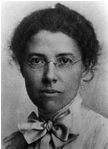
Aurelia Squire Harwood was born in Janesville, Wisconsin in September 1865, the daughter of the wealthy Charles.E. Harwood and his wife, Catherine.
As a child in Springfield, Missouri, where she moved with her parents at an early age, she evinced an uncommon love of the outdoors.
She attended Drury University, where she obtained a liberal arts undergraduate degree. Later, she completed graduate studies at Wellesley College.
In 1886, Charles Harwood relocated to Southern California, where, in 1888, be purchased from the Chaffey Brothers 20 acres of the Ontario Colony. At that time, Ontario was considered to include the City of Ontario, as well as Upland, which was then referred to as Magnolia, and San Antonio Heights. Charles Harwood became a lemon rancher, and was the first president of the Upland Lemon Growers Association, which was started in 1893.
In 1887, with his brother Alfred, he entered into a venture with Hugh MacNeil, Charles Frankish, Daniel McFarand, Lyman Stewart, Oliver S. Pilcher and Godfrey Stamm called the Ontario Land and Improvement Company. Charles Harwood was allotted 1,000 of the company’s 4,625 shares. In this way Harwood had purchased a major portion of the North Ontario land that would later become Upland. Charles and Alfred acquired at a sheriff’s sale what was referred to as the Bedford real estate. For a cost of $63,504, the brothers acquired all of the Bedford property, including the beautiful Magnolia Villa, held in lien. The Harwood brothers planted the eastern 100 acres of this property with orange trees and relandscaped the Magnolia Villa property.

Pictured in this 1918 photo is the Christening of the SS Paul Harwood, a tanker constructed by the Bethlehem Shipbuilding Company of San Francisco. The ship’s namesake was a member of both the Paul and Harwood families. Frances Paul was the founder of Upland’s San Antonio Community Hospital. She is seen toward the left between the two gentlemen behind her and is wearing rimless glasses and furs. Charles Harwood, perhaps the most successful businessman in Upland, is in the center with the white hair and white beard. Aurelia Harwood, holding a bouquet, is next to her father.
Charles Harwood, along with Charles Frankish, established the Ontario & San Antonio Heights Railway Company. The railroad went into operation in September 1888.
Charles Harwood built what is now referred to as the Old Harwood House, the stately Victorian home on the northwest corner of Euclid and 15th Street. Harwood lived there with Aurelia and a Chinese cook. With the advent of the horseless carriage, Charles Harwood was one of the few car owners in town to employ a chauffeur.
In 1906, upon the founding of the City of Upland, Charles Harwood was elected as one of the members of the maiden city council.
Aurelia was an educator. She was also a conservationist. So passionate was she about conservation that she became the first female president of the Sierra Club in 1927, and retained that position in 1928. In addition to her terms as president, she simultaneously sat on the Angeles Chapter’s executive committee, and the club’s board of directors, from 1921 to 1928.
She was instrumental in establishing the Tahquitz Game Preserve in the San Jacinto Mountains in 1927.
Over the years, she became a member of the Green Mountain Club, the Mazamas, and the Mountaineers. She joined the Sierra Club, and led local outings for fourteen years.
Following her father’s example, Aurelia donated to help fund universities, contributing to Pomona College, and scholarships for Chinese students at Mills College.
When the Chinese cook who had served her and her father so faithfully grew ill and was in the first San Antonio Hospital located near the corner of San Antonio Avenue and Arrow Highway, Miss Harwood visited him daily.
Aurelia Harwood died in 1928, predeceasing her father by five years. She had never married. She was buried at Bellevue Cemetery in Ontario, California. The Angeles Chapter of the Sierra Club named their new lodge after her in 1930. The peak east of Mount San Antonio, Mount Harwood, was also named in her honor, and recognized by the USGS in 1965. It stands at a majestic 9,552 feet and boasts a 152 foot prominence. Harwood Court at Pomona College, and her namesake scholarship at Mills College, still bear her family name.
Skepticism Over Needles Officials’ Stampede To Finish I-40 Interconnect Job
Eyes were rolling on Tuesday, September 27 when Needles City Manager, Rick Daniels claimed that the city would need to pay back the $5 million spent in engineering and environmental studies if construction on the Needles I-40 Interconnect Project is not completed by next June.
The engineering and environmental certification on the project exceeded by more than $2 million the $2,804,945.38 “base bid” cost for construction on the undertaking. The Sentinel’s review of available records indicates a more accurate calculation on expenditures to date for studies, engineering and design changes are closer to $7 million.
The “interconnect” was originally planned to be a “fly-over” route that involved the expansion and reinforcement of a bridge over the Colorado River and an elevated four-lane highway over the railroad tracks and alongside the Needles golf course connecting Interstate 40 at the J Street offramp in Needles with Arizona 95 toward Bullhead City, Arizona. Due to pressure from a “downtown business alliance” however, the project now involves widening to four lanes and installing traffic lights at certain intersections on an existing wind-about truck route. While traffic signals were to be installed at three intersections, members of the public were surprised to learn from Daniels that only two intersections would now be treated with automated signals and the third at the corner of K Street and Needles Highway would continue to be a four-way stop, although traffic counts show this corner to be the busiest of the three.
It is the hope of the Needles Downtown Business Alliance that the system will save their section of town adjacent to the railroad depot from being “bypassed” by a more straight forward routing of Arizona traffic. According to Daniels, it is the high cost of carrying out the original plan that justified the changes made, although the Sentinel has been copied with documents showing that the original plans are responsible for only about half the $7 million spent on preliminary work and that remaining half could have been obligated for construction of the original planned thoroughfare.
Needles area attorney Barbara Beardsley asked for clarification concerning information contained in an agenda item summary. Beardsley wanted to know what constituted “proof” of a “disadvantaged business enterprise.” Daniels clarified that CalTrans is required to certify that the contractor either hired or made their best efforts to hire the handicapped to obtain this type of certification.
Daniels stated that negotiations on the price to be paid for one last property seized by eminent domain is ongoing but that action by the council could be taken now to move the project forward. The Needles City Council and manager were tight lipped concerning competing bids and the clerk failed to email to the public the backup packet, as is the normal routine. The council then voted unanimously to accept a bid from Hal Hays Construction Company of Riverside in the “base bid” amount of $2,804,945.38 and issue a notice of award despite written protest and protest voiced at the meeting objecting to the destruction the historic Route 66 footprint.
Concerning the project, some Route 66 aficionados and historians say a section includes a unique and significant curve and median on the historic mother road that would be demolished. At the meeting Daniels did not mention the letter that the National Historic Route 66 Federation sent to him objecting to the destruction of the curve. The letter from David Knudsen, the president of this plus 1,000-member organization, urged the city to redesign its plans to avoid destruction of the Route 66 curve.
Knudsen’s letter reads in part: “Route 66, at its transverse through the City of Needles, is a key component of the iconic “Mother Road.” The historic remains of its footprint and the structures that were established along the Route, throughout its period of principal use in Needles, stand at the gateway to Southern California and as such herald the arrival of sojourners on Route 66 from the other 47 states. Our effort involves attempting to preserve the contouring and the original footprint of the entire road and for that reason we are concerned about the impact that the City of Needles’ proposed ‘I-40 Interconnect Project’ will have upon numerous Route 66 historic structures and their settings as well as the footprint at the intersection of Needles Highway and Broadway.
Ruth Musser-Lopez who is a candidate for one of the three city council seats to be voted on November 8, voiced concern that CalTrans and city officials conspired to avoid using the term “road expansion” and intentionally ignored the existence of historic structures including the curve and median and a multi-level brothel with underground passages to the train depot that would be impacted by the project and in so doing wrongfully represented that the federally funded project is exempt from the National Environmental Policy Act’s requirement for public review of environmental impact disclosure. A voter initiative that she authored, she said, “has received enough signatures to qualify for the ballot an ordinance that requires the preservation of the unique Route 66 corner curve. “ Musser-Lopez beseeched the council, “Please respect the voice of the people.”.
An organization that Musser-Lopez is director of, the River Branch of the Archaeological Heritage Association, also submitted written objection to the award of the project requesting that the project be redesigned to avoid demolition of the curve.
Musser-Lopez told the Sentinel, that if elected she would urge the council to negotiate with the Federal Highway Administration for funding for a “change order” to redesign the plans to avoid destruction of the corner.
Needles’ mayor, Dr. Ed Paget, owns the home in which the historic brothel was located, the setting of which will be impacted by the project. He was absent from the meeting. It is at the corner where his property is located that the signals were eliminated from the project and the four way stop will remain.
Mulefat
Baccharis salicifolia is a blooming shrub native to the sage scrub community and desert southwest of the United States and northern Mexico, as well as parts of South America. Its usual common name is mule fat; it is also called mule’s fat, seepwillow or water-wally.
The common name mule’s fat is a reflection of the consideration that mules would bloat after eating the plant.
An erect, woody, willowlike perennial shrub growing to 12 inches high with stems that are simple to branched and glabrous to minutely puberulent, often sticky, and branches that are longitudinally grooved, Baccharis Salicifolia bears plentiful small, fuzzy, pink or red-tinged white flowers which are highly attractive to butterflies. The long pointed leaves may be toothed and contain three lengthwise veins. It is most common near water sources, but is occasionally found in non-wetlands, according to the U.S. Fish & Wildlife Service.
The bushy and sticky-foliaged Mulefat’s leaves are alternate and lance linear, as well as acuminate-tipped, with the midrib more prominent than the lateral veins. The leaves can be up to six inches long and are on short petioles. The flower heads are disciform and are arranged in compact terminal clusters at the ends of the branches. Baccharis is a dioecious genus, so there are both staminate, i.e., male, and pistillate, female, heads to these plants, but they are always on separate plants. The involucres of both are hemispheric, white, and roughly 3/16 of an inch high, with imbricated phyllaries in 4-5 series, ovate to lanceolate in shape, somewhat papery or scarious in texture, glabrous and tinged red or pink.
Mulefat is mostly found below 3,500 feet in altitude, along stream banks and in dry stream beds in coastal sage scrub and chaparral. It ranges from Baja to central California and from the coast to the deserts, and blooms most of the year but principally from April to October. It used to be named B. glutinosa, referring to the glutinous character of the leaves, but in the more recent Jepson Manual it is listed as B. salicifolia, meaning it is willow-like in appearance.
The Indians made spears from the wood and hardened it by putting it in fire after stripping the bark. Kumeyaay, Maricopa and Mojave Indians made a box trap for quail from elderberry, mulefat or arroweed sticks. According to some accounts, on occasion so many quail became trapped under the box that they flew away with it.
Mulefat is treasured for its medicinal effect. The leaves were used as an eyewash and to cure baldness by some Indian tribes. The Kayenta Navajo people used the plant in a compound infusion of plants used as a lotion to counteract chills.
California Style Homecoming
By Grace Bernal
Every High School has a yearly fall dance called “Homecoming,” which the kids of today refer to as “HoCo.” The freshmen kids tend to be the most excited about this event because it will be a first for those who choose to attend. Of course, being new to these type of events, one doesn’t know what to expect, and one issue for most is what to wear. Back in my day, homecoming consisted of going to a Friday football game, and attending a dance in regular dress in the school gym. The only ones who dressed for the affair were the homecoming queen and her court of princesses. Today’s homecoming is taken up a notch because the dress code is semi-formal, and it takes place on a Saturday evening. For this affair, girls should wear cocktail dresses (usually cut at the knee) and boys should wear a suit with a tie. Stay away from the penguin tux, and the long dress. In most cases the boy wears a tie that is the same color as the girls dress, the flowers (corsage/ boutonniere) should coordinate with the colors that the couple is wearing. A low open toe heel will appropriately accentuate the shorter dress. Getting your hair, and nails done is optional since this is again a semi-formal evening. Boys be sure to wear dress socks with your dress pants, and to comb your hair neatly. With that said, here are some cute short dresses, and suits I encountered at this past weekend’s “HoCo.”
“Homecoming means coming home to what is in your heart.” ~Author Unknown