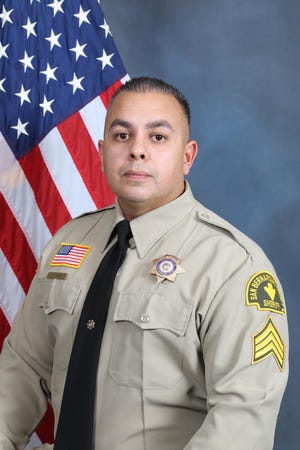
Sheriff Briefs Apple Valley Town Council On His Department’s Desert Marijuana Eradication Efforts

Four-and-one-half years after the voters in California passed Proposition 64, the Adult Use of Marijuana Act, the attitudes of most of San Bernardino County’s political leadership has not caught up with the spirit the outcome of that vote embodied.
For more than a century, marijuana being used for its intoxicative effect was illegal in the Golden State, and tens of thousands of people had gone to prison for growing it, possessing it, smoking it or trafficking in it during that time. In response to marijuana’s legalization with the passage of Proposition 64 in 2016, San Bernardino County’s governmental structure and that of its two incorporated towns and and eighteen of its twenty incorporated cities resisted going along with the new trend. Only five cities made any shift, with San Bernardino, Adelanto and Needles consenting to allow the plant to be commercially grown and altered into edible and otherwise applicable palliatives and salves, distributed and sold at both the retail and wholesale levels. Barstow has made preparations to permit sales. Hesperia has allowed businesses distributing and delivering the product to exist within its confines.
The continuing prohibition of marijuana and its commercialization elsewhere in San Bernardino has resulted in those looking to profit by cultivating and selling it, either under or outside of the regulatory schemes governments are permitted to engage in under Proposition 64, to try their hand at becoming marijuana cultivators or entrepreneurs. Recognizing that there is a tremendous appetite for the drug and that the collective resolve of San Bernardino County officials together with officials in the towns of Apple Valley and Yucca Valley and the cities of Chino Hills, Chino, Montclair, Ontario, Upland, Rancho Cucamonga, Fontana, Rialto, Colton, Grand Terrace, Loma Linda, Highland, Redlands, Yuciapa, Big Bear, Twentynine Palms and Victorville to prevent its production and restrict its availability is artificially boosting its price, daring indivduals have undertaken to cultivate it in small medium and large and gargantuan quantities in many places where they believe they can do so undetected. As a consequence, unlicensed marijuana farms over the last several years have flourished in the more remote areas of the county, in particular the vast reaches of San Bernardino County’s Mojave Desert.
Put upon by these operations, residents in those areas have made objections to them. Beginning earlier this year, the sheriff’s department has stepped up its enforcement and eradication efforts against those enterprises.
While the department has succeeded in raiding dozens of operations and uprooting literally tens of thousands plants, the sheriff’s department’s energetic efforts in this regard have resulted in few substantive criminal prosecutions. This has created some degree of controversy.
Sheriff John McMahon came before the Apple Valley Town Council at its meeting on Tuesday this week to offer what he said was an “update” of his department’s actions, and explain the legal limitations and challenges his department faces in carrying out its efforts.
We’ve heard from residents primarily in the more rural and unincorporated areas that are feeling the impact of these illegal marijuana grows,” McMahon said. “You’re fortunate in the town, and I know you have a great ordinance in place to penalize financially those that are growing illegally. Code enforcement and our folks here work very closely with one another and your primary issue here is indoor grows. [There are] very few outdoor grows in the Town of Apple Valley, and you’re really aggressive in making sure that you send a message that they’re not allowed. What’s happened in the unincorporated area and the more rural areas of the county is we saw a number of grows start poppin’ up here and there, and I will tell you, they grew faster than we could keep up with. We have one marijuana enforcement team in the county made up of five personnel. There’s just simply no way they can keep up with it, although last year, we did a special operation called Operation Weedwhacker with a bunch of folks from other parts of the county that came together, and they did serve 400 search warrants on illegal marijuana cultivation operations in the unincorporated county area, and we were able to take those grows down.”
McMahon said, “We’re at a point now where there’s about 860 grows that we’re aware of and ready to go after that were illegally being operated, and there’s probably at least another 200 if not more that we just haven’t got to yet and haven’t identified, don’t have coordinates for or addresses for. So, it’s over a 1,000, I guarantee you, throughout the county. It starts in Twentynine Palms and goes completely across the desert through Johnson Valley, Lucerne Valley, through the north part of the desert here, all the way over to Phelan, Pinon Hills and just keeps rollin’ over right into L.A. County. You may have seen some news coverage. LA. County’s got the same problem that we do, and they’re doing a big operation, and we’re assisting them, and ultimately they’re going to assist us here in the next month or so with some other grows that we have here in our part of the county.”
McMahon said his department is scrambling to address the issue but is overwhelmed with the enormity of the cultivation activity that is ongoing.
The primary reason for these illegal grows is just simply the money and the lack of consequences,” he said. “So, oftentimes what’s happening is these people are buying a plot of land, which oftentimes is relatively cheap out in the middle of nowhere, and you can describe it as in the middle of nowhere. I mean, you fly it with a helicopter and you’ll see lights and a grow way out where you would think there’d never be anything. They’re sinking a well, generally, if there’s water available. They’re getting a permit to sink a well. They’re hiring a well-driller. I was in Newberry Springs not long ago, and a well-driller actually got up and addressed the crowd, told us exactly what he’s doing, and he’s sinking wells. He’s getting permits just like everybody else. And those folks that buy that piece of property, sink a well legally, they’re entitled to whatever the acre-feet are deeded to that piece of property, and in some cases in Newberry Springs, it’s ten acre-feet a year. So, they have that right to use that water. And then they set up the hoop houses, and they start growin’ marijuana, and they turn it in about three or four months, and they start another crop. Under Prop 64, not a lot of people caught it, but almost at that last page of that proposition on the ballot was converting, growing, commercially growing or cultivation of marijuana from a felony to a misdemeanor. So, we catch somebody at one of those grows, they get prosecuted for a misdemeanor and a $500 fine. All we can do is take down the plants and haul those away, because that’s the criminal activity. The hoop house, all the other things we see there are not criminal in nature and have to be followed up by code enforcement. And to be quite honest, the county has limited resources as it relates to code enforcement.”
Current laws as defined under Proposition 64 has restricted government’s ability to deal with the expansion of marijuana production, McMahon said, opining that there is a need for draconian legislation.
So, we’re tryin’ to work with the county to come up with an ordinance that will help give us the authority and certainly the deterrent to prevent some of this,” the sheriff said. “It’s going to have to be similar to what you guys have where you fine people. Needles has the same thing. The county’s going to have to develop an ordinance, and they’re workin’ on it with all the department heads, to fine these guys that are growin’, and whether it be a thousand dollars a plant, or $5,000 a plant, or $10,000 is up for the county to decide. But the misdemeanor and $500 fine is not going to deter these guys. It’s just not going to do it. They’re going to continue to grow. When we take it down, they either move to another location, or they wait for a month or two, replant and they regrow on the same site. And so, it’s just tough to keep up with the increase. There’s so much money to be made. So, the only way we’re going to deal with it is an ordinance that fines them, and then if they don’t pay, then they lien the property and, you know the rest of the story. So, I think that will be effective.”
McMahon said a move in that direction is already being made.
Today, [Third District] Supervisor [Dawn] Rowe at the board of supervisors [meeting], introduced a resolution to send to Sacramento to change it from a misdemeanor to a felony again,” McMahon said. “Apparently that can be done in the legislature with a two-thirds vote, even though it was voted on by the people. So, that’s what they were talkin’ about this morning at the board of supervisors. Assemblymember Thurston Smith as well as Tom Lackey both came out, rode in the helicopter with our folks and videoed the grows in the desert, and I think they were just as amazed as anybody as to the number and the size. They took that video back to Sacramento, and I think they’re going to use that to try to help get it reversed, and change it back to a felony. With any luck at all that will happen. It may slow down some of it, as well.”
With or without a new law, McMahon said, his department is going to maintain its current efforts, and will indeed intensify them, perhaps as much as five-fold.
But in the meantime, today at the board of supervisors meeting, they authorized additional funding for us,” he said. “Historically, they’ve provided a million dollars in crime suppression money for us to use to address gang-related, violent crime, whatever it might be. Today they authorized $4 million, so we’re going to use it for that traditional criminal activity with gangs and violent crime and that type of thing, but also use it to ramp up our marijuana enforcement. We’re going to go from one five-member team to five teams. We’ll spread throughout the entire county, and just do more of the search warrants, and try to keep up with this ever-increasing illegal cultivation.”
McMahon said, “As you are probably aware, there’s only two places in our county that cultivation of marijuana is legal, other than [growing six plants for] personal use, and that’s Needles and Adelanto.”
McMahon omitted mention of the City of San Bernardino, which has transitioned to allowing all order of marijuana and cannabis-related operations to function within its jurisdiction.
Adelanto has the same issue in the surrounding area and a little bit inside the city limits, illegal grows as well,” McMahon said. “That’s in direct conflict and competition with the legal growers that are paying taxes and paying fees to the city to operate. It is obviously impacting their business, as well. Needles sees the same thing. Needles has an ordinance where they fine, I believe it is $10,000 a plant, if it’s an illegal cultivation operation. That seems to be effective in Needles and seems to be working. So, with any luck at all we can do something like that at the county level, also. So, just to remind everybody, cultivation or growing of marijuana for personal use is legal under Prop 64. You can have six plants for personal use. You can have one ounce of finished product for personal use. The grows that we’re seeing in the rural areas and unincorporated areas where there’s hoop houses and 10,000, 20,000, 30,000 plants: absolutely illegal. Not authorized by the county, and its illegal if it’s not authorized by the county. It’s still the misdemeanor section. That’s the challenge for us. But in the meantime, while we’re waiting for the ordinance at the county and while we’re waiting to see if they change it from a misdemeanor to a felony as it relates to the prosecution piece, we will continue to do everything we can to take these down. It’s a serious quality of life issue. There’s water issues. [There are] those that are stealing water – which is happening – [and] those that are buying water. [In] Lucerne Valley, when I was there at a couple of meetings, there [were] people at the meeting who were selling water to the growers. I don’t believe that’s illegal. I’m not sure who enforces the water rules, but I don’t think that’s illegal. They can sell water from their well if they want to. So, they’re doin’ it, which is continuing to feed the need of the growers. So, that may be a challenge, maybe something they can deal with in that regard, and ultimately work closely with the DA’s office. And there’s some environmental crimes I think the DA’s office is looking into. Obviously, they’re using pesticides and they’re using fertilizer, which potentially could be percolating into the groundwater. I don’t know much about that, but they’re working with the EPA [Environmental Protection Agency] to see if there’s something they can do in that regard.”
McMahon said, “We’re trying everything we can, but we’ll keep the pressure on. We’ll continue to take these grows down. We have the additional personnel that will be coming July 1. We’ll keep the pressure on and do what we can to try to control this.”
McMahon indicated there were further criminal issues that sprang from the illicit marijuana cultivation enterprises.
In Newberry Springs, we’ve had two incidents where the guys that are at the grows are armed,” McMahon said. “They’re protecting the grows. They’re carrying rifles and they are confronting people on the road, on the dirt road, trying to figure out who they are and, additionally, they fired at our folks twice. One case, a round went through the windshield of one of our patrol cars. We traced it back and it was an armed guy at one of the illegal grows. Now, I don’t believe he was shooting at the cop car because he knew it was a cop car, a deputy. I think he was worried more about being robbed. They’re really not that afraid of us, because they know that the penalty and prosecution is so small. They’re worried about some bandits coming and stealing from them. So, that’s why they have armed guards there. So, that’s part of the issue.”
Furthermore, McMahon said, the cultivation operations involve “Trash, dust, the water trucks goin’ back and forth. Now, when we did our operation in Lucerne Valley, we partnered up with the CHP. They brought their commercial enforcement guys out. They pulled over all of those trucks haulin’ water, most of which were overweight, unlicensed. The drivers certainly wasn’t licensed to be carrying the weight they were carrying. So, they dealt with that on that side of it as a commercial enforcement officer and we dealt with the grows itself, taking ‘em down. Labor intensive, but it’s important. With any luck at all, we’ll get some of those changes that I spoke about. Maybe with that additional prosecution and penalties for those guys that are growin’, we can slow this down. It’s nearly every community in the rural area of the county, and we’re not the only county that’s having the same problem. If you read the paper, you can see it’s happening in Siskiyou County. It’s happening in Kern County. It’s happening in Fresno County. Anywhere where there’s a large amount of open space where they can set up a growing operation, they’re doing it. It’s simply a lot of money being made.”

High Rises In The News

Though the residents of Manhattan across the continent or those living in Chicago on the southwest shore of Lake Michigan would laugh at the thought that the Inland Empire is home to high rise buildings, and dismiss most of the structures in this region as falling below the standard for mid-rises, by local standards there are a smattering of tall buildings scattered about 20,105-square mile San Bernardino County.
The county seat, San Bernardino, accounts for the most tall buildings in the county and claims the title of having the greatest number of overall stories, as well, along with four of the six tallest structures, although not the actual tallest building. Loma Linda, Redlands, Rancho Cucamonga, Ontario and Victorville have a few tall buildings, and in Upland, where in recent years some three story residential units have sprung up, a seven-story building is to grace the skyline near the 210 Freeway in the not-too-distant future.
In recent weeks and days there have been developments with regard to existing and proposed high rises that merit public attention.
In April, the Redlands Planning Commission made a recommendation that Village Partners Ventures LLC be allowed to transform the largely vacant 11.15-acre Redlands Mall, which formerly hosted the Harris’ department store, into a melange of mixed-uses including residential, retail, office professional quarters, restaurants, recreational facilities and a six-story parking structure around a pedestrian plaza and swimming pool, with multi-story residential buildings of three, four and five vertical levels.
In September, the grassroots group Friends of Redlands, working in conjunction with Redlands for Responsible Growth Management, began gathering signatures to force a vote on what the allowable height limit on Redlands buildings is to be. The proposed Friends of Redlands’ initiative calls for disallowing buildings taller than two stories next to single-story homes without the consent of the owner of the single-story home, limiting the height of buildings downtown, which involves the University of Redlands Transit Villages Area, to no more than 50 feet, and the permitting of buildings to a height of no more than 62 feet – tantamount to four stories – in the New York Street/ESRI Transit Village Area. The initiative would further require that the city council unanimously approve making any density intensifications on projects, and it would layer greater parking provision requirements on developers seeking project approvals. To qualify the initiative for the ballot in 2022, the petitioners needed ten percent of Redlands’ 42,000 voters to affix their signatures to the ballot application. To force the election to be held this year, within 109 days of the requisite number of signatures being verified, Friends of Upland needs 15 percent of the city’s voters – 6,409 – to sign the petition.
On Monday, June 7, 2021, representatives with Friends of Redlands and Redlands for Responsible Growth Management, including 95-year-old former Redlands Mayor Bill Cunningham, wheeled into Redlands City Hall three huge boxes containing petitions calling for a special election to stop tall and dense development to which 7,715 signatures were affixed. Those petitions were turned over to City Clerk Jeanne Donaldson.
One of the activists opposing development in Redlands, John Berry, told the Sentinel, “stopping hi-rise development is a huge — and visceral! — issue throughout Southern California. Since we started collecting signatures in September, we have heard from many residents from many SoCal cities who have expressed their frustrations and battles with developers and city councils ruining their cities. Only because of Redlands’ Bill Cunningham fighting these battles since 1978 did Redlands ever become the city we love. Without him, Redlands would have become just another SoCal condo canyon city. Many people who’ve signed told us they moved to Redlands for its charm and small-town feel.”
Donaldson is to count and verify the signatures to determine if the referendum on high rises will take place this year or next year.
Meanwhile, the City of Redlands, which for years has been seeking an economical way to deal with the overcrowded quarters in its police and fire departments, has arranged to purchase, for $500,000, an option on the Redlands Federal Bank Building built in 1981.
Reportedly, the option will lock in the city’s opportunity to purchase the tallest building currently in Redlands, located at 300 East State Street downtown, for $16 million. The half million dollars paid to secure the option will go toward the purchase if the acquisition is made before the option’s expiration. The building is large enough to house both the fire department administration and all of the police department, as well as parts or all of some other city departments.
In nearby Loma Linda, officials with the Loma Linda University Medical Center are striving toward securing the certificate of occupancy for the six additional stories that have been constructed on the existing medical center building, originally built with 11 floors in 1967. The current project has been ongoing since 2016. It is anticipated patients will be accepted into the new hospital quarters by September 2021, if all issues with regard to occupancy permits are resolved in a timely manner.
Existing facilities housed in the current medical center structure’s round towers will be moved into the six new floors. This means an expansive new operating room suite and a significant increase in the number of intensive-care beds. Brand new and state-of-the-art cardiovascular labs, including ones providing all needed equipment and facilities for heart surgeries, will be housed in the expansion area, along with other surgical, perioperative and pre-operative suites.
Paralleling the expansion of the project is an upgrading of the hospital’s seismic system, carried out by Turner Construction Company of New York City. The building foundation is now set upon 126 base isolators, huge springs which will allow the building to sway in what is predicated to be a 10.4 Richter Scale earthquake without buckling, collapsing or sustaining structural damage that would compromise the building’s integrity. The most intensive earthquake on record was one in Chile in 1960 that reached 9.4 on the Richter Scale.
At 17 total stories, of which 16 are above ground to a height of 267 feet, the Loma Linda University Medical Center building is now the tallest hospital in earthquake-prone California, and San Bernardino County’s tallest building.
In the City of San Bernardino, six-story City Hall remains vacant after nearly five years. It is unclear whether city officials there will seek to reclaim it by engaging in a seismic hardening of the facility or raze it.
In the early 1970s, San Bernardino officials committed to building a new City Hall in Downtown San Bernardino, on property reclaimed from a longstanding historic section of the city, where nearly a score of buildings had been demolished to undertake an urban renewal effort that was to include government-sponsored capital improvements entailing a new civic center.
César Pelli, a highly accomplished Argentine American architect who emigrated to the United States in 1952, married Diana Balmori, a landscape and urban designer, and became a naturalized U.S. citizen in 1964, was commissioned to design the edifice. Pelli was one of the world’s leading architects, particular with regard to designing majestic buildings as well as some of the world’s tallest structures, including the Petronas Twin Towers in Kuala Lumpur, which were for a time the world’s highest buildings, as well as the World Financial Center complex in downtown Manhattan, Salesforce Tower in San Francisco, the Sao Paulo Corporate Towers, Xuzhou Central Plaza in Xuzhou, the Unicredit Building in Milan, and scores of others around the world.
In the early morning of February 9, 1971, the San Fernando Earthquake, also known as the Sylmar Earthquake, occurred in the west foothills of the San Gabriel Mountains. The unanticipated thrust earthquake had a moment magnitude of 6.5 or 6.7 on the Richter Scale. The quake did damage to the San Fernando Valley and other densely populated areas north of central Los Angeles, causing several buildings to collapse. This demonstrated the inadequacy of the building standards that had been put into place in California following the Long Beach Earthquake of 1933. California lawmakers acted quickly to develop legislation related to seismic safety, tightening construction standards.
Already at that point, architects and engineers had introduced the concept of incorporating rollers into the foundation of high rise buildings, which would allow the foundation to roll or shift with a seismic disturbance. Two decades later, rollers would be replaced by massive vertical springs in the foundations of large buildings. But San Bernardino City Hall had neither of those features. What is more, the contractor on the San Bernardino City Hall project would utilize pillars composed primarily of concrete, nearly a dozen of them, to support the building.
Rather than hold off on the construction of the building until the State of California formulated new standards based on data available from the Symar quake, San Bernardino city officials, rather irresponsibly, rushed to complete the city hall project before those standards were mandated by law.
Some 43 years after the completion of the project, then San Bernardino City Manager Mark Scott was informed that it is anticipated that a 7.0 magnitude or greater earthquake is likely to occur in Southern California within the foreseeable future. If such an event were to emanate from a point proximate to San Bernardino, Scott was told, the concrete pillars supporting the six-story City Hall structure would would be likely to powderize, and the building would collapse. Out of what he said was an abundance of caution, Scott ordered the building to be cleared of city operations. It has remained vacant ever since.
In Upland, developer Jeff Burum is working toward the completion of a seven-story residential structure. That project is not likely to be completed prior to 2025.

Stymied By Lawsuit Over Amazon Warehouse Project In Upland, Bridge Development Looking To Build Distribution Center Ten Times Larger In Rancho Cucamonga

By Mark Gutglueck
Dismayed with the more than one-year delay it is encountering in its effort to construct a 201,096-square foot warehouse for online retail sales behemoth Amazon in Upland, Bridge Development Partners is now looking at constructing a warehouse ten times that size in Rancho Cucamonga.
More questions have been raised than have been answered by Bridge Development Partners’ sudden shift of focus from the City of Gracious Living to its neighboring municipality to the east. Among those questions is whether the company will draw upon its experience in Upland, where what was officially previewed to the community in June 2019 as a three-building complex with 977,000 square feet under roof to serve as an Amazon warehouse/distribution facility/fulfillment center was reduced in size and eventually given approval in 2020 by the city council, only to run into intensive resident opposition that has so far untracked the project.
Though Bridge Development Partners coyly did not mention or acknowledge at the time that it introduced the Upland project that Amazon was intended as the eventual tenant, such was intimated and ultimately confirmed when Amazon in its internal documents announced its intention to operate a distribution center in Upland.
The proposal was dubbed the Upland Bridge Point Project.
Now, Bridge Development Partners appears to have jettisoned its intention to establish the Amazon facility in western Upland in favor of a 2.175-million square foot structure in southeastern Rancho Cucamonga.
The road in Upland proved a rocky one for Bridge Development Partners, though at one time the company appeared to have four members of the Upland City Council in its pocket.
As objections to the scope of the original 977,000-square-foot three-building complex proposal in Upland manifested in 2019, the tentative site plan was modified several times until in October 2019 a revamped conception of the project was presented, one that was reduced to a single structure of 276,250 square feet. Ultimately, the project proposal was reduced to a single building of 201,096 square feet on the 50-acre property located north of Foothill Boulevard and south of Cable Airport, just east of what would be the logical northward extension of Central Avenue.
Bridge Development Partners through some methodology which engendered questions about whether the process had been tainted by graft, convinced Upland officials to allow the project to be considered and its environmental certification done using what was referred to as an “initial study” of the various environmental impacts of the project in lieu of a comprehensive environmental impact report. Ultimately, to give the project its environmental certification, the city council made a cursory examination of the initial study’s documentation and findings, thereafter making a declaration that there would be no unmitigateable impacts from the project that were not offset by the conditions of approval of the project. This form of dealing with the environmental issues is referred to as a “mitigated negative declaration.”
This skimping on the environmental impact report raised serious questions in the Upland community, as Amazon’s operations were to entail a substantial number of 18-wheel trucks as well as airplanes landing at nearby Cable Airport delivering merchandise to the warehouse, along with hundreds, indeed thousands, of vans per day delivering that merchandise to end-use customers, wreaking considerable havoc on the city’s roads and main thoroughfares. Such concerns initially led the Upland Planning Commission, on February 12, 2020, to vote 3-to-2 against recommending that the project be given go-ahead, with commissioners Gary Schwary, Linden Brouse and Yvette Walker prevailing over commissioners Robin Aspinall and Carolyn Anderson.
In a reversal unprecedented in Upland history, two weeks later, on February 26, 2020, the planning commission, this time with the previously absent Commissioner Alexander Novikov present, reconsidered its February 12 vote relating to the project. Despite the fact that Novikov cast a vote against the project on February 26, Schwary and Brouse bolted from the side that had opposed the project to support it, such that the project was given a 4-to-2 endorsement, this time with Aspinall, Anderson, Schwary and Brouse prevailing over Walker and Novikov.
At a specially-convened meeting called for the specific purpose of considering approval of the project, the Upland City Council conducted what was supposed to be the final hearing on the project on April 1, 2020.
The April 1 meeting consisted of a forum held in a non-public venue at which the city council was to consider the project, using a format that conformed with California Governor Gavin Newsom’s mandated precautions against the spread of the coronavirus, involving video/audio link-ups for the council and city officials to interact, together with brief telephonic input from members of the public.
In the meantime, operatives working on behalf of Bridge Development Partners provided Upland-based Victory Community Church with infusions of cash and hosted a free dinner earlier in the evening of April 1 for no fewer than 13 members of that congregation. During the course of the April 1 meeting, those 13 congregants called upon the city council to approve the project. During the hearing, twenty city residents, citing concerns relating to the environmental impact of the project including traffic, diesel and other emissions, site contamination, as well as the consideration that Amazon’s business model does not include the collection of sales tax on the online sales it engages in, expressed opposition to the project. They protested the city’s embracing of the project, which included giving the project environmental certification by means of a mitigated negative declaration rather than a full-blown environmental impact report.
A mitigated negative declaration is an environmental review determination made by an elected or appointed board of a governmental agency in which administrative and land use authority has been entrusted certifying that the environmental impacts from a project will be mitigated by the conditions of approval for that project. This contrasts with an environmental impact report, which delineates not only the impacts in detail but spells out explicitly what the mitigation measures for those impacts will entail.
Bridge Development Partners representatives presented to the council an endorsement of the project that bore the signatures of 1,100 city residents, and they offered the city council an assurance that in return for the city’s approval of the project, their company would enter into a development agreement that would pay the city $17 million, which was to include payments in lieu of sales tax to make up for the consideration that merchandise sold by Amazon online is not subject to sales tax.
The Upland City Council as it was then composed voted 4-to-1, with Councilwoman Janice Elliott dissenting and Mayor Debbie Stone and councilmen Ricky Felix, Bill Velto and Rudy Zuniga prevailing, to make a mitigated negative declaration and approve the project.
A number of issues pertaining to the Amazon project approval coalesced at that point to give the general impression that something was amiss. Councilman Felix abruptly resigned from the city council and moved to Utah the following month, fueling speculation that he left because of his misgivings over the heavy-handed way in which city officials, including himself, had been pushed into approving the project. Mayor Debbie Stone, whose strong suit had never been intellectual intensity, came across as militating too hard on behalf of Bridge Development Partners, as if she were seeking to make good in exchange for some inducement she had been given to support the project. Tongues began wagging when shortly after the council approval of the project Mayor Stone removed both Walker and Novikov from the planning commission, punishment doled out for their opposition to the project. Stone then appointed Dr. Brinda Sarathy to one of the vacant positions on the planning commission but rescinded that appointment when it was pointed out to her that she had forgotten that Sarathy had spoken out in opposition to the Upland Bridge Point/Amazon project.
A bothersome consideration for many was that the city’s director of development services, Robert Dalquest, whose function at City Hall is to protect the city’s residents from the consequences of any development projects that take place in the city, glossed over multiple issues when he orchestrated the approval of the project subject to using the initial study/negative declaration despite his recognition that that the members of the city council did not have the sophistication or knowledge to hash out the environmental issues at play, which gave the general impression that he was abiding by the dictates of the council to ensure that they were met with no documentation that would justify their rejection of the project. Moreover, during a planning commission meeting at which the Upland Bridge Point Project was considered, both Dalquest and then-City Attorney Steven Flower were overhead during a break the commission took, seeking to attribute to one another the rationale for abiding by an interpretation that the general plan land use designation and zoning on the property where the project was proposed was in conformance with use as a warehouse, an exchange which came after residents asserted that the zoning on the property was inconsistent with such a use.
A group of residents, unwilling to accept the approval of the project without exacting upon the developer conditions of approval that would offset what they considered to be the untoward environmental impacts of the project, formed a group, Upland Community First. On July 15, 2020, Upland Community First, represented by attorney Cory Briggs, filed a petition for a writ of mandate, naming the City of Upland. The filing contended that the members of Upland Community First as well as other residents of Upland opposed to the project had their fair hearing and due process rights violated on April 1, 2020 when the hearing relating to the project occurred via teleconference, such that “full public participation” in the approval process did not take place, which practically prevented those opposed to the project from presenting a convincing case against the project and what they propounded was its inadequate environmental certification. More pointedly, the writ of mandate presented in granular detail the contention that the documentation of the project’s impacts submitted in support for the mitigated negative declaration was lacking in multiple respects and that conditions of approval imposed on the project and its proponent did not provide adequate safeguards against those impacts. The upshot of the lawsuit was that the project approval should be rescinded and the city should be required to carry out a comprehensive environmental impact report if the project were to be reconsidered.
“Whenever a project proposed to be carried out or approved by a lead agency has the potential to cause an adverse environmental impact, the California Environmental Quality Act prohibits the agency from relying on a negative declaration,” the petition for a writ of mandate stated. “Instead, the California Environmental Quality Act requires the preparation of an environmental impact report to identify and analyze the significant adverse environmental impacts of a proposed project, giving due consideration to both short-term and long-term impacts, providing decision-makers with enough information to enable them to make an informed decision with full knowledge of the likely consequences of their actions, and providing members of the public with enough information to participate meaningfully in the project’s approval and environmental-review process. The California Environmental Quality Act also requires every environmental impact report to identify and analyze a reasonable range of alternatives to a proposed project. The California Environmental Quality Act further requires every environmental impact report to identify and analyze all reasonable mitigation measures for a proposed project’s significant adverse environmental impacts. An environmental impact report must be prepared for a proposed project if there is a fair argument, supported by substantial evidence in the administrative record, that the project may have an adverse environmental impact; stated another way, a negative declaration may not be used unless the lead agency determines with certainty that there is no potential for the project to have an adverse environmental impact.”
The city sought to have the lawsuit thrown out, asserting, essentially, that as the lead agency with ultimate land use authority in its own jurisdiction, the city, in the form of the city council, which is Upland’s ultimate decision-making body, had complete discretion in allowing the project to proceed. San Bernardino County Superior Court Judge David Cohn, however, allowed the legal challenge to proceed, which kept the project on hold.
Mayor Stone, whose efforts on behalf of Bridge Development Partners were so ham-handed that even her supporters were embarrassed by them, found herself isolated and without the crucial assistance she had counted upon in her past electoral efforts when she was due to seek reelection in the November 2020 election. Challenged by Councilman Velto, former Planning Commissioner Novikov, whom she had deposed because of his vote rejecting the Amazon project, and Lois Sicking Dieter, who was active in the Upland Community First effort against the project, Stone was blown out of office in November 2020. Velto prevailed in the race for mayor, but in short order, it became known that he was acting as a go-between seeking to settle the Upland Community First lawsuit against the city over the Bridge Development project. Velto assuming such a position was highly irregular, since he was, as a member of the city council and a representative of the city, a defendant in the lawsuit, one who was represented by legal counsel. Thus, it was both procedurally and legally improper for him to be dialoguing with Upland Community First. By using Velto in the capacity of a backchannel negotiator, Bridge Development Partners was seeking to steal a march on Upland Community First. Having Velto proffer the potential settlement terms put Upland Community First in the position of itself doing something improper if it were to engage in a direct dialog with an individual it had sued rather than through attorneys representing both sides. If Upland Community First had engaged with Velto, this would have created a weapon – indeed blackmail – Bridge Development Partners could use to force a settlement of the suit on terms favorable to it. Using Velto also allowed Bridge Development Partners to avoid putting anything in writing and preserved a degree of deniability which would allow the company to ascertain what the rough parameters of a settlement between Upland Community First and the city would look like, positioning it in a stronger position to engage in final stage negotiations with Upland Community First prior to any settlement short of the matter being hashed out in court.
Ultimately, according to information available to the Sentinel including emails and text messages, after Velto was sworn in as mayor, a settlement was placed on the table that called for Bridge Development Partners upping the $17 million in development impact fees, infrastructure impact fees and fees-in-lieu-of-property tax that Bridge Development Partners had committed to providing at the April 1, 2020 council meeting as part of the development agreement when the project was given approval to $38 million and then, subsequently, to $40 million to cover infrastructure and service demands, refurbish the city’s roads damaged by Amazon vehicles and provide payments in lieu of sales tax from Amazon’s operations over the 50-year lease life of the 201,096-square foot building. In exchange, the expectation was that the demand for the insisted-upon environmental impact report would be set aside in return for a far less rigid “environmental analysis” and an understanding that the warehouse operation would be allowed to expand, at the discretion of the occupant, presumably Amazon, to the original three-structure, 977,000 square-foot complex previewed to the city in June 2019.
Upland Community First, however, did not take the bait. Instead, it insisted on seeing the litigation through to its ultimate conclusion, and having the court ascertain whether the residents of Upland were owed a full-scale environmental impact report with regard to the project. The matter continued to drag on.
Shortly after Velto’s backchannel efforts came to light and their propriety questioned, he discontinued his role as a go-between. In the months since that time, the Upland community has made serious examination of the consideration that Bridge Development Partners was willing to more than double the $17 million it had offered the city in the development agreement approved by the council on April 1, 2020, which was taken by many as an indication that Stone, Velto, Zuniga and Felix had sold the city short in approving the project. This fueled yet another round of speculation that the project approval process had been tainted by graft, and that bribes or kickbacks had been offered, promised or provided to Stone, Velto, Zuniga, Felix and other city officials such as then-City Manager Rosemary Hoerning or Upland Director of Development Services Robert Dalquest, who had orchestrated the consideration of the project approval using the mitigated negative declaration rather than a comprehensive environmental impact report.
This prompted Bridge Development Partners Executive Vice President Brendan Kotler to publicly state, “Any suggestion that we did anything wrong is baseless.”
Thereafter, Bridge Development’s first vice president for development, Heather Crossner, stated that “assertions imbedded in …questions” relating to why, in the aftermath of the legal action by Upland Community First, Bridge Development Partners was willing to more than double the development fees, infrastructure damage/impact offset fees and fees in lieu of sales tax that were offered to the city at the time the project was approved in April 2020 “are entirely false. They have no merit or basis in fact. Bridge and the City of Upland followed the public process in accordance with all laws. At no time has Bridge, or any representative of Bridge or anyone affiliated in any way with Bridge, engaged in any of the activities referenced,” those alleged activities being Bridge Development Partners or any entity working on its behalf having made any promises to Upland’s municipal staff members, its elected officials or its appointed officials to obtain the approval given to the Upland Bridge Point Project or the company or anyone acting on its behalf having arranged payments to former Mayor Debbie Stone, former Councilman Ricky Felix, former Councilman/current Mayor Bill Velto, Councilman Rudy Zuniga, Planning Commissioner Robin Aspinall, Planning Commissioner Carolyn Anderson, Planning Commissioner Gary Schwary, former Planning Commissioner Lindon Brouse, former Upland City Manager Rosemary Hoerning, Upland Community Development Director Robert Dalquest, Upland Contract Planner Mike Poland or Upland Associate Planner Joshua Winter.
Since that time the project has continued to languish in legal limbo as the case brought by Upland Community First and the City of Upland has not been resolved.
On May 5, 2021, in what many now see as a signal that Bridge Development Partners is ready to pull the plug on the Upland project, it initiated an application for and filed what it is at this point calling a draft environmental impact report for the Bridge Point Rancho Cucamonga Project.
That project is to include the redevelopment of what was formerly the Big Lots warehouse site near the extreme southeast corner of Rancho Cucamonga.
According to Bridge Development Partners’ filing, the site is to be redeveloped with “with two new contemporary warehouse buildings (Buildings 1 and 2) with a combined building area, including the mezzanine space, of approximately 2,175,000 square feet consisting of 2,134,000 square feet of warehouse uses and 41,000 square feet of ancillary office space. There would be approximately 2,136,200 square feet of ground level floor space and approximately 38,800 square feet of mezzanine.”
It appears that Bridge Development Partners may have drawn a lesson from its experience in Upland, such that instead of pressuring Rancho Cucamonga officials to allow it to undertake up front an initial study to form the basis of the environmental certification of the project, the company is instead doing a draft environmental impact report, a far more comprehensive environmental analysis than was done in Upland. It is not fully clear whether Bridge Development Partners has acceded to undertaking the draft environmental impact report because of its unfortunate experience in Upland, because the construction on the structure to take place in Rancho Cucamonga is on a scale ten times that of what was proposed in Upland or because Rancho Cucamonga officials proved far more hard-nosed with regard to the environmental certification of the project than did those in Upland.
The Sentinel’s effort to reach Sean McPherson, the senior planner with the City of Rancho Cucamonga who is overseeing the city’s processing of the Bridge Point Rancho Cucamonga development proposal, by press time was unsuccessful.
For the purposes of the analysis conducted in the draft environmental impact report, it is assumed that up to 90 percent of the building square footage is to consist of a so-called high-cube warehouse, and 10 percent will consist of a high-cube cold storage warehouse.
Building 1 is described as consisting of approximately 1,422,500 square feet of floor area, which is to involve roughly 25,000 square feet of ancillary office space and 1,397,500 square feet of warehouse space. Building 1 is tentatively designed as a cross-dock building, meaning that loading docks are located on opposite sides of the building, both east and west.
Building 2, according to documents obtained by the Sentinel, is to feature approximately 752,500 sf of floor area, of which some 16,000 square feet is to be ancillary office space with 736,500 square feet of warehouse space. The building would also include 16,000 square feet of offices within either the ground level or mezzanine. Building 2’s cross-dock configuration will provide for loading docks on the north and south sides of the building.
In terms of offsite infrastructure, the project will involve the construction of a new public roadway, at present referred to as “Street A,” which would extend north-south along the eastern boundary of the project site between 4th Street and 6th Street.
The project site extends over 91.4 acres located at 12434 4th Street in the City of Rancho Cucamonga, bounded by 4th Street to the south, which is also the jurisdictional boundary between the City of Rancho Cucamonga and the City of Ontario, and 6th Street to the north, and generally located between Etiwanda Avenue to the east and Santa Anita Avenue to the west.
Some but not all of the on-site improvements associated with the project will involve surface parking areas for automobiles and truck trailers ancillary to the operation of the two buildings, vehicle drive aisles, landscaping, storm water quality/storage, utility infrastructure, and exterior lighting. The project site is within a transit priority area and would include improvements to 4th Street and 6th Street along the project site’s frontage to facilitate the use of transit and non-vehicular circulation.
Thus, Bridge Development Partners will remove and replace the existing sidewalk and install Class II bikeways adjacent to the project site. The City of Rancho Cucamonga intends to construct an at-grade crossing of the railroad spur to complete 6th Street between Santa Anita Avenue and Etiwanda Avenue. As a preliminary condition of approval, the city has indicated that the crossing is required to be implemented as part of the project; therefore, it is also addressed as a project component in the draft environmental impact report.
It is expected that construction of the project would be initiated in 2021 and be complete by 2022. The general plan land use designations and zoning for the project site are heavy industrial on the northern portion of the site and general industrial on the southern portion of the site.
For the project to be approved, the city council, acting as Rancho Cucamonga’s highest land use authority, will need to adopt general plan and zoning map amendments to change the land use designation and zoning designation for the northern portion of the project site from heavy industrial to general industrial; approve a tentative parcel map to subdivide the project site, which is currently a single legal parcel, into two parcels to accommodate the two proposed buildings; approve a site plan and architectural review for the site, architectural plans, and landscape plans; grant Bridge Development Partners a tree removal permit for the removal of heritage trees on-site; and certify the final environmental impact report for the site, which is to be based upon the draft environmental impact report and public comment on that draft document.
Bridge Development Partners’ pursuit of the Bridge Point Development Rancho Cucamonga project implies but does not conclusively establish that the Amazon warehouse project in Upland is being abandoned. A phone message left with Brian Wilson, the West Coast partner with Bridge Development Partners at his Los Angeles office inquiring if success in bringing the Bridge Point Development Rancho Cucamonga project to fruition will preempt the Upland Bridge Point Project did not garner a response by press time. bng