
The State of California is on the verge of mandating that San Bernardino County’s 24 cities must moderate their zoning and development codes to allow the construction industry to build 162,145 housing units within their collective confines over the eight years beginning in 2021. The majority of those new dwellings are to be priced at what is defined as “affordable” rates, that is, within the buying power of those with very low, low and moderate incomes. The balance of the units to be built are intended for purchase or rent by those with “above moderate income.”
The dictates from Sacramento mean that local governments throughout San Bernardino County and the larger area of Southern California as a whole will lose a significant degree of their traditional purview over land use policy.
There has been a trend toward an overarching regional and statewide control of development regulation, in particular residential development regulation, for some time. The regional housing needs assessment, known by its acronym RHNA, is a requirement of California housing law and is a process that determines projected and existing housing need for all jurisdictions, including cities and unincorporated county land, in California. The process to determine a regional housing needs assessment allocation is conducted by a council of governments, such as the Southern California Association of Governments, every eight years. Every jurisdiction must plan for its regional housing needs assessment allocation in the housing element of its general plan by ensuring there are enough sites together with zoning to accommodate its regional housing needs assessment allocation. Many jurisdictions use the housing element as an opportunity to complement their economic development, open space, and sustainability goals with its housing goals. Once updated, housing elements are reviewed by the California Department of Housing and Community Development (HCD) and must be adopted by the jurisdiction. The most recent regional housing needs assessment allocation for the Southern California Association of Governments region, its fifth cycle regional housing needs assessment, was adopted in October 2012 and covers the housing element planning period October 2013 to October 2021. The sixth cycle allocation, which will cover the planning period October 2021 through October 2029, will be adopted in October 2020.
In January, Governor Gavin Newsom signed an executive order to create an inventory of surplus state lands where affordable housing might be built.
On August 22, 2019, within the context of the planning toward the sixth cycle of the regional housing needs assessment, the California Department of Housing and Community Development submitted to Southern California Association of Governments (SCAG) its mandate that in the six of Southern California’s counties for which SCAG is the regional planning authority – Imperial, Los Angeles, Orange, Riverside, San Bernardino and Ventura – 1,341,827 housing units must be built over the eight-year period between 2021 and 2029.
In a letter of protest dated September 18, 2019 to Doug McCauley, the acting director of the California Department of Housing & Community Development, Kome Ajise, the executive director of the Southern California Association of Governments, put on record his association’s “formal objection to the California Department of Housing & Community Development’s regional housing need determination.”
Ajise noted that the Southern California Association of Governments “is fully aware that the State of California is in the midst of a housing crisis and that resolving this crisis requires strong partnerships with state, regional and local entities in addition to private and non-profit sectors. As such, SCAG (the Southern California Association of Governments) desires to be an active and constructive partner with the State and HCD (the Department of Housing & Community Development) on solving our current housing crisis, and this objection should not suggest otherwise. We are in fact currently setting up a housing program that will assist our local jurisdictions on activities and policies that will lead to actual housing unit construction.”
Nevertheless, Ajise wrote, “One of our major concerns is that HCD did not base its determination on the Southern California Association of Governments’ Regional Transportation Plan/Sustainable Communities Strategy Growth Forecast, which was inconsistent with Government Code 65584.01(c)(2)(A). Another major concern is that pursuant to Government Code 65584.01(c) (2) (B), the Department of Housing & Community Development’s determination of housing need in the Southern California Association of Governments region is not a reasonable application of the methodology and assumptions described in statute. Specifically, the Department of Housing & Community Development compared household overcrowding and cost burden rates in the Southern California Association of Governments region to national averages rather than to rates in comparable regions as statutorily required. The Department of Housing & Community Development seemingly uses unrealistic comparison points to evaluate healthy market vacancy, which is also an unreasonable application of the methodology and assumptions.”
While the Southern California Association of Governments disputed the methodology the state used in deriving its numbers, it pointedly did not contest the state’s authority to override the local agencies’ autonomy in setting their own development regulations, zoning standards and population saturation levels. Nor did the association contradict the overarching need to make the population increase provisions set forth by the state.
“I would like to note that SCAG’s objection focuses on the process and adherence to state housing law requirements and not necessarily to the regional housing need determination number,” Ajise wrote. “The ultimate aim of this objection, as discussed at length by the regional council, is to ensure the most technically and legally credible basis for a regional determination so that the 197 local jurisdictions in the Southern California Association of Governments region can approach the difficult task of zoning to accommodate regional needs with the backing of the most robust and realistic target that is possible.”
On October 9, Governor Gavin Newsom signed 18 bills intended to deal with housing needs in California, including ones his office said were “designed to help jumpstart housing production.” The bills signed included Senate Bill 330, legislation aimed at removing local barriers to housing construction to speed up new development by simplifying permitting and approval processes, ensuring no net loss in zoning capacity and limiting fees after projects are approved, along with Assembly Bill 1763, which creates more affordable housing by giving 100 percent affordable housing developments an enhanced density bonus to encourage development, and Assembly Bill 1485, which further streamlines environmental law and encourages moderate-income housing production. The provisions contained within those several pieces of legislation eradicate limits on residential density; provide developers of affordable housing so-called “bonus units,” meaning they can exceed the number of units per acre many cities impose on housing projects; force cities to permit garages and carports to be converted, or demolished, to accommodate accessory dwelling units sometimes known as “granny flats”; and limiting the amount of parking spaces a city can require when approving residential developments.
In this way, the discretion that local jurisdictions formally had in controlling what is to be built within those communities has been in large measure compromised.
San Bernardino County’s cities have each been consigned to building a given number of housing units in their jurisdictions that are yet to be precisely determined, but for which tentative numbers have already been projected. Those final numbers are subject to the methodology by which they were derived being ratified by the SCAG Board, any forthcoming appeals and acceptance by the State of California.
In practical terms, based upon the tentative numbers that have been set forth, all of San Bernardino County is being mandated to absorb the construction of slightly more than 12 percent of the 1,341,827 units the state is calling upon the six counties the Southern California Association of Governments oversees to accommodate. The 162,145 units have been apportioned, under the tentative schedule yet to be approved by the Southern California Association of Government Board, as follows:
In Adelanto a total 7,198 units are to be built with 765 units for those of very low income, 1,093 for those of low income, 1,249 for those of moderate income, and 4,091 for those of above moderate income.
In Apple Valley, a total of 7,523 units are to be built, with 1,927 units built to house those of very low income, 1,058 to house those with low income, 1,309 for those with a moderate income, and 3,229 for those with above moderate income.
In Barstow, a total of 2,735 units are to be built, including 314 for those with very low income, 413 for those in the low income category, 540 for residents with moderate incomes and 1,468 units for those with above moderate income.
In Big Bear a total of 426 units are to be built, with 100 of those priced to be affordable for those with very low income, 66 for those qualifying as low income residents, 75 for those with moderate income, and 185 for those of above moderate income.
Chino is being called upon to build a total of 8,361 housing units, 2,560 for those within the very low income category, 1,545 for those cataloged as low income, 1,438 for those of moderate income, and 2,819 to house those of moderate income.
Chino Hills must build 4,039 units overall, including 1,516 for those of very low income, 890 for low income inhabitants, 850 for those of moderate income, and 783 for buyers having an above moderate income.
In Colton a total 5,415 units are to be built, 1,330 for those at a very low income level, 670 for those of low income, 903 for those able to boast a moderate income, and 2,512 to be sold to those at above moderate income.
Fontana is to allow the construction of 22,101 units, 6,522 affordable to those with a very low income, 3,738 to those of low income, 3,822 to those of moderate income and 8,019 for those of above moderate income.
Grand Terrace must see 808 units built within its 3.5 square mile, 12,700 population city, 244 for those of very low income, 118 for those of low income 136 for those with moderate income, and 310 for those with an above moderate income.
Hesperia is to allow a total of 15,793 units within its 73.21-square mile confines, with 3,769 for those of very low income, 2,389 for those of low income, 2,727 for those of moderate income and 6,899 for those with above moderate income.
In Highland, a total of 4,087 units are to be built, 1021 for those with very low income, 670 for those of low income, 767 for those of moderate income, and 1,639 with above moderate income.
In Loma Linda 2,280 units are to be built, so that 588 will be affordable to those with very low income, 348 for those of low income, 391 for those of moderate income, and 953 for those of above moderate income.
In Montclair, a total 1,688 units are to be built, 460 for those of very low income, 251 for those of low income, 260 for those of moderate income, and 718 for those of above moderate income.
In Needles, a total of 160 units are mandated to be built, 17 reserved for those of very low income, 18 for those of low income, 30 for those with a moderate income, and 94 for those with an above moderate income.
In Ontario, a total of 24,478 units are to be built, 6,703 for those of very low income, 3,878 for those of low income, 3,903 for those of moderate income, and 9,994 for those of above moderate income.
In Rancho Cucamonga, the state is calling upon the city to allow 10,501 units to be built in that city from 2021 until 2029, 3,273 of them for those prospective residents with very low income, 1,923 units for those with low income, 2.073 for those with moderate income, and 3,278 for those with above moderate income.
In Redlands, a total 4,487 dwelling units are to be built, 1,248 for those with very low income, 789 for those with low income, 830 for those with moderate income, and 1,620 for those with above moderate income.
In Rialto, a total of 8,251 units are to be built, with 2,240 to house those with very low incomes, 1,209 for those with low income, 1,366 for those of moderate income, and 3,436 for those with above moderate income.
In San Bernardino, the county seat, a total of 8,104 homes of one type or another are to be built, so that 1,432 are affordable to those living on a very low income, 1,103 are within the means of those with a low income, 1,446 for those of moderate income, and 4,123 for those with an above moderate income.
In Twentynine Palms, a total of 2,066 units are to be constructed, 460 for those of very low income, 252 for those of low income, 364 for moderate income homebuyers and 990 for those with an above moderate income.
In Upland, a total of 6,456 dwellings are to be built, with 1,820 for very low income buyers or renters, 1,093 for those of low income, 1,148 for those falling in the moderate income category, and 2,395 for those with an above moderate income.
In Victorville, a total of 16,216 units are to be built, 3,493 of them for those with a very low income, 2,271 for those with a low income, 2,987 for those of a moderate income, and 7,465 of those with an above moderate income.
In Yucaipa, a total 4,681 units are to be constructed, of which 1,169 are to house those of very low income, 810 are to be for those with low income, 833 are for those in the moderate income bracket, and 1,869 are to be home to those of an above moderate income.
In Yucca Valley, a total of 1,489 units are to be built, 311 slated for those of very low income, 332 for those of low income, 288 for moderate income renters or buyers, and 658 for those of above moderate income.
While one of the planning principles the Southern California Association of Governments has sought to incorporate into its determination of where residential growth within its jurisdiction should occur is proximity to mass transit availability as well as employment opportunities, that standard did not consistently make its way into the mandates set down by the state. This is disconcerting to many advocates of planned and organized growth.
Many developmental interests, including members of the building and real estate industries, property owners, land speculators and financiers are applauding the recent passage of legislation intended to facilitate residential development, in no small measure because it deregulates development to a considerable degree and greatly decreases the limitations that local officials can impose on the proponents of residential development projects. Conversely, those long concerned about the ravages of unbridled development, leapfrog development, overcrowding and the strain on already overburdened infrastructure consider the new laws to be antithetical to the concept of ordered and controlled growth.
The Town of Apple Valley, for instance, has had for virtually all of its 31 years as an incorporated municipality a policy of permitting single family residential development to occur only on lots of one-half acre or larger. When three members of the town council, David Holman, Barbara Loux and Patrick Jacobo, all of whom had ties to the development community, in 1999 made a push to reduce the town’s standards to allow four residential units to the acre as a prelude to even further density concessions, a counterreaction among town residents resulted in a committee qualifying a recall election against the troika, which succeeded. Placed on the same ballot was Measure N, which mandated that until December 31, 2020 the “existing rural atmosphere and equestrian lifestyle” of Apple Valley would be respected by requiring a vote of the people on any amendment to the single-family residential element of the town’s general plan, thus safeguarding Apple Valley’s tradition of half-acre lots. Measure N also passed. The effort by the State of California to ensure affordable housing is available in Apple Valley led to the town, often reluctantly, approving multi-family developments, almost exclusively in an area on or surrounding California State Route 18 in the area of 34.5315°N 117.2235°W. This district has become crime-ridden, known locally as “felony flats.” As a consequence, there is a determination on the part of Apple Valley officials and a large segment of the town population to resist any further state or federal mandates intensifying land use and residential density in the town.
Precisely what will occur if local officials seek to contest, either legally or procedurally, the imposition of state mandates relating to what have been traditionally local purviews with regard to land use determinations is unknown at this time.
It appears that the State of California and the Southern California Association of Governments are taking a combined carrot and stick approach in seeking to have cities comply with their residential growth projections. Ajise in a report told city and county officials that if their jurisdictions begin to make headway toward achieving compliance with state housing law they will be eligible to receive between $65,000 and $1.5 million, based on population, directly from the state’s Department of Housing and Community Development, funds which can be used to prepare and adopt planning documents and facilitate the process of reaching full compliance with the state housing opportunity creation mandates. Some local officials have scoffed at that, indicating the money being offered is laughingly unequal to the costs complying with the mandates represent.
The 1,341,827 units the state is calling upon Los Angeles, Ventura, Orange, San Bernardino, Riverside and Imperial County to accommodate between 2021 and 2029 is a tentative one, which the Southern California Association of Governments, as the regional planning organization for six counties, will serve to finalize.
The Southern California Association of Government’s regional council will vote on a draft allocation methodology November 7, after which the state will undergo a 60-day review of the methodology, which is based on jobs and transit accessibility, growth, and socio-economic factors. After the full board of directors for the Southern California Association of Governments approves the penultimate draft, it will be submitted to the state, whereupon each city will receive an official mandate with regard to doing its part to redress the state housing shortage.
-Mark Gutglueck
Montclair Seeks Consensus On One-Year Council Replacement
The Monclair City Council next Monday, November 4, will set about filling the gap within its ranks brought on by the death of Councilwoman Trish Martinez on September 21.
At the meeting, the four remaining members of the council – Mayor John Dutrey, Councilwoman Carolyn Raft, Councilwoman Tenice Johnson and Councilman Bill Ruh – will consider the applicants for the position and determine which of them will be interviewed in a specially called meeting of the council on November 12. The general idea is that based on those interviews and the curriculum vitae that each council hopeful presents the council will be able to come to a consensus as to who is to replace Martinez. In the course of the meeting, the council is anticipated to give direction to City Clerk Andrea Phillips to randomly determine the order in which the applicants who pass muster on November 4 will be interviewed on November 12.
According to Councilwoman Raft, individuals who had indicated an interest in the appointment the council made earlier this year were contacted to see if they would again apply. That earlier vacancy came about as a consequence of the November 2018 mayoral contest in which two incumbent council members, Raft and John Dutrey vied, along with Sousan Elias and Kelly Smith. Ultimately, Dutrey prevailed in that race, garnering 3,681 votes or 49.85 percent to Raft’s 2,623 votes or 35.59 percent and Elias’s and Smith’s combined total of 14.66 percent. Because Dutrey had been reelected to the city council in 2016, he yet had two years remaining on his council term. He resigned from that post to accept the mayoral gavel. Ultimately, the council chose Tenice Johnson, the chairwoman of the Montclair Planning Commission, to take up the place she now holds on the council dais.
The Sentinel is informed that potential candidates this year are Victor Mendez, Loren Robert Martens, Benjamin Lopez, Cinty Katherine Sanchez, Sousan D. Elias, Laura Page Milhiser, Juliet Orozco, Charles F. Krewina II, Sergio Sahagun, Sr, Josie Garcia, Virginia Eaton, Joseph A. Nicoara, Edgar Gallegos and former Councilman Leonard Paulitz.
Laura Milhiser’s husband, Mike, was formerly Montclair’s city manager and is currently a member of the Monte Vista Water District Board of Directors.
Benjamin Lopez ran for the council in 2014, 2016 and 2018, finishing in third place each time. His father is Monte Vista Water District Board Member Tony Lopez. The younger Lopez is politically gregarious, and is on a first name basis with a dozen local municipal and county elected officials and familiar with a score of others.
Juliet Orozco ran for city council in 2016 and 2018.
Sousan Elias is the proprietor of three businesses in Montclair – Dragon’s Tale Brewery, Bourbon Squares Handcrafted Chocolates and Casual Closers Mobile Notary Service – as well as a former mayoral candidate who advocated that Montclair actively seek having a hotel or motel locate in the city.
Virginia Eaton is the widow of late Montclair Mayor Paul Eaton. She served on the council in an appointed capacity last year following her husband’s passing.
The appointee will serve until an election to fill the position is held next November, in conjunction with the November 2020 presidential election, with that victor serving out the last two years of the term Martinez was elected to in 2018. If the council fails to make a choice of Martinez’s successor, the city will then hold a special election which may or may not correspond with the March 3, 2020 California Primary.
SB Dilemma Entails Paying Overmatched City Manager More To Keep Police Chief
The situation involving San Bernardino’s city manager and its police chief has complexified.
Teri Ledoux earlier this year made a mercurial rise to the top of the municipal management profession through an unforeseen series of events when a divided city council in April put former City Manager Andrea Travis-Miller on paid leave and then terminated her in May. Ledoux, who had previously worked in the capacities of an administrative analyst and assistant to the city manager in San Bernardino from 1995 until 2013 before she went on to administrative assistant positions with the cities of Huntington Beach and La Verne, was brought back to San Bernardino by Travis-Miller to serve as assistant city manager in 2017.
Few expected Ledoux’s promotion to the post of interim city manager in San Bernardino to be anything more than a temporary assignment, based on a number of factors. One of those was Ledoux’s relatively thin managerial experience. The second was her proximity to retirement. She was 61 when she was brought in as interim city manager. Her known intention was to retire at 63, leaving little prospect that she would remain in the city manager’s post for more than two years. Thus, Ledoux’s skill level and staying power appeared inadequate to the task of dealing with San Beranrdino’s myriad of challenges. The city in August of 2012 had filed for Chapter Nine bankruptcy protection, remaining in that status for just under five years, during which time it stiffed 209 creditors for more than $300 million owed them. In June 2017, the city exited bankruptcy but in the interim has failed to abide by all elements in its recovery plan. Prior to Travis-Miller’s ouster, the city’s finance director, Brent Mason, departed. Based upon a financial review of the city’s current revenue and spending trends, the budget surplus the city was able to accumulate while functioning under Chapter 9 protection will be exhausted by October or November 2020.
In July, however, the city council, again on a sharply divided vote, moved to elevate Ledoux to the status of full-fledged city manager. In doing so, the council approved a contract with Ledoux that initially provided her with an annual salary of $259,674 and benefits running to roughly $46,000 per year, retroactive to June. That was equal to 99 percent of the $262,542.50 annual salary plus $45,399.06 in annual benefits that was being paid to Travis-Miller at the time of her departure. On August 1, when McBride’s pay as acting police chief was upped by 3.5 percent to $255,324.46, the city simultaneously increased Ledoux’s remuneration by the same 3.5 percent, zooming her salary to $268,762.59. such that she remained five percent ahead of McBride.
Layered into Ledoux’s contract was language that assured she would receive a salary that was higher than all of the municipal employees she supervised, spelled out in practical terms to guarantee she would make 5 percent more than the police chief, the city’s highest-paid department head.
As circumstances dictated, in 2019 there was an exodus of the city’s highest ranking employees, including Travis-Miller’s forced departure, that of Mason as well as Police Chief Jarrod Burguan.
Ultimately, indeed perhaps predictably, the city turned to Assistant Police Chief Eric McBride, who had been serving in the capacity of acting chief since February when Burguan had gone out on what was then anticipated to be a three-to-four month medical leave to undergo knee surgery. After that leave extended to more than six months, Burguan in August elected to retire.
McBride, whose résumé is bristling with experience and accomplishment, was considered the logical inheritor of the police chief’s position.
Rather than attend college out of high school, McBride enlisted in the Marine Corps at the age of 18, spending six-and-a-half years in the military, mostly as an anti-tank assault guided missileman in the infantry. He began with the San Bernardino Police Department as a patrol officer in 1991, with assignments as a member of the special weapons and assault team and as a field training officer. In 2002, he promoted to detective, working in the department’s narcotics division. He advanced to sergeant in 2004, in which rank he worked as a patrol supervisor, as a special weapons and assault team leader, and in internal affairs. He achieved the rank of lieutenant in 2011, overseeing the special events, emergency operations, records and dispatch divisions. He spent a mere five months as captain in 2014, at which point he was appointed assistant chief of police.
Along the way, McBride obtained a bachelor of science degree in political science from California Baptist University and a master of science degree in criminal justice from Troy University, augmented by a certificate in emergency management from Auburn University, as well as certification from the FBI National Academy and certification in executive leadership from the Naval Postgraduate School. He also graduated from the Police Officers and Standards Training Command College in its 56th class.
In addition, as a resident of the City of Hemet, McBride served a short time on that city’s planning commission in 2006, and later that year was elected to the Hemet City Council, subsequently serving a stint as mayor. While he was in his elected capacity with Hemet, McBride was appointed as a voting member of the Riverside Transit Agency as well as a member and later vice-chairman of the California League of Cities Public Safety Policy Committee.
In 2015, the City of El Monte hired McBride as its police chief, but after criticism regarding his participation in what was deemed aggressive anti-illegal immigration policies in Hemet, McBride opted not to take the job in that city in which roughly 69 percent, or 79,754 of its 115,586 population self-identifies as Latino.
For several reasons, McBride was heavily prized, not just for his advanced status within the San Bernardino Police Department but because the blend of his experience and education put him on a par with and conversant with issues that go into the complicated assignment of governing a municipal entity.
When the decision was made to promote Burguan as chief in 2013 upon former Police Chief Robert Handy’s departure, there were those who had advocated that McBride be given command of the department. After having filled in for Burguan in the interim capacity, McBride initially upon Burguan’s retirement was amenable to a salary of $255,324.46, augmented by $51,750 in benefits, for a total compensation package of $307,074.46.
At the age of 52, McBride is eligible to retire at any point and begin drawing a pension that is equal to 2.5 percent of his annual salary times the number of years he has been with the department, 28. Thus, McBride can at any point he chooses walk off into a comfortable retirement without the stress of running a police department functioning within what is statistically considered the 13th most dangerous city in the United States in terms of the frequency of violent crimes committed per 100,000 population. So, while McBride signaled he was willing to remain in place until he reaches the age of 55 or perhaps even 57, he wants the city to confer upon him a $10,000 raise retroactive to his assuming the police chief’s duties, and offer hims a $5,000 raise annually thereafter, in addition to the 3.5 percent raise currently granted to the police chief every August 1.
Ledoux agreed to inform the city council that if the council did not agree to the $265,324.46 annual salary figure McBride is seeking, he would retire. In doing so, Ledoux stood to gain as well, since the clause in her contract guaranteeing that she receive a salary that is at least five percent greater than any of her subordinates would be triggered if McBride’s remuneration is moved upward.
Reportedly, the city council, which is generally favorably disposed toward McBride, balked at immediately complying with his $10,000 salary enhancement request. That reluctance to grant him the raise was not based, the Sentinel is informed, because the council begrudges McBride what he feels he deserves. Rather, it has now set in on the council that the contractual arrangement it entered into with Ledoux has put the city at a disadvantage because granting McBride a salary enhancement will push Ledoux’s salary higher as well.
Ledoux’s performance over the last four months has proven inadequate on a number of fronts, members of the council now concede, and promoting her to the city manager’s post is regarded as a mistake.
From Ledoux’s perspective, remaining in place as city manager, preferably until her planned departure in January 31/February 1, 2021 or at least until the first week of August 2020 is imperative, as she must remain within her advanced salary bracket at least one full year to qualify for the enhanced pension she now believes she has an entitlement to.
The formula for calculating public pensions consists of three numbers: The highest salary achieved by the public employee for a sustained 12-month period; the number of years employed as a public employee; and the multiplicand percentage. The multiplicand for public employees generally is 2 percent. For some employees, such as some of those who delay their retirement date to 65 or beyond, some management echelon employees, and some public safety employees such as police officers or firefighters, their multiplicand can be higher – 2.25 percent, 2.5 percent, 2.75 percent or 3 percent – if the union or collective bargaining unit representing them has concluded a contract to that effect.
As a management employee, Ledoux has been provided with a multiplicand of 2.5 percent, such that she will be entitled to an annual pension of $174,695.68 [$268,762.59 X 26 (years) X 2.5 percent] if she remains in the position of city manager until January 2021. If she departs at any time prior to July 2020, her pension formula will revert to one using her salary as assistant city manager, $191,763.51, and either 24 years or 25 years as a public employee rather than 26 years, reducing her annual pension to either $115,058.10 or $119,852.19.
While the city council wants to hang on to McBride as police chief, it would prefer to not have to do so by increasing the salary and potential pension benefit to a city manager who is considered to be both inadequate to the task given her and who who holds out little or no prospect of cultivating the requisite skill to be able to carry out her assignments in the near or extended future and who, in any case, does not offer the prospect of longterm continuity in the position were she to master her duties, as she is scheduled to remain no longer than February 2021. In the last month-and-a-half, Ledoux has come to recognize that her continued tenure as city manager is in danger. One assignment given her was to compile a list of candidates to succeed her as city manager. Knowing that once the council has at its disposal multiple options for her replacement, her fear is that the council will promptly dispense with her services and bring in her replacement, dashing her hopes of qualifying for the $174,695.68 per year pension she has now set her sights on. She has thus been dragging her feet with regard to enlisting interested qualified applicants for the city manager’s job.
Ledoux has further militated to refocus the city council’s attention away from the issue of McBride’s pay increase request, believing that if the council confronts the issue and elects to meet his demand, before doing so it will come to a collective decision to remove her as city manager and purge from the contract of her successor the language pertaining to guaranteeing the city manager pay greater than that provided to the police chief.
A City Hall insider told the Sentinel that “Teri is looking around for reason to not give Chief McBride the 10 percent increase he is asking for and all his other requests.”
Additionally the Sentinel was told, “Some staff members as well as some council members have been shaming the city manager to not take the10 percentage raise she is entitled to get in her contract when Eric McBride takes the police chief position. There is growing pushback on Teri’s claims that taking this short term position was never about the money, and that it was because ‘she cares.’ Well, now some want to have her prove it.”
Moreover, the Sentinel was told, “It is very likely that she will only remain until June when she has her full highest year in, rather than December of 2020. And because she has stalled the recruitment process for a permanent city manager, the city will be in a position with no one to easily take over. It takes about five or six months to conduct a recruitment and bring someone new on at this executive level. This is entirely contrary to what was said when she started, that she wanted to be the bridge until a new permanent city manager could be found. It is almost as if she wants to leave the city in a bind.”
There are further questions as to Ledoux’s commitment to the City of San Bernardino, even while she is in the capacity of city manager. Previously, the city required its city managers to live within the city. The city dispensed with that requirement when Mark Scott was city manager, though city leaders have continued to maintain that having a city manager who holds a personal stake in the city in terms of residence and who is also immediately available to address exigencies is desirable.
“There is also pushback from a number of people about her constant claim to having roots in the city,” the City Hall insider said of Ledoux. “She rents in Redlands. She could just as easily rent in San Bernardino. It is not as though she is tied to home ownership. She hasn’t lived in the city in over two decades. She can live wherever she wants. No one wants to make her move, but she keeps dragging out the ‘roots’ story.”
At the October 16 San Bernardino City Council meeting, the Sentinel asked Ledoux if she would be willing to cure the issue revolving around the potential of McBride’s departure as police chief by agreeing to waive that part of her contract requiring that her pay grade stand at a level 5 percent higher than the police chief. She responded, “I wouldn’t discuss that with you. I will discuss it with the elected body.[i.e., the city council].”
-Mark Gutglueck
State Bar Deactivates Immigration Legal Assistance Operation In Fontana
The business formerly known as Immigrants Legal Options in Fontana has been shuttered through action by the State Bar of California. On Monday, October 28, the State Bar’s petition to the Superior Court of San Bernardino County for a permanent court order was granted, upon which the State Bar was given full access to the premises of Immigrants Legal Options, operated by Samaris Estrada.
The California Bar’s effort against Estrada and her business was led by State Bar of California Deputy Trial Counsel Veronica Trejo, acting on behalf of Melanie Lawrence, the bar’s interim chief trial counsel, based on evidence accumulated by California State Bar Investigator Michael Chavez.
According to Trejo, “Samaris Estrada is doing business as Immigrants Legal Options, Immigration Legal Options, and Imigration Legal Option, Inc. and maintains her principal office at 8456 Sierra Ave., Fontana, CA 92335. Estrada is not and never has been an active member of the California State Bar, and she has never been otherwise authorized pursuant to statute or court rule to practice law in California. Estrada has a history of engaging in the unauthorized practice of law and has been subject to several investigations by the State Bar. In 2013 the State Bar found that Estrada had engaged in the unauthorized practice of law by performing legal work and calling herself an ‘immigration specialist.’”
Under an interim order granted in early October, the State Bar seized more than 100 boxes of client files from Estrada, of which some 80 boxes were active files.
Estrada denied engaging in the unauthorized practice of law. The California State Bar presented evidence showing she had received from her clients several thousand dollars per immigration case in return for her assurance that she could assist them in obtaining legal residency, often without salutary results.
The State Bar has established a bilingual dedicated phone number for clients of Estrada who wish to reclaim their files or documents: 213-765-1673.
Mark Serious

Mark Perplexed

Beverly Allen
Harvey Drew
By Mark Gutglueck
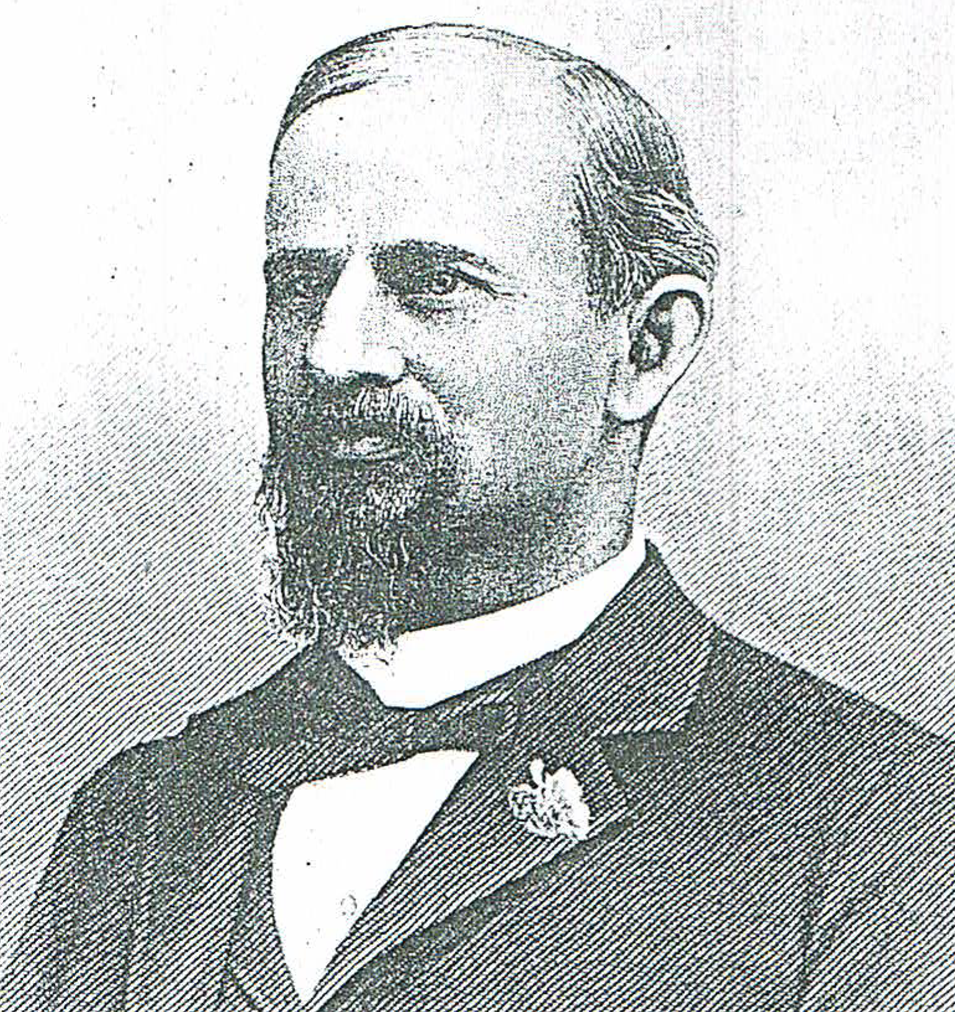
Harvey Linford Drew was a major figure in the business community of San Bernardino and its environs in the 1870s, 1880s, 1890s and shortly after the turn of the 19th to the 20th Century.
Harvey Linford Drew
Born in Milton in Cass County, Michigan on November 6, 1839, the son of Oliver Drew and Ann Drew, née Woods, H.L. Drew, as he was referred to, as a young man was involved in lumbering and merchandising. With the advent of the Civil War, he enlisted in the Union Army, in Company L, 2nd Calvary, as a corporal on September 16, 1861 at Niles, Michigan, committing to a three-year hitch. He was then 21 years of age. He mustered on October 2, 1861 and was transferred to the 3rd Cavalry on November 2, 1861, four days before his 22nd birthday as a regimental commissary sergeant. He was commissioned a second lieutenant with Company K, on August 13, 1862. He was commissioned a first lieutenant with Company M, on December 20, 1862. He was mustered on February 27, 1863. He was commissioned a captain on October 24, 1864. He resigned and was honorably discharged on November 14, 1864. His brother, Perry Green Drew, who was born in 1844, served with the 3rd Michigan Cavalry at the same time he did.
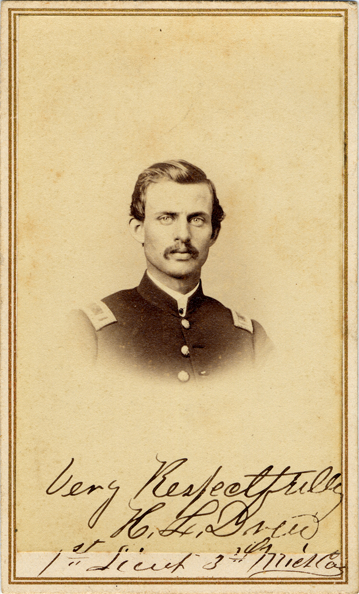
Harvey Drew was a dashing young cavalry officer in 1862.
After his stint in the military, Harvey Drew returned to logging and in 1866, he married, without the consent of her father, Alpha Aldrich.
The Great Michigan Forest Fire in the Fall of 1871 proved a test of his mettle and hardiness. The overwork and exposure to heat and smoke in fighting the fire at one point for seven straight days and nights greatly compromised his health. In 1874, in the company of Alpha, two of his children and his brother Perry, who was at that point a doctor, he came to California. He spent a short time in Sacramento, San Diego and Los Angeles before moving to San Bernardino permanently in April 1875. .
Drew engaged himself in trade, connecting himself with mining interests who came into San Bernardino, and he engaged in the mercantile business in San Bernardino and was involved in banking based in Los Angeles at that time.
The Valley Reservoir Company was formed and was incorporated on October 2, 1883 with a capital stock of $360,000 and with H.L. Drew among its eleven stockholders.
In May 1881, the Farmers’ Exchange Bank of San Bernardino, the second bank to be established in San Bernardino and the first bank to be incorporated within the city, was organized as a State bank, and located on the north side of 3rd Street between D and E streets, very close to property that Drew owned. The officers were Byron Waters as president, Richard Gird as vice president and E. H. Morse, cashier. The Farmers’ Exchange Bank opened its doors for business on September 1 of that year, with $20,000 of capital stock. The bank prospered and progressively grew, corresponding with the then-rapid growth and development of San Bernardino County. It became one of the most important and substantial financial institutions of Southern California. On January 1, 1884, Waters resigned and Harvey Drew succeeded him as president. On January 1, 1888, Morse stepped down from the position of cashier and S. F. Zombro took his place. Later that year, the bank quarters were moved slightly north from its previous location to the west side of North D Street between West 4th and West 5th Streets into a newly constructed building described as “Romanesque,” and considered to be the grandest structure in San Bernardino at that time.
According to the Lewis Publishing Company’s An Illustrated History of Southern California: embracing the counties of San Diego, San Bernardino, Los Angeles and Orange, and the peninsula of lower California, published in 1890, “In 1888 the bank erected the elegant building it now occupies, which is one of the finest and most commodious banking houses on the Pacific Coast. It is a three-story structure, 45 x 110 feet, built of brick, with brownstone trimmings and massive, arched doorways of polished Slover Mountain marble. It was erected at a cost of $43,000, and the banking offices, which occupy the first floor, are models of convenience in arrangement and artistic beauty of finish. The best indications of the judicious management and steady growth of the business of the bank is furnished in the statements published January 1 of each year, and is here reproduced: January 1, 1883, capital paid up, $21,900; deposits, $152,725. January 1, 1884, capital paid up, $30,000; surplus fund, $8,797.72; deposits, $163,037.80, January 1, 1885, capital paid up, $50,000; surplus, $12,916.63; deposits, $147,796. January 1, 1886, capital paid in, $50,000; surplus, $10,-410; deposits $271,351.63; January 1, 1887, capital paid up, $50,000; reserve, $55,544.62; deposits, $357,000. January 1, 1888, capital paid up, $50,000; surplus, $87,047; deposits, $688,697. January 1, 1889, capital paid up, $50,000; surplus, $96,000; deposits, $328,587. July 1, 1889, capital paid up, $50,000; surplus, $110,000; deposits, $301,142.50.The shrinkage in the business showing in 1889 as compared with the previous year is due to two causes, namely: the depreciation in value and consequent depression in business resulting from the collapse in the speculative boom of 1887-’88, and the establishing of two new banks in San Bernardino.”
In 1886, the California Southern Railroad proposed to the City of San Bernardino locating the company’s division headquarters, together with a depot, machine shop and improvements valued at $200,000 there if the city would donate 18 acres of land adjoining the 20 acres already owned by the company. Drew was a leading proponent in having the city accept the offer. As a reward, Drew was made a director of the railroad company .That same year, Drew supported Fred Perris in getting the California Southern Railroad to build the line from San Diego Harbor to San Bernardino.
The East Redlands Water Company was organized in September 1886 to supply water from the Bear Valley Reservoir to a 450-acre tract in East Redlands. Drew was an original director of the water company.
Drew was an early stockholder in San Bernardino National Bank formed in 1887.
In 1888, Drew and John Andreson, a brewer who was a member of the San Bernardino County Board of Supervisors representing the Third District from 1877 to 1880 and representing the Fifth District from 1883 to 1885, built the post office block, starting at the corner of E and Court Streets.
On December 2, 1889, the Savings Bank of San Bernardino was organized by men interested in the Farmers’ Exchange Bank with a capital of $10,000. Frank Hinckley was elected president, Drew vice president, with S.F. Zombro the secretary and treasurer. The banks directors were Drew, John Andreson, Sr., James Fleming, C. Kurtz and M. Byrne.

Harvey Drew lived with his family in this home at the corner of 4th and E Street in San Bernardino.
While the ventures Drew engaged in were generally successful, he suffered a few setbacks. In 1888 the Chino Valley Manufacturing Company with Robert D. Hunter, John K. Wolcott, Henry M. Ryan, H.L. Drew, Byron Waters and Richard Gird as directors was formed. Together, the directors proposed to erect extensive rolling mills, with the iron to be supplied from the he newly-discover beds at Daggett. The company started out well, with the intention of manufacturing steel on a massive scale. The Financial Collapse of 1889 caused the company to go under.
Drew also held an interest in the development of the citrus fruit industry. He owned a 240-acre ranch devoted to mostly orange groves and vineyards in what was then referred to as Old San Bernardino. In that venture, he was partnering with “some Pasadena gentlemen” as well as Charles Fairbanks, a Senator from Indiana who was later Theodore Roosevelt’s vice president.
The Mentone Company was formed in 1889 with H.L. Drew as president and N.K. Fairbanks as vice president. Drew and N.K. Fairbanks purchased 3,000 acres of land and laid out the Mentone town site. In 1891 they built the Mentone Hotel at a cost of $30,000. The hotel later was used as a sanitarium.
In 1893 the Southern California Southern Railroad, which was being absorbed by the Santa Fe Railroad, completed a line though the eastern San Bernardino Valley, with part of the track in the shape of a figure 8, which was called the Kite Route. It was intended to serve the transportation demands of the developing East Valley communities that included Highland, Mentone, Lugonia, and Redlands as a connection with the Los Angeles area and its harbor. In addition to hauling freight, the line was to provide passenger service. Among the properties bordering the Kite Route was Drew’s 240-acre ranch north of Redlands Boulevard and west of Calfifornia Street. Portions of that ranch had been subdivided into one-acre lots in 1889 and those lots were being offered for sale by James. W. Waters, Jr.
An Illustrated History of Southern California said of Drew, “Being an enterprising, public-spirited gentleman, he has taken great interest in the improvement of San Bernardino city and county.”
Indeed, in 1889, the state legislature passed a bill for the construction of an insane asylum in one of the five southern counties, appropriating $350,000 for the purchase of the site and the erection of the main building and the west and east wings, while calling upon the governor to appoint five trustees to select an architect to design the facility and another architect to supervise the construction.
After considering numerous options, the state settled on purchasing 360 acres of the Daley Tract in Highland with 60 inches of water from the North Fork Ditch for $114,000. Governor R.W. Waterman selected as the undertaking’s trustees H.A. Palmer, H.L. Drew. E.F. Spence, John Andreson and M.A. Murphy. They employed Mssrs Curlett & Eisen of Los Angeles to draw the plans and specifications, and appointed T.H. Goff as superintendent of construction. Peter Crichton of San Francisco was deemed the lowest responsible bidder on the project. The building’s cornerstone was laid on December 15, 1890. The first building was completed in 1893, equipped with an electric plant, and a complete water and sewer system. It opened on August 1 of that year. It had as its first wards 100 patients brought from Northern California. Dr. M.B. Campbell acted as the first superintendent of what is yet known as Patton State Hospital.
In 1891 an effort to secure a circulating library in San Bernardino began, led by C.C. Haskell, F.W. Richardson and J.W. Stephenson and others. In January 1892 a free library was opened in the residence of I.R. Brunn on Fourth Street with Miss Ella Lawson as librarian. The first library board was appointed on November 3, 1891 with J.W. Stephenson, chairman and C.C Haskell, Mrs. Henry Goodcel, H.L. Drew and John Andreson as members.
In 1887 what was the original San Bernardino Board of Trade was established. Buffeted by the Collapse of 1889 and even before the Panic of 1893, it had passed out of existence. At the end of the 19th Century, the concept was revived and representatives of the business community reorganized the body in 1900, electing J.B. Gill president, John Andreson, Sr. vice president, F.D. Keller secretary, C. Cohn treasurer and Thomas Hadden, James Fleming, J.W. Curtis, H.D. Drew and Joseph Jonas to the board of directors. “Committee were appointed and the board at once became an active factor in the advancement of the industrial and commercial interests in the vicinity,” according to Luther A. Ingersoll’s Century Annals of San Bernardino County, published in 1904. “It took an active part in securing the Salt Lake Road for San Bernardino, and has been largely instrumental in pushing street improvements, the new water system and in securing a revision of the city charter.”
In early June 1901, Drew contracted a cold, which by the next week had devolved into pneumonia, possibly it was believed, because of the damage his lungs had sustained and never fully recovered from nearly 30 years previously when he had battled the Great Michigan Forest Fire of 1871. On June 11, 1901, Harvey Linford Drew passed into eternity. Four of his six children – Arthur, Fred, Roy and Walter – survived him. He is buried in San Bernardino’s Pioneer Memorial Cemetery.
Emily Marie Lamb

Megan Chesterfield