
The California Department of Finance has rejected the contention of officials overseeing the development of San Bernardino International Airport that they are due $432 million in property tax revenue over the next decade.
The San Bernardino International Airport Authority, a joint powers agency involving the county of San Bernardino and the cities of San Bernardino, Highland, Loma Linda and Colton devoted to the conversion of the former Norton Air Force Base into a civilian airport, and the Inland Valley Development Authority, which includes the county and the cities of San Bernardino, Loma Linda and Colton in an effort to promote the development of the property around the airport, both maintain they should be exempt from the provisions of state legislation passed last year shuttering the state’s county and municipal redevelopment agencies.
In 2011, Governor Jerry Brown induced the state legislature to pass a law, ABX1 26, that called for the elimination of redevelopment agencies and for money normally passed through to them by the state to be utilized for education and law enforcement funding. The law dissolvied redevelopment agencies and enjoined them from entering into contracts with enforceable obligations after June 28, 2011.
ABX1 26 and its companion law, ABX1 27, were challenged by a coalition of cities but upheld by the California Supreme Court, and the state’s redevelopment agencies were closed out effective February 1. Part of the legislation shelving the redevelopment agencies called for cities to create for themselves or have the county create for them a successor agency to oversee and wind down that agency’s functions and dispose of its enforceable obligations by scheduling and executing the payments needed to discharge those obligations. The legislation also called for an oversight board to work in concert with each county’s auditor-controller and the California Department of Finance to oversee the successor agency through the dissolution process.
The boards for the San Bernardino International Airport Authority, known by its acronym SBIAA, and the Inland Valley Economic Development Authority, which goes by IVDA, have argued that since they are joint powers authorities dedicated to the reuse of what was formerly federal military property, they are not municipal redevelopment agencies and, accordingly, not subject to ABX1 26 and ABX1 27.
SBIAA and IVDA maintain the property tax money from the area around the former air base should continue to be available to it and be used to defray the $949.5 million in debt and obligations those agencies have accumulated in the airport conversion effort so far. IVDA and SBIAA issued hundreds of millions of dollars in bonds to fund improvements to the facility and the area surrounding it. Those bonds were sold to investors under the assumption that the infrastructure to be purchased with the bond proceeds would lead to the creation of an aerodrome with operational revenue, and together with property tax revenue increases enough money would be generated to make timely payments to the bondholders.
SBIAA and IVDA officials maintain that by being allowed to proceed with the airport’s development, they will ensure that those revenue streams remain in tact and all obligations will be met. Those agencies told the state Department of Finance they believe they are legally eligible to remain in place and that they intended to bring in roughly $432 million in property taxes over the next ten years and had committed $22 million of that toward road improvements and the rest for improvements and operations at the airport.
In a terse response, the state has informed the authorities that since they had no specific contracts related to the $432 million, they have no legitimate claim to the projected property tax revenue, as the money was secured only by an agency board resolution.
At press time, IVDA and SBIAA officials, led by executive director A.J. Wilson were scrambling to appeal the Department of Finance’s ruling while simultaneously laying down the basis for a lawsuit against the state if it does not perpetuate the bond financing arrangements for airport improvements.
In addition to the bond financing, IVDA and SBIAA have been party to successful applications for Federal Aviation Administration grants and other federal funds. The expectation of the delivery of the $432 million in property taxes to the agencies was intrinsic to arrangements made for the takeover of the base and failure to deliver on their financial obligations could lead to the federal government reclaiming the airport or suing IVDA and SBIAA and their constituent agencies, according to Wilson. Both IVDA and SBIAA would we vulnerable as well to actions by the bondholders and the bond underwriters, he said. Moreover, the state action could compromise the bonds’ nontaxable status.
A provision of ABX1 26 is that any legal action contesting it has to be filed in Sacramento Superior Court. IVDA and SBIAA did just that in April, seeking a restraining order in an effort to prevent the state from cataloging IVDA and SBIAA as redevelopment agencies. A determination in that matter has yet to be rendered. IVDA and SBIAA are now perched to seek yet another restraining order blocking the state from confiscating any of the property tax money IVDA and SBIAA maintain are due them.
29 Palms Contends State RDA Fund Grab Violates SEC Regulations
TWENTYNINE PALMS — With an acknowledged degree of trepidation, Twentynine Palms is proceeding with a cutting-edge legal strategy to outmaneuver the state in wresting back $31 million in bond proceeds that were seemingly foreclosed upon by the state when it shuttered municipal redevelopment agencies last year.
City officials believe that the law the state legislature passed in 2011 may be trumped by federal securities regulations, meaning the money the Twentynine Palms Redevelopment Agency bonded for last year must be utilized only for the purpose that bondholders were told the money would be applied toward.
All of California’s cities were forced to phase out their redevelopment authorities, which used a variety of financing mechanisms to eliminate blight and spur economic development. Pursuant to two bills, ABX1 26 and ABX1 27, put forth by Governor Jerry Brown and passed by the legislature last year, redevelopment agencies were closed out and their funding routed to law enforcement and education.
Both ABX1 26 and ABX1 27 were challenged by a coalition of cities but upheld by the California Supreme Court. Effective February 1, all municipal redevelopment agencies were dissolved. Part of the legislation called for cities to create for themselves or have the county create for them a successor agency to each former redevelopment agency which would oversee and wind down the defunct agency’s functions and dispose of any enforceable obligations by scheduling and executing the payments needed to discharge those obligations. The legislation also called for an oversight board to work in concert with each county’s auditor-controller and the California Department of Finance to oversee the successor agency through the dissolution process.
In 2011, while the redevelopment agency dissolution legislation was being considered in Sacramento, the Twentynine Palms City Council, which doubled as the city’s redevelopment agency board, issued two tax allocation bonds for a downtown revitalization undertaking known as Project Phoenix, which is to include a community center, a 250-seat theater, classrooms, a civic plaza, a park, a paseo, residential units, a wastewater treatment plant, and improvements to the downtown fire station. That bond money was made available before the law went into effect but was never expended.
At the May 22 Twentynine Palms City Council meeting, the council voted 4-1, with councilman Jay Corbin dissenting to move forward with a legal strategy formulated by city attorney A. Patrick Munoz to challenge the state’s attempt to horn in on the city’s redevelopment money.
Munoz, of the law firm Rutan & Tucker, believes he can convince a judge the non-taxable bonds issued last year created specific obligations between the city, the issuer, the bond underwriter and the bond purchasers, and as such are enforceable obligations. If the city were to hand off the bond proceeds to the state and the state were to use the money for a purpose other than what the city had specified in marketing the bonds to the bond buyers, that would constitute fraud, according to Munoz.
“If the proceeds were turned over to the state to be re-allocated for operational purposes, these proceeds would no longer be tax-exempt if they were not used for public works projects,” Munoz maintained. “That creates concerns as to whether we violated federal tax laws and federal securities laws due to promises we made to the public when we sold the bonds versus the way we’re using the bonds.”
In this way, Munoz’s strategy calls for having the successor agency lay claim to the redevelopment money and proceeding with the previously ratified redevelopment programs, including Project Phoenix. The state will have to go along with the city’s discharge plan because the bonds are enforceable obligations and the proceeds are secure, Munoz has theorized. Munoz suggested the city will have to be very precise about how the money earmarked for Project Phoenix is expended.
Munoz drafted a contract between the successor agency and the city by which the successor agency is to turn over the bond spending authority to the city with a directive that it go toward Project Phoenix. After the contract was presented to the council on May 22 and approved with the 4-1 vote, the oversight board took up the issue the following day, May 23, and its seven members voted unanimously to endorse a resolution to transfer their duties and obligations to administer the bond proceeds to “the city in its capacity as a municipal corporation.”
Munoz insists the dual approval of the contract by the council and the oversight board legally categorizes the bond proceeds as an enforceable obligation of the former redevelopment agency.
Munoz has been working closely with a city consultant, Rosenow Spevacek Group, in communicating with the California Department of Finance to determine the likely reaction to the city’s legal gambit. According to Rosenow Spevacek associate Matt McCleary, the California Department of Finance has been at best tentative in its response to specific questions about its interpretation of enforceable obligations under both state and federal law and whether federal securities regulations take precedence over AB X1 26, signaling the state is unsure of the strength of its own legal position.
Munoz has recommended that if the Department of Finance does not accept the contract for the Project Phoenix expenditures as legitimate, that the city and its successor redevelopment agency proceed with litigation against the state. Munoz acknowledged the strategy could entail a protracted “legal fight with the Department of Finance.”
Councilman Corbin indicated he was against the strategy on two separate grounds. He said the housing portion of Project Phoenix was not worth pursuing at this point since there is no demand for housing and that he was against engaging in costly litigation against the state. His colleagues said they too did not relish a legal battle in Sacramento, but indicated they had a case worth making.
Upland 2012-13 Budget Figures Looking Grim
In a preview of Upland’s 2012-13 budget for the city council, city manager Stephen Dunn said that despite a sincere effort to reallocate the city’s resources and reduce services and expenditures, his best projection is that the city will still run a $9.4 million deficit.
Dunn said efforts to rein in costs will be carried out across the board and will call for each municipal department to absorb its own obligated expenditures. Nevertheless the imposition of even more severe economies that will extend to the city’s previously sacrosanct public safety division will be inadequate in offsetting the burgeoning cost of keeping the city functioning, the city manager said.
In recent years, Dunn said, the city has faced fiscal challenges but last year was able to pare back certain non-safety related programs, defer others and reduce outlays in an amount sufficient to prevent the city from running a deficit.
Just prior to the beginning of the current 2011-12 fiscal year, in June 2011, the city council ratified a budget with a $4.7 million deficit, calling for revenues of $36 million and expenditures of $40.7 million. But two months later, after Dunn, who had served as Upland’s finance director before he was elevated to the position of city manager, took an axe to that spending plan and obtained the resignations of the city’s longtime community development director, its public works director and human resources/risk management director and consolidated other departments, incorporated certain other economies and cut $4.8 million out of the city’s operating costs, creating a $100,000 surplus for 2011-12.
While Dunn said he has reasonable grounds to believe that the city’s revenue will grow by $2.2 million in 2012-13, he said running the city over the same 12 months will cost $47.6 million, incurring a $9.4 million deficit.
Dunn said the city will have obligated expenditures of $3.8 million. Futhermore, Dunn said, the city will be hit with $2.3 million in new expenditure obligations in the upcoming budget, consisting of $700,000 in raises to the members of the police department that were committed to more than two years ago, $400,000 in previously agreed-to merit increases and a $1.2 million increase in the city’s contribution to the California Public Employees Retirement System to cover the cost of pensions.
His proposed budget for 2012-13 does not contain money for restoring reserves spent in past years, does not cover the city’s deficit in its self-insurance fund, does not provide any money for economic development, and does not provide money for alleyway repair. Nor will the city replace any of the vehicles in its fleet in 2012-13.
The budget will include reduced funds for street repair, citywide concrete replacement, some repaving and the purchase of library books.
To balance the city’s budget now and in the future, Dunn said the city should consider contracting with the sheriff’s department or the city of Ontario for the provision of police services, contracting with the county, the California Division of Forestry or the city of Ontario for the provision of fire service, eliminating the police department’s SWAT team, closing or browning-out a fire station, eliminating the fire department’s paramedic program, selling the fire department’s ladder truck, reducing the city’s animal control division and its animal shelter, or closing the shelter entirely and subcontracting with another organization for animal control service. Dunn said the city could also cancel the city’s fireworks show, eliminate Upland’s recreation division, cease publication of the quarterly city newsletter, outsource the management of the library, make further reductions in the library hours, reduce street sweeping services, reduce or eliminate tree trimming services, reduce landscape maintenance services, contract out for the city’s fleet services, institute modified work schedules for operation crews and field personnel, limit stand-by personnel, and contract out for engineering services.

Stephen Dunn
The city could also, Dunn said, reduce its legal expenses by settling or dismissing as many of the lawsuits it is presently engaged in as is reasonably possible, removing bonus provisions from executives’ contracts, reducing compensation to non-sworn personnel in the police department, reducing the vehicle fleet by eliminating take home vehicles, reducing the number of city-issued cell phones, and ending the practice of picking up employees’ shares of their pensions.
Dunn also told the council it could consider pushing the county to cut the city in on a larger share of the property tax collected within the city, as well as raising sale taxes, raising the business license tax, raising the transient occupancy tax at hotels and motels, and raising fees for a host of city services.
San Bernardino Offering Sales Tax Springbacks In Bid To Lure Amazon
SAN BERNARDINO—E-commerce gargantuan Amazon is pressuring city of San Bernardino officials to provide it with sales tax springbacks as part of a deal in which the company would locate a 950,000 square foot distribution center at the Alliance California complex near San Bernardino International Airport.
The state of California imposes a 7.25 percent sales tax on all non-edible goods sold in the state. In San Bernardino County, consumers are charged an extra half cent sales tax to pay for road improvements, pursuant to Measure I first passed in 1989 and renewed by voters in 2004. The city of San Bernardino levies a .25 percent sales tax on all goods sold within its city limits. Of each 7.25 cents collected by the state in sales taxes, one cent is returned to the city or jurisdiction at the point of sale.
Amazon for years has fought various state governments over whether sales tax should be levied on its customers, who purchase goods through the company over the internet. Last year, it relented in its struggle with the state of California, agreeing to obtain a seller’s permit from the Board of Equalization, which allows the company to make sales and collect and remit appropriate sales taxes to the state, effectively resulting in the company having to charge the 7.25 percent duty on in-state customers.
In the same time frame, Assembly Bill 155 was passed by the legislature and signed into law by the governor. Assembly Bill 155 delayed the operative date by which internet retailers had to be collecting sales taxes until federal legislation defining what “a retailer engaged in business” in California was passed.
After on-line retailers begin collecting sales tax in Fall 2012, it is anticipated that the state will realize $316 million per year in additional sales tax revenue. Roughly half of that, it is anticipated, will come from Amazon.
Beginning this fall, Amazon will open two huge distribution centers in California. One is already set to be located in Patterson in Stanislaus County. Amazon is leaning toward locating the other in San Bernardino in a facility approaching one million square feet at the Alliance California Center.
Amazon has already used its size and leverage to broker a deal with Governor Jerry Brown by which Amazon agreed to build its warehousing and distribution centers in California rather than out of state, where the company will employ 10,000 full-time workers and as many as 25,000 seasonal workers by December 2015 in exchange for California delaying by 12 months the requirement that Amazon collect sales tax from its customers.

Patrick Morris
Amazon is using that same leverage in negotiating with San Bernardino officials, including economic development director Emil Marzullo and mayor Patrick Morris. At stake is Amazon’s commitment to locate the distribution center, which will employ at least 1,000 workers initially and as many as 4,000 workers by 2015 in San Bernardino. In return, Amazon is seeking at least 80 percent of the sales tax it is to collect at the San Bernardino operation to be routed back to it, likewise for a set period of time.
Critical in the negotiations is Amazon’s willingness to designate San Benardino as the “point of sale” for all of the merchandize delivered to customers from the San Bernardino warehouse.

Emil Marzullo
No agreement between Amazon and San Bernardino officials has been reached. Depending on how the deal is structured, Amazon could see a greater rate of sales tax returned, that is more tax sprung back, as volumes moved out of the facility increase. In this way the city could incentivize having more workers employed in San Bernardino.
San Bernardino is not new to the concept of or practice of providing sales tax springbacks. The city provides Kohl’s with springbacks pursuant to a 20-year tax-sharing agreement by which the retailer will get progressively more sales tax returned over the life of the contract.
Such arrangements are legal, under California law, but only extend to the portion of the sales tax money provided to the city and does not cover money kept by the state or Measure I funds.
“The city may enter into an agreement with a third party relating to the disposition of those funds after an allocation is made,” Casey Wells with the office of public affairs at the State Board of Equalization told the Sentinel.
Amazon will not be required to collect sales taxes on customers who do not reside in California, Wells said.
“Generally, California companies making sales to out-of-state customers are not required to collect California tax on those transactions,” Wells said. “Whether there is a use tax obligation on the purchaser depends on the state in which they reside.”
Four First District Candidates Weigh In Against Cadiz Project
The majority of candidates in the race for First District supervisor have gone on record as being opposed to the Cadiz Water project, indicating they do not think the energetic effort to divert water from the Mojave Desert to Orange County is in the interest of their would-be constituents or the county itself.
Referred to by its proponents as the Cadiz Valley Conservation, Recovery and Storage Project but lambasted by its opponents as one that will deprive the desert of a precious resource, the undertaking is an $878 million proposal by Los Angeles-based Cadiz, Inc. to sink 34 wells into the desert and construct a 44-mile pipeline along a railroad right-of-way until it meets up with the aqueduct that carries Colorado River water to the Los Angeles and Orange County metropolitan areas. That system will be used to draw an average of 50,000 acre-feet of water annually from the Cadiz Aquifer for use by the Santa Margarita Water District, the second largest water agency in Orange County; the Three Valleys Water District, which provides water to the Pomona Valley, Walnut Valley, and Eastern San Gabriel Valley; the Golden State Water Company, which serves several communities in Southern California, including Claremont; Suburban Water Systems, which serves Covina, West Covina and La Mirada; and the Jurupa Community Services District, which serves Mira Loma in Riverside County.
The Cadiz Valley lies just south of the Marble Mountains and northeast of the Sheep Hole Mountains near the National Trails Highway. Cadiz is home to a former railroad stop along the Santa Fe line, 17 miles east of Amboy and 70 miles from Needles. Cadiz, Inc. owns or has options on 45,000 acres in and around the Cadiz Valley, 9,600 acres of which is zoned for agricultural use. That company operates an organic table grape, citrus, melon, pepper, squash, asparagus and bean growing farm on 500 acres in Cadiz, utilizing roughly 1,965 acre-feet of water per year to sustain that operation.
Cadiz has made a disputed claim to the water rights beneath 34,000 acres it has tied up in the area, and its plan calls for tapping that water supply, which is connected to other neighboring aquifers beneath land not controlled by Cadiz, Inc. Cadiz maintains it has the right to pump that water and sell it as it sees fit.
Environmentalists and many residents of the East Mojave are opposed to the project and claim the company has not established water rights beyond the 1,965-acre feet the agricultural operation uses yearly. They maintain the project will deprive the already parched desert of its most precious resource, wreak ecological devastation to the environment and allow Cadiz, Inc. to appropriate water rights it does not legally possess to commandeer water and thereby privatize a public resource.
Cadiz has arranged for the Santa Margarita Water District, which lies 217 miles from the Cadiz Valley and will be the recipient of the lion’s share of the water to be obtained under the plan, to serve as the lead agency in the environmental certification of the project. Critics of the project say this is an unacceptable conflict of interest and have already cited shortcomings in the environmental impact report, claiming that document does not accurately describe or provide a mitigation for the impact the drafting of water will have on adjacent aquifers. Environmentalists maintain that ultimately the desert’s springs, which support the region’s fragile wildlife, will dry up if such vigorous pumping is initiated. During a three-and-a-half hour hearing before the board of supervisors on May 1, they pleaded with the county board of supervisors not to have the county enter into a memorandum of understanding with Cadiz, Inc. and the Santa Margarita Water District relative to the project.
Other critics of the project maintain that diverting the region’s water resources to Orange and Los Angeles Counties will sharply curtail or eliminate any future development potential in the East Mojave.
At the May 1 San Bernardino County Board of Supervisors meeting, Scott Slater, the president and general counsel for Cadiz, Inc., said the project would conserve water. The board also heard from local contractors and vendors who stand to make money by working on or supplying materials for the pipeline to be constructed.
After considering whether it should appeal to the California Office of Planning and Research to have the Santa Margarita Water District removed as the lead agency overseeing the environmental certification of the project and ultimately rejecting that option, the county board of supervisors on May 1 approved the memorandum of understanding between the county, Cadiz, Inc. the Santa Margarita Water District, and the Fenner Valley Mutual Water Company relative to the project. The Fenner Valley Mutual Water Company is a corporate entity created by and wholly owned by Cadiz, Inc.
According to Christian Marsh, a contract attorney retained by the county to advise it on the Cadiz project, the memorandum of understanding does not give final approval to the project but puts a regime in place by which the project application being processed through the Santa Margarita Water District can be reviewed by the county, and provides the county with the authority to make an ultimate veto of the permitting of the project. Third District Supervisor Neil Derry, expressing skepticism that the Santa Margarita Water District would give proper weight to the input of San Bernardino County residents and interests during the approval process for the project, was the sole dissent in a 4-1 vote to approve the memorandum of understanding. A key vote in its support was that of First District Supervisor Brad Mitzelfelt, in whose district the Cadiz Valley lies. Mitzelfelt, who is now running for Congress, has received $48,100 in political donations from Cadiz, Inc. since 2007.
A survey of those vying to succeed Mitzelfelt in December shows none are favorably disposed to the project.
Jermaine Wright, a member of the Adelanto School District Board of Trustees who was the first of those running to declare his candidacy for First District supervisor this year, said he would not support the project.

Jermaine Wright
“My stance is that water belongs to the people of the county,” Wright said. “Private business does not have the right to take over their rights to sell it to another public entity outside of the county. We have a water shortage in the desert. That water needs to stay in San Bernardino County to offset and mitigate the use of water from elsewhere in the desert, including water that is being taken from the [Colorado] river by outside entities such as Los Angeles. Managed properly, that water will eventually provide work for people in the county. Others are ready too fast to privatize things that are held by the public for the public good.”
Bret Henry, the president of the San Bernardino County Firefighters Association who is seeking election as First District supervisor, stated, “I oppose the Cadiz Water Project and as supervisor will do my best to protect our desert resources. Water supplies in the desert are scarce and water is the backbone to life survival. So-called scientists and experts state that this project will have no impact on the water aquifer and mention they are counting water based on evaporation rates. My gut tells me this is wrong, especially since we will not know the consequences until it’s too late.

Bret Henry
“I have and will continue to support our desert and the many recreational activities it provides the people of San Bernardino County,” Henry said. “Our leaders must stand up for the people and not special interest groups who provide campaign donations.”
Another First District supervisor candidate, Apple Valley Councilman Rick Roelle, said, “My views are quite simple. I am opposed to the shipment of Cadiz water out of the area. Water should not be sold for profit. It is a natural resource needed to maintain life. The fact that the water would be shipped to the Los Angeles area is unacceptable to me. If elected to the 1st District supervisor position, I will do everything in my power to keep the water for residents in the 1st District.

Rick Roelle
“My record as an elected official for the town of Apple Valley and a lieutenant in the San Bernardino County Sheriff’s Department is well known,” Roelle said. “I don’t bow down to special interests, especially special interests who want to exploit our natural resources which belong in San Bernardino County.”
Another candidate for First District supervisor, Michael Orme, said, “The Cadiz Water Project concerns me since it proposes to take water – the most valuable resource we have in a desert — and transfer it to Santa Margarita. The High Desert should not be penalized for their lack of planning and growing beyond their available resource availability. Rather than taking High Desert water, the Cadiz Water Project could easily be replaced through grant funds from Prop 84, a 2006 water bond which favored urban infrastructure over rural needs.

Michael Orme
“The role of First District supervisor is to be the steward of the district and guard the resources, including environmental, of our residents, businesses and local governments,” Orme continued. “Transferring our water resource to Orange County is a blatant infringement upon the stewardship entrusted to the supervisor.”
Robert Lovingood was unwilling to make a pronouncement for or against the project. He noted that more than a decade ago Cadiz, Inc. had floated a water use and storage proposal that called for pumping water from the Colorado River into the aquifer underlying the Cadiz Valley in wet years and drawing water out of the water table in dry years.

Robert Lovingood
“That project seemed to make sense, since it would have brought water into the desert in overflow years but now they just want to drain it and sell it and use what they call surplus water. There is a storied history to the use of water in California and we wouldn’t have some of the urban areas we have if water was not taken from one place to be used in another. Inherently, water rights come with property. I am in favor of property rights. If you own property, then there is ownership of the water. Much of this issue would be controlled by the environmental impact report. There is way more to environmental impact reports today. The bottom line is this is a very complex issue and I am not informed enough to make that call.”
Requests for statements with regard to the Cadiz Water Project made to Bob Smith and Russ Blewett, two other candidates for First District supervisor, did not elicit responses.
Judge Reilly Receives County Bar Association’s Kaufman-Campbell Award
San Bernardino Calif. (May 22) – The San Bernardino County Bar Association, a professional association of attorneys and jurists, has honored Superior Court Judge Tara Reilly with the 2012 Kaufman-Campbell Award.
The award was presented at the annual Kaufman-Campbell Awards Banquet, which was held May 17 at the San Bernardino Hilton Hotel.
The Kaufman-Campbell Award is given to judges who have served the bench with distinction while making significant contributions to the community. Recipients typically display the highest standards of judicial excellence while showing integrity, wisdom and impartiality.
Judge Reilly joined the bar in 1989 as a new attorney, and has been an honorary (judicial) member of the San Bernardino County Bar Association since taking the bench in 1996. Her judicial assignments have included criminal, civil, juvenile dependency and treatment courts. She is currently assigned to family law court.
I have the greatest job in the world,” Reilly said shortly before receiving the award. “Even on the bad days, and there are some, it’s still the best job in the world. It’s a constant opportunity to learn.”
Being selected as a Kaufman-Campbell Awardee is “a tremendous honor” and one of the highlights of her judicial career, Reilly said.
“I was really surprised when they told me,” she said. “Very pleased, but surprised. It’s, a huge honor. The difficult part will be living up the award.”
Reilly is a deserving recipient of the Kaufman-Campbell Award, said Michael Scafiddi, past president of the San Bernardino County Bar Association. “She’s a great judge and an even better human being. The association couldn’t have picked anyone better,” Scafiddi said.
The bar association established the Kaufman-Campbell Award in 1999 in honor of Marcus M. Kaufman, former Associate justice of the California Supreme Court, and Joseph P. Campbell, former presiding justice of the California Court of Appeal, 4th District, Division 2.
Chino Bareknuckling It With State DOF Over RDA Loan Payback
The California Department of Finance is resisting the city of Chino’s efforts to stake a claim to a significant portion of the redevelopment funding it was forced to give up by the state of California last year.
Redevelopment agencies are, or were, adjuncts to local government intended to eliminate blight by encouraging economic development. Redevelopment agencies were empowered to issue bonds and use the proceeds from the sale of those bonds to create infrastructure or undertake improvement projects within a designated redevelopment project area. That infrastructure was intended to spur development and eradicate blight, thereby increasing the value of the property in and around the project area. The increase in property tax realized as a consequence of the improvements would then theoretically be utilized to debt service the bonds, i.e., make annual payments over a period of time – usually 20 to 30 years – to the bondholders. In other cases the redevelopment agencies would borrow money from the governmental entities that created them.
Last year, Governor Jerry Brown induced the state legislature to pass a law, ABX1 26, that called for the elimination of redevelopment agencies and for money normally passed through to them by the state to be utilized for education and law enforcement funding.
ABX1 26 and its companion law, ABX1 27, were challenged by a coalition of cities but upheld by the California Supreme Court and the state’s redevelopment agencies were closed out effective February 1. Part of the legislation shelving the redevelopment agencies called for cities to create for themselves or have the county create for them a successor agency to oversee and wind down that agency’s functions and dispose of its enforceable obligations by scheduling and executing the payments needed to discharge those obligations. The legislation also called for an oversight board to work in concert with each county’s auditor-controller and the California Department of Finance to oversee the successor agency through the dissolution process.
In April, after dissolving its redevelopment agency, Chino in compliance with the protocol laid out by the state, held a meeting of its redevelopment successor agency. That successor agency, taking stock of the consideration that the city of Chino had made more than $15 million in loans to its redevelopment agency for improvements in its redevelopment agency project areas, in April submitted to the state Department of Finance a recognized payment schedule for the first half of 2012 that called for the successor agency to begin retiring the debt on more than $15 million in promissory notes issued by the Chino Redevelopment Agency and held by the city of Chino.
Earlier this month, on May 16, the board for Chino’s successor redevelopment agency followed up on its April action, and again submitted to the state a recognized obligation payment schedule for the second half of 2012 that cited payment on the promissory notes as an outstanding obligation.
The Department of Finance, according to Jeff Oderman, an attorney for the Chino redevelopment successor agency, has rejected the approved list, holding that loans made to the redevelopment agency by the city that founded it are, with the dissolution of the redevelopment agency, invalid debts.
Chino is not alone among California cities in asserting it has a legitimate claim to be repaid for money it loaned to its now-defunct redevelopment agency. Chino appears to be leading the way among San Bernardino County cities in seeking to recover its loans, and other municipal officials are following the case. Either independently, or in concert with several other cities, Chino may file suit against the state to force the refunding of money in the form of loans made in the past.
According to a number of attorneys, the promissory notes from the Chino Redevelopment Agency held by the city of Chino, like many other debts pursuant to loan arrangements involving other cities and their respective redevelopment agencies, are enforceable under ABX1 26. ABX1 26 requires that any legal challenges to it take place in Sacramento Superior Court. That provision of the law was, ostensibly, intended to save the state the expense of having to send its lawyers into court in 58 different locations to respond to potential lawsuits. It also has the effect of making it expensive, perhaps prohibitively so, for cities to pursue such litigation. In this way, the state is calculating that most cities will elect to “write off” the loans.
Simultaneously, a move is on to apply a legislative fix to the dilemma. Assembly Bill 1585 would clarify a standard protocol for cities to collect on debts owed to them by their former redevelopment agencies. Governor Jerry Brown, who was the prime mover in the effort to shutter redevelopment agencies statewide with ABX1 26 and ABX1 27, is opposed to AB 1585 and is marshalling the Democratic Senate Leadership to kill the bill.
Landowners Reject AV’s Annexation Overture
APPLE VALLEY—The owners of more than 2,700 acres on Apple Valley’s doorstep have turned down an invitation to be annexed into the town.
Town officials were pushing to have Apple Valley gobble up 2,774 acres referred to as the Golden Triangle, an area between Interstate 15 on the west, Dale Evans Parkway on the east, Johnson Road on the south and Morro Road on the north.
Last July, the town quietly proposed annexing the property, calculating that by taking over jurisdiction of what is now unincorporated county land, it could eventually impose up to $55 million in developer impact fees when the property is developed and that it would realize $1.3 million or more in property tax revenue over the next 20 years. The annexation would also have resulted in the area’s sales, property transfer and highway user taxes, and motor vehicle in-lieu fees accruing to the town, and it would have cleared the way for the Apple Valley Fire Protection District to net more than $5 million in fire developer impact fees. At a public hearing held last summer pertaining to the proposal, only one resident of the area objected to the annexation and the council unanimously approved initiating the annexation process.
The annexation would have provided the 2,774 acres and its residents with the full range of municipal services currently overseen by City Hall, including but not limited to law enforcement, road maintenance, street lights, code enforcement and animal control. The city further intended to allow for a mixture of housing and factories in the currently rural area with 168 residents, such that low density estate residential single family units would be allowed on 778 acres and industrial uses would have been permitted on 812 acres.
While town officials maintain the area’s residents were given adequate advance notice of the annexation attempt, many residents claimed they were not kept informed of the town’s intentions. Upon learning of the town’s application, many of the Golden Triangle’s residents objected to the takeover.
The county’s Local Agency Formation Commission, known by the acronym LAFCO, oversees such jurisdictional matters. An important criteria applied in annexation determinations is the willingness of the property owners to be annexed. By standards applied by LAFCO, if fewer than 25 percent of the landowners are opposed to the annexation, the town could proceed with the merger. If more than 25 percent but fewer than fifty percent express opposition to the annexation, the matter must be put up for a vote if the annexation is to proceed. And if more than fifty percent oppose the annexation, the annexation process must be suspended for at least one year.
A certificate of the termination of the annexation consideration dated May 3 signed by Rebecca Lowery, LAFCO’s deputy clerk, was received by the Apple Valley Community Development Department on May 10, informing town officials well over half of the area’s residents are opposed to the annexation. According to Lowery, the annexation consideration was terminated “due to protest by a majority of the registered voters within the reorganization area.”
The Golden Triangle in Apple Valley’s sphere of influence should not be confused with another area in the High Desert formerly referred to as the Golden Triangle, consisting of the property between the I-15 Freeway on the east, Highway 395 on the west and Bear Valley Road on the north. That property was the subject of an annexation war between Hesperia and Victorville in the late 1980s and early 1990s, a battle eventually won by Victorville.
Dire Financial Status Pushes CJUSD To Brink Of State Takeover
The financial condition of the Colton Joint Unified School District has deteriorated to the point that the California Department of Education, the San Bernardino County Superintendent of Schools or both will intervene by June 2014 if the district’s current spending patterns are not reduced.
In a highly sobering assessment May 17, Colton Joint Unified’s superintendent for business services Jaime Ayala informed the school board the district faces pending insolvency, such that it will likely have cumulative budget deficits approaching $26 million from the current and next two yearly budget cycles.
If the board, which has been hamstrung in the economies it has attempted to institute by an intransigent teachers union, does not substantially rein in spending, Ayala said the district will lose its spending authority altogether and the San Bernardino County Superintendent of Schools will take on oversight of the district’s coffers.
“If we do not start taking action quickly,” Ayala told the board, “I can almost guarantee you at this point that we will be insolvent sometime in 2013-14. The numbers draw no other conclusion. We are running out of time.”
Ayala’s warning galvanized the board into action. Three weeks ago the board, which is wrestling with a $7.8 million budget shortfall in the fiscal year ending June 30, had considered and then rejected cuts outlined by Ayala and district superintendent Jerry Almendarez which included reducing school bus transportation, delaying maintenance and making temporary swimming pool closures that would have saved the district $1.8 million in the current budget. At the suggestion of board members Patt Haro and Roger Kowalski, the board moved to reconsider making those cuts.
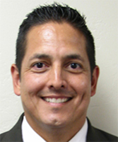
Jerry Almendarez
While many school districts utilize bonds and other forms of borrowing to finance the construction of schools, the Colton Joint Unified School District, which is responsible for the education of 23,000 public school students in all of Colton, Grand Terrace, Bloomington and parts of Fontana and Loma Linda, is a rarity in that in recent years it has taken to using borrowed funds to carry out operations and meet payroll. In the 2010-11 school year, 15.3 percent of the district’s revenues came from borrowed money, making Colton Joint Unified the largest deficit spender of all school districts in San Bernardino County. In addition to $10 million borrowed from private investors, the district to cover its operational costs has tapped into $19 million in bond financing and other funds set aside for such projects as building construction.
Beset with dwindling resources similar to those plaguing districts up and down the state, Colton Joint Unified does not appear to be in a position to sustain operations or keep up with the debt service on the existing loans. Indeed, were an audit of the district’s books to be carried out by the county superintendent at this point, Colton’s budget would be declared to be in so-called “negative status,” i.e., a circumstance in which the district is incapable of meeting its financial obligations, triggering the need for the state or the county superintendent to assume operational control.
There is a degree of irony in the district’s condition, since some of the district’s financial difficulty is a result of the state delaying payments as it struggles with its own fiscal challenges. At present, the district is considering borrowing another $32 million in the form of tax revenue anticipation notes, short-term instruments that will tide the district over until the state provides the remainder of the money due the district for the current fiscal year. That money should have arrived at the start of the final 2011-12 quarter April 1 but will not become available at least until July.
According to Ayala, Colton Joint Unified is heading toward a $7.8 million budget deficit in 2011-12, will be $20.2 million behind the eight ball in 2012-13 and will be $25.7 million in the red in 2013-14. “Deficit spending is destroying this district,” Ayala said.
The district’s deteriorating fiscal position has been accelerated by the Association of Colton Educators’ continuing efforts to challenge Almendarez. In May 2011, the district signaled that it would lay off 72 employees, including 57 teachers in a cost-cutting effort, but two months later indicated it had found funding to rehire 43 of the teachers. Teachers union agitators, however, engaged in ever more strident protests over salary and benefit cuts the district said it needed to impose to keep the district solvent.
Teachers insisted they had made more than adequate concessions and that the district was flush with money, including a surplus of $26 million. Almendarez insisted the teachers were mistaken and the $26 million referred to by protestors was a ledger anomaly. He said the money was actually due to be transferred into an account to be used for paying outstanding principal and interest on one of the loans to the district that was coming due.
More recently, the Association of Colton Educators have come to accept the dire financial circumstance of the district as a reality, and agreed to accept nine furlough days and some cuts in benefits during the upcoming fiscal year. District administrators have also accepted taking 14 furlough days in 2012-13. None of the district’s employee bargaining units have yet agreed to make salary concessions.
Hazlett Returns As PSA Business & Finance Head
SAN BERNARDINO – Peggi Hazlett, who was lionized as the prime mover in the effort to rehabilitate the Public Safety Academy last year but then resigned as the charter school’s executive director when it was suggested she was likewise profiting from her association with the school, has now returned to serve as the academy’s director of business, finance and communications.
The San Bernardino Public Safety Academy was founded by Michael Dickinson, a one-time arson investigator, in 1999 as an unaccredited educational seminar for teenagers pertaining to fire science. The seminars broadened to include law enforcement issues, and with the assistance of others, Dickinson established a campus at the former Norton Air Force Base. In 2005, the school received accreditation and Dickinson made a petition to transform the school into a charter academy under the sponsorship of the San Bernardino City Unified School District, achieving that goal in 2006. The academy found a niche among students who aspired to careers in the field of public safety. Nevertheless, under Dickinson the Public Safety Academy fell short of both educational and accounting goals over the several years of its operation, then plunged into chaos last year. Four years ago a financial review revealed the school had not kept accurate payroll and accounting records and had spent $164,000 that was not budgeted for. There were also questions about $20,000 worth of expenditures for laptops that were either never delivered, misappropriated or stolen. In January 2011, a report commissioned by the district found the academy’s accounting practices deficient and cataloged arrearages with regard to accounts payable.
In May 2011, Michael Dickinson’s wife who served as a principal at one of the school’s campuses, Susan Dickinson, fell under the charter school board’s focus after a report surfaced that she had crossed the line in prepping her students for questions contained in the state’s Standardized Testing and Reporting exam by showing them some of the questions contained in the test. When the charter school’s head principal, Kathy Toy, recommended that the board of trustees terminate Susan Dickinson, Michael Dickinson dismissed the board of trustees before they could do so.
At that point Hazlett, who was a board member of the Public Safety Academy, on June 20, 2011 filed suit on behalf of herself and her board colleagues against Public Safety Academy Inc., an adjunct to the academy set up and controlled by Michael Dickinson, who received $121,000 per year in salary for his services. That suit sought to restore the authority of the board that Michael Dickinson had terminated. In July, the court ruled that the board had legal authority to run the charter academy. The board then terminated the contracts of Michael Dickinson, as the chief executive officer, and Dickinson’s hand-picked chief financial officer, Mike Davis, who was paid $120,000 per year.
With the academy’s charter due for renewal earlier this year, the academy’s board began casting about to hire a new CEO to reassure the San Bernardino City Unified School District the academy was again focused on its educational mission. But the board succeeded only in stepping further into controversy on February 8, when without giving previous public notification it chose Hazlet to serve as what was first deemed to be CEO. To take the position, Hazlett abruptly resigned as special assistant to San Bernardino Mayor Patrick Morris. Hazlett’s hiring was undertaken so hastily that one of the academy’s board members who was absent from the meeting, San Bernardino Fire Chief Michael Conrad, did not learn that the hiring had occurred until after the meeting. While Hazlett and the board members present justified the alacrity of the move as being an emergency action, there was an immediate firestorm of controversy when it was learned that Hazlett boasted a rather thin academic record, with some college coursework in public administration at San Bernardino Valley College, but no college degree. As Conrad went public with statements to the effect that he disapproved of the process by which Hazlett had been elevated from the non-paying board of directors to the paid position of chief executive, other board members sought to defend selecting her, pointing out that she had worked as a special assistant to Morris and his predecessor as San Bernardino mayor, Judith Valles, before that was an environmental projects assistant with the city of San Bernardino and was also the chief financial officer as well as an administrator and instructor at the Dikaios Christian Academy in San Bernardino from July 1994 to July 1996. By virtue of that experience, the majority of the board deemed her to be qualified to serve as charter academy CEO. Charges that Hazlett simply lacked the academic credentials to serve in the capacity of a CEO of an educational institution were resounding, however, and on February 28, the board met to clarify that her status was actually that of executive director rather than chief executive officer and her area of responsibility would be to oversee the academy’s daily operations, finances and business affairs on an interim basis. She resigned from the board on February 29 and on March 1 began as executive director. But her secret elevation to the paying position by the board while she was a member of the board resulted in the filing of a complaint with the district attorney’s public integrity unit. On March 15, Hazlett abruptly resigned as executive director and the public integrity unit dropped its inquiry.
Last week, after more than a two-month cooling-off period, the charter school’s board moved to hire Hazlett as director of business, finance and communications. She went to work on May 17.
The district has decided to forego hiring an executive director, and Hazlett’s function will fill much of that role. One of the advertised qualifications for the post was “a college degree in business management, finance or related fields and five years experience” or in the alternative, “ten years experience of articulable progressive responsibility involving the described job responsibilities, preferably in either an educational or governmental environment.” According to the board, Hazlett met the alternative qualifications. Hazlett beat out two other applicants for the job.