
As I embark on my topic this week, I must remind myself to be very circumspect as to how I go about writing down what I am thinking. There has been considerable talk over the last fortnight about the moving picture “The Interview” and the reaction it has provoked across the Pacific in North Korea and the series of counterreactions that has spawned…
So there is no misunderstanding, let me state for the benefit of those who do not know me what everyone who knows me does not need to be told: I am an avowed anti-communist. I am indeed, a capitalist of the first order. I am in no mood to share what is mine with anyone else. And though I appreciate the thought, I am in need of no handouts from the government, s’il vous plaît, as I can, I assure you, take care of myself on my own…
Moreover, the leader of North Korea, Kim Jong-un appears to me to be quite a laughable fellow in his own right. He needs no lampooning as he is already a joke unto himself. A rather sad and pathetic joke, as he is the leader of a country of some 25 million people, over whom he has complete and utter sway, including the power of life and death. That he holds such sway, I find personally very offensive…
I, of course have not seen “The Interview” but am given to believe that it is a farce that celebrates the farcical cult of personality that is Kim Jong-un and takes as its plot a farce-laden mission by two young Americans tasked by the CIA or some such other secretive U.S. agency to assassinate the North Korean leader…
It seems Kim Jong-un took umbrage at the advance reports of this entirely fictional celluloid scenario and he unleashed some of his own technical resources to attack the computer systems of Sony Pictures, the production company responsible for the creation and distribution of “The Interview,” wreaking mayhem along the way by revealing, with the help of the U.S. media to whom many confidential Sony memos were provided, a number of embarrassing exchanges relating to Sony Pictures’ producers, directors, stars and starlets….
This outraged and alarmed many Americans, including elements of the U.S. Government, who had perhaps underestimated the technical savvy of what is understandably considered to be a backward, almost Third World country. That hacking episode was accompanied by threats, emanating from no less of a source than Kim Jong-un himself of further reprisals upon the United States, including, it sounded like, terroristic acts of violence against any moviegoers in the United States who chose to attend screenings of “The Interview” at their local theaters…
Amid the outrage over this threat, some theater chains and owners, concerned about their liability if the North Korean leader made good on any of those threats, voiced reluctance or refusal to run the movie at their venues. In reaction, Sony, at least initially, cancelled the intended Christmas Day release date for “The Interview.” Then, three days before Christmas, some entity the U.S. media widely insinuated was an arm of the U.S. Government shut down North Korea’s access to the Internet. As it turned out, at least a few intrepid theater owners braved whatever it is that North Korean agents have in store for us and actually ran the movie, through some special arrangement with Sony, on Christmas Day…
I am not privy to what is being said about the United States in North Korea, but I am frightfully aware of what has been said about Kim Jong-un and Korea in the U.S. over the last two weeks. All order of invective has been hurled the dictator’s way. His reaction to “The Interview” has been cited as yet further proof of how unsuited he is to be seated at the pinnacle of governance in his country. And the anger at him has been extended toward Sony executives and theater owners for what is essentially deemed cowardice and a craven willingness to abandon the American principle of artistic license and freedom of thought, expression and speech in the face of the Korean reaction and threats…
Lost in all of this, it seems to me, is our sense of decorum, proportionality and, yes, decency. The problem is not on the east side of the Pacific, we reason, but on the west side of the Pacific, at the top half of the Korean Peninsula. As Americans, native and naturalized, we figure it is not along the boulevards or in the theater houses of Main Street USA where this brouhaha originated but in the palace in Pyongyang. This international incident did not come about because of the creative fancy of our movie makers or the license the studio heads gave them but because of Kim Jong-un’s inability to take a joke in the spirit in which it was intended…
No matter how funny some of us may find them, some jokes are simply inappropriate. I would suggest that even a short one or two line joke about murdering a head of state is inappropriate. When that two line joke is transformed into an 110-minute moving picture presentation that costs $40 million to produce and which will be seen by 100 million Americans and at least 50 million citizens of other nations all over the globe, I would say it has gone beyond merely being inappropriate to being, well, an international incident with potentially grave implications…
In 1865, 1881, in 1901 and in 1963, assassins succeeded in killing four U.S. presidents. In 1933, in 1950, 1975 and in 1981, assassins attempted and failed to kill four U.S. presidents, coming very close each time. This is not something we Americans, native or naturalized, find to be funny or worthy of farce. By extension, it should be easily understood why the citizens of another country, no matter how backward we perceive that country to be, would find objectionable making jokes about the killing of their ultimate political leader…
I am all for free speech and artistic license. I can imagine a movie script, for example, in which the current president is represented as a simplistic, platitude-mouthing moron of the lowest political instinct who has demeaned the White House by transforming its living room into a basketball court and engaging in every other stereotypically ethnic behavior imaginable, while promoting all order of unworthy and unqualified personages to head the important ministries of government, who proceed to break the national treasury through a series of welfare agency giveaways to the teeming masses of Democrats who voted him into office in the first place. The plot would revolve around the resolve of some patriotic duck hunters from Louisiana to take matters into their own hands by embarking on a zany and fun-filled series of hijinx-prone capers ultimately intended to dispatch the occupant of the executive mansion. Somehow, I don’t think that script would ever be transformed into an actual Hollywood production…
And that is the point. Some things are in such poor taste that they are not worthy of being validated by our celebration of freedom of expression, and a $40 million show of faith by studio executives. Lest someone point out my own hypocrisy before I do, I will acknowledge now that probably at some point, I will order up a copy of “The Interview” and sit down to view it in the chalet’s screening room, alternately chortling and howling like a hyena throughout the showing. So to the extent that I will view it and most likely enjoy it myself, I am afraid, I too will, at some level, be encouraging this exercise in poor taste. But my personal shortcoming does not render any less inadvisable drawing upon the assassination of a foreign head of state as subject matter for comedic presentation…
Marie Michell
By Mark Gutglueck
The Women Airforce Service Pilots (WASPs), also known as the Women’s Flying Training Detachment (WFTD) and the Women’s Auxiliary Ferrying Squadron(WAFS)
were the pioneering organizations of civilian female pilots first organized in September 1942 and, employed to fly military aircraft under the direction of the United States Army Air Forces during World War II. The WFTD and WAFS were merged on August 5, 1943, to create the paramilitary WASP organization.
Their contribution to the war effort consisted of ferrying military aircraft both from the factories where they were produced to military bases and in some cases from military bases to other military bases, thus freeing up Army Air Corps pilots for combat duty. WASPs did not receive combat training and did not fly in combat roles. Records do not reflect that they ever served overseas, though one WASP who lived in Southern California in the 1980s claimed she had ferried planes to Greenland. Between September 1942 and December 1944, the WASPs delivered 12,650 aircraft of 78 different types.
Some 25,000 women applied to join the WASP, but only 1,830 were accepted and took the oath. Only 1,074 of them passed the training and joined, receiving commercial pilot certification in the process. They were trained to fly using Army Air corps standards by the U.S. Army Air Forces in a four-month military flight training course at Avenger Field in Sweetwater, Texas.
Thirty-eight WASPs died in service to their country.
One of those was Marie Michell.
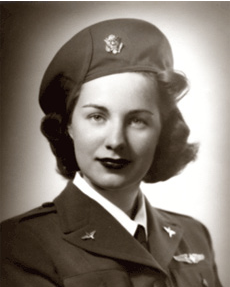
Marie Michell
Born on May 23, 1924, in Detroit, Michigan, Marie Michell joined the WASP in late 1943 when she was 19. She already had her private pilots license when she reported to Avenger Field. She graduated on March 13, 1944 in Class 44-W-2. .
She was initially assigned to the Fifth Ferrying Group at Love Field in Dallas, Texas. The Fifth Ferrying Group was part of the Air Transport Command. While with the Fifth, Michell flew all order of military planes from their factories to various bases around the Continental United States.
She was later transferred to Victorville Army Air Field , later renamed George Air Force Base in what is today Victorville.
Regulations prohibited WASPs from being married. Nevertheless, secretly in August or September 1944, Marie Michel married a U.S. Army Air Corps flight surgeon, Major Hampton C. Robinson.
On October 2, 1944, Michell Robinson reported to replace another WASP pilot on what was in official log books described as a “day transition” training mission. In the B-25D Mitchell bomber with her were First Lieutenant George Danilo Rosado from San Diego, a twenty-seven –year Army Air Corps pilot with two sons, and Staff Sergeant Gordon L. Walker, also married with a two-year-old son. Rosado was the pilot; Michell was the copilot; Walker was acting as the crew chief, whose task would be to lower the landing gear in the case of a hydraulic failure.
The plane took to the air in clear weather from Victorville Army Air Force Station at 1:15 p.m. local time with Rosado, who had 1,521.5 flight hours to his credit, at the controls.
Two other aircraft, Bell-P-39 were in the air during that approximate time. One of the P-39 pilots, Second Lieutenant Lawrence A. Beishel, reported that he saw the B-25D stall and then enter a spin from which there was insufficient altitude to recover. The centrifugal force from the spin would have prevented any of the crew from ejecting. Lieutenant Beishel reported he could see no parachutes emerge from the plane, which crashed into the desert floor roughly 25 miles west of Victorville Army Air Force Station at 1:30 p.m.., and burst into flames.
The army board looking into the crash made a finding that the pilot, assumed at that point to have been Rosado, had permitted the B-25D, serial number #41-30114 to stall and enter a spin from which there was insufficient altitude to recover. Who was actually flying the craft at the time of the fatal plunge could not be conclusively determined. The North American Aviation Corporation flight manual for the B-25 gravely warns pilots that the aircraft should not be intentionally entered into a spin under any circumstance.
Unlike Army Air Corps pilots, WASPs were considered civil service employees and did not receive military benefits. Because they were not considered military under the existing guidelines, a fallen WASP was sent home at family expense without traditional military honors or note of heroism. The army would not allow the U.S. flag to be placed on the coffin of the fallen WASP. Major Robinson was granted leave to accompany his wife’s body home to Flint, Michigan, where her remains were interred.
Giving Up On Grossman Prosecution, Upland Does Not Amend Criminal Complaint
(December 25) The criminal case the city of Upland had pursued against attorney Marc Grossman was closed out with absolute finality on December 22 when San Bernardino Superior Court Judge Gerard Brown dismissed the case in the interest of justice.
On August 6, the city cited Grossman, the proprietor of a law firm which employs eight attorneys and twelve support staff including paralegals, investigators and clerical workers operating out of an office he owns located at 100 North Euclid Avenue, for not having a business license on display for a second hand store/pawn shop he was running out of a second building he owns in Upland, this one located at 525 North Central Avenue. Rather than pursuing the case as an infraction, the city ratcheted the matter up to the status of a misdemeanor, citing him for two separate violations of the business and professions code in addition to the city citation for not having an Upland business permit.
The business and professions code charges were within the county district attorney’s prosecutorial province. After examining the facts in the case, the district attorney declined to proceed against Grossman. The city used its municipal prosecutor,Dan Peelman to initiate a prosecution of Grossman on the business permit matter, filing criminal charges against him in West Valley Superior Court in Rancho Cucamonga. Grossman’s attorney, Michael Vollandt, filed a demurrer motion with regard to the charge, challenging both the legal and factual sufficiency of criminal charges. If a court grants a demurrer motion in total, the charges are dismissed.
With respect to the charges against Grossman, Volandt was able to demonstrate that Grossman and the individual running the second hand store/pawn shop at 525 Central Avenue, Romie Singh, had previously secured an Upland business license for the establishment and that in February 2014, the license for this year was renewed and paid for. The city had not forwarded the license to the business, thus preventing Grossman and Singh from being able to display the 2014 business license on the premises.
Apprised of these circumstances in the demurrer, Judge Brown on December 12 dismissed the city’s case against Grossman,but gave Peelman and the city leave to amend the criminal complaint within ten days. Brown scheduled an arraignment date of December 22 on those amended charges on the prospect that the city would amend and refile a case against Grossman.
Peelman did not file an amended complaint against Grossman and on December 22, Peelman failed to show up for the arraignment.
Judge Brown, noting that “the complaint has not been amended within 10 days,” ordered that the “matter be dismissed by a matter of law.”
The minute order in the case reflects that “on the motion of the court, count 1 is dismissed in the interest of justice.”
Black Throated Sparrow
The black-throated sparrow (Amphispiza bilineata), also known as the desert sparrow or New World sparrow is present in San Bernardino County in plentiful numbers, as is it in the southwestern United States and Mexico.
It is referred to as the desert sparrow due to its preferred habitat of arid desert hillsides and scrub. These birds, however, should not be confused with the desert sparrows of Africa and Asia.
Black-throated sparrows are roughly 4.5 inches to 5.5 inches in length. They are pale gray on top, with a distinctive black and white head pattern. These birds’ throats do not turn black until they mature.
Black-throated Sparrows are very common in the Mojave Desert, living in a variety of dry open areas, including in barren flats of creosote bush which most birds avoid. They thrive as well among Mojave shrubs and cacti, and in saltbush. They occur as well in grasslands and pinyon-juniper woods.
In winter, flocks feed on the ground in open areas, making little tinkling, metallic and shrill callnotes and trills. In spring during the mating season, males perch atop low bushes to sing, using their high and bell-like song to defend nesting territory. Though larger groups may accumulate around sources of desert water, they travel generally in small groups.
Black throated sparrows feed mostly on seeds and insects, dining more on seeds in the winter and more on insects in the summer. They also devour fresh green shoots, other green vegetation, and ripe berries and fruits when available. They can survive without water for extended periods during the drier part of the year, drawing liquid from insects and green plants. The young are fed mostly insects.
They forage primarily while scampering on the ground but occasionally forage up in shrubs and desert trees. When an opportunity presents itself, they will make short flights to catch insects in mid-air.
They create loose nests of grass twigs and plant fibers carefully hidden in brush six to eighteen inches above the ground. The female of the species typically lays three or four white or pale blue eggs.
The nesting activity can vary with the timing of rains. A typical nest site is in a low shrub or branching cactus, well hidden and usually within 2 feet of the ground. Nests are sometimes located on the ground at base of shrub. A nest is bulky and sturdy, entailing an open cup of grass, weeds, plant fibers, and small twigs, lined with fine grass, plant down, and often with animal hair. Both parents will feed the nestlings once they hatch. A pair will often raise two broods per year.
Unlike some desert birds, the black throated sparrow has not adopted well to encroaching civilization and development. As a result, their numbers have declined in some areas. In their undisturbed habitat, these birds are yet widespread and common.
The black throated sparrow is a permanent resident in much of the Southwest, but migrates farther north. Its northern limit of breeding range may vary from year to year, with occasional northward “invasions.” Strays sometimes wander as far east as the Atlantic Coast.
Open This Post To Download A Copy Of The December 19 SBC Sentinel
By clicking on the portal below, you can download a PDF of the December 19 San Bernardino County Sentinel.
Attorney Mulls Options After Upland Criminal Case On Code Issue Fails
By Mark Gutglueck
(December 15) The city of Upland on December 12 was rebuffed by San Bernardino Superior Court Judge Gerard Brown in its effort to criminalize an individual over a code enforcement matter. In this instance the individual cited and prosecuted was a lawyer with extensive holdings and resources within the city. The grounds for the prosecution have been brought into doubt, and with the city’s gambit to prosecute the matter as a criminal violation having failed, there now exists the possibility the city will face a potentially costly countersuit over the matter.
Because the lawyer is also the publisher of a local magazine and had been active in supporting candidates for city office during the last two election cycles, there are indicators of a political motivation behind the prosecution and the appearance that the city may have violated the lawyer’s First Amendment Rights, as well.
Marc Grossman is an Upland native who set up his law practice in Upland in 1998. His firm handles personal injury cases, family law, bankruptcies, general civil cases and criminal defense, practicing in both the state and federal courts. He has personally handled a number of noteworthy cases, the most recent and celebrated of which was his defense of Joseph Hall, the ten-year-old who shot and killed his father, Neo-Nazi Jeffrey Hall, in 2011. Marc Grossman is the son of David Grossman, another prominent Upland-based attorney of long standing.
Marc Grossman’s law office functions out of two locations in Upland, an 8,000 square foot main office at 100 North Euclid Avenue, formerly the Upland Bank/Pacific Western building, roughly a quarter of a mile from the Upland Civic Center, and an 11,000 square foot building at 525 North Central Avenue, at the corner of Central and Arrow Route. His firm employs 20 people, eight of whom are attorneys. Six of the attorneys work at the Euclid Avenue office and two work out of the Central and Arrow Route building. Three years ago, Grossman set up a precious metals trading business as a limited liability company with Romie Singh as its operator, locating it within a portion of the ground floor of the 525 North Central address. He and Singh applied for, paid for and received a business license from the city and set up shop. This year, in compliance with the city code, they paid to renew their business license for that operation which was known as AAA Gold & Check Cashing.
Roughly three months later, Grossman and Singh were contacted by the city and informed that the precious metals trading business was not permitted at that location under the city’s current zoning codes. He was faced with the option of shutting the business down, applying for a variance or in some fashion altering the business so that it conformed with the city’s code. After contemplating and examining their options, Grossman and Singh elected to operate the business as a second hand store, which was permitted under the city’s antiquated business and zoning code and would allow them to legally engage in the purchasing and sale of precious metals.
In May, facing the reality that the trade in gold and other precious metals was not as active or lucrative as they had hoped, Grossman and Romie Singh ended entirely that aspect of the business. Shortly thereafter, the city’s code enforcement division, accompanied by Upland police detective Jim Tseng inspected the downstairs operation at 525 North Central Avenue. On August 6, the city’s code enforcement division cited Grossman, as the proprietor of the second hand/pawn business, with three violations. Two of those citations were for business and professions code violations, including not having a second hand dealers license on display, which are subject to the jurisdiction of and prosecution by the county district attorney. The third misdemeanor citation was issued for not having an Upland business permit.
Grossman checked with Singh, who informed Grossman that though they had in fact paid for a renewal of the business license at that location and had a receipt from the city for the license, the city had as yet neglected to send the license to them.
Grossman checked with the city again, only to be informed that the third party company contracted to process business license applications and renewals had been instructed by detective Tseng to withhold it. Grossman informed the city that he and Romie considered the business license to be valid. Within the next few days, the city provided Grossman and Singh with the business license.
The district attorney’s office declined to file charges against Grossman. Nevertheless, the city proceeded with a prosecution of the charge that Grossman lacked a business license.
Muddling the issue was the city’s charge, which Grossman contested, that he shifted the location of the various business operations in the ground floor at the 525 Central Avenue location. The city asserted that any movement of operations within the building constituted a business relocation, requiring a license reapplication and set of inspections. In reality, Grossman maintained, any separation between different operations in his building are artificial and impermanent ones or are otherwise a fiction of certain city officials’ imaginations.
Perhaps the most disturbing element of the case the city brought against Grossman is the consideration that the action against him was accompanied by signals from City Hall that his involvement in city politics is frowned upon, at least by some city officials.
That political involvement, such as it is, consisted of his support, during the 2012 election, of Gino Filippi in the mayoral race, and during this year’s election, Filippi and Debbie Stone in their reelection bids and former city manager Stephen Dunn in his maiden political run. In addition to some monetary support, allowing his name to be used in endorsements and the use of his property for the posting of signs, Grossman provided Dunn with the opportunity to enunciate his proposals in the September edition of the monthly publication he owns, 909 Magazine.
Grossman was born and raised in Upland. He attended and graduated from Upland High School. He believes his status as a lifelong and committed resident of the city qualifies him, and the U.S. Constitution empowers him, to speak his mind with regard to his perception of who is best qualified to serve on the city council.
Despite his function as a contentious litigant or committed advocate for his clients in and out of a court room setting, Grossman insists that he has shunned personal attacks in his political involvement, seeking to participate by voicing his perspective in the collective marketplace of ideas.
He stated repeatedly that he has consistently eschewed being confrontational in his interaction with city officials and officialdom in general, basically because he is seeking to achieve financial success in his endeavors and does not perceive it to be in his own interest to provoke the ire of those with regulatory authority. He expressed bafflement at the motivation of the city in prosecuting him.
He takes it as a personal offense that he has been threatened for becoming politically active.
In discussing with the Sentinel his reaction to the city’s enforcement action against him, Grossman displayed a range of philosophical, intellectual, legal and emotive intensity, saying he wanted most “for this [the prosecution] to just go away” while insisting that he instinctively did not want to simply back down against a powerful adversary that was abusing its authority.
“My first reaction was, ‘They can’t be serious.’ But they were. I’m not at all sure of what it was that drove this. Don’t think that I didn’t try to just settle this, and not on my terms but theirs. I asked, ‘What is it you want me to do? Tell me and I’ll do it.’ But I got no clear answer back,” Grossman said. “They didn’t want to settle.”
Grossman called the citations “very upsetting. Though there were not charges filed in connection with the craziness about me moving suites, the city of Upland is proceeding with a misdemeanor prosecution of me because the corporation I own which operates the closed gold store did not have a city business license when I had the store opened for them to inspect. Romie, who runs the stores, had paid for the renewal many months earlier at the time it was due and the city cashed my check in February, though never sent me the license that I had paid for. After I got my citation, we discovered that Upland contracted out to a third party the mailing of the licenses and that the third party handler had been told by Detective Tseng to hold on to it, presumably while he was waiting for us to pick up our second hand dealers licenses, which we did. We never received it. We were entitled to it. We paid for it, and never received any notification from anyone about there being an issue. I did receive it almost instantly when I complained to the chief of police that I had not received it. I complained because to my complete astonishment I had just been given three misdemeanor citations for utter nonsense.”
With regard to the city splitting hairs over the precise location of business entities functioning out of his office, Grossman said, “There are not firm suite numbers and suite numbers are just made up by us out of convenience when we need it and to make sure mail is directed properly. When we do shuffle seats, we don’t change suite numbers so as to avoid the attorneys from having to do a notice of change of address. Thus, the notion that we misidentified our location by not updating a suite number is just nonsense since there is no suite number assigned to each unit except those we choose. On one hand they seem to suggest that we did something criminal by not having clearly marked suites but there is no indication that the citation was because of a change of address as opposed to not having the license present. If it were true that the citation was because I had moved, then why did they send me the license for the wrong address the day after the citation was issued? There was no change of suite numbers and there are no assigned suites for postal purposes. Short of providing a physical description of what part of the building I was in, what could the law have expected of me without any clarification? Certainly, a reading of the municipal code does not advise nor am I required to advise of the precise physical location beyond the street address. In this case, there was never a notice or request for me to get a new license and it is absurd that I would do this on my own for moving within my own building.”
Grossman pointed out that he had made a good faith effort all along to register his businesses and have them conform with the city’s zoning and other regulations and it was the city’s action – failing to deliver a business license he had paid for – that directly led to his criminal citation.
“Detective Tseng is the one who caused us not to get the license we were entitled to,” Grossman said. “We were never advised that Detective Tseng had told them not to send it to us and code enforcement only first became aware we did not have a license when they were let into the store and noticed it wasn’t hanging on the wall. The only notification that was ever given by anyone to anyone was our notification to the city that we hadn’t received the license we paid for. That notice we sent to the city came hours after the citation was issued and we were given our license immediately without taking any further action.”
Grossman said he deeply resents having been criminally charged. He suggested there was some individual abusing his or her authority at City Hall, out of incompetence, ignorance or corrupt motivation.
“Who is it that wanted to pick this fight with me?” he asked. “This was a mistake by Upland, not by me. It is entirely unheard of in the world of legitimate code enforcement to bring a criminal case for someone who is compliant. Is it my fault I did not complain about the city’s neglect earlier? I used to believe that there was no sinister desire to cause me harm. I have sent over a dozen emails to city officials to try to set things straight before Upland ended up making further mistakes that would cause me harm and cause me to have to defend myself. Though some have told me there is no such plot against me, it has become clear to me that I was being treated different by code enforcement than the other business owners who were second hand dealers.”
Rhetorically, Grossman asked, “Is this the way Upland still is?” His reference was to former mayor John Pomierski, who was indicted by the federal government and convicted of shaking down individuals with applications at City Hall.
”Being a lawyer in the community who knows how the system works and knows the nature of criminal code enforcement prosecutions, it is 100 percent clear that this decision is the product of corruption,” Grossman said.
One of the attorneys associated with his firm, Michael Vollandt, represented Grossman and filed a demurrer on his behalf. Judge Gerard Brown granted the demurrer, effectively dismissing the case against Grossman on December 12. Brown gave the city and its prosecutor, deputy city attorney Dan Peelman leave to amend the complaint within ten days. At press time, the city had not amended and refiled the complaint against Grossman.
Grossman said he did not believe the city will refile the case but said he recognizes that is possible. If the city does, Grossman predicted, one of two things will occur. Either the court will dismiss all of the charges against him on his attorney’s motion or the matter will go to trial and he will prevail, Grossman said. It is impossible, Grossman said, given the facts of the case that he will be convicted.
“I think it is worth noting that the complaint was dismissed by the judge,” he said. “The city has 10 days to try to amend it to state an actual complaint against me if they want to. I do not think it is possible for them to do so and even if they could tell some lie to state a complaint against me, we would prevail by demonstrating my factual innocence.’
Having prevailed in the criminal case against him, Grossman said a part of him just wants to accept that his ordeal is over so he can reestablish cordial relations with the officials in his home town, where he is trying to do business and prosper. He said he would rather not sue the city over what it just put him through and that he does not relish getting into a knockdown drag out fight with the city in which he is not the attorney but the plaintiff.
Nevertheless, Grossman said, he is contemplating his legal options. “I am unable to just turn the other cheek and let corruption bully me this way,” he said, indicating he will not be satisfied until “I have a defacto apology and acknowledgement from Upland that this is all based on their error.”
The only question, Grossman said, is “How much of my money am I going to spend and how much of the taxpayers’ money are they going to spend before that happens?”
Marsie Grady, the city of Upland’s lead code compliance officer, this week told the Sentinel she had no knowledge with regard to the case filed against Grossman or any of its specifics. The Sentinel, however, is in possession of two emails between Grady and Grossman with regard to the 525 North Central Avenue property.
Likewise, Upland Community Development Director Jeff Zwack, who oversees the city’s code enforcement function, spurned multiple invitations to discuss the Grossman prosecution.
City manager Rod Butler said he was unable to explain the rationale for escalating the citation of Grossman’s business to a criminal case. In general, Butler said, pursuing a criminal case against an individual or business deemed to be out of compliance with the city’s codes is an extraordinary occurrence in Upland, “It is never our first option to use criminal charges,” Butler said. Ratcheting a code enforcement case up to the level of a misdemeanor is justifiable, he said, “depending on the severity of he matter and how much effort we have to make to get compliance. If there is a lack of cooperation and the party is not responsive, then we might go to the option to pursue criminal charges. We try to gain compliance through normal means before we take it to the next level.”
When several email communications between Grossman and city staff demonstrating Grossman’s efforts to achieve compliance or that he had already obtained, reapplied for and paid for a business license during the relevant time frame were referenced, Butler said, “I don’t know very much about this case. I will have to decline to comment on the specifics.”
Butler acknowledged he knew that the district attorney’s office had declined to prosecute Grossman on two of the charges the city had cited him for and that Peelman had informed him that Judge Brown had dismissed the last remaining criminal count the city was using its own authority to prosecute. He said he and senior staff would be discussing their options with regard to amending the complaint “over the next week.”
As to Grossman’s view that he had been prosecuted out of some political or personal animus, Butler said, “I have had a couple of email exchanges with Mr. Grossman in regard to his comments about there being a political relationship to this case. I will be meeting with him and will give him a full hearing on that account. In the three months that I have been here [as city manager] I have not seen anything that would support his contention that there was any political retribution against him.”
Victorville Councilman Links Hit Pieces To BIA
VICTORVILLE—( December 15) Victorville City Councilman Jim Cox has linked his recently installed council colleague, Eric Negrete, to political attack ads that targeted councilman Jim Kennedy during this year’s council race, which Cox characterized as false and which he said depicted the city and the remainder of the council in poor light.
The mailers took as their primary target Kennedy, an incumbent who was seeking reelection and who was ultimately successful in that bid. One of the mailers asserted that “Jim Kennedy is just wrong for Victorville.” Kennedy was represented as being in favor of a “water rate increase” for the city’s residents while favoring water subsidies for the Green Tree Golf Course, at which he was depicted golfing. “Taxpayers should bite the bullet and pay more,” he was quoted as saying. The mailer implied that the city, under Kennedy’s watch, had squandered, lost or otherwise misappropriated $250 million, resulting in an “F.B.I. Probe.”
While the mailers, on their flip sides, promoted both Negrete and another candidate, Michael Stevens, both Negrete and Stevens were able to plausibly deny that they had anything to do with them in that they were put out by an independent expenditure committee, the Quality of Life Coalition.
The Quality of Life Coalition, which is specific to Victorville, is a specially-created political arm of several developer-funded groups.
Since early last year, developmental and real estate interests have grown animated over proposals related to changes in the city’s residential density standards. At issue is a move by city officials to raise from 7.200 square feet to 10,000 square feet the minimal lot size requirement. The city’s planning staff has pushed for that change. Staff members contend such a move would increase property values and reverse a trend that has saddled the city with a glut of smaller homes with small lots which some have cited as an attraction for blight and crime. Neighboring Apple Valley has a minimum lot size requirement of one half acre (21,800 square feet), which is three times the size of permissible lots in Victorville.
The development community has opposed staff’s effort, asserting that lot size does not have an impact on the quality of dwelling or the character of occupants. They and their lobbyists have stepped up attendance at city council and planning commission meetings when issues relating to development and density standards have been on the agenda, charging that the city will prolong economic stagnation by intensifying or toughening development criteria.
Cox, who was city manager in Victorville for more than thirty years beginning in 1969 and oversaw the transformation of the city into the county’s fifth most populous municipality, has become somewhat more cautious with regard to unbridled development and is now perceived to be supportive of staff’s plan to decrease the density in residential projects to be built in the future. Last week, without taking Negrete to task specifically, Cox spelled out that it was a political faction aligned with Negrete that had tried to do a hatchet job on Kennedy, and by extension the remainder of the city council.
The Quality of Life Coalition, Cox said, had engaged in “dirty tactics” aimed not just at Kennedy but at city staff, the city council and the city itself. The assertions in the mailers were false and misleading, Cox said. “The FBI is not investigating the city. Our budget is balanced,” he insisted. Cox referenced campaign finance statements, known as California Form 460s, which show the Quality of Life Coalition contributed thousands of dollars to Negrete and Stevens’ campaigns in the form of mailers and public affairs.
The Quality of Life Coalition’s statement of organization, filed with the California Secretary of State on October 17, just 18 days before the election, shows Carlos Rodriguez as its principal officer. Rodriguez is the president of the Baldy View Chapter of the Building Industry Association. The Quality of Life Coalition was funded almost entirely by development trade groups and individual developers, including $2,500 from the Building Industry Association of Southern California’s political action committee. That donation came in on October 24.
The true originator of the attack ads, Cox said, was the Building Industry Association. And, he implied, Stevens and Negrete were in league with the Building Industry Association.
The Building Industry Association provided $2,000 each to Negrete and Stevens, on top of the independent mailings attacking Kennedy.
While Cox did not say so directly, he suggested that the Building Industry Association, by attacking Kennedy, may have made a strategic error. The focus group working on the density issue had formerly included councilman Ryan McEachron and councilwoman Angela Valles. Valles, who did not seek reelection this year, had been the strongest advocate of lowering density. She has now been replaced by Kennedy on the focus group. The vitriolic attack on Kennedy may leave him more disinclined than he would have been otherwise to reverse the course Valles had charted on the density issue.
County Ups Law Firm Contract In Suit To Recover Jail Construction Overruns
(December 16) The county of San Bernardino this week increased by $450,000 its existing $250,000 contract with the law firm handling its lawsuit against the engineering firm it deems responsible for design flaws and excessive cost overruns on the smoke ventilation system at the High Desert Detention Center Project.
The county of San Bernardino experienced substantial cost overruns on the Adelanto Detention Center Project, which originally was a 706-inmate capacity facility owned and run by Maranatha Private Corrections, a part of the Moreland Family Trust. The Moreland Family Trust in April 2005 sold the prison, located on 9438 Commerce Way in Adelanto, to the county of San Bernardino for $31.2 million. The county initially envisioned shouldering the lion’s share of the cost of adding 1,392 new beds to the holding facility, but in March 2008 the board of supervisors approved the submittal of a proposal to the State Correction Standards Authority requesting available funding of up to $100,000,000 to cover 75 percent of the cost to construct 1,368 additional jail beds at what was then dubbed the Adelanto Detention Center. In May 2008, the county was conditionally awarded the requested $100 million for the expansion, and was ranked first on the list of public entities to be conditionally awarded funds available under a state detention facility financing law, AB900. In July 2010, the board gave conceptual approval to the project and established the various obligations of the county, California Public Works Board, and the California Department of Corrections and Rehabilitation as to the project’s general terms and termination, cost, cost sharing, scope, schedule, bidding and construction, post project completion and records retention for the project.
Initially, the total cost of the project was pegged at $120 million, which included a ten percent cost increase contingency, and the construction bill on the project was originally slated at $90,951,937 when it was approved in 2010.
Throughout the nearly four-year construction of the project there were continual change orders and amendments to the project, all of which benefitted the project contractor, Bellevue-Washington-based Lydig Construction. By 2012 there were recurrent rumors and reports of kickbacks relating to the project. Upon the completion of the project in March of this year, there had been a total of $20,657,043 worth of amendments to the project contract and $8,810,810 worth of change orders, totaling $29,467,853 in cost overruns on the construction portion of the project. Moreover, the total price tag on the project, including engineering, architectural, licensing and inspection costs, reached $145,451,910, which was $25.45 million more than the $120 million not-to-exceed price tag for the undertaking.
A major portion of the cost overruns pertained to changes to the prison’s fire control, fire alarm, fire suppression and smoke ventilation systems.
After a period of review of the matter by the county’s architecture & engineering division in conjunction with county counsel, county officials concluded that the cost overruns were largely a consequence of design deficiencies by the project’s architect of record, Hellmuth, Obata + Kassabaum, Inc. and the engineer of record, Jacobs Engineering Group Inc. A decision to sue both entities was made on the basis of that conclusion. Following a competitive solicitation, the county selected the law firm of Allen Matkins Leck Gamble Mallory & Natsis LLP to advise and assist county counsel in the legal matters concerning the construction cost overruns on the project and concerns regarding the design of the smoke control system and other design failings. Allen Matkins Leck Gamble Mallory & Natsis firm was selected to provide these legal services because of its expertise in construction litigation and familiarity with some of the parties involved in the construction of the project. On April 22, 2014, the board of supervisors authorized county counsel to initiate litigation against Hellmuth, Obata + Kassabaum and Jacobs for breach of contract and other issues related to the project.
This week, the board of supervisors practically tripled down on its initial retainer of Allen Matkins Leck Gamble Mallory & Natsis, approving a $450,000 increase in the not-to-exceed amount of the contract, to a total of $700,000.
According to county counsel Jean-René Basle, the change in the contract amount is now required due to additional costs anticipated as litigation against Hellmuth, Obata + Kassabaum and Jacobs proceeds.
Jacobs Engineering, a once highly respected firm, has not fared well of late in court when the competence of its work has been challenged.
The city of Victorville sued Jacobs Engineering, which was doing work under the name of Carter & Burgess Engineering, on an electrical co-generation plant the city had obtained permits for and was seeking to construct. The project never came to fruition, entailing losses on the purchase and scheduled purchase of equipment. The suit was settled through a $54 million pay out to the city.
$158K More To Monitor Ground Contamination At Chino Airport
(December 16) The county this week upped by $158,000 its existing $675,000 project budget for the ongoing installation of groundwater monitoring wells at the Chino Airport.
On August 5, 2014 the board of supervisors awarded a contract to Yellow Jacket Drilling
Services, LLC for the installation of thirty-two groundwater monitoring wells to determine the extent of the contamination in the groundwater beneath the Chino Airport and to track the progress of future plume mitigation measures implemented as part of the ongoing groundwater assessment effort.
A host of chemicals and substances used and cavalierly handled in the past have resulted in soil contamination below and around the airfield, located at 7000 Merrill Avenue in Chino.
On October 31, 1990, the Regional Water Quality Board issued Clean-up and Abatement Order No. 90-134 to the county of San Bernardino for suspected contamination of ground water beneath Chino Airport. At that time, it was suspected that the groundwater had been contaminated due to past usage of Perchloroethylene/Trichloroethene.
Perchloroethylene/Trichloroethene were solvents that were commonly used in the aeronautic industry from the 1930s until the 1990s.
The county complied with the order by conducting activities at the Chino Airport to identify all potential sources of contamination, characterizing identified source areas; remediating discovered soil contamination; characterizing ground water contamination; monitoring groundwater contamination; and mitigating identified groundwater contamination within the confines of Chino Airport.
In 2008, the county installed nine monitoring wells on and adjacent to Chino Airport to assist in the vertical characterization of the suspected contamination plume. In 2010, the county installed 10 additional monitoring wells on and adjacent to Chino Airport to assist in the horizontal characterization of the volatile organic chemical- impacted groundwater plume.
The concern about contamination at and around Chino Airport intensified after the July 22, 2010 discovery of the first three of what turned out to be 51 drums of napalm buried at the airport. The drums were found during trenching for installation of a storm drain pipeline for a Southern California Edison facility. The County of San Bernardino Department of Airports was notified and it contacted the county fire department’s hazardous materials division and Tetra Tech, an environmental engineering and consulting firm. Tetra Tech retained Double Barrel, a commercial hazardous materials emergency responder, to assess the situation.
Additional drums were discovered that day and by sunset on July 22, 2010, eight buried drums had been removed from the excavation. The drums did not have lids and contained soil on top of a tan resinous material. The contents of the drums were field tested using a chemical identification kit and determined to be a non-explosive, flammable, non-corrosive, organic resin-type material.
Soil samples were delivered to Microbac Laboratory in Riverside for analysis. Microlab determined the drums contained high concentrations of benzene together with lesser amounts of toluene, ethylbenzene, xylene, styrene, 1,2,4-trimethylbenzene, and naphthalene, leading to the conclusion that the tan resinous material was a jellied fuel mixture, most likely napalm. In all, 51 barrels were unearthed.
According to a report/recommendation to the county board of supervisors coauthored by Carl Alben, the county’s director of architecture and engineering, and James Jenkins, the county’s department of airports director, the county should lay out another $158,000 “with Yellow Jacket Drilling Services, LLC, increasing the total contract amount from $565,170 to $724,105, for unforeseen conditions that require increasing the depth of the wells and for the installation of additional groundwater monitoring wells as part of the ongoing groundwater assessment required at Chino Airport. The installation of these wells will allow the county to ensure public safety and promote development of a well-planned, balanced and sustainable county by continuing to take steps to ensure a clean and usable water supply for the region.”
According to Alben and Jenkins, “The additional required work resulted from a separate potential source area of groundwater contamination that was not discovered until after the original contract was awarded, when data was received from additional groundwater borings installed at Chino Airport.”
The additional work includes the collection of continuous cores during drilling required to understand the subsurface conditions through which the plume is migrating; an additional 1,305 feet of drilling for the 32 original groundwater monitoring wells for vertical delineation of the volatile organic compounds plume; and the installation of up to three additional groundwater monitoring wells at three additional locations to effectively monitor the plume over time.
The revised project budget of $811,000 is comprised of multiple components, including $12,000 for permit fees, $3,000 for project management, the $724,105 construction cost and a construction contingency of $71,895.
Bids Rejected On Suicide/Escape Barriers At County Hospital Psychiatric Care Unit
(December 16) The county board of supervisors this week rejected both bids received for the installation of safety and security barriers on the second floor balcony of the psychiatric ward at the county hospital in Colton.
The county’s primary behavioral health facility is located on the second floor of the main county hospital campus, the Arrowhead Regional Medical Center, a five story structure at 400 North Pepper Avenue in Colton.
According to Carl Alban, the county’s director of architecture and engineering, the “installation of security barrier fencing minimizes the risk of harm from falling or injury to patients able to access the second floor balcony and exterior east wall areas.”
Accordingly, his department was looking to complete such a project, having earmarked $211,300 to complete the assignment. Alban estimated the county would need to spend $15,700 on the design, another $19,600 on project management and inspection and $160,000 on construction, while setting aside a contingency of $16,000. In April, the architecture and engineering department advertised for bids and attracted ten contractors, who attended a mandatory job walk on the project. On June 11, the county received two bids on the job, one from Angeles Contractor, Inc. of Buena Park for $193,200 and another from Dalke & Sons Construction, Inc. of Riverside for $208,480.
According to Alban, “Both bids received exceeded the project budget and exceeded the amount that could be awarded utilizing the informal bidding procedures. Following the opening of the bids, staff further reviewed the project and recommends rejecting all bids and re-advertising the project to incorporate revisions and clarifications to the bid documents that should result in more accurate and lower cost bid results.”
In accordance with Alban’s recommendation, the board of supervisors on Tuesday rejected both bids received on June 11, 2014, approved the revised plans and specifications; and authorized architecture and engineering to re-advertise for the installation of security barrier fencing at the ARMC Behavioral Health Center.
A mandatory pre-bid meeting for prospective bidders is scheduled to be conducted on January 7, 2015, at 1 p.m. at 400 N. Pepper Avenue in Colton. The bid opening is scheduled for January 20, 2015, at 2 p.m. at the architecture and engineering office. Plans and specifications for the project are on file with the clerk of the board of supervisors.